Adapted from the study, She – volume 4/pp33-34.
Unlike most of the women we have journeyed with, Herodius is not a woman we would want to pattern our lives after. We meet her in our story today as the wife of Herod; however, Herod was not her first husband. Before marrying Herod, or Antipas1 as he was also known, Herodias was married to Herod’s half-brother, Philip. The more troubling part of the family connection is that she was also the daughter of Herod’s and Philip’s half-brother Aristobulus, making her their niece. Gotquestions.org states that when Herod was visiting Philip, he met Herodias and fell in love with her. Long story short, she divorces Philip and marries Herod Antipas.
As the study journal describes her, Herodias was one of the most wicked women. While there is no reference in the Bible comparing her to Jezebel,2 many commentators write that she was the “Jezebel of the New Testament”, using a variety of reasons, such as:
- The Prophet vs. The Queen: Just as Jezebel fiercely opposed and sought the life of the prophet Elijah (1 Kings 19), Herodias held a deep grudge against John the Baptist and ultimately succeeded in having him beheaded. [1, 2, 3]
- The “Elijah” Connection: Theologically, John the Baptist is recognized as coming in the “spirit and power of Elijah” (Luke 1:17). This makes Herodias’s hostility toward John an exact New Testament mirror of Jezebel’s hostility toward Elijah. [1, 2, 3, 4]
- Controlling Wives: Both women were highly ambitious and manipulated their weaker husbands (King Ahab and King Herod Antipas, respectively) into carrying out their malicious goals. [1, 2, 3]
- Using Their Daughters: Both used familial relationships—Jezebel using her daughter Athaliah and Herodias using her unnamed daughter—to achieve their wicked objectives. [1, 2, 3]
The last point (using her daughter) in the list of reasons that she was compared to Jezebel is where we find Herodias in our journey today. You see, Herodias bore a grudge against John the Baptist 3, because he had told Herod that their marriage was unlawful. 4 Herodias wasn’t just bothered by John’s declaration; her grudge was so strong that she wanted to kill him, but without Herod’s approval, she was powerless to do so.5 Herod, while not a fan or friend of John, “knows John is a righteous man and he fears him, plus he liked to listen to John. So, since Herodias is trying to kill John, Antipas holds him in the one place she can’t reach: prison.6“
Then his daughter, also named Herodias, came in and performed a dance that greatly pleased Herod and his guests. ‘Ask me for anything you like,’ the king said to the girl, ‘and I will give it to you.’
Mark 6:22
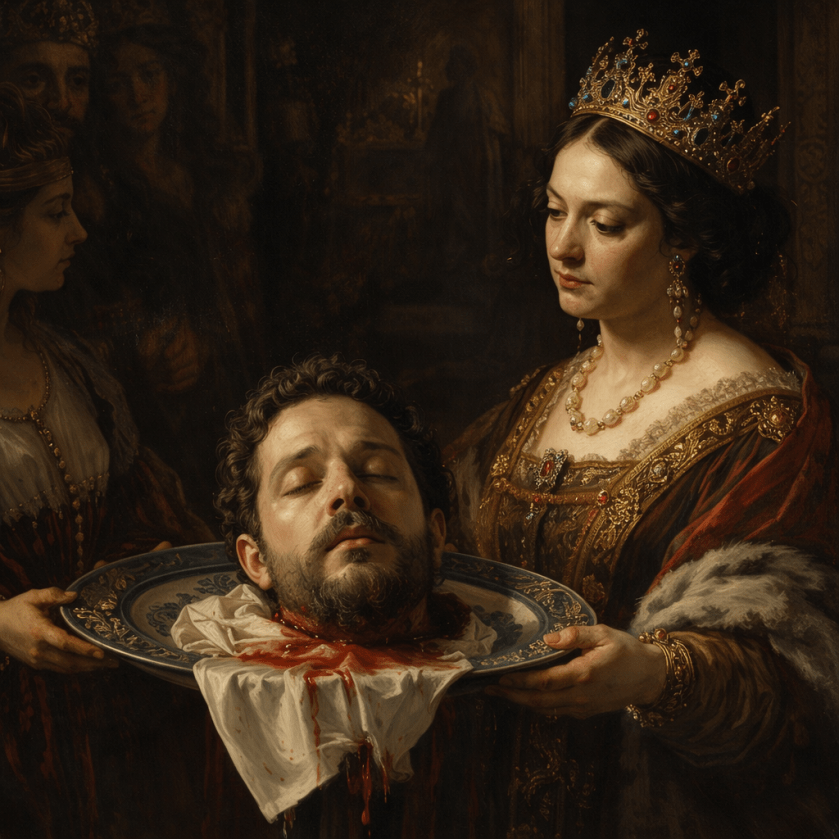
One would think that John’s imprisonment would have appeased Herodias, but prison did not satisfy her; she wanted him dead. So she came up with an evil plan and used her daughter to manipulate Herod when she danced for him at his birthday celebration. Whether the dance was meant to arouse his lust or simply play with his emotions, Harod was so pleased with the dance that he offered her anything she wanted. The girl asked her mother what she should request, and Herodias seized the opportunity and replied: “The head of John the Baptist.” Without hesitation, Herod ordered it done, and John was not only beheaded, but his head was delivered to Herodias’ daughter on a tray, who took it to her mother.
The story of Herodias serves as an example of the disgrace that lust and sin brings to a life consumed with pride.
Reflection and Application
Friends, from Herod’s lustful7 desire for his brother’s wife to Herodias’ hurt/angered pride aroused by John’s condemnation of their marriage and the sin of murder that ensued because of the lust and pride ~ is it any wonder that we are warned in Scripture that pride goes before destruction,8 and to “get rid of all bitterness, rage, anger, harsh words, and slander, as well as all types of evil behavior. Instead, we are to be kind to each other, tenderhearted, forgiving one another, just as God through Christ has forgiven us.” 9? Oh, let us not be like Herodias, manipulating an end that we desire – but may our hearts and minds be forever yielded to God, slow to anger, abounding in love, and quick to repent of our sins.
Practical Applications by Bible Hub
• Expect resistance when confronting sin with truth.
• Guard your heart from grudges; unresolved resentment breeds greater evil.
• Public righteousness may cost temporal safety but garners eternal reward (Matthew 5:11-12).
• The gospel calls even Herodias-like sinners to repentance; Christ’s resurrection proves that forgiveness is available to the hardest heart.
Summary
Herodias harbored a grudge against John the Baptist because his uncompromising proclamation of God’s law threatened her illicit marriage, her ambition, and her conscience. Her reaction—rooted in pride, political calculation, and spiritual darkness—culminated in John’s execution, fulfilling the biblical motif of prophetic suffering and underscoring the peril of resisting revealed truth.
The More We Know
- The family history of Herod the Great is twisted and confusing. This is especially true given that “Herod” means “king” and seems to have been used as a family name by several members, whether they were recognized as kings by the Roman emperor or not. Herod Antipas is one of at least eight sons. Upon the death of Herod the Great, the kingdom was split into four tetrarchies, and Antipas the Tetrarch was given rule over Galilee, north of Samaria, and Perea, across the Jordan River from Judea. Antipas married the daughter of the king of Nabatea, a nation which bordered southeast Perea, and settled down to a life of irritating the Jews. ↩︎
- https://www.gotquestions.org/life-Jezebel.html ↩︎
- John the Baptist, the cousin of Jesus, not John the disciple of Jesus. John was related to Jesus, as their mothers were relatives (Luke 1:36). In fact, when the angel Gabriel told Mary that she would give birth to Jesus, he also told her about John. When Mary was carrying Jesus in her womb, she visited Elizabeth, and John leapt in his mother’s womb for joy at the sound of Mary’s voice (Luke 1:39-45).
Although his name implies that he baptized people (which he did), John’s life on earth was more than just baptizing. John’s adult life was characterized by devotion and surrender to Jesus Christ and His kingdom. John’s voice was a “lone voice in the wilderness” (John 1:23) as he proclaimed the coming of the Messiah to a people who desperately needed a Savior. He was the precursor for the modern-day evangelist as he unashamedly shared the good news of Jesus Christ. He was a man filled with faith and a role model to those of us who wish to share our faith with others. ↩︎ - Mark 6:17-18 ↩︎
- Gotquestions.org ↩︎
- Gotquestions.org ↩︎
- Lust is an intense, overwhelming desire, craving, or enthusiasm. While most commonly associated with strong, uncontrolled sexual attraction, the term is also frequently used to describe a powerful, often obsessive longing for something—such as a “lust for power,” wealth, or adventure. [1, 2, 3, 4] ↩︎
- https://www.bibleref.com/Proverbs/16/Proverbs-16-18.html ↩︎
- Ephesians 4:31-32 (NLT) ↩︎
Dear Reader: Do you know the Lord of Heaven and earth, the one whom John the Baptist so faithfully proclaimed? If not, I invite you to follow the link to know the truths about who He is, and how He loves you and can save your soul.


