Posted in Bible study, Devotion, Easter, From the Insideout, Journey Through The Word

So – Now What?

Today’s Reading is Philippians 2:1-8. It’s a longer but perfect passage to answer our question – The Tomb is empty, so now what?

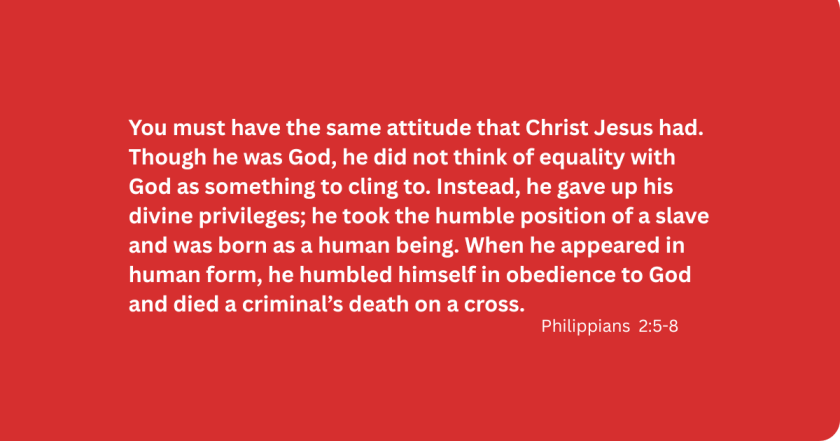
 Is there any encouragement from belonging to Christ? Any comfort from his love? Any fellowship together in the Spirit? Are your hearts tender and compassionate? Then make me truly happy by agreeing wholeheartedly with each other, loving one another, and working together with one mind and purpose.Don’t be selfish; don’t try to impress others. Be humble, thinking of others as better than yourselves. Don’t look out only for your own interests, but take an interest in others, too. You must have the same attitude that Christ Jesus had. Though he was God,   he did not think of equality with God as something to cling to. Instead, he gave up his divine privileges; he took the humble position of a slave and was born as a human being. When he appeared in human form,he humbled himself in obedience to God and died a criminal’s death on a cross.

Philippians 2:1-8

Many of Paul’s writings hold answers to the question that I posed the day after Easter – “the tomb is empty, now what?” However, perhaps none so clearly answer it as Philippians chapter 2, which we will look at today and tomorrow.

Paul poses His own questions at the opening of the chapter that opens the door way for him to teach them what it means to live the Christian life. After listing many “dos and don’ts” like live in unity, be tender and compassionate, don’t be selfish, or a show-off, but be humble and think of others, not just yourselves. Paul makes sure they truly understand what he’s saying by using Christ as their example. He didn’t just tell them to have the same attitude of Christ, but took all personal interpretation out of the mix by listing exactly what that attitude entailed.

Jesus didn’t hold out His “God card” and wait for everyone to serve Him. Instead, He…

  • left Heaven for the purpose of saving the world
  • took on the human flesh and dwelt among men
  • humbly submitted to God’s authority
  • died a death meant for the guilt of a criminal

The tomb being empty wasn’t the end of Jesus’ legacy of faith. He wasn’t meant to only reach just those early disciples, but to continually be a way for ‘the world’ to come to God through Him. Now that the tomb was empty, the work was left to His followers. Their job was to take His message to the world – and in large part by the way they lived. Consider some of Jesus’s own commands/teachings, such as John 13:34 and Mark 12:29-31, where He emphasized love.

So now I am giving you a new command, love each other. Just as I have loved you you should love each other.

John 13:34

Jesus replied, “The most important commandment is this: ‘Listen, O Israel! The Lord our God is the one and only Lord. 30 And you must love the Lord your God with all your heart, all your soul, all your mind, and all your strength.’ 31 The second is equally important: ‘Love your neighbor as yourself.’ No other commandment is greater than these.”

Mark 12:29-31

Jesus had told them these things because He knew the tomb would be empty. He knew one day He would no longer be with them on the earth, so He prepared them for after the empty tomb – by showing them and telling them how to live.

  • Love others
  • Love God
  • Spread the Gospel
  • Make the Father known

Paul summed it up nicely in Colossians 3:17 by telling them that whatever they did or said, they should do it as representatives of Jesus – and this, my friends, is perhaps the overall best answer to our question – “the tomb is empty, so now what?”

And whatever you do or say, do it as a representative of the Lord Jesus, giving thanks through him to God the Father.

Colossians 3:17

Posted in Bible study, Devotion, Easter, From the Insideout, God is good, Journey Through The Word, Know These Truths, Prayer Starters, Quiet Time

A Day of Lament

Friends, we have journeyed for weeks now, toward the cross, and we have known this day would come. The day God planned from eternity past, the day His only begotten Son would hang and die for us, sinners, condemned unclean! Yet in this world of animatronics, it is easy to forget that He came not as a spirit or a robotic type creature, but as “fully man”! He came as a baby in a manger – a suffering servant – the son of God, yet sent to earth as the son of a carpenter – sent not to sit on a royal throne and be served but to serve and ultimately to die for the world God so loved. Yet not before He would seek and save those who were lost. For He came to dwell among them, teaching them about the God who saves, and to show them the way to live and the way to eternal life. A life that could only come through death – the death of the spotless, scarificial lamb of God.

Just days before His death, we find Him walking into Jerusalem, weeping as He entered the city.

Even as He was being welcomed by the crowd as He rode in on the donkey, the crowd was waving palm branches and shouting, “Blessings on the King who comes in the name of the Lord! Peace in Heaven and glory in the highest heaven!” Even then, (like us today), He wept for He knew what the leaders and rulers were planning. He knew then what had to be – ‘fully man but fully God,’ -He knew and had come to accomplish it – to redeem the lost, a lost and dying world – a world God had chosen to love and to save through the blood of a lamb – a people who would believe in this man – who was also fully God! He knew the death He would die and the destruction that would come upon this city and its people, and He wept – lamenting that the Jews – “of all people,” would have understood the way to peace! He was that Way, but they had rejected Him. They could not see Him as the rescuer He was, but rather as a threat to be done away with! — So He wept, and continued on the road … the road that led to the Temple…the road that led to Him lamenting their blindness, their lack of understanding, and what would come because of it – not just His own death – but the destruction of Jerusalem – The City of God!

It was a road that led to His authority being challenged…the road that would lead to the upper room…the washing of feet…the last supper with His disciples…the Garden of Gethsemene and His heartfelt prayer of lament that the Father would “let this cup pass from Him” It was the road that led to…Judas’ betrayal and the arrest that followed…Peter’s denial…the trial… and ultimately the road that ended at the cross, or more appropriately stated today – “On the cross”, where He suffered and bled and died, not as one without feeling, but in agony,1 on a cross of scorn, of sin, and shame meant for us.

Friends, Jesus could have called down 10,000 angels to take Him from the cross – , where He suffered and bled and died, not as one without feeling, but in agony.1 It wasn’t His cross to bear, it was ours – a cross of scorn, of sin, and shame but as a sacrifical lamb led to the slaughter He took our place, our scouraging, our nails, our pain and shouted, “Father, I entrust my spirit into your hands!” And with those words he breathed his last.

Prayer of Response

Father this day brings great sorrow to me, a great awareness of Your sacrifice, of Jesus’ suffering, and of my sin. But I do not sorrow as one without hope – but one who knows that Sunday is coming! And so I cry with grateful heart, thank You, God, for loving me. Thank you, Jesus – Lamb of God, for Your tears and Your willingness – even through lamenting – to not turn back but to take my stripes and my wounds and all the torment it must have been. I am forever indebted and forever changed because of Your love and Your obedience to the will of the Father. Amen and amen! – May my life and lips forever tell Your story!2

The More We Know

Credits for today’s graphic belong to Susan Hill’s excellent Easter Devotional, “A Savior Is Risen”, p121.

  1. The Medical Aspecs of the Crucifixion ↩︎
  2. I love to tell the Story ↩︎

Dear Reader: If you do not know the story of Jesus, the truths of His Word and the invitation that is open to you to receive salvation through Faith in Jesus, the sacrificial lamb of God – I invite you (urge you) to click on “Know These Truths” and believe in the Lord Jesus Christ ~ the Way, the Truth, and the Life -~ to all who believe.

KNOW THESE TRUTHS

Posted in Bible study, Devotion, Easter, From the Insideout, God is good, Journey Through The Word, Passion Week, Prayer Starters, Quiet Time

GOOD FRIDAY

… Before we rush to Resurrection Sunday, let’s sit with the weight of Jesus’ sacrifice today. Let us sit with the pain of the Man of sorrows (Isaiah 53:3), who endured the wrath of God at the cross. Let us ponder the injustice of the spotless Lamb of God punished for our sins. Let us marvel at the astounding death of the Creator of life. Let us worship the King of glory who let go of the splendor of heaven to become flesh and blood, to humble Himself, to hunger and thirst, to suffer and hurt, to be betrayed and rejected, mocked and humiliated — all for love.

For the Good Friday Devo, please click the button below – you won’t want to miss it!

  1. EXCERPT FROM THE PASSION, BY DR JEREMY SHAFFER, CHILDREN AND FAMILY PASTOR AT LEWIS MEMORIAL BAPTIST CHURCH  ↩︎

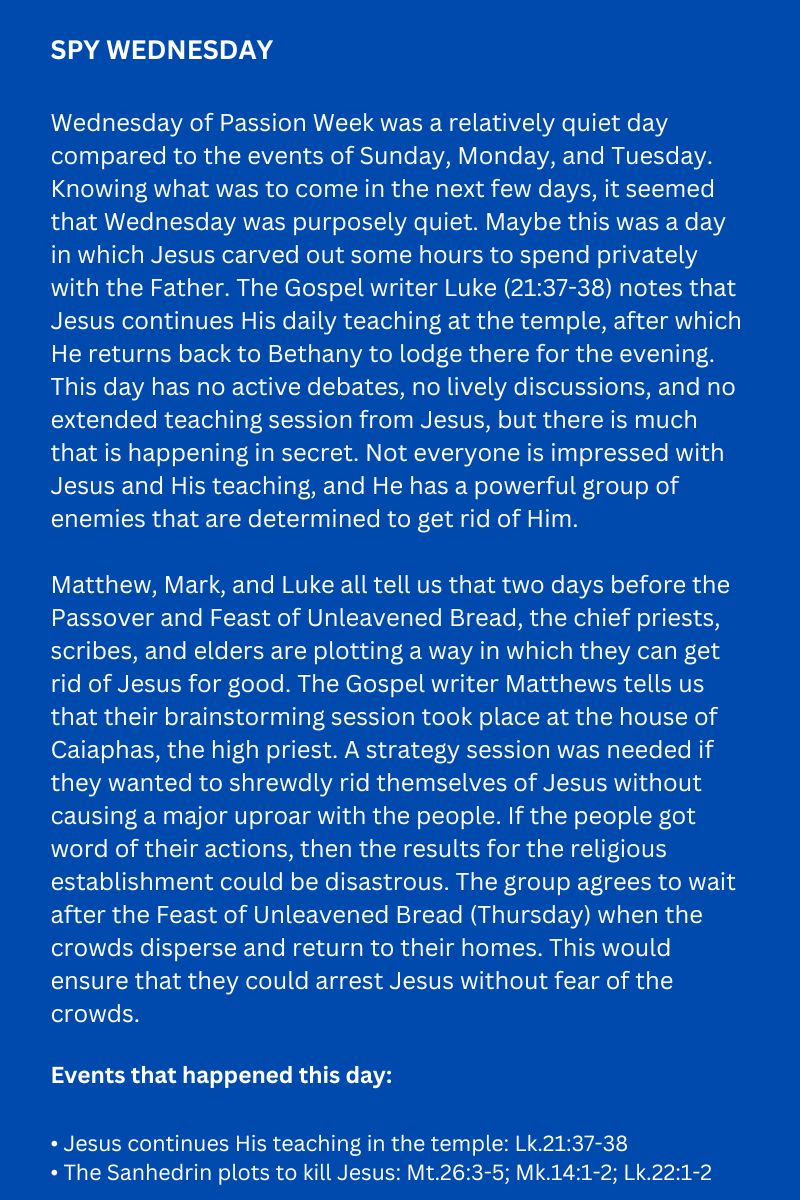
Posted in Bible study, Devotion, Easter, From the Insideout, God is good, Journey Through The Word, Passion Week, Prayer Starters, Quiet Time

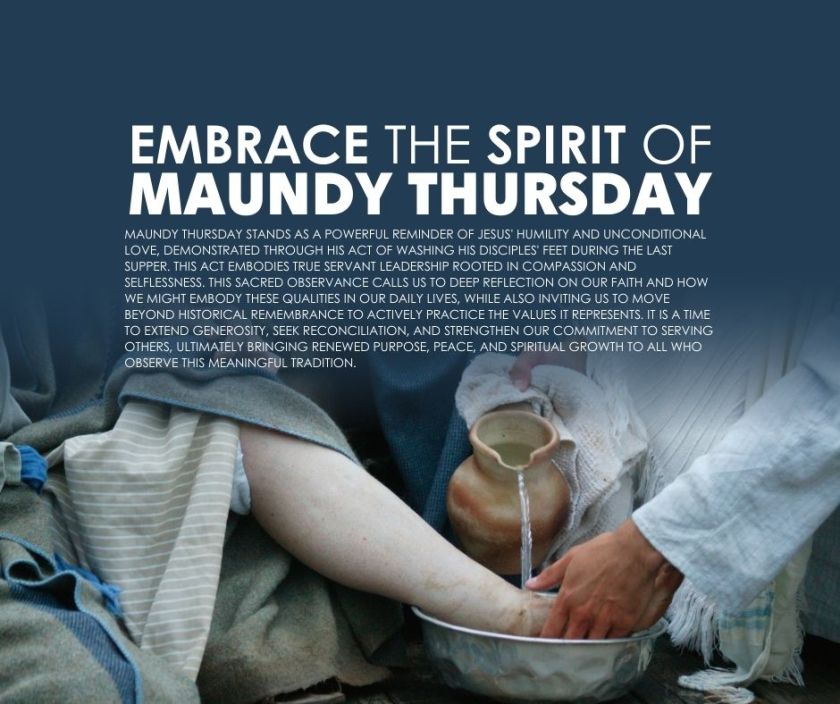
MAUNDY THURSDAY

Jesus had already made initial contact with some of His followers in Jerusalem to secure a place in which the group would share in the Passover meal. Some scholars believe that Jesus’ arrangement of the meal location was made secretly so as to prevent Judas’ betrayal plot from interrupting the meal. Sometime during the meal, Jesus gets up and washes the disciples’ feet, even the feet of Judas. Jesus knew that Judas had already planned to betray Him (Jn.13:11), but He still proceeded to wash his feet anyway – that is the epitome of love. After the foot washing, Jesus makes a public declaration that there is a traitor at the table; the disciples are a bit confused about what Jesus meant, but Judas understands and promptly leaves the group to commence his actions of betrayal. As Jesus and His disciples continued the Passover meal, Jesus abruptly introduced a completely new explanation of the symbolism of bread and wine. These two elements now become part of our present-day observance of the Lord’s Supper (communion) as we remember His body and blood that were given in sacrifice for all humanity.

As the evening continues on, Jesus gives His followers some additional instructions because He knows that the time of His death is quickly approaching. These instructions are collected into a body of material that we often call the Upper Room Discourse. We can thank the Apostle John, as he is the only Gospel writer who includes this material (John 14-17). Toward the end of this discourse, Jesus offers up a prayer for His disciples (Jn.17:6-19) because He knows that these same disciples who are sitting at the table will fail in the face of persecution that very night. Specifically, He singles out Peter, saying that before the rooster crows, Peter will have denied Jesus three times. Of course, Peter vehemently denies that this would ever happen, assuring the Lord that he would follow Him to prison, even to death.

The night is late, and Jesus and His disciples head to the Garden of Gethsemane. The time for teaching and instruction is over, and the time for sorrow and distress is here. Jesus instructs the disciples to sit in a certain location while He takes Peter, James, and John with Him a little further to pray. Jesus pours out His heart to the Father, asking Him if there is any other way in which redemption can happen that would not include the cross. He knows He is about to bear God’s judgment as a sin sacrifice for all the world. Nevertheless, He knows that the Father’s will is by way of the cross, and He willingly submits Himself to the Father’s plan. Taking a break from His time of prayer with the Father, Jesus finds His disciples fast asleep. The only source of human support and help during the hardest moment of His life was sleeping away. Yet even in this shocking moment of the disciples’ carelessness, Jesus is more concerned for their welfare than His own – He knows that they, too, must pray so that they can be equipped to face the difficulties that lie ahead (Matt.26:41).

Judas, who left the scene earlier, now returns with a group of chief priests, Pharisees, and some Roman soldiers. Jesus steps forward and asks the group who they are here for, and when they answer, “Jesus of Nazareth,” Jesus replies, “I am HE.” When Jesus spoke these words (reminiscent of the phrase “I AM” in Exodus 3:14), the power behind those words caused the soldiers to retreat back and fall to the ground! Jesus permits the soldiers to arrest Him so long as they don’t arrest His followers. However, Peter does briefly resist by cutting off the right ear of the high priest’s servant; Jesus miraculously heals the ear and tells Peter that He must follow the Father’s plan. At this point, all the disciples flee the scene, leaving Jesus deserted and alone.

Events that happened this day: • The Passover meal: Mt.26:17-29; Mk.14:12-23; Lk.22:7-30; Jn.13:1-17:26 • Jesus predicts Peter’s betrayals: Mt.26:31-35; Mk.14:27-31; Lk.22:31-34 • The Garden of Gethsemane: Mt.26:36-46; Mk.14:32-42; Lk.22:40-46 • Jesus is betrayed: Mt.26:47-56; Mk.14:43-52; Lk.22:47-53; Jn.18:2-121

For Maunday Thursday Devo, please click the button below – you won’t want to miss it!

  1. EXCERPT FROM THE PASSION, BY DR JEREMY SHAFFER, CHILDREN AND FAMILY PASTOR AT LEWIS MEMORIAL BAPTIST CHURCH ↩︎