Based on The Fruit of the Spirit study by LGG, week 4/day 4
Roadmap for the Journey: Proverbs 3:1-6; SOAP: Proverbs 3:5-6
Trust in the Lord with all your heart; do not depend on your own understanding. 6 Seek his will in all you do, and he will show you which path to take.
Proverbs 3:5-6. NLT
Friends, trust is not a fruit of the Spirit, but as today’s verses show us, trust is fueled by faithfulness. When we know God, when we make His Word part of our life, learning from His teaching, seeing His love and faithfulness, we grow to trust Him. The proverb encourages us not simply to trust Him but to trust Him with all of our heart, not relying on our own understanding but seeking the Lord, our God, in all our ways. Whether it’s health, finances, jobs, marriage, school, friends, home, church, thoughts …we are to seek (or pray) God’s will in every area of our lives. When we do this, He will answer, showing us His will, providing for us, guiding us, helping us … and, as the proverbs says, He will make the path clear.
Faithfulness is something we wear or carry deep within our hearts. It is something we allow to shape us from the inside out.
The Fruit of the Spirit / digital journal, p131
Today’s LGG Journal poses and answers the question: So what does faithfulness lived out look like? “It looks like opening God’s Word even when you don’t feel like it. It looks like keeping your word when it would be easier to back out. It looks like showing up for the people God has placed in your life, even when no one is watching or clapping. It looks like choosing obedience over convenience, day after day after day.”
Friends, as the journal goes on to say: “Our faithful steps today are not wasted, even when you cannot see where they are leading. Keep showing up. Keep choosing obedience. Keep walking with GOd one quiet, faithful step at a time. He is with you on your journey.” ~ So let’s keep this in mind and keep on keeping on. We do this best when we keep our minds fixed on God, not on the circumstances and/or desires of our lives.
Reflection and Application
In what area of your life do you most struggle to trust God’s direction rather than relying on your own understanding? What would full surrender in that area look like?
Based on the LGG Study, The Fruit of the Spirit / w4d3
Road Map for the Journey: Lamentations 3:19-26; SOAP: Lamentations 3:21-23
21This I recall to my mind, therefore have I hope. 22It is of the Lord’s mercies that we are not consumed, because his compassions fail not.
23They are new every morning: great is thy faithfulness.
Lamentations 3:21-23 ESV
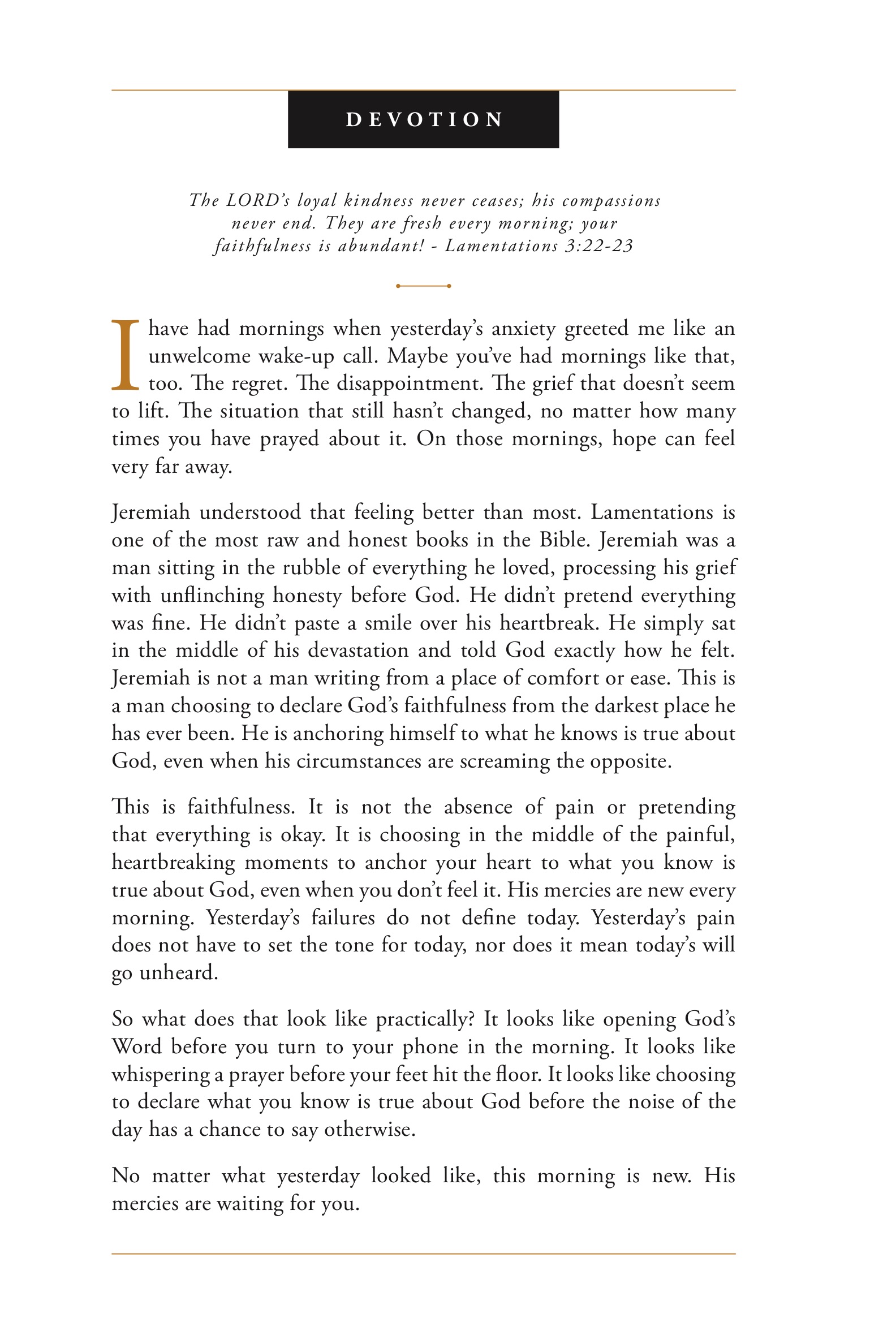
I’ve had these verses tucked in my heart since my senior year of high school, and over the years, God’s sweet Holy Spirit has brought them to mind more times than I can count. They have chased away fears, given me strength to stand when the ground around me felt like sinking sand, and calmed many regrets and disappointments. They have comforted me in times of grief and anchored me in hope when life’s storms raged around me. Seriously, friends, there is great power for every believer who doesn’t just know that God is faithful but stands upon this unfailing truth.
This is faithfulness. It is not the absence of pain or pretending that everything is okay. It is choosing in the middle of the painful, heartbreaking moments to anchor your heart to what you know is true about God, even when you don’t feel it. His mercies are new every morning. Yesterday’s failures do not define today. Yesterday’s pain does not have to set the tone for today, nor does it mean today’s will go unheard.
The Fruit of the Spirit, digital journal, w4d3/LGG
Check out this beautiful devotion by the Love God Greatly Team. I find them sweet, powerful, and encouraging reminders of God’s faithfulness. I’m praying you will too. If you are reading this and don’t know the God of this promise, I invite you to visit the link “Know These Truths” below.
Inspired by the LGG Study, The Fruit of the Spirit/w4d1
Read 1:8-18; SOAP: Ruth 1:16
But Ruth replied, “Stop urging me to abandon you! For wherever you go, I will go. Wherever you live, I will live. Your people will become my people, and your God will become my God.
Rulth 1:16/NLT
Goodness is virtue and holiness in action. It results in a life characterized by deeds motivated by righteousness and a desire to be a blessing. It’s a moral characteristic of a Spirit-filled person. The Greek word translated “goodness,” agathosune, is defined as “uprightness of heart and life.” Agathosune is goodness for the benefit of others, not goodness simply for the sake of being virtuous.
Someone with agathosune will selflessly act on behalf of others. Confronting someone about a sin demonstrates goodness. So do giving to the poor, providing for one’s children, visiting the sick, volunteering to clean up after a storm, and praying for an enemy. Expressions of goodness are as varied as the Spirit is creative.
Gotquestions.org/The Fruit of the Holy Spirit – What is goodness?
“In a world where walking away has never been easier, there is something beautiful and rare about a person who chooses to stay. Someone who shows up when things get hard. Someone who loves without conditions and gives without keeping score. Ruth is one of the best examples of it in Scripture.” Ruth had nothing to gain and everything to lose. She was choosing poverty, uncertainty, and a foreign land. She stayed anyway because her love for Naomi was not conditional, and her commitment was not based on convenience. Their relationship is goodness put on display. Real, costly, Spirit-produced goodness that shows up not only when it is easy but especially when it is hard.
LGG Journal / The Fruit of the Spirit, p112
Although the dialogue between Ruth and Naomi doesn’t mention goodness, according to gotquestions.org’s definition, I believe it was on full display in both women. Both women beautifully expressed goodness in action by yielding to what would benefit the other. Naomi understood that Ruth, a Moabite widow in a foreign land, had no certainty of provision, so she set her free to stay with her Moabite family. At the same time, Ruth understood that Naomi was returning to her people as a widow with no immediate family and no certainty for the future, so she insisted on going with Naomi.
Whether Ruth stayed out of loyalty to or love for Naomi, her words declared devotion to both Naomi and her God (the God of Israel). This was not simply an act of kindness or an attempt to do ‘the right thing’; I believe it was an outward act of selfless love and goodness to her mother-in-law, who, as a widow herself, had no independent income or legal standing, even when she returned to her people.1
Ruth had nothing to gain and everything to lose. She was choosing poverty, uncertainty, and a foreign land. She stayed anyway because her love for Naomi was not conditional, and her commitment was not based on convenience. Their relationship is goodness put on display. Real, costly, Spirit-produced goodness that shows up not only when it is easy but especially when it is hard. LGG Journal / The Fruit of the Spirit, p112
gotquestions.org, explains that “Goodness is not a quality we can manufacture on our own. James 1:17 says, ‘Every good thing given and every perfect gift is from above, coming down from the Father of lights.’ This certainly includes a life characterized by goodness. In letting the Holy Spirit control us, we are blessed with the fruit of goodness. As others see our good works, they will praise our Father in heaven (Matthew 5:16).” Friends, may this be our desire and goal.
Reflection and Application
Is there a relationship or situation in your life right now where God is calling you to show up with Ruth-like goodness to stay when leaving would be easier?
Response of Prayer
Father, I confess it isn’t always easy to be selfless, to be other focused – forgive me when I fall short of living out or showing ‘goodness’. Thank You for Your Spirit in me who is able to make goodness abound in me. May goodness be a virtue that others see displayed in my life and may they give You the glory that You deserve. ~Amen
The More We Know
If a widow was a foreigner who had married into an Israelite family, her situation was doubly perilous. She lacked the local kinship network that might otherwise step in out of charity. Additionally, certain groups (like the Moabites) faced strict religious and social integration prohibitions. [1, 2, 3]
For a foreign widow to survive, she either had to return to her biological family in her pagan homeland (as Naomi urged Ruth and Orpah to do) or rely completely on the community’s adherence to God’s commands regarding the compassionate treatment of the ger (stranger/foreigner). [1, 2] ↩︎
Based on The Fruit of the Spirit Study, by LGG / W3D4
Today’s Road Map for the Journey: Ephesians4:29-32; SOAP: Ephesians 4:31-32
31 Get rid of all bitterness, rage, anger, harsh words, and slander, as well as all types of evil behavior. 32 Instead, be kind to each other, tenderhearted, forgiving one another, just as God through Christ has forgiven you.
Ephesians 4:31-32. NLT
If we want to be kind, we must first “put away” or get rid of everything that stands in the way or in opposition to kindness. Paul shares a whole list of negative attitudes and actions we must eliminate from our lives to truly be able to show kindness to others.
The old saying/song, “accentuate the positive, eliminate the negative,” came to mind as I was writing the previous sentence. A good oldie that is described as: “a classic American standard structured like a sermon that encourages listeners to focus on the affirmative.” Warning: it’s one of those that gets in your head and keeps on going.
This Scripture reveals a blanket principle for all people: “…our words always eventually reveal what’s going on inside of us. There’s no such thing as an unimportant act or an unimportant word.”(bibleref.com/Matthew12:36)
“Out of the mouth flows the overflow of the heart,” is another statement that comes to mind…for if my mind and heart are filled with bitterness, rage, and anger, the overflow will not be kindness but harsh words and/or slander. Even if I’m not angry with you, if my mind/heart is saturated with anger, it will control me; it will interfere with, if not completely block, any positive attitudes, actions, and words. (see Bibleref.com)
I’ve known some angry people in my lifetime. They weren’t necessarily angry at “something or someone”; under the right circumstances, they could be kind, helpful, and caring. However, there was almost always an edge about them. Something in life had left them battling bitterness and anger. These attitudes simmered somewhere beneath the surface of their being and seeped into their conversations and demeanor. The littlest thing could set them off, leaving those around them wondering what happened. On the flip side, I have seen how a kind deed or word can make a bad day better or even soften an angry person’s heart and actions. As today’s LGG Journal entry points out, “kindness has a way of doing what nothing else can.”
Paul knew we would need a reason to choose kindness when it felt hard. So he gave us the best one there is. Be kind and compassionate, forgiving each other, just as God forgave you. It is not because the other person deserves it. It is because you have already been on the receiving end of a kindness you didn’t deserve either. This truth changes everything.
Freely given. Completely undeserved. That is the kindness Jesus models for us. And His kindness has the power to change every relationship, room, and heart it touches.
LGG Journal/The Fruit of the Spirit/p98
Response of Prayer
Father, this world, and the people and situations we encounter in it, often give us ample reasons to be bitter and/or angry. But Your Word instructs us to put away bitterness, anger, and other less-than-godly attitudes. Instead, we are to be kind to each other, tenderhearted, forgiving one another, just as You, through Christ, have forgiven us. It isn’t always easy, but as we have mentioned many times on our journeys, we have been filled with His Spirit and able to do all things through Christ who strengthens us. May kindness define us so others will see Jesus in us. ~Amen and Amen!
Reflection and Application
Is there a relationship in your life where bitterness has quietly taken root? What would it look like to begin the process of choosing kindness and forgiveness in that relationship?
Based on The Fruit of the Spirit Study, by LGG / W3D2
Today’s Road Map for the Journey: Romans 5:1-5; SOAP: Romans 5:3-4
3Not only this, but we also rejoice in sufferings, knowing that suffering produces endurance, 4and endurance, character, and character, hope.
Romans 5:3-4
My daughter’s cancer diagnosis was not a cup I would have chosen, but I know that it is one that God used to develop, deepen, and strengthen my faith. Her illness and all of the suffering that came with it were used to teach and convince me that God is good, full of compassion, and abounding in love and grace. Through that difficult time, I experienced firsthand how intimately involved He is in His people’s lives. I saw just how purposeful, timely, and faithful He truly is. Without question, the suffering produced endurance as I learned to persevere through each day, every test, setback, and hospital stay. Little did I know then that, through it all, God was teaching me to trust Him on a different level, and that this new level of faith was producing in me a desire to live more faithfully for Him, to please Him in every aspect of my life. I believe this is what Paul refers to, in the passage of our journey today, as “character”.
While Annie’s suffering eventually ceased and life returned to ‘normal’, my trust in God has continued to deepen through a variety of other trials, each with its own source of suffering, developing an unshakable hope that God will do all He has promised. No matter what comes my way, I am fully convinced that my “ultimate end will be sharing in the glories of God forever1“. Instead of fearing the next ‘bad or difficult thing,’ I strive to keep my eyes on Him, convinced – along with Paul2 – that regardless of what trouble may come, neither height nor depth nor anything else in all creation will be able to separate me from the love of God that is mine in Christ Jesus. These years and the lessons that came from Annie’s suffering and my suffering as her mother weren’t wasted, nor were they cruel. They were moments, some better than others, but they all taught and trained me and reshaped me from the inside out, so that I’m not who I used to be.
Hope implies some level of certainty that we will receive God’s good forever. Hope defines the baseline or a “bottom line” for a Christian’s thoughts and emotions. No matter what comes along, we are fully convinced that our ultimate end will be sharing in the glories of God forever.
Bibleref.com
During those three+ long years, He broke countless chains, reshaped my thought processes, and solidified my faith with roots that are planted deep and growing deeper still. He was literally making me into a new creation! He taught me to trust and love… to wait and watch… To listen…To hunger for and study His Word… To love others more than self and Him most of all… To walk in His light, His truth, His way, and not the world’s darkness or my own desires. He showed me what Christian friendship looks like and how to be a friend to others. He taught me the gift of prayer is not just an item on a to-do list but one of the greatest privileges we have been given.
Refelction and Application
What season of waiting or suffering in your life right now could God be using to develop patience and Christlike character in you?
Response of Worship ~
I’ve included the lyrics because I think they are a beautiful and powerful message that we would do well to adopt as a mantra/song in the storms of this life.
Day by day, I’m learning how to stay In the middle of the storm I’m learning where to lay my head And step by step, I’m learning how to listen In the middle of the noise I will listen for Your still small voice
[Chorus 1] So let the thunder roll And I won’t be afraid, ’cause You roll the thunder And let the rain beat hard Upon my roof, and I’ll dance to its rhythm And let the mighty wind Blow between the oak trees As I let You steady me ‘Cause You’re right here in the whisper Of my heart
[Verse 2] Breath by breath, I’m learning what You say When You told me I could trust Even when the storm is raging on And song by song, I will sing of Your great love While You’re singing it back to me With the very voice that calmed the sea
[Bridge] So say peace be still To every beat of my heart Say peace be still To every thought in my head I know Your voice, and I will listen and obey Every time You call, in the night
[Chorus 2] So let the thunder roll And I won’t be afraid, ’cause You roll the thunder And let the rain beat hard Upon my roof, and I’ll dance to its rhythm And let the mighty wind Blow between the oak trees As I let You steady me ‘Cause You’re right here in the whisper You’re right here in the whisper You’re right here in the whisper Of my heart
[Outro] You’re right here in the whisper You say peace be still Say peace be still
Based on The Fruit of the Spirit Study, by LGG / W3D1
Today’s Road Map for the Journey: Genesis 50:15-21; SOAP: Genesis 50:19-20
19But Joseph replied, ‘Don’t be afraid of me. Am I God, that I can punish you? 20You intended to harm me, but God intended it all for good. He brought me to this position so I could save the lives of many people.
Genesis 50:19-20 NLT
At first glance, today’s story of Joseph may make you ask: How is this an example of the fruit of the Spirit? Or at least it did me. However, it truly is a great example of not only patiencebut kindness and of how we can, and should, base our reactions to life not on our circumstances but on our trust/faith in God.
Joseph knew something that kept him steady through every injustice and every delay. He knew that God was writing a story far bigger than the one he could see. “You intended to harm me,” he tells his brothers, “but God intended it for good.” That is not a passive, defeated acceptance of pain. That is a radical, faith-filled trust in the sovereignty of God. ~The Fruit of the Spirit Journal1
When God’s plan takes longer than expected, as it often does, and as Joseph’s did, it isn’t easy to be patient while we wait. The waiting can cause us to lose heart and even shake our faith, but not so with Joseph. Instead, his response to the fear his brothers expressed in the message they sent (vv. 16- 17) was one of kindness that flowed from years of patience and an understanding of God’s complete and perfect control over all things.
15 But now that their father was dead, Joseph’s brothers became fearful. ‘Now Joseph will show his anger and pay us back for all the wrong we did to him,’ they said.
16 So they sent this message to Joseph: ‘Before your father died, he instructed us 17 to say to you: ‘Please forgive your brothers for the great wrong they did to you — for their sin in treating you so cruelly.’ So we, the servants of the God of your father, beg you to forgive our sin.’ When Joseph received the message, he broke down and wept. 18 Then his brothers came and threw themselves down before Joseph. ‘Look, we are your slaves!’ …
Genesis 50:15-18
Joseph had lived patiently for thirteen long years and, despite his brothers’ fears (vv. 15-17), he showed them kindness (vv. 19-21). I love that Joseph’s words do not point to himself but to God. When most would have sought revenge, Joseph chose kindness, and like Paul and Silas from last week’s journey, instead of bitterness and anger, Joseph chose to praise and glorify God, not only in word but in his actions.
Patience reveals our faith in God’s timing, omnipotence2, and love.
gotquestions.org
Friends, consider this definition of patience from gotquestions.com: “When everything is going our way, patience is easy to demonstrate. The true test of patience comes when our rights are violated—when another car cuts us off in traffic; when we are treated unfairly; when our coworker derides our faith, again. Some people think they have a right to get upset in the face of irritations and trials. Impatience seems like a holy anger. The Bible, however, praises patience as a fruit of the Spirit (Galatians 5:22) which should be produced for all followers of Christ (1 Thessalonians 5:14).” 3
Reflection and Application
Is there a situation in your life right now where you are struggling to trust that God is writing a story bigger than the one you can see? What would trusting Him look like in that situation?
Response of Prayer
Father, thank You for the beautiful examples You give us throughout Your Word of how we are to live and not live. Thank You for this lesson from Joseph’s life, which reflects his patience in Your timing and the suffering he endured through the years. Thank You for Your patience with me through the years and Your forgiveness for the many, many times I have lacked patience. The fact that I ever display patience is evidence of Your Spirit in me and the truth that “nothing is impossible with You.”
The More We Know
Love God Greatly’s The Fruit of the Spirit Digital Journal, p 93 ↩︎
The word omnipotent comes from omni- meaning “all” and potent meaning “power.” As with the attributes of omniscience and omnipresence, it follows that, if God is infinite, and if He is sovereign, which we know He is, then He must also be omnipotent. He has all power over all things at all times and in all ways. Read the full explanation of what it means that God is omnipotent at gotquestions.org↩︎
A bible verse that talks about patience is Romans 12:12: “Rejoice in hope, be patient in tribulation, be constant in prayer.” Patience, one of the most cherished virtues, finds a central place in Scripture, offering guidance for faith-filled living. Patience is about waiting calmly and with trust… The Bible provides ample advice on how to embody and nurture patience, both in our spiritual journey and our daily interactions.
Here are some key Bible verses that highlight patience:
Romans 12:12 – Be patient in affliction.
1 Corinthians 13:4 – Love is patient, love is kind.
Colossians 3:12-13 – Clothe yourself with compassion and patience.
The need for patience transcends simple endurance. It involves loving-kindness, understanding, and a deep-rooted faith in God’s timing. As life’s challenges arise, patience enables us to reflect Christ’s love more fully in our relationships and personal growth. … 4
DEVOTION for w2d5 of Fruit of the Spirit / by LGG Team/journal entry, p 76
Rejoice in the Lord always. Again I say, rejoice! – Philippians 4:4
There have been seasons in my life when I chased joy and peace as if they were two separate finish lines to cross at different times. I thought peace would finally show up when things settled down. I thought joy would come when life got easier. And I kept waiting and coming up empty. It wasn’t until I sat with Philippians 4 that I realized I had been looking for them in all the wrong places.
Paul gives us both joy and peace in the same breath. Rejoice in the Lord always. Do not be anxious about anything. Present your requests to God with thanksgiving. And the peace of God will guard your heart. They travel together, grow together, and are rooted in the same soil of a heart that is fully surrendered to and trusts in God.
Joy is the choice to rejoice in who God is, regardless of what is happening around us. Peace is the gift we receive when we release our grip on our circumstances and place them in God’s hands. Together they create something extraordinary. They produce a life that is marked by a deep, settled, unshakeable confidence in God that the world looks at and simply cannot explain.
Paul and Silas understood this better than anyone. Singing in a prison cell wasn’t denial. It was worship. They were declaring that God was still good, faithful, and worthy of praise, no matter what their circumstances said. And from that place of joy, peace stood guard over their hearts.
That same life is available to you. It is not that your circumstances will always be favorable, or your road will always be easy. It’s because the God who held Paul and Silas in the prison cell is the same God who is holding you right now, in yours.
Rejoice in Him. Release your worries to Him. Receive the peace that only He can give. That is the fruit of the Spirit. It is joy and peace living together in a surrendered heart.
Based on The Fruit of the Spirit Study, by LGG / W2D4
Today’s Road Map for the Journey: Isaiah 26:3; SOAP: Isaiah 26:3
You will keep in perfect peace all who trust in You, all whose thoughts are fixed on You!
Isaiah 26:3 NLT
Some might question if perfect peace is only an elusive dream. Isaiah writes not only that it is possible, but for whom and how it is possible. The way seems simple enough: believers must maintain their faith in God and fix their thoughts on Him. In other words, our righteousness, good works, or any amount of human effort will not earn us a place in Heaven. It is solely a right of those who have placed their trust in God.
Perfect peace is not a state without any anxiety at all, or one where life is always easy and perfect. The prophet is describing internal peace. This would be a feeling of confident contentment independent of circumstances. It is a mind focused on trusting the Lord to provide all that is needed in the present, the future, and for salvation. ~Bibleref.co/Isaiah 26:3
This statement from today’s LGG Journal entry not only resonates with my heart and mind, but I can attest to its validity. It is part of my testimony: “What we choose to focus our minds on shapes how we feel, how we respond, and how we move through our days. When we fix our minds on our problems, our peace evaporates. When we fix our minds on the what-ifs and worst-case scenarios,” (something I was very prone to do for many years) “anxiety moves in. But when we fix our minds on God’s character, faithfulness, promises, and track record, everything changes. Peace moves in.”
Seriously, it’s as though the writer is sharing my story.
The writer goes on to point out that: “Fixing our minds on God instead of our problems requires a daily, sometimes a moment-by-moment, choice to keep your mind anchored to Him. It requires training your thoughts to return to God when they wander toward worry. As you spend more time with Him, it becomes easier to keep your mind fixed on Him, no matter if your life feels like shifting sand.”
Perfect peace is not the absence of hard things. It is the presence of God in the middle of them.
Friends, don’t let God’s perfect peace be an elusive dream for you ~ take hold of His promise – fix your thoughts on Him and trust Him without reservation. When your mind begins to lean toward worry, lean into Him, spend time with Him, rest in Him, talk to Him and trust Him. To quote the author’s words again: “Peace moves in.” Of course, this doesn’t mean we will never worry, but it does mean our worry doesn’t have to define us or fill our minds with anxiety and panic. We can choose what we will think about and fix our minds on that thing. Paul suggested that the Philippians “set their minds on things that are true and honorable, right and pure and lovely and admirable. It anything is excellent or praiseworthy, think on these things.” Give it a try ☺️ or share how you’ve already experienced this beautiful peace in your on life.
Reflection and Application
Where does your mind tend to wander when life gets hard? What is one practical way you can intentionally fix your mind on God this week?
Based on The Fruit of the Spirit Study, by LGG / W2D3
Today’s Road Map for the Journey: Philippians 4:6-7; SOAP: Philippians 4:6-7
Do not be anxious about anything. Instead, in every situation, through prayer and petition with thanksgiving, tell your requests to God. 7And the peace of God that surpasses all understanding will guard your hearts and minds in Christ Jesus.
Philippians 4:6-7 NLT
This is one of my life verses, and a true game-changer. This verse is a beautiful lesson in how to pray, specifically how and why to give our anxiety to God. Praying is not meant to be just a dinner or bedtime routine. After all, Paul told the Thessalonian believers to pray continually (1 Thessalonians 5:17), and here in Philippians he says to pray in every situation. Through Paul’s words, we are invited to bring God our prayers and petitions, including our anxieties; and Peter encourages us to cast all our cares on the Lord because He cares for us (1 Peter 5:7). John even wrote that we can be confident that God hears and answers our prayers according to His will (1 John 5:14); all with the promise that, in doing this, we will know the peace of God that passes all understanding, and it is a peace that will guard our hearts and minds as we live in Christ Jesus His Son. Friends, I have been practicing this for 37 years now, and I’m here to testify that His promise does not disappoint. It is not just a peace that makes you feel better; it truly overwhelms you and changes you from the inside out, as it guards your heart and mind from the troubles, anxieties, and other concerns of this life/world.
Addressing problems in our lives should begin with prayer.
Because I know what it is like to worry, and actually, what it is like to battle worries, fears, and anxieties of all types, I understand why Paul uses the word “anything”. And I appreciate that he doesn’t stop there, but once again offers a solution: “...in every situation, through prayer and petition, with thanksgiving, tell your requests to God.”
God’s peace hasn’t changed or taken away my troubles, but it most definitely has changed me! Me from the Inside out 🦋
Friends, when we choose to pray to God and trust in Him, we will receive peace, and not just the peace that the world gives, but the peace of God. It is beyond our understanding, or as bibleref.com explains, it is “supernatural and unexplainable.” Time and time again, it has quieted my panic and worry with a peace that fills both my heart and mind.1 Whether it is in the middle of a wind storm that has startled me from my sleep, or in the hospital corridors waiting on the doctor to let you know a loved one is ok, or when my mind won’t quit spinning over a problem – whatever it is that shakes me – His peace always proves greater.
I love the way today’s journal entry puts it: “Notice Paul doesn’t say bring God the situations you’ve already tried to fix and couldn’t. He says to bring Him everything, both the big and the small. The things that keep you up at night and the things that quietly nag at you throughout the day. Nothing is too small for God’s attention, and nothing is too big for His power.
And when we do, when we genuinely lay it all at His feet with a surrendered heart of thanksgiving, His peace shows up like a guard standing watch over our hearts and minds. He doesn’t always remove the hard thing, but He stands between us and the anxiety that would otherwise consume us.“2
Prayer Response
Peace, peace, wonderful peace flows down from You, Father. It floods the soul, setting a guard on the mind and heart. It has rescued me from panic and quieted battles waging war in my mind. It has swept over my spirit again and again, and lies buried deep in the heart of my soul. What a treasure I have in this wonderful peace so secure that no power can take it away. Oh, how I bless Your name and loving kindness. ~Amen
Reflection and Application
What are you carrying today that you haven’t given to God yet?
His hands are open, and He is ready to take it. In exchange, He offers you something the world can’t give: a peace that doesn’t make sense but is more real than anything you’ve ever felt. All you have to do is ask.
Worship Response
1 What a friend we have in Jesus, all our sins and griefs to bear! What a privilege to carry everything to God in prayer! O what peace we often forfeit, O what needless pain we bear, all because we do not carry everything to God in prayer!
2 Have we trials and temptations? Is there trouble anywhere? We should never be discouraged; take it to the Lord in prayer! Can we find a friend so faithful who will all our sorrows share? Jesus knows our every weakness; take it to the Lord in prayer!
3 Are we weak and heavy laden, cumbered with a load of care? Precious Savior, still our refuge– take it to the Lord in prayer! Do your friends despise, forsake you? Take it to the Lord in prayer! In his arms he’ll take and shield you; you will find a solace there.
Worship and Rejoice, 2003
The More We Know
It is important for His peace to guard/fill the heart and mind. For the heart determines the course of our lives (Prov 4:23); and the mind plays a role in Christian unity (Phil 1:27; 2:2, 5). ↩︎
Love God Greatly / The Fruit of the Spirit / Digital Journal / p75 ↩︎
Based on The Fruit of the Spirit Study, by LGG / W2D2/The Upside Down Gift of Joy
Today’s Road Map for the Journey: James 1:2-4; SOAP: James 1:2
2Dear brothers and sisters, when troubles of any kind come your way, consider it an opportunity for great joy.
James 1:2 NLT
I would venture to say that none of us delight in trials (troubles and suffering). However, in this life, they will come, and when they do, they are meant to be useful teaching tools that produce endurance and perfect us in godliness. It is not only helpful to remember this truth but to embrace it so that we do not run from the troubles that come into our lives.
So, how are you when trials and troubles disrupt your life? Do you welcome them with open arms, seeing them as opportunities for great joy? Or are you prone to grumble and avoid them at all costs? Or does your reaction vary depending on the type of trouble? Not finding your favorite travel mug might be a problem; however, not finding your car keys is a much bigger situation, often affecting not just you, but your kids’ transportation or a meeting at work. From the most incidental trial to a seemingly insurmountable problem to a full-blown catastrophe, James encourages his readers to see them all as opportunities for great joy. But – how and why?
How? How are we to rejoice or count our troubles as opportunities for joy? We are not told exactly how, but yet it is inferred with these three words: “Because you know…” and the ones that follow: “when your faith is tested, your endurance has a chance to grow…” We can because we know. What/who do we know that will help us see our troubles as pure joy? We know God; we know He is faithful, loving, kind, and trustworthy… which means if our faith is being tested, we can trust that He has a purpose, and it is for our good, not our harm. James quickly defines why our faith is tested by explaining that when it is tested, our endurance has a chance to grow, ultimately making us and our relationship with God more mature and complete.
So, James says that when a trial or hardship comes our way, we should label that moment as joyful because it will test our faith. By definition, a trial creates a moment where we don’t know how things will work out. A trial wrecks our plans. A trial takes away our ability to see the clear path to getting what we think will make us happy. It is in those moments that we make life’s most critical choices. Either we will decide, “If God let this happen to me, I will not trust Him. If He will not prevent days like this, I will find someone else to trust.” Or, the struggle will push us to turn to God for more help, to trust more deeply that He is with us and for us, to believe that He will carry us through.
When we choose to trust Him, He provides. Our endurance—the ability to keep trusting Him while trials continue unresolved—grows. And since our faith is the most important thing to our God, that is worth rejoicing.
Bibleref.com / James 1:3
It should be noted that “counting it all joy” does not mean jumping up and down with cheers that our tire is flat or the doctor’s report is bad. It does, however, include/require trusting God to know the situation and to help us through the troubles that will come. It means fixing our eyes on Him and not the problem. After all, our problems generally prompt statements like: “I can’t do this…” “I don’t know how I’m going to do this…” and/or a load of others, including: “Why me?” However, when we switch our minds from the problem to God, the One who can help us do ‘it’ and the One who knows the way and the why ~ He fills us with His peace (Isa 26:3). God not only has all of the answers and strength we need; His answer to the why we are tested should bring us not only encouragement but joy to know that our earthly struggles aren’t being waisted, but making us stronger in our faith and drawing us closer to our God.
Listen again to the words of Paul, as to why the trials come: ‘because the testing of our faith produces endurance, v3’ which leads to a ‘healthy and mature faith/relationship with God, v4 ‘. As Bibleref.com points out, and I have found to be true in my own experience: “trials test our faith. When we keep trusting God through the trials, our faith in Him grows. From God’s perspective, our growing faith in Him is far more important than not experiencing hard things.1“
“Trials test our faith. When we keep trusting God through the trials, our faith in Him grows. From God’s perspective, our growing faith in Him is far more important than not experiencing hard things.”
Bibleref.com
Prayer Response
Father, I confess that I don’t enjoy when troubles and trials come my way, nor do I like it when they plague my children, family, or friends. Yet You have faithfully taught me that I never walk through them alone. You faithfully hold me up with Your victorious right hand and guide me through them. You have taught me to refocus my mind, to trust You, to call out to You, to look for You, to depend on You; and through all of this You have strengthened my faith and deepened my relationship with You. I am forever grateful and filled with joy knowing that Your purposes are good, trustworthy, and true ~ whether in times of trouble or peace, and in this I find JOY! Amen💜
Worship Response
Reflection and Application
What trial in your life right now could God be using to develop perseverance, character, and hope in you?
The More We Know
Consider it pure joy. That’s a hard truth to swallow when you feel like your life is falling apart. If we are honest, most of us read those words from James and think, “easier said than done.”
Consider it joy when I face trials? When the diagnosis comes? When my marriage is struggling? When the finances fall apart? When the thing I prayed hardest for doesn’t happen?
James isn’t being dismissive of our pain. He isn’t telling us to pretend everything is fine or paste a smile over our heartbreak. He is pointing us toward something deeper, a joy that is forged not found. A joy that is produced through the very trials we would never choose for ourselves.
The testing of our faith, James tells us, produces perseverance. And perseverance, when it has finished its work, produces maturity, completeness, and wholeness that cannot be manufactured any other way. There are no shortcuts to becoming the woman God has called you to be.
Please know that God is not wasting your hard seasons. He is using them. They serve a greater purpose. Every trial you walk through is an opportunity for your faith to be tested and strengthened. Every painful season is a classroom where God is developing something in you that could not be developed any other way. The woman who comes out on the other side of a hard season with her faith intact is a woman who has been refined and made stronger. That is not an accident. It is God intentionally, painstakingly working in your life.
This is why joy is possible in the middle of trials. It is not because the trial is good but because God is good. He is at work in the middle of it. When we trust this truth, joy becomes possible.
You are not forgotten in your trial. You are being formed. Keep going. Better days are ahead. That’s God’s promise.
Love God Greatly / Fruit of the Spirit Journal / p 71 digital