Posted in Bible study, Devotion, From the Insideout, Journey Through The Word, Prayer Starters, Quiet Time, She, Volume 3

Tamar

adapted from She, Volume 3, Delighting in the Women of the Bible, pp 69-70

Today’s Scripture: Genesis 38 and 1 Corinthians 15:57

1 Corinthians 15:57

Tamar, believed by most commentators to be a non-Jew1, ‘married into the family of God’ when she married Er, the oldest son of Jacob and Leah. While Er was Judah’s son and thus of Israelite descent, it is important to note that after selling his brother into slavery, Judah had left his home and family and married a Canaanite woman2. Through this woman, Judah had three sons, Er, Onan, and Shelah. Er was given in marriage to a woman by the name of Tamar3. As we read in today’s Genesis 38, “Er was an evil man, so the Lord put him to death (verse 7). Following the custom of levirate marriage, Tamar was then given to Onan, who selfishly refused to give Tamar children (verse 9); he was also put to death by the Lord for his actions. Shelah was too young to take a wife, so Judah ordered Tamar to live as a widow in her father’s house (verse 11).4

Then Judah said to his daughter-in-law Tamar, “Live as a widow in your father’s house until Shelah my son grows up.” For he thought, “I don’t want him to die like his brothers.” So Tamar went and lived in her father’s house.

Genesis 38:11

However, as today’s journal entry points out: “Instead of doing what he had promised, Judah refrained from giving his third son to her to marry. When she realized this, Tamar took matters into her own hands and disguised herself as a prostitute, or harlot as she is called in the KJV, by covering her face from Judah when he inquired of her. She became pregnant with twins after her encounter with Judah, though he did not know it was her.” Afterward, Scripture says:

 When Judah saw her, he thought she was a prostitute because she had covered her face. 16 He turned aside to her along the road and said, “Come, please, I want to sleep with you.” (He did not realize it was his daughter-in-law.) She asked, “What will you give me so that you may sleep with me?” 17 He replied, “I’ll send you a young goat from the flock.” She asked, “Will you give me a pledge until you send it?” 18 He said, “What pledge should I give you?” She replied, “Your seal, your cord, and the staff that’s in your hand.” So he gave them to her, then slept with her, and she became pregnant by him. 19 She left immediately, removed her veil, and put on her widow’s clothes.

Genesis 38:15-19

Tamar had tricked Judah into sleeping with her so that she would become pregnant. She also cleverly kept the one pledge for “her services” that she knew would prove that Judah was the father. According to verse 24 of Genesis 38, it is a good thing that she had the proof. For when Judah first learned she was pregnant, he ordered for her to be burned – “While they were bringing her out, she sent word to her father-in-law: “I am pregnant by the man to whom these belong.” Then she said, “Identify the one to whom the seal, cord, and staff belong.” 26 Judah recognized them and said, “She is more upright than I am, because I wouldn’t give her to Shelah my son.” He was not physically intimate with her again” (Genesis 38:23-26).

Tamar gave birth to twin sons, Zerah and Perez, and through the line of Perez came our Savior, Jesus Christ.


1This is a record of the ancestors of Jesus the Messiah, a descendant of David and of Abraham :

2Abraham was the father of Isaac.Isaac was the father of Jacob.Jacob was the father of Judah and his brothers.3Judah was the father of Perez and Zerah (whose mother was Tamar).Perez was the father of Hezron.Hezron was the father of Ram.4Ram was the father of Amminadab.Amminadab was the father of Nahshon.Nahshon was the father of Salmon.5Salmon was the father of Boaz (whose mother was Rahab).Boaz was the father of Obed (whose mother was Ruth).Obed was the father of Jesse.6Jesse was the father of King David.David was the father of Solomon (whose mother was Bathsheba, the widow of Uriah).7Solomon was the father of Rehoboam.Rehoboam was the father of Abijah.Abijah was the father of Asa.8Asa was the father of Jehoshaphat.Jehoshaphat was the father of Jehoram.Jehoram was the father of Uzziah.9Uzziah was the father of Jotham.Jotham was the father of Ahaz.Ahaz was the father of Hezekiah.10Hezekiah was the father of Manasseh.Manasseh was the father of Amon.Amon was the father of Josiah.11Josiah was the father of Jehoiachin and his brothers (born at the time of the exile to Babylon).12After the Babylonian exile:Jehoiachin was the father of Shealtiel.Shealtiel was the father of Zerubbabel.13Zerubbabel was the father of Abiud.Abiud was the father of Eliakim.Eliakim was the father of Azor.14Azor was the father of Zadok.Zadok was the father of Akim.Akim was the father of Eliud.15Eliud was the father of Eleazar.Eleazar was the father of Matthan.Matthan was the father of Jacob.16Jacob was the father of Joseph, the husband of Mary.Mary gave birth to Jesus, who is called the Messiah.

17All those listed above include fourteen generations from Abraham to David, fourteen from David to the Babylonian exile, and fourteen from the Babylonian exile to the Messiah.

Matthew 1:1-17

  1. While the Bible does not explicitly state her ethnicity, Tamar (Genesis 38) is widely considered to have been a Canaanite or Aramean Gentile. She married into the Hebrew family of Judah, and despite her foreign background, she became an ancestor of King David and Jesus Christ. C.S. Lewis Institute +4
    Gentile Background: Many scholars and traditions, including the C.S. Lewis Institute, describe her as an Aramean or Canaanite Gentile.
    Marriage and Family: She was married to Judah’s firstborn son, Er, and later to his brother Onan.
    Significance: Tamar is noted for her righteousness by Judah himself and for using unconventional means to secure her place in the family line.  ↩︎
  2. Genesis 38:1 ↩︎
  3. Did you know there are three Tamars in the Bible? ↩︎
  4. https://www.gotquestions.org/Judah-in-the-Bible.html ↩︎

Posted in Bible study, Devotion, From the Insideout, Journey Through The Word, Prayer Starters, Quiet Time, She, Volume 3

Rahab, part 2

Adapted from the She study, volume 3, pp. 51-52

By faith Rahab the prostitute escaped the destruction of the disobedient, because she welcomed the spies in peace.

Hebrews 11:31

Rahab, a prostitute in Jericho, had not only welcomed the spies into her home, hid them, and lied to protect them, but she also professed her faith in their God. God considered this an act of genuine faith and spared her and her family from the destruction that met all the others who lived within the city’s walls. This was the promise the spies had made to her at her profession of faith in God and her request to “be saved” (Joshua 2:12-13).

For the Lord your God is God in heaven above and on earth below!

Joshua 2:11

The spies agreed to her request, giving her three conditions:

  • 1) She must distinguish her house from the others by hanging a scarlet rope out of the window so the Israelites would know which home to spare.
  • 2) Her family must be inside the house during the battle; and
  • 3) She must not later turn on the spies.

Rahab agreed to the conditions and sent them safely on their way, and then tied the scarlet cord in the window, a signal of their commitment to her and visible expression of her faith in God

Safely escaping the city, the two spies returned to Joshua and reported that the “whole land was melting with fear.” The Israelites crossed the Jordan into Canaan where they laid siege to the city of Jericho. The city was completely destroyed, and every man, woman, and child in it was killed. Only Rahab and her family were spared. Ultimately, Rahab married Salmon, an Israelite from the tribe of Judah. Her son was Boaz, the husband of Ruth. Joseph, the legal father of Jesus, is her direct descendant.

Gotquestions.org

I love that Scripture gives us details about what happened after the spies escaped. I love that it includes the details of Rahab and her family being spared, and I marvel at how we see that she was saved for a purpose – and what a purpose it was! Rahab was not only spared from certain death but also escaped to safety and married Salmon. Salmon was from the tribe of Judah, whose wife, Tamar, gave birth to Boaz, who grew up to marry Ruth, who gave birth to Obed, who became the father of Jesse, the father of King David, whose royal dynasty leads directly to the Messiah, Jesus Christ.

The Lord has done great things for us,
And we are glad. Psalm 126:3

The More We Know

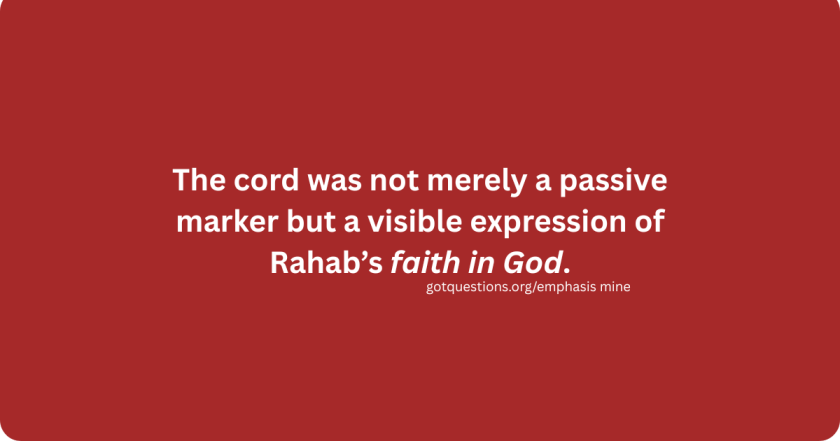
The cord was not merely a passive marker but a visible expression of Rahab’s faith in God.

Rahab was a Canaanite prostitute from Jericho who, due to her faith, protected two Israelite spies and became a significant figure in the Bible. Often cited as one of the first Gentile converts to worship the God of Israel, she is part of the lineage of Jesus Christ, demonstrating God’s grace to outsiders. (gotquestions.org)


Salmon, the father of Boaz is a significant figure in the genealogy of Jesus Christ, as outlined in the Gospels. He is traditionally believed to have been one of the Israelite spies who married Rahab, the Canaanite woman from Jericho who protected the spies (Joshua 2). This union is a powerful example of God’s grace and the inclusion of Gentiles into the covenant community. Salmon’s marriage to Rahab also highlights the theme of redemption and transformation, as Rahab’s faith led to her becoming part of the lineage of the Messiah. This connection to Rahab is a testament to God’s ability to use unexpected people and circumstances to fulfill His divine purposes.

Posted in Bible study, Devotion, Easter, From the Insideout, God is good, Journey Through The Word, Know These Truths, Prayer Starters, Quiet Time

A Day of Lament

Friends, we have journeyed for weeks now, toward the cross, and we have known this day would come. The day God planned from eternity past, the day His only begotten Son would hang and die for us, sinners, condemned unclean! Yet in this world of animatronics, it is easy to forget that He came not as a spirit or a robotic type creature, but as “fully man”! He came as a baby in a manger – a suffering servant – the son of God, yet sent to earth as the son of a carpenter – sent not to sit on a royal throne and be served but to serve and ultimately to die for the world God so loved. Yet not before He would seek and save those who were lost. For He came to dwell among them, teaching them about the God who saves, and to show them the way to live and the way to eternal life. A life that could only come through death – the death of the spotless, scarificial lamb of God.

Just days before His death, we find Him walking into Jerusalem, weeping as He entered the city.

Even as He was being welcomed by the crowd as He rode in on the donkey, the crowd was waving palm branches and shouting, “Blessings on the King who comes in the name of the Lord! Peace in Heaven and glory in the highest heaven!” Even then, (like us today), He wept for He knew what the leaders and rulers were planning. He knew then what had to be – ‘fully man but fully God,’ -He knew and had come to accomplish it – to redeem the lost, a lost and dying world – a world God had chosen to love and to save through the blood of a lamb – a people who would believe in this man – who was also fully God! He knew the death He would die and the destruction that would come upon this city and its people, and He wept – lamenting that the Jews – “of all people,” would have understood the way to peace! He was that Way, but they had rejected Him. They could not see Him as the rescuer He was, but rather as a threat to be done away with! — So He wept, and continued on the road … the road that led to the Temple…the road that led to Him lamenting their blindness, their lack of understanding, and what would come because of it – not just His own death – but the destruction of Jerusalem – The City of God!

It was a road that led to His authority being challenged…the road that would lead to the upper room…the washing of feet…the last supper with His disciples…the Garden of Gethsemene and His heartfelt prayer of lament that the Father would “let this cup pass from Him” It was the road that led to…Judas’ betrayal and the arrest that followed…Peter’s denial…the trial… and ultimately the road that ended at the cross, or more appropriately stated today – “On the cross”, where He suffered and bled and died, not as one without feeling, but in agony,1 on a cross of scorn, of sin, and shame meant for us.

Friends, Jesus could have called down 10,000 angels to take Him from the cross – , where He suffered and bled and died, not as one without feeling, but in agony.1 It wasn’t His cross to bear, it was ours – a cross of scorn, of sin, and shame but as a sacrifical lamb led to the slaughter He took our place, our scouraging, our nails, our pain and shouted, “Father, I entrust my spirit into your hands!” And with those words he breathed his last.

Prayer of Response

Father this day brings great sorrow to me, a great awareness of Your sacrifice, of Jesus’ suffering, and of my sin. But I do not sorrow as one without hope – but one who knows that Sunday is coming! And so I cry with grateful heart, thank You, God, for loving me. Thank you, Jesus – Lamb of God, for Your tears and Your willingness – even through lamenting – to not turn back but to take my stripes and my wounds and all the torment it must have been. I am forever indebted and forever changed because of Your love and Your obedience to the will of the Father. Amen and amen! – May my life and lips forever tell Your story!2

The More We Know

Credits for today’s graphic belong to Susan Hill’s excellent Easter Devotional, “A Savior Is Risen”, p121.

  1. The Medical Aspecs of the Crucifixion ↩︎
  2. I love to tell the Story ↩︎

Dear Reader: If you do not know the story of Jesus, the truths of His Word and the invitation that is open to you to receive salvation through Faith in Jesus, the sacrificial lamb of God – I invite you (urge you) to click on “Know These Truths” and believe in the Lord Jesus Christ ~ the Way, the Truth, and the Life -~ to all who believe.

KNOW THESE TRUTHS

Posted in Bible study, Devotion, From the Insideout, Journey Through The Word, Know These Truths, Prayer Starters, Quiet Time, She, Volume 2

Ruth, Part 3

Adapted from She, Volume 2, pp 67

Read: Ruth 2:14-23

There is a version/translation of the Scriptures called the Message. I’m assuming most are at least familiar with it but if you aren’t it is, as Christianbooks.com describes it, “a unique, contemporary paraphrase of the Bible that captures the heart, tone, and vibrant imagery of Scripture in everyday language—making it an inspiring choice for personal devotion, fresh insights, and connecting with God’s Word in a relatable, emotionally engaging way that speaks powerfully to both new believers and longtime readers alike.” ~While I do not use the Message as a study Bible, I do appreciate its tone and imagery – particularly in books like Ruth, as it seems to capture the heart and voice of the characters and the all-encompassing love and personal care of our God.

14 At the lunch break, Boaz said to her, “Come over here; eat some bread. Dip it in the wine.”

So she joined the harvesters. Boaz passed the roasted grain to her. She ate her fill and even had some left over.

15-16 When she got up to go back to work, Boaz ordered his servants: “Let her glean where there’s still plenty of grain on the ground—make it easy for her. Better yet, pull some of the good stuff out and leave it for her to glean. Give her special treatment.”

17-18 Ruth gleaned in the field until evening. When she threshed out what she had gathered, she ended up with nearly a full sack of barley! She gathered up her gleanings, went back to town, and showed her mother-in-law the results of her day’s work; she also gave her the leftovers from her lunch.

19 Naomi asked her, “So where did you glean today? Whose field? God bless whoever it was who took such good care of you!”

Ruth told her mother-in-law, “The man with whom I worked today? His name is Boaz.”

20 Naomi said to her daughter-in-law, “Why, God bless that man! God hasn’t quite walked out on us after all! He still loves us, in bad times as well as good!”

Naomi went on, “That man, Ruth, is one of our circle of covenant redeemers, a close relative of ours!”

21 Ruth the Moabitess said, “Well, listen to this: He also told me, ‘Stick with my workers until my harvesting is finished.’”

22 Naomi said to Ruth, “That’s wonderful, dear daughter! Do that! You’ll be safe in the company of his young women; no danger now of being raped in some stranger’s field.”

23 So Ruth did it—she stuck close to Boaz’s young women, gleaning in the fields daily until both the barley and wheat harvesting were finished. And she continued living with her mother-in-law.

Ruth 2:14-23 ~The Message

What a beautiful love story that unfolds on the pages of Scripture as God leads Ruth to the field of Boaz, one of their Kinsman Redeemers, and the heart and actions of Boaz respond with tender compassion and protection for Ruth and her mother-in-law.

Equally as beautiful is the visible melting of Naomi’s bitterness when she hears what God has done for them and declares, “Why, God bless that man! God hasn’t quite walked out on us after all! He still loves us, in bad times as well as good!” (Ruth 2:20).

Friends, this is such an important truth for us to know and remember throughout all of life. Even when life is overwhelming and the way ahead seems uncertain, we have the promise of God’s never-ending love and wisdom. We have the promise that He will never leave us or forsake us, and that He will lead us and guide us by His Spirit and His Word.

I will lead the blind by ways they have not known, along unfamiliar paths I will guide them; I will turn the darkness into light before them and make the rough places smooth. These are the things I will do; I will not forsake them.

Isaiah 42:16

Isaiah 42:16 was the passage of a morning devotion I recently read, and it came to mind as I was working on today’s journey through Ruth chapter 2, where Ruth knew no one and was desperately trying to help provide for herself and Naomi. There is no indication that she knew which fields were safe or who they belonged to. There is, however, overwhelming evidence that God was guiding her along unfamiliar paths, turning her darkness into light, and making the rough places smooth. Ruth had chosen to leave her pagan gods and family behind, committing herself not only to Naomi but to her true and living God, the faithful God of Israel. Now, she would begin to realize His love and personal involvement in her life as He provides not only safety but the attentiveness of a kinsman redeemer and the handfuls of barley purposefully dropped along the path for her to pick up as she gleaned.

She returned home to Naomi with the reserve of barley, and the amount sparked the interest of her mother-in-law.1

The passages (Ruth 2:14-23 and Isaiah 42:16) are worth rereading, for they reveal the absolute beauty of God leading, guiding, planting … us where He wants us, both for our good and His purpose and glory. Even the Isaiah passage is evidence of that truth in my own life, as I had not gone looking for the verse, the people who post the daily verses do not know me or what I would be studying – nor do I believe it is a mere coincidence, but rather the beautiful direction and timing of our lovingly purposeful, sovereign God.

May God continually open our eyes and hearts to behold all the wonderful things in His Word and His work in and around our lives. May we, as Naomi, trust, see, and declare that, regardless of how difficult our days and situations may be, God has not abandoned us, He still loves us – “in the bad times as well as good,” and may we bless His Holy Name.

Why, God bless that man! God hasn’t quite walked out on us after all! He still loves us, in bad times as well as good!” Naomi went on, “That man, Ruth, is one of our circle of covenant redeemers, a close relative of ours!”

Ruth 2:20

I love that we not only see Naomi’s scales of bitterness falling away, but we can hear the restored hope in her words to Ruth (2:20). We can also hear the beautiful evidence that she truly considered Ruth her daughter. As we move toward the end of our journey with Ruth over the next day or two, we will see that those around Ruth could see these truths as well.

Reflection and Application

What have you recently gleaned from the Word of God?

The More We Know
  1. She, Volume 2/p67 ↩︎
  2. She, Volume 2/p67 ↩︎

Posted in Bible study, Devotion, From the Insideout, Journey Through The Word, Prayer Starters, Quiet Time, Thanksgiving

Praise the Lord for His Goodness

Oh that men would praise the Lord for his goodness, and for his wonderful works to the children of men! For he satisfieth the longing soul, and filleth the hungry soul with goodness.

Psalm 107:8-9 KJV

To be clear, while God certainly provided for the people’s physical hunger and thirst, the Psalmist is also referring to a spiritual hunger and thirst rather than simply the physical need. For as Spurgeon explains: “They were lost in the worst possible place, even as the sinner is who is lost in sin; they wandered up and down in vain searches and researches as a sinner does when he is awakened and sees his lost estate; but it ended in nothing.”

First, the Psalmist calls the people to give thanks to the Lord for His goodness and loyal love, for He has delivered them from the power of their enemies. He has gathered them from foreign lands around the world. Yet, even in their freedom from the enemy, the Psalmist writes that they wandered through the wilderness with no place to live. They were starving and thirsty, but “they cried out to the Lord in their distress,” and He lovingly and compassionately led them to a place of provision.

Psalm 107:1-7 NET

Thankfully, true physical starvation and unquenched thirst have never been a reality in my life. However, I have found myself wandering in spiritual deserts before, trying to find my way back to God, thirsting for His spring of living water, and hungry – not just to feast on His Word but to understand its truth. Today’s ‘thankful’ passage is a picture of Israel finding themselves in such a place. God had delivered them from their enemy, and they were now being “gathered” from every direction where they had been held captive. By the Psalmist’s description, some were led through a wasteland in the wilderness, where they found no place to live. They were hungry and thirsty, to the point of exhaustion — and they cried out to the Lord. And our God, the True and Living God, intervened on behalf of His people, Israel, and “led His redeemed to just the right place, to a city for a dwelling place.1

Friends, are you hungry and thirsty for God, and find yourselves fainting from the exhaustion of the physical and spiritual needs and wars of this world? Then cry out to the Lord in your distress and watch, for He will deliver you from your troubles and lovingly and compassionately lead you to the place of His provision.

Now, because of His deliverance, the Psalmist calls the people again to give thanks, not just for His loyal love but alsofor the amazing things He has done,” such as satisfying their thirst and hunger, both of body and soul.

Oh, friends, have you noticed how God has satisfied your longing soul, and/or filled your hungry soul with goodness? Let’s ask Him to help us daily keep our eyes up and become more aware of His spiritual and physical provision, and less and less aware of our needs, that we may faithfully give Him thanksgiving for His goodness and for His wonderful works of grace and mercy toward us.

Posted in Devotion, From the Insideout, Journey Through The Word, Prayer Starters, Quiet Time, Thanksgiving

God is Good …

It is good to give thanks to the Lord! Scripture says it, and I have personally found it to be true in my life. The writer of this Psalm obviously knew it to be true, for throughout the chapter, he calls his listeners/readers to proclaim God’s goodness. He also continues to reveal the goodness of God throughout the entire Psalm.

I love that the Psalmist not only calls us to give thanks but also tells us why to give thanks. He calls us to give thanks for two specific reasons that we are wise to remember and daily declare.

  • He is good.
  • His mercies (or loyal love) endure forever.

To know His goodness and mercies is a wonderful thing/feeling, but more than that, it is a catalyst for knowing Him intimately. His goodness and mercy allow us to know Him. They draw our eyes upward. They open our eyes to His love and kindness. They convince us of His faithfulness to never leave or forsake us. They are seen in His grace to save/deliver us from our sins, and in His power to transform us from the inside out. His goodness knows no boundaries – for God is only, always, good.

The gotquestions.org commentary explains it like this: To say that God is good means that God always acts in accordance to what is right, true, and good. Goodness is part of God’s nature, and He cannot contradict His nature. Holiness and righteousness are part of God’s nature; He cannot do anything that is unholy or unrighteous. God is the standard of all that is good.”

Friends, let’s ask Him to open our eyes to see His goodness and mercy throughout the day, and may we be quick and faithful to give Him thanks, declaring aloud: ‘Thank You, God!’ For You are good and Your mercies endure forever!

The More We Know

What does it mean that God is good?

If you do not know God or would like to know more about Him, I would love to introduce you to Him … simply click on the Know These Truths link below.

Posted in Bible study, Devotion, From the Insideout, Journey Through The Word, LGG Study, Prayer Starters, Quiet Time, Secure In Christ

Put Off/Put On

based on the LGG Study, Secure in Christ/w4d5

Read: Ephesians 4:25-32; SOAP: verse 32

Therefore, having laid aside falsehoodeach one of you speak the truth with his neighbor, because we are members of one another. 26 Be angry and do not sin; do not let the sun go down on the cause of your anger. 27 Do not give the devil an opportunity. 28 The one who steals must steal no longer; instead he must labor, doing good with his own hands, so that he will have something to share with the one who has need. 29 You must let no unwholesome word come out of your mouth, but only what is beneficial for the building up of the one in need, that it would give grace to those who hear. 30 And do not grieve the Holy Spirit of God, by whom you were sealed for the day of redemption. 31 You must put away all bitterness, anger, wrath, quarreling, and slanderous talk—indeed all malice. 32 Instead, be kind to one another, compassionate, forgiving one another, just as God in Christ also forgave you.

Ephesians 4:25-32

Being secure in Christ gives us the freedom and the courage to live like Christ.

From the Inside Out 🦋

Paul has just told the believers of Ephesus to put off their old, sinful nature and put on their new nature, created in God’s image to reflect the righteousness and holiness of Jesus Christ (Eph 4:22-24). Today’s passage is a practical application of putting off and putting on. Paul lists out seven things that should not characterize our lives: lying, anger, Satan’s influence, stealing, unwholesome words, and grieving the Holy Spirit with a hardness toward sin. Thankfully, Paul doesn’t stop here but continues with a practical list of sins that grieve the Holy Spirit: bitterness, anger, wrath, quarreling, and slanderous talk—indeed all malice. He then continues with a list of godly/Christ-like characteristics we should put on, namely: kindness, compassion, and forgiveness (noting that we aren’t just to forgive but to forgive just as God in Christ has forgiven us).

While kindness and compassion may not always come easily, I believe forgiveness can be the most difficult of the three. I have talked to many women who say the same, and more often than I can count, I have had them tell me, “I just can’t or won’t forgive that person.

God promises that, when we come to Him confessing our sin and asking for forgiveness, He freely grants it for the sake of Christ (1 John 1:9). Likewise, the forgiveness we extend to others should know no limits (Luke 17:3–4). The forgiveness we extend to others is an act of the will. We do not deserve God’s forgiveness; likewise, our forgiveness is not granted because a person deserves to be forgiven. No one deserves to be forgiven. Forgiveness is a deliberate act of love, mercy, and grace. Forgiveness is a decision not to hold something against another person, despite what he or she has done to us.

Adapted from Gotquestions.org/What is Forgiveness?/emphasis mine

I love that today’s reading also included the words of Jesus in John 13:34-35.

“I give you a new commandment—to love one another. Just as I have loved you, you also are to love one another. 35 Everyone will know by this that you are my disciples—if you have love for one another.”

John 13:34-35

This is a passage I believe all who follow Christ should have hidden in their heart/minds. After all, there is no greater commandment than loving God and loving others (Mark 12:29-31). Loving others, like forgiveness, isn’t always easy; loving others just as Jesus loved us can be even more difficult, for His love knew no limits, not even death on the cross. Friends, we may not lose our lives on a cross like Jesus, but we are called to put off (lose) the old life and put on the new. When we do this, when our life is characterized by kindness, compassion, and forgiveness (all of which require love), we will be the light that points others to Jesus.

Paul writes that our words, thoughts, and actions should point others to Christ and not away from Him. The way we do this is by keeping love at the forefront of all that we do and allowing forgiveness to be our first response to others (John 13:35).

From the LGG Journal, Secure in Christ/p135

The More We Know

Visit LoveGodGreatly.com for more insight on today’s journey

Posted in Bible study, Devotion, From the Insideout, Journey Through The Word, Know These Truths, LGG Study, Prayer Starters, Quiet Time, Secure In Christ

Live the New Life

based on Love God Greatly’s study, Secure in Christ/w4d4

Read: Ephesians 4:17-24; SOAP: verse 24

So I say this, and insist in the Lord, that you no longer live as the Gentiles do, in the futility of their thinking. 18 They are darkened in their understanding, being alienated from the life of God because of the ignorance that is in them due to the hardness of their hearts. 19 Because they are callous, they have given themselves over to indecency for the practice of every kind of impurity with greediness. 20 But you did not learn about Christ like this, 21 if indeed you heard about him and were taught in him, just as the truth is in Jesus. 22 You were taught with reference to your former way of life to lay aside the old man who is being corrupted in accordance with deceitful desires, 23 to be renewed in the spirit of your mind, 24 and to put on the new man who has been created in God’s image—in righteousness and holiness that comes from truth.

Ephesians 4:17-24

After telling the believers in Ephesus to practice, or live out and speak the truth to one another in love, and to use their gifts to build up the body of Christ (Eph. 4:14-16), Paul continues with his instructions/teaching. He insists that they quit living like they did before they came to know God through Christ. He paints a vivid picture of what they used to live like and then strongly encourages them to live like the new person Christ created them to be.

So then, if anyone is in Christ, he is a new creation; what is old has passed away—look, what is new has come!🦋

2 Cor 5:17

Paul has been with these believers for nearly three years, so he knows they have been taught the “truth” of Christian living. He knows they understand what it means to follow Jesus. They know that the followers of Jesus are to turn from their selfish ways and take up their cross daily to follow Him. They know they are not to hang on to their old life but to give it up for the new life Christ has called them to. Paul wrote to the church of Rome, “Don’t copy the behavior and customs of this world, but let God transform you by changing the way you think” (Romans 12:1-2). Similarly, here, he reminds the Ephesians to be renewed in the spirit of their minds and to put on the new man who has been created in God’s image. In other words, they (and thus all believers) are to live and love like Jesus, not the world. Specifically, their lives are to be characterized by righteous and holy living that comes from the truth.

Jesus said to him, “I am the way, the truth, and the life. No one comes to the Father except through Me.

John 14:6

Friends, to live this new life as it is meant to be lived, we can not hold on to even a smidgen of our life before Christ. I tried that for years. In one ‘crowd’ I was the new, and in another ‘crowd’ I was the old. Sometimes, it was because I didn’t want to give up some of my old ways of life and/or desires; but other times it was because I didn’t want to be left out, and for a period of time it was because I was angry with God. Thankfully, He did not leave me but pursued me and rescued me from that double life to a life that is fully surrendered to Him. When I think of these scenarios and that season of my life, and how I allowed myself to chase after or get caught up with the ‘little gods’ of my life, I am reminded of some of the words He used to transform me. They were the words of Joshua to the people of God, when he said: “Choose you this day whom you will serve…but as for me and my house we will serve the Lord” (Josh 24:15).

Today’s Reflection

Who have you chosen to serve? The true and living God or the gods…the people…the desires of this world? Does your life look like the new creation Christ created you to be – or the old? Tough questions, but ones worth asking and praying over.

The More We Know

Posted in Bible study, Devotion, From the Insideout, Journey Through The Word, LGG Study, Prayer Starters, Quiet Time, Secure In Christ

The Importance and Way of Unity

based on the LGG Study, Secure in Christ/w4d1

Read: Ephesians 4:1-6; Matthew 5:14-16 and SOAP: Ephesians 4:2-3

 I, therefore, the prisoner for the Lord, urge you to live worthily of the calling with which you have been called, with all humility and gentleness, with patience, putting up with one another in love, making every effort to keep the unity of the Spirit in the bond of peace. There is one body and one Spirit, just as you too were called to the one hope of your calling, one Lord, one faith, one baptism, one God and Father of all, who is over all and through all and in all.

Eph 4:1-6

Friends, as believers, we must never forget that, like Paul, we have been called to live and love like Jesus (John 13:34; Luke 9:23-24). Knowing that Jesus was sinless and loved us even to death on the cross, it may be easy to think this is impossible and skip right over it. However, in Paul’s letter to the believers in Ephesus, He laid out four principles or characteristics to help them in their quest to accomplish God’s calling on their lives. Humility, gentleness, patience, and love are the chief characteristics, but he also tells them to “Make every effort to keep yourselves united in the Spirit, binding yourselves together with peace.”

Humility is defined by gotquestions.org as meekness, lowliness, and absence of self. Biblical humility is not simply an outward expression or show. Instead, it is an attitude of the heart. Between us and Christ/God, it is a heart change that reflects our understanding that we are utterly helpless and hopeless without Him. We are completely dependent on Jesus Christ for life here on earth and eternity in Heaven. Likewise, we are utterly dependent on Him for godliness, ie, living and loving like Jesus. (This attitude/mind-set is a game-changer.)

Gentleness, as one commentary says, “involves humility and thankfulness toward God, and polite, restrained behavior toward others.” We cannot produce it in ourselves, for it is a fruit of the Spirit(Galatians 5:22-26). Gentleness has, by some, been mistaken for weakness. Yet, certainly, when we consider the opposites of gentleness, such as anger, a desire for revenge, and promoting oneself as better than others, we are able to see that gentleness requires great strength.

Every person is powerful. We can speak words that influence others; we can act in ways that help or hurt; and we can choose what influences will inform our words and actions. Gentleness constrains and channels that power. To be gentle is to recognize that God’s ways and thoughts are high above our own (Isaiah 55:9). It is to humbly realize that our worldviews are shaped by exposure to sin and the misinterpretation of experience. It is to accept God’s worldview, reflecting truth about the spiritual and the material worlds.

Gotquestions.org

Patience, in this passage, implies bearing with or putting up with one another (in love). Similar to gentleness and humility, it requires putting others above ourselves and living in the power of God’s Spirit. On the flip-side, In 1 Corinthians 13, Paul identifies patience as a by-product of love – so it appears you cannot have one without the other.

Particularly as it is used in the New Testament, “love” is not merely a feeling or an emotion. It means taking actions which benefit others. A feeling which doesn’t result in action is not biblical “love.”

Gotquestions.org

Love is patient, love is kind, it is not envious. Love does not brag, it is not puffed up. It is not rude, it is not self-serving, it is not easily angered or resentful. It is not glad about injustice, but rejoices in the truth. It bears all things, believes all things, hopes all things, endures all things” (1 Cor 13:4-7). These were the words Paul used to define love to the church of Corinth. Love was also the answer Jesus gave to the one who asked Him to name the greatest commandment. “Love the Lord your God with all your heart, all your soul, and all your mind; the second is equally important, love your neighbor as yourself. No other commandment is greater than these” (Mark 12:29-31). Thankfully, we don’t have to guess what Jesus meant when He told us to love. In John 13:34, John records what Jesus said this love is to look like when He introduced the “new commandment” to His disciples, saying: “I give you a new commandment—to love one another. Just as I have loved you, you also are to love one another.” Again, I urge you not to set this aside as something you cannot do, and as an extra measure of encouragement, I remind you, as I have often reminded myself, that God has given us everything we need to live a godly life (2 Peter 1:3-4).

By his divine power, God has given us everything we need for living a godly life. We have received all of this by coming to know him, the one who called us to himself by means of his marvelous glory and excellence. And because of his glory and excellence, he has given us great and precious promises. These are the promises that enable you to share his divine nature and escape the world’s corruption caused by human desires.

2 Peter 1:3-4

Paul wraps up this list of characteristics by which we are to live out God’s calling on our lives with a final instruction (or perhaps reason) for living with all humility, gentleness, patience, and love. They are to practice these attributes… “making every effort to keep the unity of the Spirit in the bond of peace.” As we have been reminded throughout this journey through Ephesians, Jews and Gentiles were now united in Christ, and should live in peace with one another. As Bibleref.org puts it: “This unity ought to also take place “in the bond of peace.” Peace is another theme that Paul mentions multiple times in this letter (Ephesians 1:2; 2:14, 15, 17; 6:15, 23). Christ is our peace; He made peace, preached peace, gives unity in peace, and offers a gospel of peace. Peace is part of the fruit of the Spirit (Galatians 5:22) and important for every believer (Romans 5:1).”

When we live and love like this, we fulfill another calling of God on our lives, which is to be lights in this dark world. May we remember that to maintain the light, we must faithfully practice the teachings of God through Paul to “live with all humility and gentleness, with patience, putting up with one another in love, making every effort to keep the unity of the Spirit in the bond of peace.

The love Jesus has for his followers cannot be duplicated by them in one sense, because it effects their salvation, since he lays down his life for them: It is an act of love that gives life to people. But in another sense, they can follow his example (recall to the end, 13:1; also 1 John 3:164:16 and the interpretation of Jesus’ washing of the disciples’ feet). In this way Jesus’ disciples are to love one another: They are to follow his example of sacrificial service to one another, to death if necessary.

bibleref.com
The More We Know

For more insight, read today’s Love God Greatly’s post HERE

Posted in Bible study, Devotion, From the Insideout, God is good, Journey Through The Word, LGG Study, Prayer Starters, Quiet Time, Secure In Christ

Exceedingly, Abundantly More…

Read and SOAP: Ephesians 3:20-21

Now to Him who is able to do exceedingly abundantly above all that we ask or think, according to the power that works in us, 21 to Him be glory in the church by Christ Jesus to all generations, forever and ever. Amen.

Ephesians 3:20-21 NKJV

Wow! How I love this verse! I frequently end prayers with it, or incorporate it in a prayer when I am pressed with worry. It’s been a go-to verse when I am encouraging others. I praise Him often for the truth of His omnipotent power, because the truth of it gives me strength to press on in trying or fearful situations. Seriously, it sparks joy in my soul, hope in my heart, and peace in my mind; the combination of which fills me with strength. According to Paul’s explanation here to the church of Ephesus, because the Spirit is working within us, God can do exceedingly, abundantly more than we ask or even imagine. As Paul wrote to his readers, “to God be the glory in the church and in Christ Jesus to all generations, forever and ever. Amen.”

Knowledge of this truth can affect how we pray and react to the big and little concerns of our lives. However, understanding this truth on a personal level changes everything, and without question, it affects how we pray, react, and trust in any situation that dares to shake us.

Gotquestions.org

Are there troubles in your life? Do you know someone who is sick or struggling to make ends meet?Is there a relationship you believe can never be repaired? Whatever you are facing, you can rest in the knowledge that God not only hears our prayers and cares about our ‘situations’, but He is able to do immeasurably more than we ask or even imagine.

In the online Oxford dictionary, Immeasurable means: too large, extensive, or extreme to measure. The Bible Hub topical encyclopedia defines the word very similarly; it states, the term “immeasurable” refers to something that is beyond the capacity to be measured or quantified. In the context of the Bible, it often describes the infinite nature and attributes of God, His love, wisdom, and power, as well as the vastness of His creation and the depth of His grace and mercy.”

God’s means for accomplishing more than we can imagine comes through His strength. His work is done by the Holy Spirit’s power within us, rather than by our human strength. As Jesus taught His apostles, “The spirit indeed is willing, but the flesh is weak” (Matthew 26:41Mark 14:38). Paul also refers to “power” throughout this letter (Ephesians 1:19212:23:7166:12). Ephesians 3:7 described Paul as a minister “by the working of [God’s] power.” Paul’s readers, likewise, could minister by God’s power.

Hide me now under Your wing

cover me within Your mighty hand

When the oceans rise and thunder roars

I will soar with You above the storm

Father You are King over the flood

I will be still and know You are God

~ Find rest my soul in Christ alone

Know His power ~ in quietness and trust.

Still by Hillsong