Adapted from the She Study, delighting in the examples of the women of the Bible, Volume 3/pp 37-38
Today’s Scripture: Luke 2:7-20; John 1:14; and 1 Samuel 12:24
Only fear the LORD, and serve him in truth with all your heart; for consider how great things he hath done for you.
1 Samuel 12:24
“Greetings, favored woman! The Lord is with you!” Confused and disturbed, Mary tried to think what the angel could mean. “Don’t be afraid, Mary,” the angel told her, “for you have found favor with God! You will conceive and give birth to a son, and you will name him Jesus.
Friends, I hope you have found as much joy as I have in walking through Mary’s story. From the angel’s announcement that she had been chosen to carry and bear the Son of God into the world, we have seen her tender, receptive heart not only to the unexpected (and humanly impossible) announcement, but also to a possible threat to her engagement and relationship with Joseph, not to mention what the changes might do to her (and her familiy’s) reputation in the community. We have heard her willingness to accept and believe the message and surrender to the will of God, and we have watched as God not only kept Joseph from walking away but also gave her a much-needed embrace and words of encouragement from her cousin, Elizabeth.
“I am the Lord’s servant. May everything you have said about me come true.” Luke 1:38
Mary responded, “I am the Lord’s servant. May everything you have said about me come true.” And in time, everything the angel had told her came to pass. She gave birth to the only begotten Son of God, and He was named Jesus (Matthew 1:25). Jesus, God with us, as John 1:14 emphasizes, and as Isaiah had prophesied (Isaiah 7:14), A virgin would conceive and give birth to a son. People will call him “Immanuel,” which means “God with Us.” ~”Viewed in this light,” as gotquestions.org explains, “Isaiah’s prophecy is clear that Jesus is God, sent to earth to be with us, and to save mankind from our sins.” A savior born, the begotten Son of God, born in a stable, wrapped in swaddling clothes,1 and laid in a manger; a perfect reminder that, as today’s study journal points out, “Regardless of whether or not there is room made for Him, the Lord will carry out His purpose.”
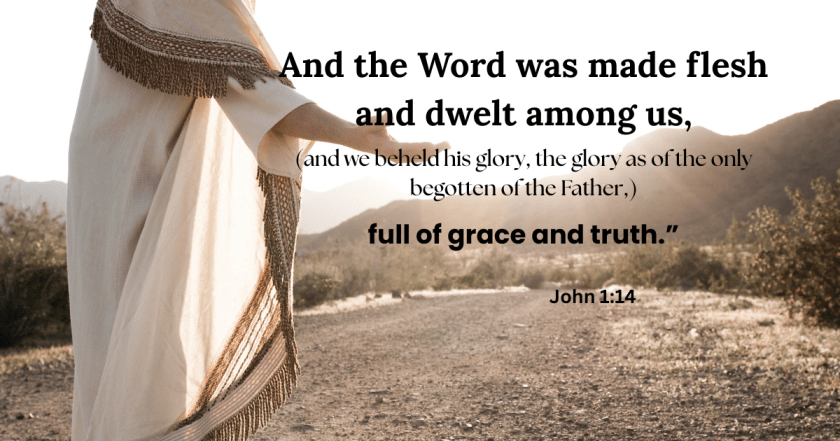
And the Word became flesh and dwelt among us, and we beheld His glory, the glory as of the only begotten of the Father, full of grace and truth.
After Mary had given birth, swaddled her newborn son, and laid Him in the manger, she was visited by shepherds, who had been visited by an angel in the fields. The angel told them about the Savior, Christ the Lord, who had been born in Bethlehem, the city of David. And the angel said to them, “Fear not, for behold, I bring you good news of great joy that will be for all the people. For unto you is born this day in the city of David a Savior, who is Christ the Lord. And this will be a sign for you: you will find a baby wrapped in swaddling cloths and lying in a manger.” …When the angels went away from them into heaven, the shepherds said to one another, “Let us go over to Bethlehem and see this thing that has happened, which the Lord has made known to us.” And they went with haste and found Mary and Joseph, and the baby lying in a manger. And when they saw it, they made known the saying that had been told them concerning this child. And all who heard it wondered at what the shepherds told them. But Mary treasured up all these things, pondering them in her heart.” (Luke 2:10-12, 15-19)
But Mary treasured up all these things, pondering them in her heart.
MARY, THE MOTHER OF JESUS, ALSO SERVES AS AN EXAMPLE OF THE GREAT THINGS THAT ARE POSSIBLE THROUGH US IF WE WILL SIMPLY YIELD OURSELVES TO THE LORD.
REFLECTION AND APPLICATION
- Why would Mary ponder these things?
- Take time today to ponder what He has done for you.
The More We Know
- There are some interesting theories about Luke’s detail of Jesus’ swaddling clothes. Some have postulated that the swaddling clothes were a foreshadowing—a prophetic reference—of Jesus’ burial cloths. The Greek word sparganoo is the root word used in the phrase “swaddling clothes,” and it means “to clothe in strips of cloth.” But this word sparganoo is never used in the New Testament to refer to burial cloth. In the descriptions in the Gospels of Jesus’ burial, we see variations on the phrase “wrapped in linen cloth,” and different Greek words are used for the binding. The swaddling clothes could prefigure Jesus’ burial (the Magis’ gift of myrrh in Matthew 2:11 is a clearer bit of foreshadowing), but the link can’t be proved linguistically. Gotquestions.org ↩︎


