Posted in Bible study, From the Insideout, LGG Study

John’s Testimony: This Is the Son of God

Read John 1:19-42 and SOAP John 1:34

  I have both seen and testified that this man is the Chosen One of God.”

John 1:34

John uses a variety of names to identify Jesus to the people in verse 19-42, for instance in the NET version John references Him as Lord (23), The Lamb of God (29, 36), and The Son of God (34). On top of the specific names John also uses several specific references such as “the One – whose sandal strap I’m not worthy to untie” (27), “the one who takes away the sin of the world!” (29),”a man who has surpassed me, because He existed before me.” (30), “The One who baptizes with the Holy Spirit” (33). All of these references are specific to this One Man. They are applicable to Jesus alone.

John had a job to do – a ministry call to fulfill, for he was commissioned before he was even born to “prepare the way for the Lord” (Luke 1:17 and 76), and he did it well. However, he not only tasked with telling people who Jesus was – but he had seen who Jesus was. God gave John an unmistakable sign that left no room for doubt that Jesus was the Chosen One, The true and undeniable Lamb of God.

Every time I read this portion of Scripture, one question pops in my head and convicts my heart. What is my testimony about Jesus? This question is followed by a seemingly endless list of follow-up questions like – Do I know Him well enough to testify about Him? Am I certain enough of who He is that I talk freely and assuredly about Him, where He came from, what He can do, and what He’s done already? I am convinced that if we are to be His witnesses (Acts 1:8) we must be able to move beyond simply knowing His name and His birthday, to seeing “who He is” because God has shown us who He is! – We must be able, like John, to say without wavering – “I have both seen and testified that this man is the Chosen One of God”.

Yes God, may we see the Son through Your eyes, may we watch for and remember the ways you make Him known to us so that in due time we can make Him known to others. May our lips not only name Him but may we point Him out with descriptions that testify to who He really is. In all of this may You be glorified.

Me, From the Inside Out – 2 Corinthians 5:17

Posted in Bible study, From the Insideout, LGG Study

Jesus – The Word and The Creator

Grab your favorite Bible and read John 1:1-18; SOAP: John 1:1-4

In the beginning the Word already existed.
    The Word was with God,
    and the Word was God.
He existed in the beginning with God.
God created everything through him,
    and nothing was created except through him.
The Word gave life to everything that was created,
    and his life brought light to everyone.

John 1:1-4

John was born and sent by God to be the one who prepared the way for “the Lord”, the Messiah to come, (Luke 1:1-25 and 67-80). While Jesus was not yet with John, we find John introducing Him in the very first verse of John’s Gospel. He doesn’t introduce Him as a baby in a manger or a name at the end of a long line of genealogy – but he boldly proclaims Him as “the Word” … as One being with God in the very beginning – we’re talking Genesis 1:1 beginning – before creation was spoken into being beginning. John not only says that Jesus was with God in the beginning but he introduces Him … as being God and as being used by God in the creation of everything – “Nothing was created except through Him.” The other word John uses to describe Jesus is life – “life that brought light to everyone”. The importance of that last statement, “brought light to everyone”, is made clear in verse 5 where we are told that His light shines in the “darkness” but the darkness does not overcome it. Jesus will explain this part of Himself later in John 8. For now just let John’s description settle over you for a moment – Jesus, the very word of God … with God in the beginning … God Himself … Life and Light. The One, who though He was God, came and took on flesh to offer us the hope of eternal security wasn’t dreamed up when all else failed – He was there in the beginning.

Don’t miss today’s blog from the LGG Team

Posted in Bible study, From the Insideout, LGG Study

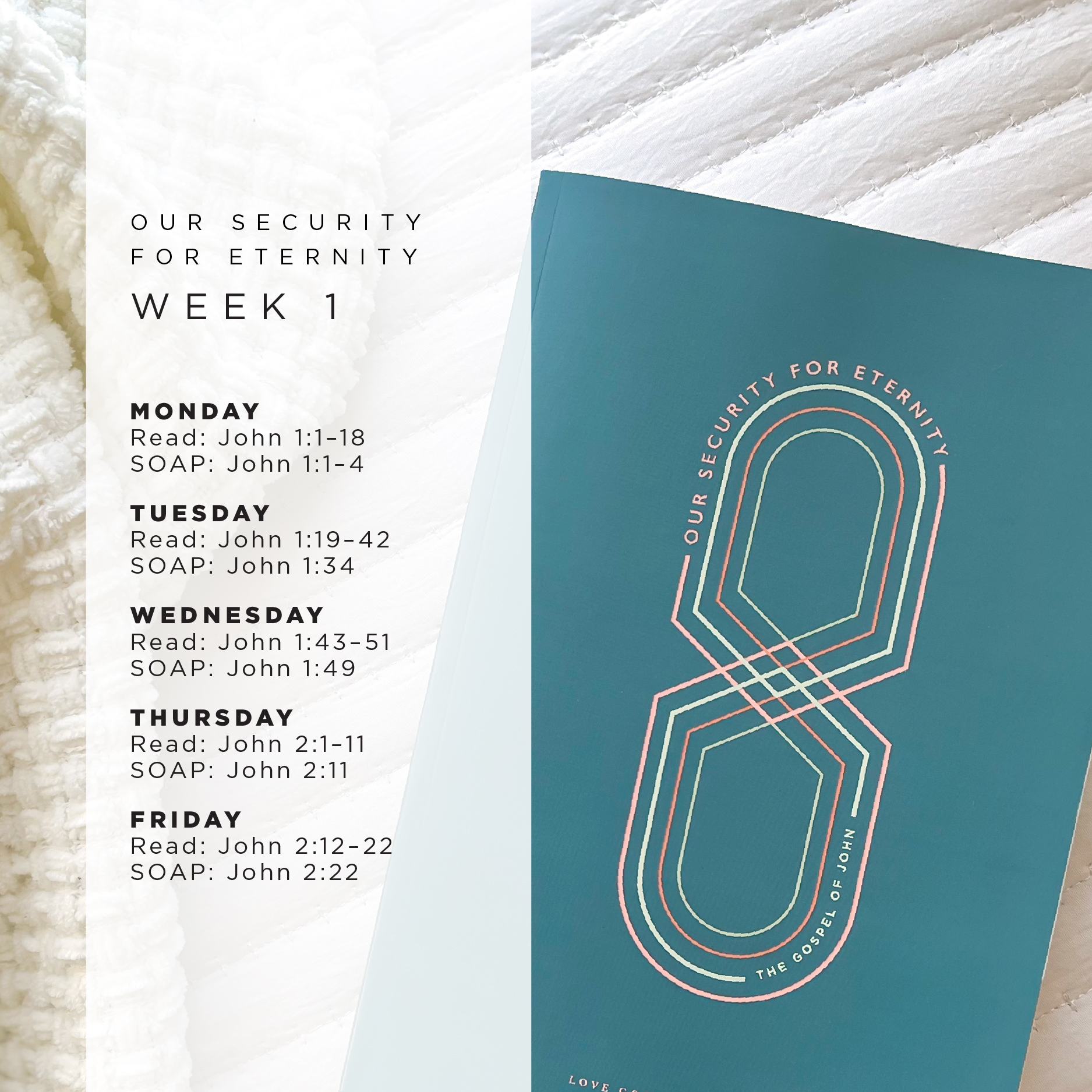
OUR SECURITY FOR ETERNITY

“One of the biggest and most humbling questions in life is what happens when we die. We long for peace, for certainty to know that, even though our lives on earth will end, there is something more. But how can we know for sure? How can we be certain death is not the end? – The only true answer is found in the Scriptures – the Word of God – and the Book of John is a great place to start … Through the reading of John’s Gospel we can know what it means to have faith in Jesus and what it means to have eternal life. – If you’ve ever had questions about faith – this Bible study is for you – whether you’ve never placed your faith in Jesus or you’ve been walking with Him for more years than you can remember – Our Security for Eternity will deepen your understanding of who Jesus is.”

Come join me for this 6 week journey through John's Gospel. Regardless of how often you've heard it, read it, or studied it I am confident that God's Spirit will make it fresh - for His Word is alive and active and has the power to transform our lives.
Join me for week one of “Our Security for Eternity” from the Gospel of John (March 7 – March 11)

Discover how to SOAP the Scriptures for a more meaningful Bible Study

Posted in Bible study, Devotion, From the Insideout, Journey Through The Word, Uncategorized

A Lasting Impact

Women’s History Month and a Look at Women of Faith through the Pages of the Scriptures

Eve … Noah’s wife (Na’amah) … Lot’s wife … Sarah … Naomi … Ruth … Esther … Tamar … Rahab … Moses’ mother (Jochebed) … Miriam … Rebekah … Rachel … Hannah … Deborah … Mary and Martha … Anna … and so so many more.

Women from history … the history of God’s people … written down, remembered for sinful disobedience, mistakes, faith, hurts, heroics, deceit, loyalty, obedience, and lineage. All of them, created by, used by, and for God’s purposes. All of them — memorable to most who are familiar with the Scriptures, and some, like Eve, are known to those who have little or no real knowledge of Scripture. Some are inspirations of hope when there appeared to be no hope, like Esther, who was used to save a people who were facing annihilation. Others, invoke courage, like Jochebed, who defied the edict that her infant son must be put to death, or Rahab, who hid the spies on her rooftop and helped them escape certain death. Eating forbidden fruit, looking back when you were told not to, trickery, deceit, and manipulation are all things that come to my mind when I remember some of these women. While we might be tempted to sweep their stories under the carpet, so to speak, it’s important that we don’t miss how God used them and the invaluable lessons we can learn from them. We may think they aren’t appropriate to share, or at least not all of their sordid details, with those outside “the family,” but I would disagree – consider the impact they make on the gospel story when God is not just seen as someone who saves but someone who saves prostitutes and liars and those who have no hope of salvation. I cannot help but think of the hope these women might bring when those who have tarnished pasts hear how our God, the one true living God, uses the disobedient or outcast to accomplish great things. How much hope might a woman who has endured pain and suffering from abuse or broken promises gain when she hears the story of Tamar and how God worked all things together for the good of His people, or of the devastating losses of Naomi and God’s amazing provision? Think of the inspiration to pray boldly and with confidence that comes from Hannah’s story, or the desire to sit at the feet of Jesus and listen to His teaching like Mary, or to reach out in faith like the woman who had the bleeding problem. Oh, the stories, the examples, the fingerprints of God through the women He chose to make known to us through His Word. The Bible is rich with history, and women are a great part of it. May we be inspired by their faith, learn from their mistakes, practice what God saw and pointed out as good, and share them with others as lights in a world full of crooked and perverse people who need to know the truth and love of our God, a love that knows no boundaries. Ladies, may we, like Queen Esther, hear the words and challenge of Mordecai, who said, “And who knows whether you have not come to the kingdom for such a time as this?” The people around us who do not know Jesus face an eternal hell when their life here on earth is over, but we have been given the opportunity to make the truth known – our king has given us the power we need – for such a time as this.

Eve, “The woman who was instrumental in sin entering the world and from whom we can learn what not to do”. She was the first women created by God from Adam’s rib … placed in the Garden of Eden as a helpmate to her husband. Given the privilege of God’s company of knowing His goodness and the beauty of His creation prior to sin entering the world. She could be the poster child for Peter’s warning to be self-controlled and alert, because our enemy, the devil, prowls around like a roaring lion (or in Eve’s case, like a serpent) looking for someone to devour.

Noah’s wife, (Na’amah), walked onto an ark with only her family. Following the leadership and faithful obedience of her husband, she left all that she knew behind because God said He was going to send a flood. [Genesis 7:7 And Noah and his sons and his wife and his sons’ wives with him went into the ark to escape the waters of the flood.]

Lot’s wife, unnamed in the Scriptures but known for becoming a pillar of salt after looking back when they were fleeing the destruction of Sodom and Gomorrah. Jesus cites this story in Luke 17, as He describes a future event: “It was the same in the days of Lot. People were eating and drinking, buying and selling, planting and building. But the day Lot left Sodom, fire and sulfur rained down from heaven and destroyed them all. It will be just like this on the day the Son of Man is revealed. On that day, no one who is on the housetop, with possessions inside, should go down to get them. Likewise, no one in the field should go back for anything. Remember Lot’s wife! Whoever tries to keep their life will lose it, and whoever loses their life will preserve it” (verses 28–33).

Sarah, the wife of Abraham and mother of Isaac, who failed to trust God when His promise to give her a child did not happen quickly enough. Her lack of faith brought great trouble to her life and to our world today as she instructed her handmaiden, Hagar, to sleep with Abraham and provide a child for them. God still honored His promise, and Sarah gave birth to Isaac at the age of 90, but the consequences that followed are still known today. We must not miss the example that Peter uses of Sarah, where he refers to her as “a holy woman who hoped in God”, 1 Peter 3:5-6. Sarah willingly left her home and stepped out into the unknown to follow Abraham, as he followed the directions of a God with whom she was unfamiliar at the time. She endured much to try to provide an heir for her husband and to keep her husband safe in dangerous lands. In the end, she had faith enough to believe that she and her husband, at the ages of 90 and 100, would produce the promised heir, Isaac. Although she lived in a world of danger and confusion, Sarah stood firm in her commitment to her husband and to God, and her commitment was rewarded with a blessing.

Naomi and Ruth, whose lives are testimonies to God bringing good out of something tragic, or bitter, as Naomi’s story infers. When a famine hits Judea, Elimelech and Naomi and their two boys relocate to Moab (Ruth 1:1). There, Mahlon and Kilion marry two Moabite women, Orpah and Ruth. After about ten years, tragedy strikes. Elimelech dies, and both of Naomi’s sons also die, leaving Naomi, Ruth, and Orpah widows (Ruth 1:3–5). Naomi, hearing that the famine in Judea was over, decides to return home (Ruth 1:6). Orpah stays in Moab, but Ruth chooses to move to the land of Israel with Naomi. The book of Ruth is the story of Naomi and Ruth returning to Bethlehem and how Ruth married a man named Boaz and bore a son, Obed, who became the grandfather of David and the ancestor of Jesus Christ.

Esther, the Jewish maiden who became queen of Persia and rescued her people from a murderous plot to annihilate them. Her story is recorded in the Old Testament book bearing her name. Esther was the cousin of a Benjamite named Mordecai, who was also her guardian, having adopted her as his own daughter when her parents died. Mordecai held some type of official position within the Persian government (Esther 2:19). When Esther was chosen as a candidate for queen, Mordecai instructed her not to reveal her Jewish background (verse 10). He also visited the king’s harem daily to see how Esther was doing (verse 11). She won the grace and favor of the king, according to Esther 2:17; he loved her more than all the others and made her queen. As the story progresses, it becomes evident that God was at work through the whole process. For you see, some time after she became queen, Mordecai heard about a plot against the king’s life and made it known to Esther, and later, a plot to annihilate her people, the Jews. Esther’s bravery and faith in God are a testament to the trust this young woman had in the living God. Her life is a lesson in God’s sovereignty over His creation. God maneuvers every aspect of life to position people, governments, and situations for His plan and purpose. We may not know what God is doing at a particular moment, but a time might come when we realize why we have gone through certain experiences or met certain people or lived in certain areas or shopped in certain stores or taken certain trips. The time may come when everything comes together, and we look back and see that we, too, were in the right place at the right time, just as Esther was. She was in the harem “for such a time as this.” She was made queen “for such a time as this.” She was strengthened and prepared to intercede for her people “for such a time as this” (Esther 4:14). And she was faithful to obey. Esther trusted in God and humbly served, no matter what it might cost. Esther is truly a reminder of God’s promise, as written in Romans 8:28: “And we know that God causes all things to work together for good to those who love God, to those who are called according to His purpose.”

Tamar, the daughter-in-law of Judah Jacob’s son Judah (patriarch of the line of Judah) had three sons: Er, Onan, and Shelah. A woman named Tamar married Er, but then Er died, leaving her a widow. Since it was required that the next of kin care for a brother’s widow, Tamar was given to Onan, but he also died. Shelah was still a boy and could not marry Tamar, so Judah asked her to return to her father’s house and wait until Shelah was grown up. However, once Shelah was old enough, Judah did not honor his promise. Tamar remained an unmarried widow. Tamar then went into town disguised as a prostitute, tricked Judah, and got him to sleep with her. She then became pregnant by Judah and bore twin sons named Perez and Zerah. The story is recorded in Genesis 38. It was through Perez’s son Hezron that King David and, eventually, Jesus Christ descended.

Rahab a prostitute who places her faith in the true living God and saves the two men Joshua sent in to spy out the land. Gotquestions.org refers to her as “one of the most thought-provoking and astonishing heroines of the Old Testament”. Her story is found in Joshua 2-6, but lives on in the story of Jesus, whose legal father was Joseph, a direct descendant of Ruth.

You see, once the spies safely escaped the city, they returned to Joshua and reported that the “whole land was melting with fear.” The Israelites crossed the Jordan into Canaan, where they laid siege to the city of Jericho. The city was completely destroyed, and every man, woman, and child in it was killed. Only Rahab and her family were spared. Ultimately, Rahab married Salmon, an Israelite from the tribe of Judah. Her son was Boaz, the husband of Ruth.

Jochebed, the mother of Moses, who found a way to protect her son (Ex 1:17-19 and 2:3) from the edict of Pharaoh that all infant boys be put to death (Ex.1:6-18)

Miriam, who did as her mother, Jochebed, instructed and was used in the plot to save Moses from certain death. Miriam watches over her baby brother Moses among the bulrushes on the banks of the Nile. Their mother had hidden Moses in a basket on the riverbank to protect him from Pharaoh’s decree to throw all Hebrew baby boys into the river (Exodus 1:22—2:4). As Miriam watches, Pharaoh’s daughter discovers and pities Moses, and Miriam quickly intervenes to ask if the Egyptian princess would like a Hebrew woman to nurse the child for her. The princess agrees, and Miriam quickly gets their mother. Pharaoh’s daughter commands Moses’ biological mother to nurse him and bring him back to her when he is older. By the grace of God, Miriam helps save the infant Moses (Exodus 2:5–10).

Rebekah, the wife of Isaac and the mother of Esau and Jacob. Rebekah’s marriage to Isaac was the result of God’s providence, her pregnancy was an answer to prayer, and the lives of her sons fulfilled prophecy. Rebekah’s choice to lie and deceive her husband is an example of how wrongdoing in human beings does not thwart the plans of God and how God can ultimately bring about His will, through His mercy and wisdom, despite our sin (see Genesis 50:20).

Hannah, who was barren and prayed to God out of her “great anguish and grief,” was soon given a son. She named him Samuel and dedicated him to the Lord as a Nazarite, fulfilling the promise she had made in her prayer (Numbers 6:1-8). In Hannah’s prayer, God is presented as the One who helps the weak. She begins her prayer with “My heart exults in the Lord; my strength is exalted in the Lord.” Hannah recognized that her strength came from God and not from herself. She was not proud in her strength but rejoiced in God’s ability to make a weakling strong. Her story also teaches us that God can use human weakness to accomplish great things. Samuel, Hannah’s son, grew up to be a great man of God – the final judge and the prophet who anointed the first two kings of Israel. But why was Hannah’s story necessary? Why not just start with Samuel in the tabernacle or at the start of his judgeship? Why not simply let him be born to a God-fearing couple and send an angel to tell them to dedicate their son to God? In short, why involve Hannah’s grief? Because God is glorified in Hannah’s story. Her weakness, her trust in God as she turned to Him, the fervency of her desire, and her faithfulness in bringing Samuel to God as promised are all evidence of God working in Hannah’s life. Her tears were ordained to be part of the glorious story of what God was doing in Israel’s history. Every person experiences desires that will not be quenched and circumstances that cause grief. Many times, we simply do not understand these things. But in the life of Hannah, we see that God knows our story from beginning to end, that everything has a purpose, and that trust in Him is never misplaced.

Rachel, a major character in the early Old Testament; she was a daughter of Laban, sister of Leah, favored wife of Jacob, and mother of two of Jacob’s children, but not before much anguish. In order for Jacob to be able to marry Rachel he had to work for her brother for seven years, after which time Laban tricked him and put his daughter Leah in Rachel’s place at the wedding. Rachel and Jacob’s tale is one of the great love stories of the Bible. Jacob preferred her sons, Joseph and Benjamin, over his other children. He loved Joseph particularly (Genesis 37:3), and, although his preferential treatment of Joseph was wrong, it eventually led to the Hebrews’ move to Egypt. All of this was part of God’s plan for His people to prepare them for the coming of the promised Messiah, Jesus.

Deborah was one of the judges of Israel during a time of oppression. She is called a prophetess and the wife of Lappidoth. The Lord spoke through her as she held court under a tree called “the Palm of Deborah” in Ephraim. The Lord also used her to set her people free and defeat the king of Canaan. Deborah’s story is found in Judges, chapters 4 and 5. We can see that God’s power is what matters, regardless of the instrument He chooses to use. Man or woman, strong or weak, confident or hesitant – all are strong when they are moved by God’s Spirit and filled with His strength. We can also see in Deborah a picture of God’s tender care for His people. As a mother cares for her children, so Deborah led and nurtured Israel (Judges 5:7).

Martha, a significant New Testament figure, a personal friend of Jesus, and someone with whom many women today identify. She was quite the spirited woman, rebuking Jesus when she found her sister, Mary, sitting at the feet of Jesus while she was busy serving. Martha’s life was changed by her friendship and encounters with Jesus. Through her stories (Luke, 10, John 11 and 12) we see the importance of balancing service with worship, of trusting the Lord even when all seems lost, and of using our material resources for the glory of God.

Mary (of Bethany), Martha’s sister, is considered one of the most beautiful women in Biblical history. She had a heart’s desire to be near her Lord. What we see in her in every occasion (Luke, 10, John 11 and 12) is a sweet Spirit focused on Christ and not herself or the other situations or people around her. If we, like Mary, make sitting at the feet of Jesus and listening to Him our priority, we will have her depth of understanding, her passion for Christ, and her complete faith in His plan for our lives. We may not have Jesus sitting in our living rooms in person, but we have His Word, the Bible, and from it we have all the knowledge and understanding we need to live a life of secure and confident faith like Mary of Bethany.

Anna , another of the few prophetesses mentioned in the Bible. “She never left the temple but worshiped night and day, fasting and praying” (Luke 2:37). After becoming a widow, Anna dedicated herself wholly to the Lord. She never left the temple in Jerusalem but spent her time worshiping, fasting, and praying. What stands out is that her devotion was constant for the majority of her life, and her devotion was rewarded with a face-to-face encounter with her Savior. Her many years of sacrifice and service were worth it all when she beheld the Messiah, the One for whom she had waited so long ….  
Posted in From the Insideout

Fear was My Captor

Fear was my nemesis for years, and still can be if I’m not careful and alert to its cunning ways. Fear of health issues, not that they would “hurt” me but of how they would effect my family … Fear of death, not of dying but of leaving my children without a mother. Fear of people, not of physical harm but of hurtful opinions, words, or actions. Fear of self, of failing others or disappointing God, fear of my past and of the future … you name it – I probably feared it. Fear is a captor like no other! It’s personal and crippling, even deadly if we don’t find the keys that loosen the captor’s grip.

I wasn’t an anxious child growing up. Don’t get me wrong – my brothers knew how to sneak up behind me and scare me. Snakes and spiders scared me but not life or people. I grew up in a safe small town where I was allowed to run and play in the neighborhood, ride my bike, or walk blocks to my friend’s house, school, piano practice, the library or the pool with friends or by myself. Long before cell phones came along I often walked alone and unafraid. Somewhere along the way, after I was grown and married, that changed and fear entered my life and eventually took hold of me.

God’s promises, love, and presence rescued me from fear’s tight grip.

I can look back now and see the fingerprints of God. He knew one day fear would become my captor and He began to prepare me for that day. All those years going to church – God had a plan. Sunday school lessons and Bible drills – God had a plan. My high school years in a Christian school where memorizing Scripture (thanks to Mrs. Hall) played a big part – God had a plan. Scripture memory resurfaced in my life years later with a friend from church who asked me to be her “memory partner” – God had a plan. How do I know He had a plan? Because, the Scriptures and many of the verses I had read or put to memory became keys that would one day unlock the captor’s hold on me. One of those verses, the first to loosen the chains, came from the prophet Isaiah, who wrote: You (God) will keep in perfect peace all who trust in You, all whose thoughts are fixed on You 💜 (Isaiah 26:3). The second key was just as powerful – Don’t be anxious about any thing but by prayer and petition present your request to God and the peace of God which surpasses all understanding will guard your hearts and minds as you live in Christ Jesus … Philippians 4:6-7 🙌 God had been weaponizing me for the day of battle, preparing me to stand firm with the belt of truth securely in place.

What about you?

Is the grip of fear tightening around you? Perhaps it already has you bound by its fingers of anxiety, distress, and desperation … hurry to God’s Word – listen for His voice – hear Him say: “Do not be afraid for I am with you, do not be discouraged for I am your God. I will strengthen you and help you I will hold you up with my victorious right hand.” (Isa 41:10). Look at the blood stained cross and the empty tomb, recall the depth of His love and the reality of His promises and rest in Him regardless of what fear is telling you – “Be still and know that He is God” (Isa 46.10).

Me from the InsideOut 💕

Other keys: prayer … walking … a trusted friend … helping or serving others … learning trigger points … an awareness of the enemy, he’s real and he’s armed and dangerous! … Scripture/Gospel centered music … an Arsenal of Scripture combatting fear (start with Philippians 4:4-8) – written on cards or memorized and hidden in your heart …

Want more help on conquering fear checkout this devotional by David Jeremiah https://www.davidjeremiah.org/magazine/daily-devotional?date=2022-02-12&tid=email_edevo-wknd-021222

Posted in Bible study, From the Insideout, LGG Study

Praying for God’s Good Gifts

Matthew 6:5-14; 7:7-11

11 If you then, although you are evil, know how to give good gifts to your children, how much more will your Father in heaven give good gifts to those who ask him!

Matthew 7:11

I love to give gifts to my children, now 26 and 32 years old. Christmas is the best – they receive three gifts each and there is a budget. They supply me with a list of more than three items – since we all want it to be a surprise. Sometimes it’s compiled like a grocery list but more often it filters in through a text or in conversations. I wrap the gifts in boxes of various shapes and sizes all in an effort to disguise the contents. For instance, a pair of running shoes may be wrapped in a long cylinder box, while a watch may be in a tennis shoe box. Because of the limit they know that they won’t get everything they’ve asked for – this means they really have to think it out and ask carefully – they often prioritize but the top of the list may not be what is under the tree. Nonetheless, they are always delighted and I am always filled with joy at how pleased they are – even with those packages that are totally rogue – you know – the item you see and think, ‘hmmm? I really think she might like that, or this might be better for her …. and then you wrap it – all the while hoping and praying she sees the good in it and the love behind it.

I’m sure by now you’re wondering what in the world this out of the blue story has to do with our passage today. All I can tell you is that when I began to write this devotional – this is what came to mind. I was reminded of how God doesn’t always tell us how something will be. He does however allow us to talk to Him about our desires and needs and concerns. (1 Peter 5:7, Phil 4:6-7, James 1:4 and 5:14 …) In love, He hears and considers our requests (John 16:23-24). We ask, we seek, and we knock – as Jesus taught – and then at just the right time we receive what we asked for , or find what we were seeking, or we watch the door open. The similarities to our yearly adventure don’t stop there though. Just like with the girl’s presents what we receive doesn’t always look like what we asked for or sought, and when that door opens what’s on the other side isn’t necessarily what we had in mind. However, all of it is good because God is good and His gifts are always good. No, His answers to our prayers won’t always be what we hoped for or wanted but they are given with His sovereign knowledge that it is the best gift or answer for us. We can always know that He has given or answered out of love and with a good purpose – and that He makes no mistakes. And, if you look close enough with each answer you will find traces of His heart in the shape of grace, love, joy, peace, mercy, hope, provision, compassion and more. May we learn to trust these truths and in faith receive and use each gift or answer He gives – according to His glory and pleasure.

Posted in Bible study, From the Insideout, LGG Study

Pray with Confidence

Read: Ephesians 3:1-13; SOAP: Ephesians 3:12

12 Because of Christ and our faith in him, we can now come boldly and confidently into God’s presence. 

Ephesians 3:12 (NLT)

Much like we discovered in looking at 1 John 5:13-15 praying with confidence is a privilege of our faith that God gives us through Jesus Christ. John wrote that when we (those who believe in Jesus) pray according to the will of God that we can pray with confidence – knowing that God will hear us and answer accordingly; and in today’s passage Paul teaches that because of the Gospel of Christ, God’s power to save, we can not only come confidently but boldly into the very presence of God. In both situations the privilege is attached to our belief in the son of God.

For I am not ashamed of the gospel, for it is God’s power for salvation to everyone who believes, to the Jew first and also to the Greek.

Romans 1:16 NET

Reflection question: Why do you think it’s important that we pray with confidence? (see James 1:6) Share your thoughts in the comment bar below –

Posted in Bible study, From the Insideout, LGG Study

Pray to Abide in Christ (1.0)

The Importance of Prayer, A Love God Greatly Study – w2d5
Read: John 15:1-8; SOAP: John 15:5

“I am the vine; you are the branches. The one who remain in me—and I in him—bears much fruit, because apart from me you can accomplish nothing.

John 15:5

I believe it is important to grasp the whole vine and gardener analogy to truly appreciate and rightly apply the message of verse 5.

In verses 1-4

  • Jesus likens Himself to a vine and God to a gardener,
  • He says we are the branches.
  • Some branches will be “taken away” and some “will be pruned”.
    • It is vital that we stay focused on the analogy of the vine, branches, and gardener and remember that in a real life gardening scenario some branches are already dead because they were never truly attached and viable, so they are thrown out. This is in no way teaching that believers will be cut away from Jesus.
  • The disciples would have understood the statement, “You are already clean” as a message from Christ that they were among those with a true saving faith. (see John 13:1-11)
  • Jesus teaches in verse 4 that if they remain or stay in Him/connect to Him then – in turn – He remains in them and they will produce spiritual fruit.

In verse 5, Jesus expands on what He’s already stated about Him being the vine and now makes it clear that we are the branches. Of course, this is just an analogy. Jesus isn’t truly a vine nor are we branches but it is a good illustration of how Jesus is the source of life for all who believe in HIm. Much like us working in our gardens, throwing away all the things that are dead and pruning our growing and viable plants and then enjoying the beautiful new blooms/growth in the weeks and months to come – Jesus teaches, when the branches are pruned – they will bear more “fruit”, bearing evidence of God’s work in our lives. He also teaches, the one who remains (abides … stays) in Him bears much fruit. You see, our faith involves active participation and this produces much fruit. However, the ones who just hang close to the vine but do not actively participate or take nourishment from the vine (remember they were never truly connected to the vine) will be cut off and thrown into the fire. In the analogy. as the gardener, God knows which are which and tends to us (the branches) accordingly. Finally, don’t miss that it is a joint participation – requiring not only us abiding in Him but Him abiding in us – for apart from Him we can accomplish nothing.

Father – through Faith – I am attached to Jesus, and He abides in me. help me to produce fruit to Your glory.

Posted in Bible study, From the Insideout


John the Baptist Prepares the Way

Matthew 3:1-12

In our passage today we are introduced to John the Baptist. This isn’t the first reference to John in the Scriptures. As Matthew shares in 3:3, Isaiah proclaimed John would come. Matthew affirms the prophecy with his own introduction of John by introducing him not only as one living in the Judean wilderness but as one proclaiming the message of Jesus. Matthew also paints a picture of John for us by describing his preaching style, the way he dressed, what he ate, and how the people were attracted to him, but even better, how they responded to his message by repentance and turning to God.

People from Jerusalem and from all of Judea and all over the Jordan Valley went out to see and hear John. And when they confessed their sins, he baptized them in the Jordan River.

Matthew 3:5-6

However, the words that really captured my attention today are found in verses 8 and 9, where John addresses the Pharisees and Sadducees who had come to “watch” the baptism. He calls them out – demanding them to prove with their lives that they have repented and turned to God. He warns them not to think they are safe simply because they are descendants of Abraham.

Prove by the way you live that you have repented of your sins and turned to God. Don’t just say to each other, ‘We’re safe, for we are descendants of Abraham.’ That means nothing, for I tell you, God can create children of Abraham from these very stones. 

Matthew 3:8-8

This is the true message of the Gospel and of the Savior John was preaching, and we would do well to heed the warning. Our salvation isn’t based on whether or not our parents are Christians or if we go to church … Nor does it matter if we attended a Christian school or can recite Bible verses from Genesis to Revelation, and have read through the Bible every year of our life. It isn’t based on our good deeds, bad deeds, or our knowledge of who God is. Salvation is based on faith alone in Christ alone. God’s Word says that we are saved by grace through faith in Christ Jesus and not by our own efforts or works (Ephesians 2:8-9). No matter how hard or long we try we will never be good enough to earn salvation. Only God, by His grace and His mercy through Christ, can give us our salvation. It is a gift freely given to all who place their faith in Christ Jesus, the only “begotten”, sinless Son of God who died in our place – so that we could become the sons and daughters of God.

May we be careful not to place our hope and faith in what we know, or do, or for that matter what we don’t do – but rather in Jesus alone, the one who came, not to condemn the world but in order to save the world.

For God did not send his Son into the world to condemn the world, but in order that the world might be saved through him.

John 3:17
Posted in Bible study, From the Insideout

Joy in Trials

Trials are a part of life but that doesn’t make them something we look forward to. Typically we avoid them at all cost and pray for relief when they come, but in today’s passage James instructs the believers to consider their trials opportunities for great joy. Is that even possible? Check out today’s LGG devotional to understand how it’s possible to experience joy even through trials – https://lovegodgreatly.com/devotional-the-greatest-gift…/