
Posted in Bible study, Devotion, From the Insideout, Journey Through The Word, Prayer Starters, Quiet Time, She, Volume 3

Tamar

adapted from She, Volume 3, Delighting in the Women of the Bible, pp 69-70

Today’s Scripture: Genesis 38 and 1 Corinthians 15:57

1 Corinthians 15:57

Tamar, believed by most commentators to be a non-Jew1, ‘married into the family of God’ when she married Er, the oldest son of Jacob and Leah. While Er was Judah’s son and thus of Israelite descent, it is important to note that after selling his brother into slavery, Judah had left his home and family and married a Canaanite woman2. Through this woman, Judah had three sons, Er, Onan, and Shelah. Er was given in marriage to a woman by the name of Tamar3. As we read in today’s Genesis 38, “Er was an evil man, so the Lord put him to death (verse 7). Following the custom of levirate marriage, Tamar was then given to Onan, who selfishly refused to give Tamar children (verse 9); he was also put to death by the Lord for his actions. Shelah was too young to take a wife, so Judah ordered Tamar to live as a widow in her father’s house (verse 11).4

Then Judah said to his daughter-in-law Tamar, “Live as a widow in your father’s house until Shelah my son grows up.” For he thought, “I don’t want him to die like his brothers.” So Tamar went and lived in her father’s house.

Genesis 38:11

However, as today’s journal entry points out: “Instead of doing what he had promised, Judah refrained from giving his third son to her to marry. When she realized this, Tamar took matters into her own hands and disguised herself as a prostitute, or harlot as she is called in the KJV, by covering her face from Judah when he inquired of her. She became pregnant with twins after her encounter with Judah, though he did not know it was her.” Afterward, Scripture says:

 When Judah saw her, he thought she was a prostitute because she had covered her face. 16 He turned aside to her along the road and said, “Come, please, I want to sleep with you.” (He did not realize it was his daughter-in-law.) She asked, “What will you give me so that you may sleep with me?” 17 He replied, “I’ll send you a young goat from the flock.” She asked, “Will you give me a pledge until you send it?” 18 He said, “What pledge should I give you?” She replied, “Your seal, your cord, and the staff that’s in your hand.” So he gave them to her, then slept with her, and she became pregnant by him. 19 She left immediately, removed her veil, and put on her widow’s clothes.

Genesis 38:15-19

Tamar had tricked Judah into sleeping with her so that she would become pregnant. She also cleverly kept the one pledge for “her services” that she knew would prove that Judah was the father. According to verse 24 of Genesis 38, it is a good thing that she had the proof. For when Judah first learned she was pregnant, he ordered for her to be burned – “While they were bringing her out, she sent word to her father-in-law: “I am pregnant by the man to whom these belong.” Then she said, “Identify the one to whom the seal, cord, and staff belong.” 26 Judah recognized them and said, “She is more upright than I am, because I wouldn’t give her to Shelah my son.” He was not physically intimate with her again” (Genesis 38:23-26).

Tamar gave birth to twin sons, Zerah and Perez, and through the line of Perez came our Savior, Jesus Christ.


1This is a record of the ancestors of Jesus the Messiah, a descendant of David and of Abraham :

2Abraham was the father of Isaac.Isaac was the father of Jacob.Jacob was the father of Judah and his brothers.3Judah was the father of Perez and Zerah (whose mother was Tamar).Perez was the father of Hezron.Hezron was the father of Ram.4Ram was the father of Amminadab.Amminadab was the father of Nahshon.Nahshon was the father of Salmon.5Salmon was the father of Boaz (whose mother was Rahab).Boaz was the father of Obed (whose mother was Ruth).Obed was the father of Jesse.6Jesse was the father of King David.David was the father of Solomon (whose mother was Bathsheba, the widow of Uriah).7Solomon was the father of Rehoboam.Rehoboam was the father of Abijah.Abijah was the father of Asa.8Asa was the father of Jehoshaphat.Jehoshaphat was the father of Jehoram.Jehoram was the father of Uzziah.9Uzziah was the father of Jotham.Jotham was the father of Ahaz.Ahaz was the father of Hezekiah.10Hezekiah was the father of Manasseh.Manasseh was the father of Amon.Amon was the father of Josiah.11Josiah was the father of Jehoiachin and his brothers (born at the time of the exile to Babylon).12After the Babylonian exile:Jehoiachin was the father of Shealtiel.Shealtiel was the father of Zerubbabel.13Zerubbabel was the father of Abiud.Abiud was the father of Eliakim.Eliakim was the father of Azor.14Azor was the father of Zadok.Zadok was the father of Akim.Akim was the father of Eliud.15Eliud was the father of Eleazar.Eleazar was the father of Matthan.Matthan was the father of Jacob.16Jacob was the father of Joseph, the husband of Mary.Mary gave birth to Jesus, who is called the Messiah.

17All those listed above include fourteen generations from Abraham to David, fourteen from David to the Babylonian exile, and fourteen from the Babylonian exile to the Messiah.

Matthew 1:1-17

  1. While the Bible does not explicitly state her ethnicity, Tamar (Genesis 38) is widely considered to have been a Canaanite or Aramean Gentile. She married into the Hebrew family of Judah, and despite her foreign background, she became an ancestor of King David and Jesus Christ. C.S. Lewis Institute +4
    Gentile Background: Many scholars and traditions, including the C.S. Lewis Institute, describe her as an Aramean or Canaanite Gentile.
    Marriage and Family: She was married to Judah’s firstborn son, Er, and later to his brother Onan.
    Significance: Tamar is noted for her righteousness by Judah himself and for using unconventional means to secure her place in the family line.  ↩︎
  2. Genesis 38:1 ↩︎
  3. Did you know there are three Tamars in the Bible? ↩︎
  4. https://www.gotquestions.org/Judah-in-the-Bible.html ↩︎
Posted in Bible study, Devotion, From the Insideout, Journey Through The Word, She, Volume 2

Ruth, Part 4

Adapted from She, Volume 2/p69-72

Read: Ruth 3:1-20; Ruth 4; and Matthew 1:5

As someone who used to scheme and manipulate situations to get a desired result, the opening lines of Ruth chapter three catch my attention every time. Whether it was culturally acceptable to arrange marriages in that day and time, the conversation that ensues seems to fall under the plotting and scheming category of any generation or culture.

One day her mother-in-law Naomi said to Ruth, “My dear daughter, isn’t it about time I arranged a good home for you so you can have a happy life? And isn’t Boaz our close relative, the one with whose young women you’ve been working? Maybe it’s time to make our move. 

Ruth 3:1-2

It is worth noting that marriage arrangements were the custom of the day in which Naomi and Ruth lived. So, the argument could be made that they were simply following the lead or path that was opened when Boaz extended her the kindness, protection, and provision of gleaning in his field. As bibleref.com commentary explains, “Naomi has a problem. She wants Boaz, an older, highly honored Jewish man, to marry Ruth, her young Moabite daughter-in-law. Culturally, there is nothing about this scheme that makes sense. But Naomi knows Ruth deserves the best in life, and she’s resolved to make it happen. Naomi must balance several things all at once. She needs to figure out how Ruth can propose to Boaz while keeping safe and maintaining enough privacy that Boaz doesn’t lose face for talking with a foreign widow.”

Ruth Proposes

Ruth was a willing participant and followed all of the instructions Naomi gave her. After seeing/hearing all that Boaz had done thus far, there was no reason for either woman to doubt that Boaz, as a “near kinsman who could redeem them, would do what he could”2. Whether it is the man or woman who proposes, I think we would all agree that no one wants to hear the answer, ‘Yes, but…’. Unfortunately, however right he was, this is the answer that Boaz gives Ruth.

The Lord bless you, my daughter!’ Boaz exclaimed. ‘You are showing even more family loyalty now than you did before, for you have not gone after a younger man, whether rich or poor.3 Now don’t worry about a thing, my daughter. I will do what is necessary, for everyone in town knows you are a virtuous woman. But while it’s true that I am one of your family redeemers, there is another man who is more closely related to you than I am. 

Ruth 3:10-12

Despite her Moabite heritage, Ruth had come to be known as a kind and virtuous woman, and even though another man was a closer redeemer than Boaz, Boaz was the one whom God had prepared to be her redeemer.

12 But while it’s true that I am one of your family redeemers, there is another man who is more closely related to you than I am. 13 Stay here tonight, and in the morning I will talk to him. If he is willing to redeem you, very well. Let him marry you. But if he is not willing, then as surely as the Lord lives, I will redeem you myself! Now lie down here until morning.”

14 So Ruth lay at Boaz’s feet until the morning, but she got up before it was light enough for people to recognize each other. For Boaz had said, “No one must know that a woman was here at the threshing floor.” 15 Then Boaz said to her, “Bring your cloak and spread it out.” He measured six scoops[a] of barley into the cloak and placed it on her back. Then he[b] returned to the town.

16 When Ruth went back to her mother-in-law, Naomi asked, “What happened, my daughter?”

Ruth told Naomi everything Boaz had done for her, 17 and she added, “He gave me these six scoops of barley and said, ‘Don’t go back to your mother-in-law empty-handed.’”

18 Then Naomi said to her, “Just be patient, my daughter, until we hear what happens. The man won’t rest until he has settled things today.”

Ruth 3:12-18

While Naomi told Ruth she wouldn’t have to wait long, she also told her to “be patient.” Those two words can be very good advice, however they can also be a very annoying and often challenging statement. Yet, according to the commentary by Bibleref.com, just as Naomi had predicted, it is only a few hours later that Boaz goes to the city gates. Determined to do all he could to help care for Ruth and Naomi, Boaz follows the cultural demands of the day, which are described in the first twelve verses of Ruth, chapter four. They are a wonderful display of Boaz’s character, and I believe, his respect and heart’s desire to marry Ruth.

The Story of the Sandal

Boaz went to the town gate and took a seat there. Just then the family redeemer he had mentioned came by, so Boaz called out to him, “Come over here and sit down, friend. I want to talk to you.” So they sat down together. Then Boaz called ten leaders from the town and asked them to sit as witnesses. And Boaz said to the family redeemer, “You know Naomi, who came back from Moab. She is selling the land that belonged to our relative Elimelech. I thought I should speak to you about it so that you can redeem it if you wish. If you want the land, then buy it here in the presence of these witnesses. But if you don’t want it, let me know right away, because I am next in line to redeem it after you.”

The man replied, “All right, I’ll redeem it.”

Then Boaz told him, “Of course, your purchase of the land from Naomi also requires that you marry Ruth, the Moabite widow. That way she can have children who will carry on her husband’s name and keep the land in the family.”

“Then I can’t redeem it,” the family redeemer replied, “because this might endanger my own estate. You redeem the land; I cannot do it.”

Now in those days it was the custom in Israel for anyone transferring a right of purchase to remove his sandal and hand it to the other party. This publicly validated the transaction. So the other family redeemer drew off his sandal as he said to Boaz, “You buy the land.”

Then Boaz said to the elders and to the crowd standing around, “You are witnesses that today I have bought from Naomi all the property of Elimelech, Kilion, and Mahlon. 10 And with the land I have acquired Ruth, the Moabite widow of Mahlon, to be my wife. This way she can have a son to carry on the family name of her dead husband and to inherit the family property here in his hometown. You are all witnesses today.”

11 Then the elders and all the people standing in the gate replied, “We are witnesses! May the Lord make this woman who is coming into your home like Rachel and Leah, from whom all the nation of Israel descended! May you prosper in Ephrathah and be famous in Bethlehem. 12 And may the Lord give you descendants by this young woman who will be like those of our ancestor Perez, the son of Tamar and Judah.” Ruth 4:1-12

Then Boaz said to the elders and to the crowd standing around, “You are witnesses that today I have bought from Naomi all the property of Elimelech, Kilion, and Mahlon. 10 And with the land I have acquired Ruth, the Moabite widow of Mahlon, to be my wife. This way she can have a son to carry on the family name of her dead husband and to inherit the family property here in his hometown. You are all witnesses today.”

Ruth 4:9-10

Scripture paints a beautiful picture of the story, allowing us to see the amazingly personal hand of God carrying out His purposes and plans for generations upon generations to come.

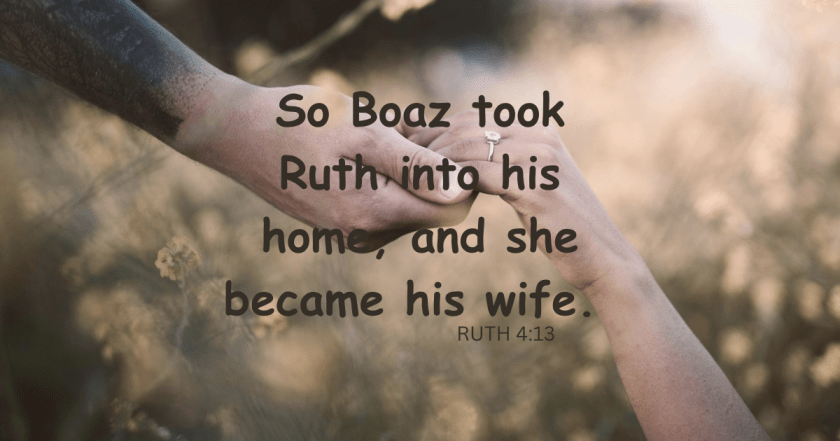
So Boaz took Ruth into his home, and she became his wife. When he slept with her, the Lord enabled her to become pregnant, and she gave birth to a son. (Ruth 4:13) – Cue the water works and celebration, for Naomi (and Ruth) have been redeemed and restored!

Then the women of the town said to Naomi, “Praise the Lord, who has now provided a redeemer for your family! May this child be famous in Israel. 15 May he restore your youth and care for you in your old age. For he is the son of your daughter-in-law who loves you and has been better to you than seven sons!”

Ruth 4:14-15

As the study journal points out, Ruth’s son would be the grandfather of King David of Israel. And fourteen generations after him, Jesus Christ would be born of the same lineage. ~ for even more details on the beautiful plan of God in and through the story of Ruth and the glorious arrival of Jesus, “in whom we have redemption through His blood, the forgiveness of sins, according to the riches of His grace5“, click here.

Reflection and Application
  • Why do we need a Redeemer?
  • What was the name of Ruth and Boaz’s son, and how does he play a part in the life of Jesus, our Redeemer?
The More We Know

Would you like to know more about Jesus, My Redeemer?