A Handwritten Note From Paul
The following is the final page of the LGG, Christ Is All I Need Journal. It is sweet evidence of Paul’s sincere love and concern for these believers in Colossae whom he had not even met. It is evidence of a bond that believers experience within the church body – even when they haven’t formally met – to pray for and share needs with one another. I took particular delight in this, as it is in some form an example for us as we meet day after day, through these online written formats.
May this encourage each of us to be devoted to praying for and encouraging one another daily. May we be purposeful in our participation, allowing God to knit us together, whether near or far apart, that we might be strengthened in our faith, hope, and love in the Lord.💜
A personal note from Me
Will you especially join me in praying for the Love God Greatly Ministry and the team of women behind the scenes💙 ~ This study and the others that we have done come about from the hard work and faithful stewardship of women devoted to prayer and studying the Scripture, with the intended purpose of reaching other women with the Gospel message and encouraging us to grow in our faith. It also comes from the painstaking work of the many translators who make it possible for women around the world who would otherwise have no hope of participating in these invaluable studies.
Be part of the story…
We’re so glad you are here! Our story is about what God can do through a team of women, each using their gifts for a common purpose. Did you know that more than 61% of women globally don’t have access to Bible study materials or a Bible study community? We are here to meet that urgent need, and we’d like to invite you to be a part of the story…
More than Bible study tools… we are a community
Our desire is to help EVERY WOMAN in EVERY NATION have access to God’s Word in THEIR LANGUAGE. To accomplish this goal, Love God Greatly has developed a network of trained translators, who help us translate all our Bible studies into 40+ languages (view languages). As a result, we have been able to establish hundreds of Bible study communities globally, and our Bible study tools have now reached 100+ of the countries of the world!
We publish 6-7 Bible studies annually as either topical or book-based journals, which are available for purchase on Amazon. The funds from each Bible study journal purchase go right back into the LGG ministry, allowing us to train and equip our translators as they build communities.
Week 6 / Day 5
Friday / Finish the Work
Read: Colossians 4:7-18; 1 Peter 4:7-11 SOAP: Colossians 4:17-18
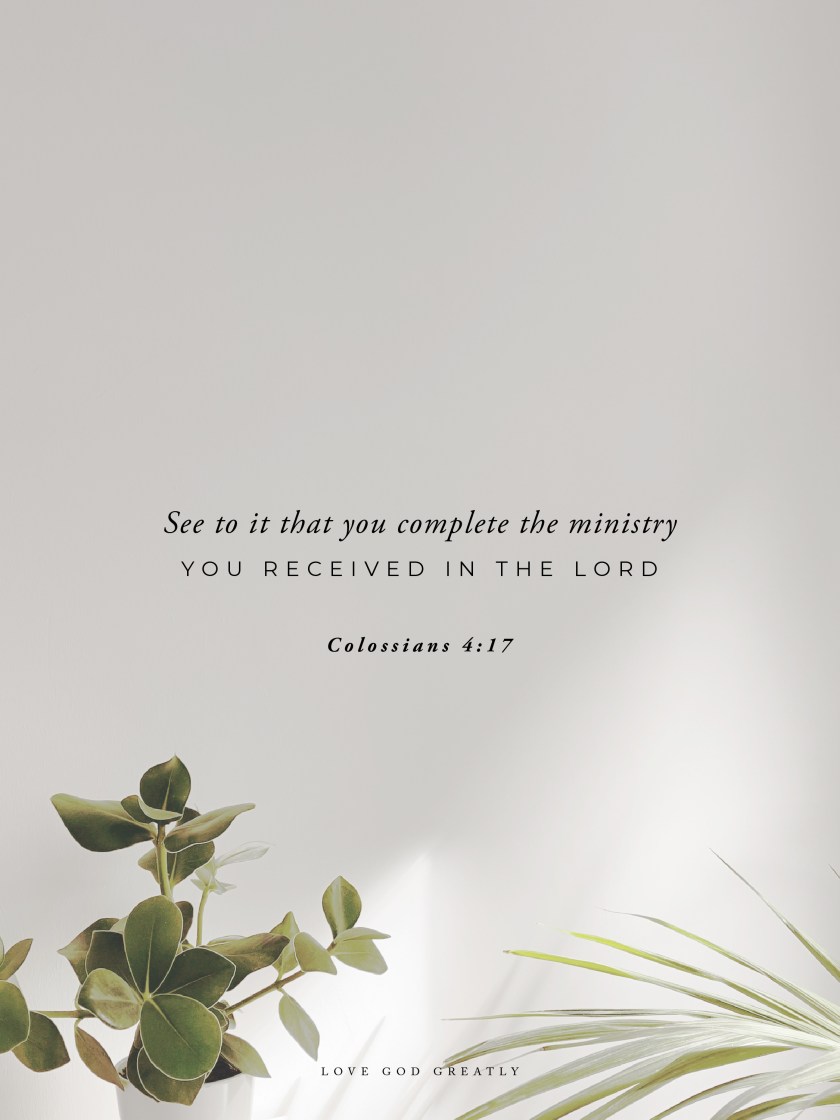
And tell Archippus, “See to it that you complete the ministry you received in the Lord.” I, Paul, write this greeting by my own hand. Remember my chains. Grace be with you. – Colossians 4:17-18
Paul ends his letter to the Colossian believers with some personal notes and greetings. One of the people he mentions is Archippus, whom Paul cared about enough to tell the whole church to encourage him to complete the ministry he had received.
God has given each of us some special work to do. And we need to be reminded to keep going in that ministry, to get back to it if we have quit, and to complete it if we feel like giving up. Do you know what God is calling you to do? Have you left your work unfinished? Sometimes we get tired, distracted, or discouraged, and we leave our God-given ministry in order to find something easier. But God says to us, “Don’t quit. Finish the work.”
As in all of his letters, Paul ends by saying, “Grace be with you.” Grace, or God’s unmerited favor, has come to us in His Son, Jesus Christ. Paul has taught us that being a Christian is about sharing the very life of Jesus, being called to join in the eternal purposes of God, and having all His limitless resources available to us.
As we live to complete the work we have been called to, let’s look to Jesus. He has loved and redeemed us. He has nailed all our sins to the cross, and He has raised us to new life. By our faith in Him, we have been made gloriously rich. He is enough.
Let’s continue to be faithful in our God-given ministry. Let’s join Paul when he says: “I also labor, struggling according to his power that powerfully works in me” (Colossians 1:29).
Dear Heavenly Father, please help me to finish the work you have called me to do. I praise you for your gracious gift that is salvation and life in Jesus. Amen.