10 “If you are faithful in little things, you will be faithful in large ones. But if you are dishonest in little things, you won’t be honest with greater responsibilities. NLT
Observation:
A glimpse of Joseph
Today’s passage from Genesis gives us a sneak peak at Joseph, whom we will continue to learn from in the coming weeks. Some of the things from today’s reading may be helpful to remember in future passages. While some speculate that Joseph was more loved than his brothers because he was the son of Rachel, the truth is that Joseph was loved more than all of his brothers because he born to Jacob in his old age, Genesis 37:3. As you can imagine, this caused problems with the brothers, as jealousy and hatred arose, fueled not only by the obvious display of Jacob’s love for Joseph, Genesis 37:3, but made worse by the dreams Joseph shared with them that seemed to be prophecies that he would one day rule over them. It also didn’t help that he gave a bad report to his father on how the brothers were caring for the sheep, Genesis 37:2. Scripture makes it clear that the brothers hated Joseph, leaves no doubt that the hate was fueled by jealousy, and clearly reveals that the hate destroyed relationships, Genesis 37:4, 8, 11.
Today’s Focus Verse
Today’s verse, Luke 16:10, is short and to the point. Basically it can be a stand-alone statement, “if you are faithful in a little you will be faithful in much and if you are dishonest in a little you will be dishonest in much”. However, there is much to be learned from it and the verses that surround it that make it much more than a general statement.
Learn more about the parable of the ‘unjust steward’, found in Luke 6:1-13, from Gotquestions.org
We should be a faithful steward, not unfaithful. Being faithful with our ‘earthly’ wealth or things entrusted to us here will bear witness to what kind of stewards we will be with the responsibilities and treasures that God will entrust to us in His Kingdom.
Prayer: Response to God’s Word
Father, help us to be faithful stewards here so that we may be found even better stewards with the responsibilities and treasures of Your Kingdom. This to Your glory both on earth and in heaven. – Amen!
Your Turn:
Over what areas has God given you responsibility?
How can you be faithful in the small things in you life?
How can you be faithful in the big thing God has given you?
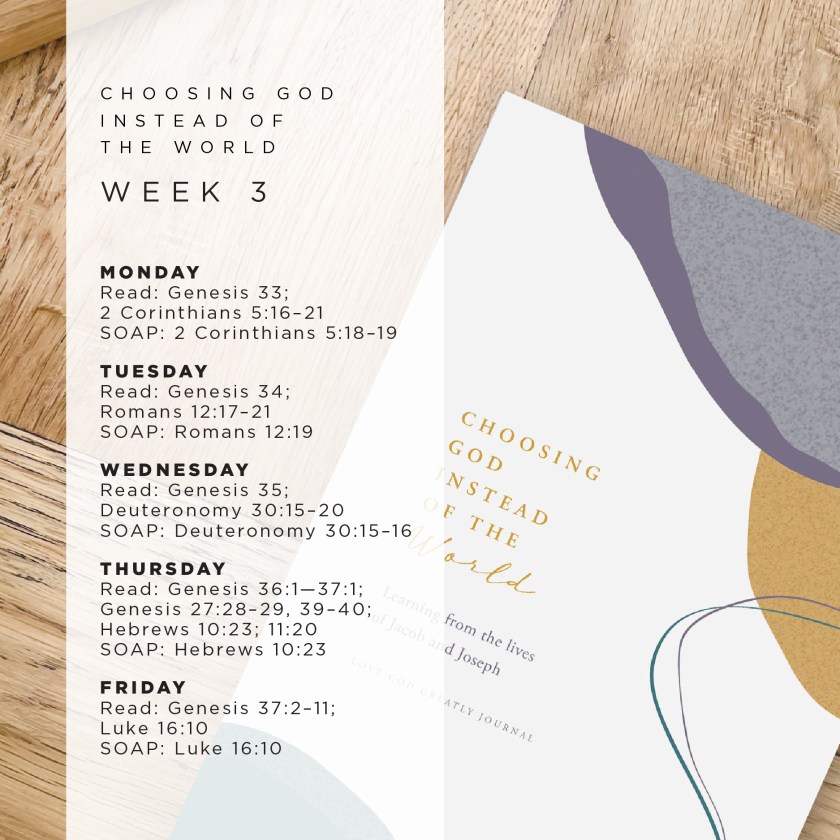
Scripture Reading: Genesis 35 and Deuteronomy 30:16-20 (SOAP: Deuteronomy 30:15-16)
15 “Now listen! Today I am giving you a choice between life and death, between prosperity and disaster. 16 For I command you this day to love the Lord your God and to keep his commands, decrees, and regulations by walking in his ways. If you do this, you will live and multiply, and the Lord your God will bless you and the land you are about to enter and occupy. Deuteronomy 30:15-16 NLT
Observation:
In our Deuteronomy passage we hear Moses encouraging the Israelites. Were we to listen to the whole “farewell speech” we would hear him reminding the people of all God had done for them and of what He had promised to do for them. Here in this section – what we hear is the reminder that God has set a choice before them – and what He expects their choice to be. They can choose life and prosperity or death and disaster. This makes me think of Jesus’ words to the Pharisees in John 10:10, when He told them He had come that the sheep, [believers] might have a rich and satisfying life, but the thief [the ruler of this world] comes to steal, and kill, and destroy – that certainly sounds like death and disaster to me. It also reminds me of Paul’s declaration, in Romans 6:23, that the wages of sin is death but the gift of God is eternal life in Christ Jesus our Lord! Seems to me that while Moses was making a specific speech to the Israelites in Deuteronomy, God, through Christ has made the same offer available to the world today. We can choose the wages of our sins – or – His gracious and merciful gift of eternal life. To put it another way – we can choose Him [God] or the world.
Application: How then should we Live?
Life or death? Prosperity or disaster? God instead of the world? The answer to all of these questions seems crystal clear – doesn’t it? Yet so many have chosen option ‘b’ to each of the questions – even as believers who have chosen life over death by placing our faith in Jesus – we still find it difficult at times to choose option ‘a’ as the answer to the second and third questions. We choose ‘life’ through faith in Christ but then choose the world instead of His ways more often than not. In doing so we forego the prosperous and blessed life and relationship with God that Christ came to give, John 10:10. This kind of living comes with a warning from Matthew’s Gospel, where he recorded the Lord saying, “I never knew you”.
21 “Not everyone who says to me, ‘Lord, Lord,’ will enter the kingdom of heaven, but the one who does the will of my Father who is in heaven.22 On that day many will say to me, ‘Lord, Lord, did we not prophesy in your name, and cast out demons in your name, and do many mighty works in your name?’ 23 And then will I declare to them, ‘I never knew you; depart from me, you workers of lawlessness.’
One other note on this application and the “fire-insured Christian”, a believer with one of his/her feet in heaven and the other running after the world. The verses we find just prior to 21-23 seem to provide another good reminder not to treat salvation like an insurance policy. For rest assured, The Lord will be the one to judge whether or not your ‘policy’ is creditable or not.
So, every healthy tree bears good fruit, but the diseased tree bears bad fruit. 18 A healthy tree cannot bear bad fruit, nor can a diseased tree bear good fruit. 19 Every tree that does not bear good fruit is cut down and thrown into the fire. 20 Thus you will recognize them by their fruits.
Matthew 7:17-20 ESV
How then should we live if we want to bear fruit? Since I love a list when it comes to ‘how tos’ and ‘to dos’, let’s make a list so we can see how we are doing …
We should love the Lord our God with all of our heart, mind, soul, and strength. (Mark 12:29-31)
We should walk in His ways, keep His commandments, statutes, and ordinances If you’re wondering what Moses meant by the words, according to gotquestions.org they are all Hebrew words referring to commands from God to be obeyed by God’s people regardless of the situation you are in.
We should be enjoying His blessings of life and provision (property, in the case of the Israelites)
Prayer: My Response to God’s Word
Oh LORD, my God – You are to be loved, imitated and obey. Help me to live this way – so that I might find favor in Your eyes and know Your blessing – In Jesus’ name – Amen and Amen!
Your Turn:
What’s your prayer response?
How will you choose to follow God today?
What temptations are you feeling?
What is pulling you away from God and toward the things of the world?
19 Dear friends, never take revenge. Leave that to the righteous anger of God. For the Scriptures say, “I will take revenge; I will pay them back,” says the Lord. Romans 12:19 NLT
Observation:
The Genesis Saga
The story in chapter thirty-four turns unexpectedly grim. If you don’t mind a spoiler alert keep reading, but if you haven’t read the story yet stop and read it … You may remember at last count there are eleven brothers and at least one daughter, Dinah, the daughter of Leah. Today’s story begins with her being sexually assaulted while she was meeting the other young women of the land. It is written that the man, Shechem, who assaulted her fell in love with her and wanted to marry her. When Dinah’s brothers learned of the assault they were angry. Their emotions were fueled by righteous indignation and shame. When Shechem’s father approached Jacob and the brothers about marrying Dinah, the brothers “answered deceitfully” and their deceitful plan led to a massacre of Shechem, his father, and every male in the city, by Simeon and Levi – the sons of Leah. They plundered everything in the city including the children and wives. Jacob’s sons did not consider the consequences for themselves or the family – they thought only of what had happened to their sister and their anger took control of them. Revenge comes with a great and terrible price for all involved.
Revenge comes with a great and terrible price for all involved.
Me-From the Inside-out
Our Focus Passage:
This part of Jacob’s story and especially the actions of Simeon and Levi are a perfect segue to our focus passage. The brothers certainly could have benefited from Paul’s instructions to “not repay evil for evil: consider what is good for all people … to live peaceably with all people so far as it depends on you.” Paul goes on to quote a verse from Deuteronomy, “Do not avenge yourselves – but give place to God’s wrath, for it is written, ‘Vengeance is mine, I will repay,’ says the LORD.”
Application: How then should we Live?
As followers of Christ, the obvious answer as to how we should live in light of this passage is to not repay evil for evil and to trust that God will take care of the situation. This isn’t easy, in fact it is one of the most difficult callings on a believer – ranking right up there with turn the other cheek (Matt 5:39) and forgive seven times seventy (Matt 18:22). It requires getting rid of anger and malice, being self-controlled rather than emotionally controlled. It requires not leaning on our own understandings that convince us how wrong the situation is and taking it upon ourselves to make it right. Simply put, it requires trusting God will take care of the situation the way He deems best and in His perfect timing. We would also do well to remember that anything we do or say to right the wrong will only bring more problems and heartache. Retaliation of any kind, from swords drawn for a massacre or fingers on a keyboard typing hard and hurtful words to strike back, is wrong and we must resist. Before you say, it’s impossible not to retaliate in some situations – consider 2 Peter 1:3-4 … “God has given us everything we need for a godly life through our knowledge of Him who called us by His own glory and goodness. Through these He has given us His great and precious promises so that we might participate in the divine nature having escaped the corruption of of the world caused by evil desires.” The question is – will we choose God’s way instead of the world’s way?
Prayer: Response to God’s Word
Father, I confess it is so difficult to not retaliate when my loved ones are hurt by others – So thank You for this reminder from Your Word – that even when our anger is justified, You want us to let You handle it. Help us to remember to lean on You and Your strength to resist the urge to pay back evil for evil; and please cause us to consider not just our anger but how Your name and the lives of others will be affected by our actions. In Jesus Name – thank You that you have given us everything we need to choose Your way instead of the world’s – Amen!
Your Turn:
Do you believe God will bring about justice?
In what areas is it difficult for you to wait on and trust in God’s justice?
18 And all of this is a gift from God, who brought us back to himself through Christ. And God has given us this task of reconciling people to him. 19 For God was in Christ, reconciling the world to himself, no longer counting people’s sins against them. And he gave us this wonderful message of reconciliation. 2 Corinthians 5:18-19 NLT
Observation:
Reunited: A glimpse at Jacob and Esau
After twenty plus years and all of the fear and planning Jacob and Esau are finally reunited and reconciled to one another. No longer was there a fear of death or present anger over the other’s past deceit or threat of death. While the scene reveals more of Jacob’s careful, or what I like to call – “just in case” planning, it also reveals a beautiful reunion and open reconciliation.
New Testament Reconciliation
As our focus verse points out – without the love of God and the sacrifice of Jesus we would have every reason to live in fear of death like Jacob did. We were God’s enemies according to Paul, in Romans 5:10, when we were restored/reconciled by the death of Jesus.
10 For since our friendship with God was restored by the death of his Son while we were still his enemies, we will certainly be saved through the life of his Son.
Romans 5;10 NLT
Like Jacob, we have been given a new identity in Christ, the old character is gone and the new is here. It is a gift of God. Not only has He clothed us with the righteousness of Christ, no longer counting our sins against us, but the title ‘Ambassadors for Christ’. He has given us a purpose, a ministry of making His Son known so that others can be reconciled to Him. – Til the whole world knows.
Application: How then should we Live?
We have been made ambassadors for Christ and should live faithfully proclaiming the Good News of the Gospel and what Christ has done for us. We should also faithfully praise Him for laying our sins on Christ and not counting them against us.
Prayer: Response to God’s Word
Father, as Jacob and Esau were reconciled to one another – so You have even more so – reconciled us to You – through Christ. And You no longer count our sins against us because we are new creations in Christ, the old has passed and the new has come! Glory to Your Holy Name!
Your Turn: Personal Reflections
Is there a relationship in your life that needs reconciliation?
What is God prompting you to do as you wait for His perfect timing for the reconciliation?
In the third week of our study, we will watch as Jacob and Esau finally meet up again, there will be trouble over his daughter Dinah, and both tragedy and blessing on his return to Bethel. We will meet Esau’s descendants and be given our first glimpse of Joseph as a teenager. All events will continue to strengthen our understanding and resolve of choosing God instead of the world.
Don’t forget our memory verse from John 14:15
This week’s focus verse(s) will come from day one’s reading of Colossians 3:1-3. A passage that we will see the need for in Jacob’s life story as well as our own.
15 “Now listen! Today I am giving you a choice between life and death, between prosperity and disaster. 16 For I command you this day to love the Lord your God and to keep his commands, decrees, and regulations by walking in his ways. If you do this, you will live and multiply, and the Lord your God will bless you and the land you are about to enter and occupy.
Deuteronomy 30:15-16 NLT
This Week’s Challenge from the team at Love God Greatly:
Reflect on the events of Jacob’s life you have read so far. Would God have delivered Jacob without Jacob’s shrewd behavior? Did Jacob miss out on the blessing of God’s blessing of God through self-reliance and deception? How did Jacob’s children display the same tendencies of self-reliance and deception?
Week 2, Day 5 of Choosing God Instead of the World, A Love God Greatly Study
“Your name will no longer be Jacob,” the man told him. “From now on you will be called Israel, because you have fought with God and with men and have won.” Genesis 32:28 NLT
observations:
I had so many things jotted down as I read through this passage but when I went to some commentaries to see if anyone explained the blessing – there was no real explanation to the blessing, only that he received it. What I did find though – I knew I had to share … so, foregoing my normal observations I offer you this wonderful insight to today’s passage. I promise you it is worth the time – and I encourage you to slow down and soak it in and even read it again…I did and it was so much better the second and third time. It has much to offer and it has in itself been a blessing to be – I pray the same for you. –
What is the meaning of Jacob wrestling with God? by Gotquestions.org
“To best answer this question, it helps to know, among other things, that deep-seated family hostilities characterized Jacob’s life. He was a determined man; some would consider him to be ruthless. He was a con artist, a liar, and a manipulator. In fact, the name Jacob not only means “deceiver,” but more literally it means “grabber.”
To know Jacob’s story is to know his life was one of never-ending struggles. Though God promised Jacob that through him would come not only a great nation, but a whole company of nations, he was a man full of fears and anxieties. At a pivotal point in his life, Jacob was about to meet his brother, Esau, who had vowed to kill him. All Jacob’s struggles and fears were about to be realized. Sick of his father-in-law’s treatment, Jacob had fled Laban, only to encounter his embittered brother, Esau. Anxious for his very life, Jacob concocted a bribe and sent a caravan of gifts along with his women and children across the River Jabbok in hopes of pacifying his brother. Now physically exhausted, alone in the desert wilderness, facing sure death, he was divested of all his worldly possessions. In fact, he was powerless to control his fate. He collapsed into a deep sleep on the banks of the Jabbok River. With his father-in-law behind him and Esau before him, he was too spent to struggle any longer.
Fleeing his family history had been bad enough; wrestling with God Himself was a different matter altogether.
But only then did his real struggle begin. Fleeing his family history had been bad enough; wrestling with God Himself was a different matter altogether. That night an angelic stranger visited Jacob. They wrestled throughout the night until daybreak, at which point the stranger crippled Jacob with a blow to his hip that disabled him with a limp for the rest of his life. It was then that Jacob realized what had happened: “I saw God face to face, and yet my life was spared” (Genesis 32:30). In the process, Jacob the deceiver received a new name, Israel, which likely means: “He struggles with God.” However, what is most important occurred at the conclusion of that struggle. We read that God “blessed him there” (Genesis 32:29).
In Western culture and even in our churches, we celebrate wealth, power, strength, confidence, prestige, and victory. We despise and fear weakness, failure, and doubt. Though we know that a measure of vulnerability, fear, discouragement, and depression come with normal lives, we tend to view these as signs of failure or even a lack of faith. However, we also know that in real life, naïve optimism and the glowing accolades of glamour and success are a recipe for discontent and despair. Sooner or later, the cold, hard realism of life catches up with most of us. The story of Jacob pulls us back to reality.
Frederick Buechner, one the most read authors by Christian audiences, characterizes Jacob’s divine encounter at the Jabbok River as the “magnificent defeat of the human soul at the hands of God.” It’s in Jacob’s story we can easily recognize our own elements of struggle: fears, darkness, loneliness, vulnerabilities, empty feelings of powerlessness, exhaustion, and relentless pain.
Even the apostle Paul experienced similar discouragements and fears: “We were harassed at every turn—conflicts on the outside, fears within” (2 Corinthians 7:5). But, in truth, God does not want to leave us with our trials, our fears, our battles in life. What we come to learn in our conflicts of life is that God proffers us a corresponding divine gift. It is through Him that we can receive the power of conversion and transformation, the gift of not only surrender, but freedom, and the gifts of endurance, faith, and courage.”
Application: How Then Should I Live?
We must stay in the battle. No matter how hard or how long it takes, we must not give up until we have received God’s blessing.
Me – from the inside-out
The writers from gotquestions.org go on to share the perfect answer to our question of how we should live in light of the message – “In the end, Jacob does what we all must do. He confronts his failures, his weaknesses, his sins, all the things that are hurting him . . . and faces God. Jacob wrestled with God all night. It was an exhausting struggle that left him crippled. It was only after he came to grips with God and ceased his struggling, realizing that he could not go on without Him, that he received God’s blessing (Genesis 32:28-29).
What we learn from this remarkable incident in the life of Jacob is that our lives are never meant to be easy. This is especially true when we take it upon ourselves to wrestle with God and His will for our lives. We also learn that as Christians, despite our trials and tribulations, our strivings in this life are never devoid of God’s presence, and His blessing inevitably follows the struggle, which can sometimes be messy and chaotic. Real growth experiences always involve struggle and pain.
Jacob’s wrestling with God at the Jabbok that dark night reminds us of this truth: though we may fight God and His will for us, in truth, God is so very good. As believers in Christ, we may well struggle with Him through the loneliness of night, but by daybreak His blessing will come.
Prayer: Response to God’s WoRD
Father, thank You for the reminder that we are New Creations with new characters- We are changed from the Inside-out! Thank You for giving me Your name and for helping and teaching me to prevail.
One last interesting nugget of truth… In reference to our focus verse (28)
Jacob’s new name was “Israel”, which means “God Fights”. “The new name is meant, at least in part, to describe Jacob’s new character, – based on the fact that God fights for him and, more importantly, for the nation that will one day come from him.”
Bibleref.com Genesis 32:28
Your Turn:
In what ways has God transformed your identity?
In what ways have you seen God strip you of self-reliance?
When I am afraid,I trust in you.4 In God—I boast in his promise—in God I trust; I am not afraid.What can mere men do to me? Psalm 56:3-4 NET
Observation
In today’s Genesis’ passage we see Jacob prepare to meet Esau by setting a plan into motion that involved inviting Esau to meet him. Then Jacob prayed with bold honesty, telling God of his fears, remembering God’s faithfulness, goodness, and promises. He lays his fears before Him and they were overcome by all that He knew to be true about His God, the God of Abraham and Isaac. He stood on the promises of God and made plans to meet Esau rather than run – this is evidence of His trust.
We see the same thing in our focus passage from Psalm 56:3-4. Like Jacob the Psalmist had or was experiencing fear but chose to trust in God and to boast in the promises of God rather than cave to the fear what man could do to him. To boast in something is to put our confidence in it – to stand on what we know to be true of a person, place, or thing. What a great lesson to put into action in our relationship with God and the world.
*Note on Jacob’s strategies… Some would say that Jacob didn’t really trust because he came up with a plan even after praying for God to rescue him. Perhaps this is a right interpretation, however, I believe praying in faith and believing God is going to do something does not negate the need to act or plan wisely. After all, don’t forget it was God who let Mordecai hear the plot of Haman to kill the Jews, just as it appeared to be God who allowed Jacob to hear the conversation of his brothers-in-law – revealing how Laban felt, and for that matter Rebekah hearing Esau’s plan to kill Jacob. In all of these circumstances the people acting wisely upon what they heard represented their trust in God.
Application: How Then Should I Live?
When we are afraid we are to put our trust in God. In this way we will not fear the circumstances of our life nor the men who make us afraid. The key to this, throughout all of Scripture is standing on the promises of God. When the fears of the world assault us we must choose to trust in God.
Prayer: Response to God’s Word
Father, thank You for teaching me to trust in You more than I fear what man can do. Thank You for Jacob’s example of remembering Your promises – and speaking them out loud to You. He boasted in You and counted himself as unworthy of Your faithful love. Thank You for showing me You incomparable greatness, not only in Your Word and the history of Your people but in my life. – Oh how I praise You – Amen!
It’s Your Turn
In what areas of your life do you often ask God for deliverance but then create your own rescue plans?
What would happen if you waited on God for deliverance?
Do you believe waiting on God for deliverance means do nothing more than have faith?
 Me From the Inside Out