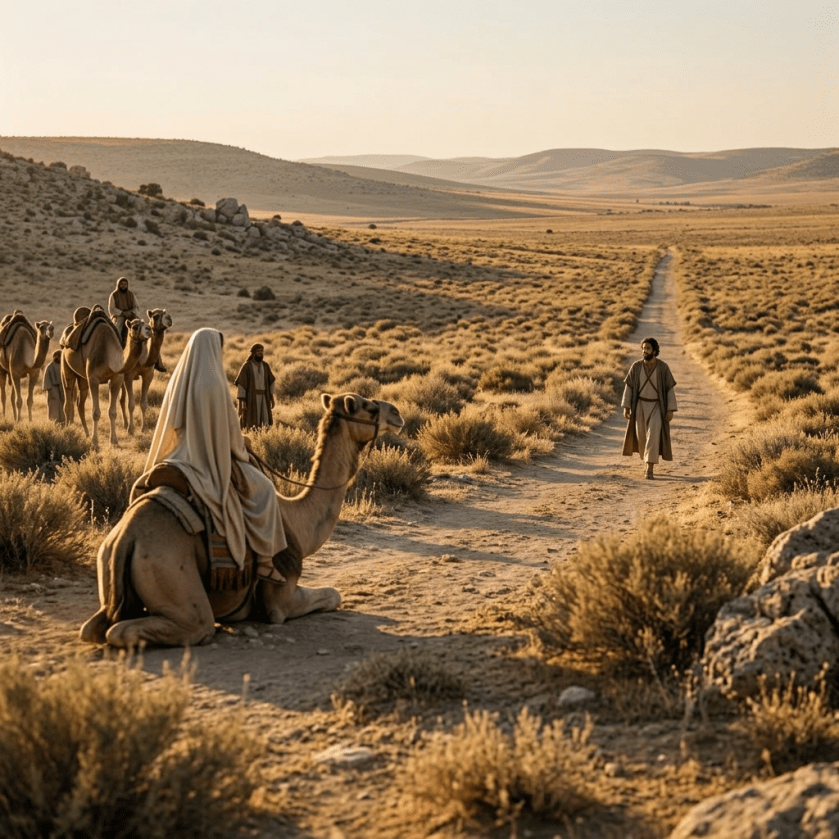
Who doesn’t love a sweet ‘love’ story? Whether it’s in a book, a movie, or you see it unfold in real life ~ there is just something about that first moment when they meet. Isaac undoubtedly knows why Eliezar had been gone. Perhaps he had been anxious about who he would bring for him or if he would find anyone suitable for him. Either way, when Eliezar and Rebekah arrived, Isaac was out meditating in the field. As for Rebekah, she knew she would soon meet the man God had planned for her to marry. Having left her family so willingly, I can only imagine she was ready, if not eager, to become his wife. When she looked up and saw a man walking in the field to meet them, Eliezar told her it was Isaac. She covered herself with a veil, indicating that she was not only “fair to look at” or “very beautiful,” as one translation says (Genesis 24:16 but also modest. Commentator David Guzik explains that the veil “signified chastity, modesty, and submission.” He goes on to say, “This was how Rebekah wanted to meet the man she would marry.”
Rebekah also serves as an example that God can hand-pick our spouse for us, and then unite us with them through His divine providence 💜 She, volume 4/p56
Eliezar tells Isaac all that had transpired on his journey and the outcome of his mission; undoubtedly, he included the way God had made it clear that Rebekah was the one. Then Scripture gives us a bird’s-eye view of their “wedding,” telling us that “Isaac took Rebekah into his mother Sarah’s tent, and she became his wife … and the best part is the confirmation that it was truly a love story, as we are told that Isaac loved her” (Genesis 24:65-67). God richly rewarded/blessed Isaac, not only did he love her, but she was someone who brought him comfort.
Reflection and Application
How does this encourage you to follow the Lord’s direction?
In our previous post, we traveled with Eliezer, Abraham’s oldest servant, to Abraham’s homeland1. Abraham, desperate and determined that Isaac not marry a Canaanite woman, had sent Eliezar on a mission to find a wife for his son Isaac from among his own people. Eliezar took the mission seriously, promising Abraham that he would do just as he had requested. He not only relied on Abraham’s promise that God would send an angel to help him, but when he arrived in the land of Abraham’s brother, he prayed a very specific prayer. We read it on yesterday’s journey and again today as he recounts both the prayer and God’s answer to Rebekah’s family.
And I came this day unto the well, and said, O Lord God of my master Abraham, if now thou do prosper my way which I go:
43 Behold, I stand by the well of water; and it shall come to pass, that when the virgin cometh forth to draw water, and I say to her, Give me, I pray thee, a little water of thy pitcher to drink;
44 And she say to me, Both drink thou, and I will also draw for thy camels: let the same be the woman whom the Lord hath appointed out for my master’s son.
45 And before I had done speaking in mine heart, behold, Rebekah came forth with her pitcher on her shoulder; and she went down unto the well, and drew water: and I said unto her, Let me drink, I pray thee.
46 And she made haste, and let down her pitcher from her shoulder, and said, Drink, and I will give thy camels drink also: so I drank, and she made the camels drink also.
47 And I asked her, and said, Whose daughter art thou? And she said, the daughter of Bethuel, Nahor’s son, whom Milcah bare unto him: and I put the earring upon her face, and the bracelets upon her hands.
48 And I bowed down my head, and worshipped the Lord, and blessed the Lord God of my master Abraham, which had led me in the right way to take my master’s brother’s daughter unto his son. ~Genesis 24:42-48
Friends, praying ‘specifically’ not only builds a more personal relationship with God, but it also enriches our prayer life with trust, confident boldness, and joy. Last year, when I was going weekly to the knee doctor and my knees were really bad, I would pray for God to save me a parking place. I would remind Him of my pain and how the parking lot gets so crowded, and the steps in the parking garage were excruciatingly painful. I would pray the day before, the morning of, and on the way to the appointment. I learned to watch for His answers and would often laugh and rejoice as I pulled up and saw an empty spot or a car backing out of a spot very close to the door. A smile would line my lips, and praise would flow forth.2
This is similar to how Eliezar responded when God so specifically answered his prayer: from
Rebekah showing up at the well
to her offering not only Eliezar a drink
but also his camels, just as Eliezar had prayed
and then finding out she was the daughter of Abraham’s brother
26 The man bowed low and worshiped the Lord. 27 Praise the Lord, the God of my master, Abraham,’ he said. ‘The Lord has shown unfailing love and faithfulness to my master, for he has led me straight to my master’s relatives.’
Genesis 24:26-27
~God’s attentiveness to the prayers of His people is evident and a tremendous encouragement, not to mention a source of motivation for us to pray specifically. Even more so would it have been an encouragement to Rebekah and her family when they sat together hearing Eliezar recount his prayer concerning a wife for Isaac, his master’s son, and how Rebekah (not knowing his prayer) had responded just as he had prayed. Now she had listened as Eliezar retold why and how God had led the servant to them, and why he believed Rebekah was the one God intended for Isaac. So, when given the choice to stay or go, she said, “I will go”. As we will see in the remainder of our Journey, “Rebekah has many blessings awaiting her because of her willingness to do what the Lord had purposed for her”.3
Rebekah also serves as an example of what can be found when we are willing to go where the Lord directs.
~She, Volume 4/p54
Reflection and Application
Where is the Lord directing you to go?
Then I heard the Lord asking, “Whom should I send as a messenger to this people? Who will go for us?” I said, “Here I am. Send me.” ~ Isa. 6:8
The Rest of the Story…Make no mistake, there were days when there was no parking place available within a comfortable walking distance – yet, even on those days, I learned to praise Him. I learned to trust that there was a reason for the answer I had received (yes, “no, not today” is an answer). On one of those days, as I was wondering why He had me park in the garage, nowhere near the elevator ~ I was blessed on the walk out of the garage to be able to share the love of Jesus with a young man who was having a rough day. My guess is I will never see that young man again, but I fully believe that God parked me in the garage for the purpose of talking to that man. I continued to pray for the close spots, but I trusted and watched each time for His better purpose, and praised Him just the same. ↩︎
adapted from She, delighting in the examples of women in the Bible, volume 4, pp. 71 and 72
Today’s Scripture Reading: Genesis 21:1-8, 22:2, and 23:1-2; Hebrews 10:23 and 11:11-12,
“Let us hold fast the profession of our faith without wavering; (for He is faithful that promised;)”. Hebrews 10:23
“…she judged him faithful who had promised.” Hebrews 11:11
The Promise
We’ve been journeying through Sarah’s story for five days now, so the question begs to be revisited: What was the promise, and who made it?” We find the answer in Genesis 17, where God is conversing with Abraham, expounding on a promise He had made in chapter 12, in which He called Abraham to leave his father’s family and his country for a new country. He wasn’t even told where he was going, only that he was to leave and go to a land God would show him. Abraham, along with Sarah, his wife, answered the call.1 The call God made came with a promise2, which is where today’s journey picks up:
God Gives More Details
6 I will make you very fruitful; I will make nations of you, and kings will come from you. …15 Then God said to Abraham, “Regarding Sarai, your wife—her name will no longer be Sarai. From now on, her name will be Sarah. 16 And I will bless her and give you a son from her! Yes, I will bless her richly, and she will become the mother of many nations. Kings of nations will be among her descendants. 17 Then Abraham bowed down to the ground, but he laughed to himself in disbelief. “How could I become a father at the age of 100?” he thought. “And how can Sarah have a baby when she is ninety years old?” 18 So Abraham said to God, “May Ishmael live under your special blessing!” 19 But God replied, “No—Sarah, your wife, will give birth to a son for you. You will name him Isaac, and I will confirm my covenant with him and his descendants as an everlasting covenant. 20 As for Ishmael, I will bless him also, just as you have asked. I will make him extremely fruitful and multiply his descendants. He will become the father of twelve princes, and I will make him a great nation. 21 But my covenant will be confirmed with Isaac, who will be born to you and Sarah about this time next year.” Genesis 17:6, 15-21
Sarah, who was barren, had laughed when she heard God tell her husband, Abraham, that through his descendants a great nation would arise, but God still placed her in the ‘Hall of Faith’ that we find in Hebrews chapter 11. Yes, “Even though she laughed, even though she was afraid, she is still known for her faith.3” Actually, Scripture tells us that it was through her faiththat Sarah received strength to conceive and give birth to a child, even though she was past the age of childbearing. The author of Hebrews writes, “…she judged God faithful who had promised;” and because she did, God opened her womb, and she gave birth to a son, just as God had promised, and his name was Isaac. From Isaac, the seed of Abraham and Sarah, came descendants as numerous as the stars in the sky and the sand on the seashore. Again, this was just as God had promised (Genesis 22:17).
When I look at my daughters (Annie, who battled childhood cancer but now is married with two children of her own…and Abi, who was born with crippled feet but now runs on two healthy feet, I rarely see them without also seeing God’s mercy, love, and grace, and His hand of miraculous power. So I can only imagine that every time Sarah looked at Isaac, she would have remembered God’s faithfulness to keep His promises.
Friends, remembering God’s faithfulness is not only an encouragement to stay faithful to Him, but it is the weapon we need to use in our warfare with the enemy, when fears rise up to surround us, or sorrows keep us inward focused, or following God’s call on our lives seems too risky… It is why we are told throughout Scripture to keep our eyes on Him. Or, paraphrasing one commentary, recalling God’s guidance through the wilderness and His protection from enemies, anchors our current trust in His past faithfulness.
Consider the words of the Psalmists and others in the Bible:
Psalm 77:11-12: “I will remember the deeds of the LORD; yes, I will remember your wonders of old. I will ponder all your work, and meditate on your mighty deeds.”
1 Chronicles 16:12: “Remember the wondrous works that he has done, his miracles and the judgments he uttered.”
Psalm 103:2: “Bless the LORD, O my soul, and forget not all his benefits.”
And may we never forget the words of the Apostle Paul which guide us to a peace that passes all understanding:
Philippians 4:8-9: “And now, dear brothers and sisters, one final thing. Fix your thoughts on what is true, and honorable, and right, and pure, and lovely, and admirable. Think about things that are excellent and worthy of praise. 9 Keep putting into practice all you learned and received from me—everything you heard from me and saw me doing. Then the God of peace will be with you.”
SARAH SERVES AS AN EXAMPLE THAT GOD IS FAITHFUL
Father, help us continually remember Your faithfulness, and, in response, may we remain faithful to You, even in the seasons of waiting we face along the way. Thank you for the beautiful examples you have given us throughout Your Word. ~ Strengthen us, as the author of Hebrews wrote, to hold fast to the profession of our faith without wavering, knowing that You who promised are faithful. ~Amen and Amen
Reflection and Application
Why do you think Sarah was included in the Hall of Faith in Hebrews chapter 11? ~ I believe it is because her faith points us to The One in whom we are to place our faith – The One Who is the most faithful Promise Keeper we will ever know. ~What are your thoughts?
The More We Know
Paul Weighs In
Even when there was no reason for hope, Abraham kept hoping—believing that he would become the father of many nations. For God had said to him, “That’s how many descendants you will have!” And Abraham’s faith did not weaken, even though, at about 100 years of age, he figured his body was as good as dead—and so was Sarah’s womb. Abraham never wavered in believing God’s promise. In fact, his faith grew stronger, and in this he brought glory to God. He was fully convinced that God is able to do whatever he promises. And because of Abraham’s faith, God counted him as righteous. Romans 4:18-22 NLT
The Lord had said to Abram, “Leave your native country, your relatives, and your father’s family, and go to the land that I will show you. Genesis 12:1 ↩︎
“2 I will make you into a great nation. I will bless you and make you famous, and you will be a blessing to others. 3 I will bless those who bless you and curse those who treat you with contempt. All the families on earth will be blessed through you.” ↩︎
She, delighting in the examples of women in the Bible, volume 4, pp. 71↩︎
adapted from She, delighting in the examples of the women of the Bible, Volume 4/pp69-70
Today’s Scripture: Genesis 18 and 21:1-3; Isaiah 64:4; Psalm 56:3
For since the world began, no ear has heard and no eye has seen a God like you, who works for those who wait for him! Isaiah 64:4 NLT
Genesis 18 is filled with details that are helpful, if not necessary, for understanding and truly appreciating this part of Sarah’s story and the blessing that she and Abraham experience.
Bibleref.com sums the first portion up like this: “The events of Genesis 18 take place not long after God’s visit with Abraham in chapter 17. However, this visit from the Lord is quite different. It’s not clear, at first, if Abraham even recognizes the three men who appear outside of his tent as the Lord and two angels in human form. In either case, Abraham runs to show them deep respect and hospitality. He tells Sarah to bake them bread and has a young calf slaughtered for them to eat as they rest in the heat of the day.
Once the meal is over, the Lord fully reveals Himself, in a conversation He conducts with Sarah through Abraham while she remains hidden and listening in the tent. First, the Lord asks where Sarah is and then reveals to her what He had said to Abraham in the previous chapter: by this time a year from now, she will have a son.“
Part of the story hasn’t changed, Sarah is still barren and advanced in age…but now she knows her waiting is about to come to an end. As we read in Genesis 21:1, the Lord keeps His promise – regardless of how difficult a thing may seem in human eyes or understanding – nothing is too difficult for our God! We are not told exactly how the promise comes about – only that “the Lord visited Sarah as He had said, and the Lord did unto Sara as He had spoken. For Sarah conceived, and bare Abraham a son in his old age, at the set time of which God had spoken to him. And Abraham called the name of his son that was born unto him, whom Sarah bare to him, Isaac” (Genesis 21:1-3).
How would you say you wait? Patiently…Impatiently…Excitedly…Nervously…Doubtfully…? I would venture to say that for most – if not all of us, it depends on what we’re waiting for. My four-year-old grandson is working on waiting patiently to have our attention if we are already talking to someone else. Sometimes he waits really well, but if what he wants to say is super exciting or important, the wait becomes nearly impossible for him. Sometimes I wait well, but waiting on a doctor’s report or a job position may turn into waiting nervously, waiting on my smoothie at McDonald’s when I’m running late for work may stir up the impatient side of me, and the eight years of waiting on a baby ran the gamut from waiting patiently to impatiently to excitedly and nervously and eventually doubtfully. The fact of the matter is, waiting is generally not easy, so when you’re talking 25 years of waiting, which is approximately the amount of time that Sarah and Abraham waited on the promise God had made concerning Sarah having a child, specifically a male child who would be the first seed of the great nation God had told Abraham he would one day father.
As we have seen through our journey with Sarah, it wasn’t an easy wait for her, and subsequently not an easy wait for Abraham either. However, “the longer she waited, the more of a miracle her situation became.” Why? Because the older she and Abraham became, the possibility of conceiving and giving birth, humanly speaking, diminished. Sarah understood this, which is why she laughed at the very thought of it being true – it is also why God’s rebuttal to her laughter was a question: “Is anything too hard for the LORD?” (Genesis 18:14). It was a pointed reminder then and remains so today, that nothing, absolutely nothing, can limit or hold back the power of God.
“Waiting sometimes causes us to fear the unknown. However, there is no need to fear when we trust in Him.”
She, study guide, volume 4, p70
Friends, I don’t know if waiting ever becomes easy. However, I have found that the more life has required me to wait, the more God has strengthened/deepened my roots of faith. Waiting teaches us to depend on God, to look to Him for help when we grow weary and/impatient, to confess our weariness and trust Him even in the midst of humanly impossible situations that raise shadows of doubts. … Yes, as today’s journal entry states: “Waiting sometimes causes us to fear the unknown. However, there is no need to fear when we trust in Him.1“
The More We Know
The Wait for Isaac
Genesis 12 begins the story of Abraham (then called Abram) and his barren wife, Sarah. Verses 1 through 4 record God’s first words to him about a homeland for his offspring. Even though the gift of a son is not directly mentioned in this first communication, God hinted at His plan for Abram. Abraham was 75 years old when he first received the promise, and Genesis 21:5 tells us he was 100 years old when Isaac was born. Sarah was 90. So Abraham and Sarah waited 25 years for the fulfillment of God’s promise.
In those 25 years between the time that Abram was promised a son and the birth of Isaac, Abram and Sarah had certain ideas of how they might facilitate the keeping of the promise. One was that Abraham’s steward, Eliezer, would become the heir of Abraham’s household (Genesis 15:2–3). Another idea was that Abraham could have an heir through a son conceived by Sarah’s slave, Hagar (Genesis 16:1–2). In both cases, God rejected those men as Abraham’s heirs, pointing Abraham and Sarah to a literal, miraculous fulfillment of the promise.2
adapted from the study She, delighting in the examples of the women of the Bible, volume 4/pp63-64
Today’s Scripture Reading: Genesis 17, Genesis 18:11-12, and Jeremiah 32:17
Ah Lord GOD! behold, thou hast made the heaven and the earth by the great power and stretched out arm, and there is nothing too hard for thee:”
This is our third day’s journey with Sarah, or Sarai, as she has been known until now, when God gives her a new identity. It wasn’t a drastic change, simply one letter, but when God changed someone’s name, there was always a reason. According to gotquestions.org, “it was usually to establish a new identity. In this case, Sarai, meaning ‘my princess‘, became ‘Sarah’, meaning ‘mother of nations‘ (Genesis 17:15).”
It has been said before, but the ‘elephant’ (as they say) is still in the room: Whether she is called Sarai or Sarah she is still not pregnant and there is literally no human hope or physical possibilities of her being able to conceive. So, why would God grace her with this new identity? “Motherof nations? Seriously? She wasn’t even the mother of one. She had been barren for decades and well beyond childbearing age. This was more than Sarah’s opinion it was physical reality for we read in Genesis 18:11-12 that Abraham and Sarah were both very old by this time, and Sarah was long past the age of having children. 12 So she laughed silently to herself and said, “How could a worn-out woman like me enjoy such pleasure, especially when my master—my husband—is also so old?” It would take a miracle for Sarah to give Abraham a son now ~ and that’s exactly what happened. As just “one year later, God’s supernatural restoration of Sarah’s womb and Abraham’s vitality resulted in the promised son, Isaac. Abraham and Sarah’s moment of too much inward focus and not enough focus on God’s ability to do the impossible was a brief interlude to an otherwise trusting and believing relationship, as the author of Hebrews attests.1“
By faith Sarah herself received power to conceive, even when she was past the age, since she considered him faithful who had promised. Therefore from one man, and him as good as dead, were born descendants as many as the stars of heaven and as many as the innumerable grains of sand by the seashore.
Sarah is an example that nothing is too hard for the Lord our God.
Friends, let’s remember ~ if God can provide the impossible for Sarah, He is also able to so for us💜
Reflection and Application
How have you doubted God before? Is there something you are doubting Him about now?
The More We Know
What’s in a Name?
God changed Abram’s name, meaning “high father,” to “Abraham,” meaning “father of a multitude” (Genesis 17:5). At the same time, God changed Abraham’s wife’s name from “Sarai,” meaning “my princess,” to “Sarah,” meaning “mother of nations” (Genesis 17:15). This name change took place when God gave Abraham the covenant of circumcision. God also reaffirmed His promise to give Abraham a son, specifically through Sarah, and told him to name his son Isaac, meaning “laughter.” Abraham had another son, Ishmael, through Sarah’s handmaiden, Hagar. But God’s promise to bless the nations through Abraham was to be fulfilled through Isaac’s line, from whom Jesus descended (Matthew 1:1–17; Luke 3:23–38). Isaac was the father of Jacob, who became “Israel.” His twelve sons formed the twelve tribes of Israel—the Jews. The physical descendants of Abraham and Sarah formed many nations. In a spiritual sense, their descendants are even more numerous. Galatians 3:29 says that all who belong to Jesus Christ—Jew, Gentile, male, or female—are “Abraham’s offspring, heirs according to promise.”