Posted in Bible study, Devotion, From the Insideout, Journey Through The Word, LGG Study, prayer, Quiet Time, The Fruit of the Spirit

The Most Humble Man

inspired by the LGG Study, The Fruit of the Spirit / w5d1

Today’s Roadmap for our Journey

  • Read Numbers 12:1-8
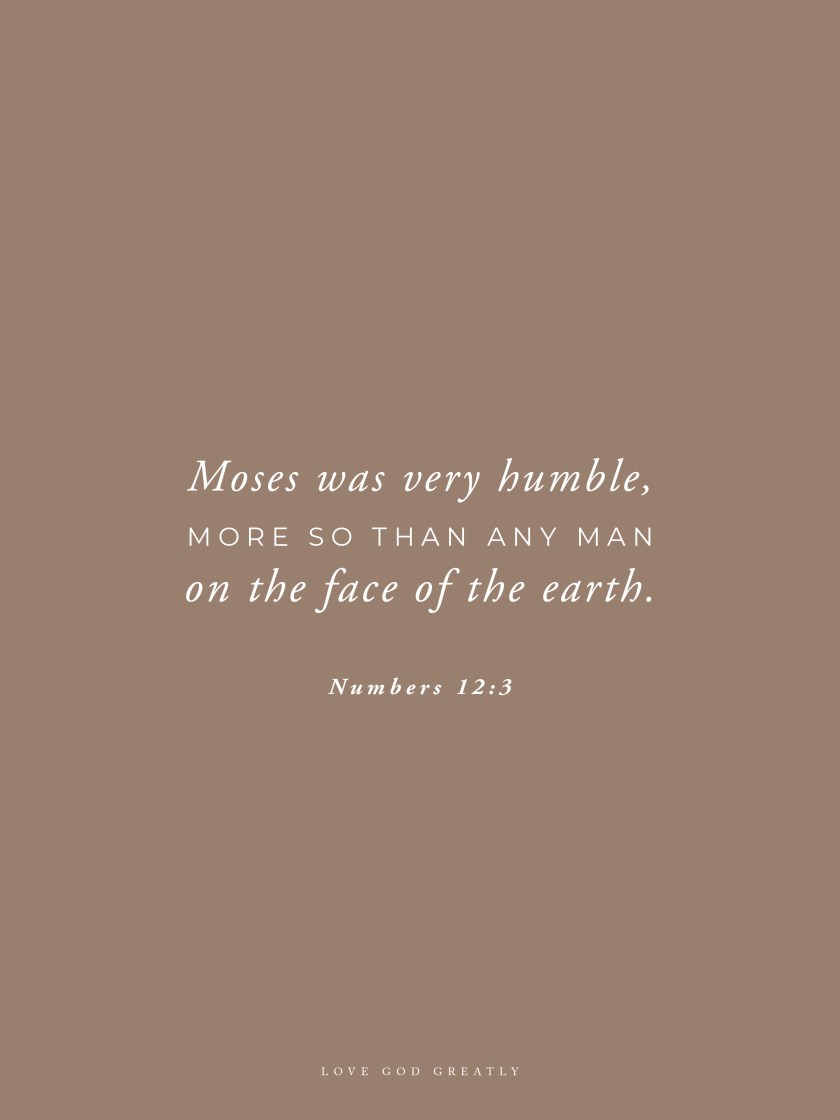
  • SOAP: Numbers 12:3

Reflections and Application of Today’s Passage

Miriam and Aaron, Moses’ sister and brother, became disgruntled with Moses. They gave the reason for their attitude as his marriage to an Ethiopian woman. However, their words reveal that their real problem was pride and/or jealousy because they had not been recognized as equal leaders with Moses over Israel.

So they said, “Has the LORD indeed spoken only through Moses? Has He not spoken through us also?” And the Lord heard it. ~Numbers 12:21

Of course the Lord heard what they said. God hears everything we say; nothing escapes His attention. Whispered, spoken, shouted, or written on a piece of paper and thrown into the fire, our words and thoughts are always known. God not only heard what they said; He knew the intent of their hearts and called them out on it. When I read this verse, “The LORD spoke immediately to Moses, Aaron, and Miriam: ‘The three of you come to the tent of meeting.’…” I jotted down in the margin of my journal that they were called to the principal’s office. He made it very clear to Miriam and Aaron that their words were offensive. He put them in their place by reminding them that Moses had not elevated himself as leader over Israel, but that He (the LORD) had chosen and called Moses to serve Him in this capacity. Friends, while this is not our focus today, it is a good reminder that we are not to speak against those whom God has called to teach and preach. In fact, we should be afraid to do so; as God points out, they were not only disrespecting Moses, but they were disrespecting God and His authority.

As David Guzik points out in his commentary on this passage, Aaron and Miriam had the pride problem, not Moses, who is identified here as very humble, more so than any man on the face of the earth.2 And this is the focus of today’s journey. Because not every reader uses the same translation of Scripture, note that commentators also define the word for humble as gentle, or meek. These terms, as we understand them, are evident in Moses’ life, particularly in his response to Miriam and Aaron’s words. As today’s journal entry points out, “Moses doesn’t defend himself. He doesn’t retaliate. He doesn’t use his position to put them in their place. He simply remains quiet and lets God handle it.” Some may see this as weakness, but, as the journal also points out, it is a sign of “a strong, settled, surrendered gentleness that doesn’t need to prove itself.” In other words, it is a gentleness (humbleness) that comes from knowing God. More specifically, in reference to our focus on the ‘fruit of the Spirit’, it grows in us through the presence of God’s Spirit. Because His Spirit lives in us, we are no longer to be filled with anger or bitterness; we are not to use harsh words, repay evil for evil, or seek vengeance on those who hurt us. Instead we are to love others as Christ has loved us and we are to forgive as God forgives.3

Just like Jesus, Moses could not deliver when he lived in the palaces of glory. He had to come down off the throne, away from the palace and into a humble place before he could deliver his people.

EnduringWord.com / Exodus 2:124

David Guzik points out in his commentary on Exodus 2:12 that Moses, like Jesus, had to step away from the palace. Jesus left His place of glory with the Father to take on the life of a servant. Moses left his palace as a prince of Egypt to “identify with the people of Israel rather than his Egyptian prestige and opportunity.5”

By faith Moses, when he became of age, refused to be called the son of Pharaoh’s daughter, choosing rather to suffer affliction with the people of God than to enjoy the passing pleasures of sin, esteeming the reproach of Christ greater riches than the treasures in Egypt; for he looked to the reward. (Hebrews 11:24-26)

Friends, I leave you with this question and answer application from today’sjournal entry: “So what does this look like in your everyday life? It looks like pausing before you respond when someone pushes your buttons. It looks like choosing a soft answer in a tense conversation. It looks like letting God defend you instead of scrambling to defend yourself. And sweet friend, the world around you is desperately in need of women who are gentle, just like Moses.”6

Response of Prayer

Father, thank You for Your Word, which is living and active, sharper than any double-edged sword, penetrating every part of us and judging the thoughts and attitudes of our hearts. Thank You for being a loving Father who makes us aware of our sins so we can turn from them and walk in a way that pleases You. Guard our hearts, O God, from pride and jealousy. Help us to live a humble life in the fashion of Moses. Help us, like Jesus and Moses, to step away from those places and things that keep us from reaching the people You have called/sent us to reach for You. Help us to get rid of all anger, rage, bitterness, and harsh words. Guard us from defending ourselves, and instead let You defend us. ~ In the Name of Jesus ~ Amen

Response of Worship

The More We Know

In full disclosure, I am not completely familiar with or affiliated with this speaker and/or his church. I simply found this segment a compelling addition to today’s journey and an interesting insight into Moses and how he dealt with Miriam and Aaron’s complaint.

  1. Enduring Word/David Guzik commentary on Numbers 12 ↩︎
  2. “More than all men who were on the face of the earth: This statement, if written by Moses, seems to be self-contradictory. It doesn’t seem to be proper for a very humble man to write of his great humility. Though Moses wrote the first five books of the Bible, it is likely that someone added this comment after the death of Moses – perhaps Joshua, who would have known Moses well.” (David Guzik/Enduring Word/Numbers 12:3,b ↩︎
  3. Ephesians 4:31 and Colossians 3:12-17 ↩︎
  4. Moses left his palace and became the servant of the Most High God ↩︎
  5. https://enduringword.com/bible-commentary/exodus-2/ ↩︎
  6. The Fruit of the Spirit – Digital Love God Greatly Study, p145 ↩︎
Posted in Bible study, Devotion, For Such A Time As This, From the Insideout, Journey Through The Word, LGG Study, Prayer Starters, Quiet Time

Truth & Love Go Hand-in-Hand

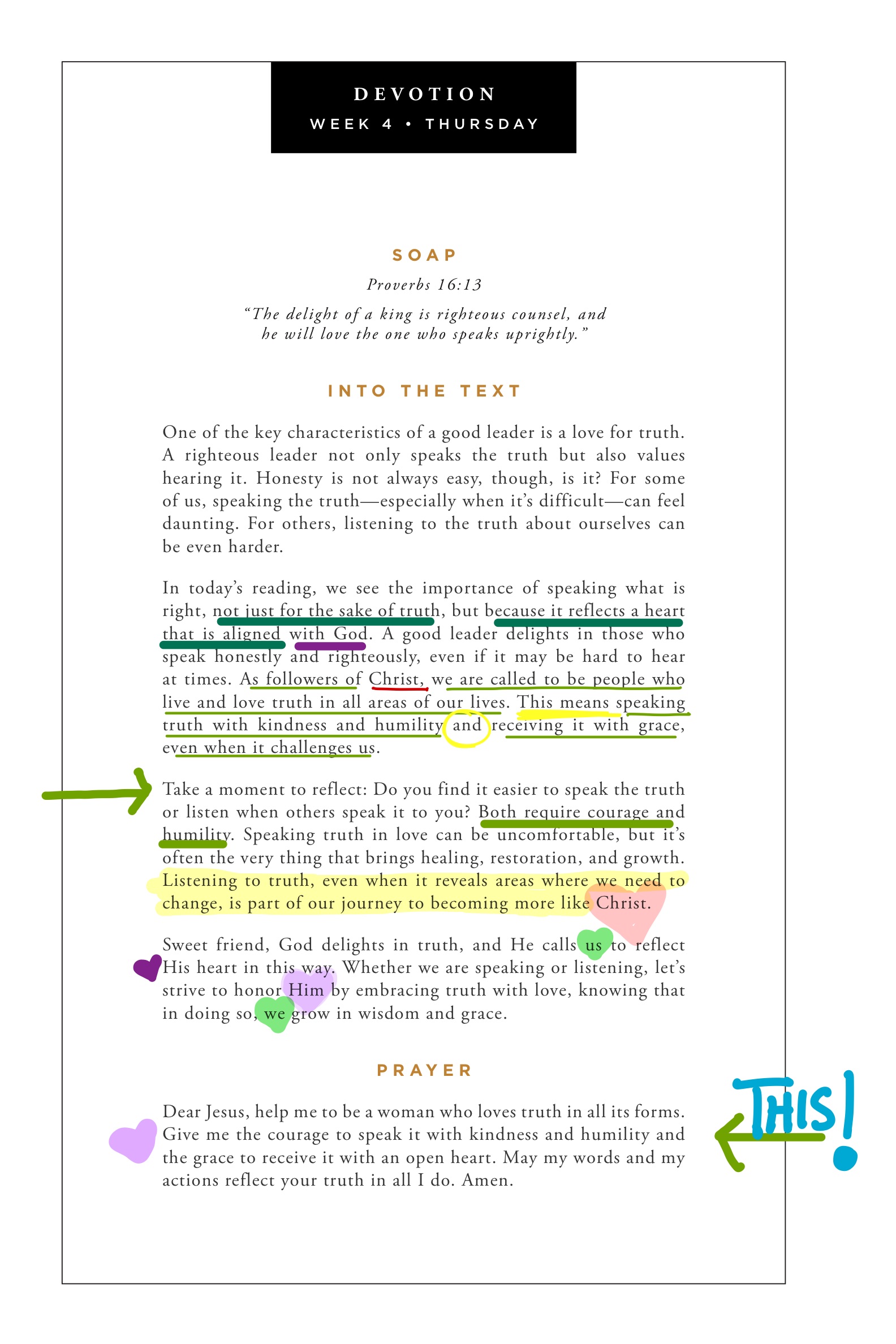
From the Journal of: For Such A Time As This / w4d4, p131

READ: Esther 6:1-6 and SOAP: Proverbs 16:13

The king is pleased with words from righteous lips;
    he loves those who speak honestly.

Proverbs 16:13
The More We Know

Posted in Bible study, From the Insideout, Journey Through The Word, Quiet Time

Be A Good Listener

Modeling the love of Christ through Good Listening [Part 2] – if you missed part 1 please click here –

Yesterday – we focused on listening to God first. This is the first step because it helps us to develop and sharpen our spiritual maturity – which is a necessary component of being a good listener. It is also vital to not just listen to others but we must learn the art of listening and practice it faithfully. Which, as we will see today, requires humility. I also believe it is helpful to have a faithful friend – or two – that will hold you accountable to this end. I can tell you the skill most definitely takes humility and can be frustrating and humbling – but God is faithful and able to accomplish in us what He has purposed for us to do. Me – from the inside-out🦋

2. We Must Humble Ourselves to Be Good Listeners

Listening requires humility. Have you ever found yourself formulating an answer while the other person is still speaking? Pride causes us to focus on what we want to say instead of really listening to the words of others. Listening shows respect for others’ thoughts and ideas, affirming them as valuable in God’s eyes. We are to clothe ourselves in humility (1 Peter 5:5), and following the example of Jesus, consider others as more important than ourselves (Philippians 2:3).

In the book of Proverbs, we find the terms “word” or “words” more than forty times; “mouth” appears at least forty-six times. This shows us that how we use our words is a key indicator of whether we are wise or foolish, righteous, or unrighteous. Pride speaks in haste; humility shows restraint. The wise man will humble himself to hear and increase in learning (Proverbs 1:5).

Proverbs 18:2, 13 – “A fool does not delight in understanding, but only in revealing his own mind. … He who gives an answer before he hears, it is folly and shame to him.”

Proverbs 17:27-28 – “He who restrains his words has knowledge, and he who has a cool spirit is a man of understanding. Even a fool, when he keeps silent, is considered wise; when he closes his lips, he is considered prudent.”

Proverbs 29:20 – “Do you see a man who is hasty in his words? There is more hope for a fool than for him.”

Make it personal:

I don’t know about you but this step is quite difficult for me. Seriously, I am totally the person that formulates an answer while the other person is still speaking. – Sad thing is, I thought this was a good thing – YIKES!

  • What about you? Is this step easy or difficult for you?
Posted in Bible study, From the Insideout, Journey Through The Word, LGG Study, Living In Community, Not Made to Be Alone, Quiet Time

Christ Our Example

Today’s Reading: Philippians 2:1-11 / SOAP: Philippians 2:3-5

Understanding Humility

In any given dictionary you will find humility defined something like this … “a modest or low view of one’s own importance, humbleness, the state of being humble.” Most of these definitions are followed by a sentence structured around the word in the hope of making the definition clear. However, there is no clearer illustration of humility than what we are reading in Philippians today, specifically verses 3-8. What I love about Paul – is he doesn’t simply instruct the believers to let their actions be motivated by or in humility but he includes the perfect illustration in the person and actions of Christ.

Instead of being motivated by selfish ambition or vanity, each of you should, in humility, be moved to treat one another as more important than yourself. Each of you should be concerned not only about your own interests, but about the interest of others as well. you should have the same attitude toward one another that Christ Jesus had., who though He existed in the form of God did not regard equality with God as something to be grasped, but emptied himself by taking on the form of a slave, by looking like other men, and by sharing in human nature. He humbled himself, by becoming obedient to the point of death – even death on a cross!

Philippians 2:3-8

Christ-like Humility

To this day I still remember the first day that I read this passage with any real knowledge or understanding and it still makes the same aww-inspiring impact on me when I read it today. What a beautiful perspective it puts on the love and actions of Jesus Christ on our behalf. From the humble cradle in the animal stall to the garden prayer, and the nails, thorns, and cross Christ was the ‘poster-child’ for humility – and we are called to have that same attitude. His attitude was one that”

  • wasn’t motivated by selfish ambition or vanity but –
  • was – steeped in humility and therefore –
  • even though He was God in the flesh He didn’t demand to be treated like God – but instead
  • He emptied Himself of His rightful authority and took on the form of a servant
    • by looking like other men
    • by sharing in human nature and –
    • humbling Himself and becoming obedient to death on the cross

Putting Away

Thus – if we are going to have the same attitude as Christ, we must practice humility – namely, by putting away any selfish ambitions or vanity. We must treat one another better than we treat ourself. we must be truly concerned about others – for only then is there any hope for our attitude to mirror the servant heart of Christ.

Response to God’s Word

Father, I ask again today for an attitude like that of Christ – a servant’s heart, an obedient spirit that puts Your will above my own or anyone else’s. I know this is Your will for me and for all of Your children. In Jesus’ name and power – and in accordance with Your will – I pray, Amen!

Love God Greatly

Be sure and check-out Wednesday’s blog post from the Love God Greatly team –

Posted in Quiet Time

John 13:1-17

Today’s Scripture: John 13:1-17 (S.O.A.P. John 13:14-15)

Question of the Day: Why do you think Jesus chose to wash the feet of His disciples?

Washing the Disciples’ Feet – Just before the Passover Feast, Jesus knew that his time[a] had come to depart[b] from this world to the Father. Having loved his own who were in the world, he now loved them to the very end.[c] 2 The evening meal[d] was in progress, and the devil had already put into the heart[e] of Judas Iscariot, Simon’s son, that he should betray[f] Jesus.[g] 3 Because Jesus[h] knew that the Father had handed all things over to him,[i] and that he had come from God and was going back to God, 4 he got up from the meal, removed[j] his outer clothes,[k] took a towel and tied it around himself.[l] 5 He poured water into the washbasin and began to wash the disciples’ feet and to dry them with the towel he had wrapped around himself.[m]

Then he came to Simon Peter. Peter[n] said to him, “Lord, are you going to wash[o] my feet?” 7 Jesus replied,[p] “You do not understand[q] what I am doing now, but you will understand[r] after these things.” 8 Peter said to him, “You will never wash my feet!”[s] Jesus replied,[t] “If I do not wash you, you have no share with me.”[u] 9 Simon Peter said to him, “Lord, wash[v] not only my feet, but also my hands and my head!” 10 Jesus replied,[w] “The one who has bathed needs only to wash his feet,[x] but is completely[y] clean.[z] And you disciples[aa] are clean, but not every one of you.” 11 (For Jesus[ab] knew the one who was going to betray him. For this reason he said, “Not every one of you is[ac] clean.”)[ad]

 So when Jesus[ae] had washed their feet and put his outer clothing back on, he took his place at the table[af] again and said to them, “Do you understand[ag] what I have done for you? 13 You call me ‘Teacher’ and ‘Lord,’ and do so correctly,[ah] for that is what I am.[ai] 14 If I then, your Lord and Teacher, have washed your feet, you too ought to wash one another’s feet. 15 For I have given you an example[aj]—you should do just as I have done for you. 16 I tell you the solemn truth,[ak] the slave[al] is not greater than his master, nor is the one who is sent as a messenger[am] greater than the one who sent him. 17 If you understand[an] these things, you will be blessed if you do them.