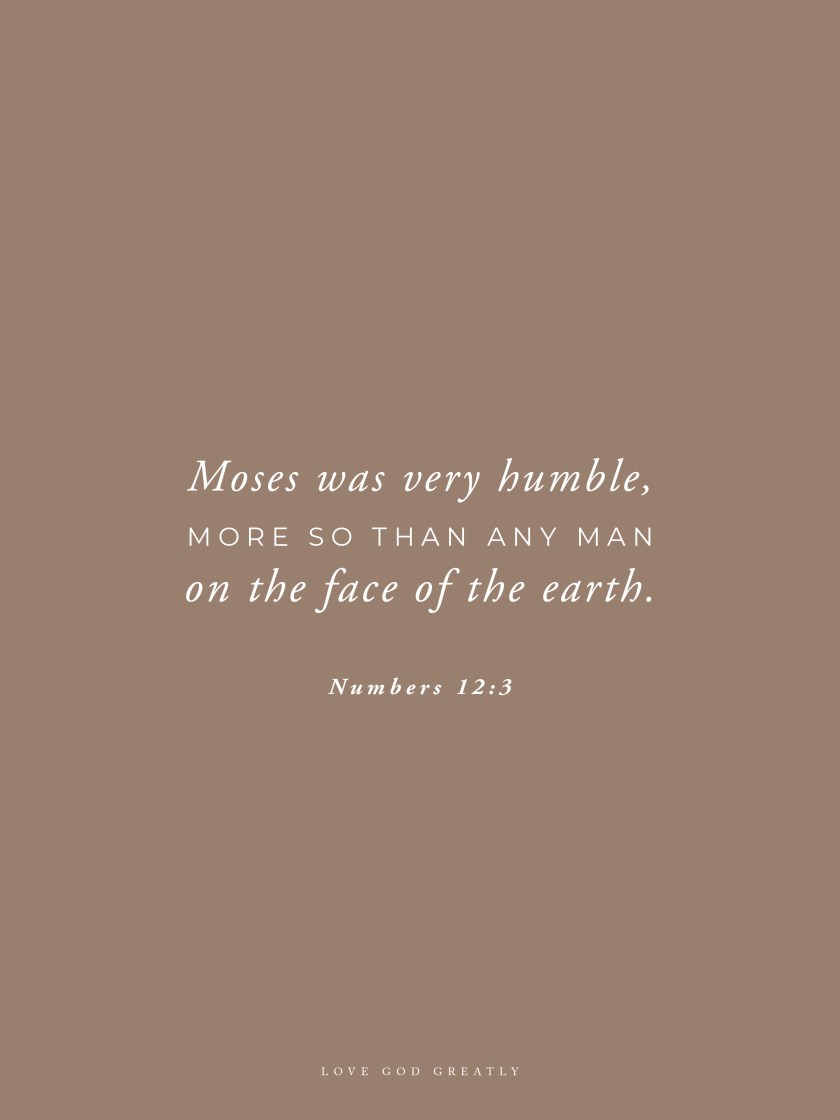
inspired by the LGG Study, The Fruit of the Spirit / w5d1
Today’s Roadmap for our Journey
- Read Numbers 12:1-8
- SOAP: Numbers 12:3
Reflections and Application of Today’s Passage
Miriam and Aaron, Moses’ sister and brother, became disgruntled with Moses. They gave the reason for their attitude as his marriage to an Ethiopian woman. However, their words reveal that their real problem was pride and/or jealousy because they had not been recognized as equal leaders with Moses over Israel.
So they said, “Has the LORD indeed spoken only through Moses? Has He not spoken through us also?” And the Lord heard it. ~Numbers 12:21
Of course the Lord heard what they said. God hears everything we say; nothing escapes His attention. Whispered, spoken, shouted, or written on a piece of paper and thrown into the fire, our words and thoughts are always known. God not only heard what they said; He knew the intent of their hearts and called them out on it. When I read this verse, “The LORD spoke immediately to Moses, Aaron, and Miriam: ‘The three of you come to the tent of meeting.’…” I jotted down in the margin of my journal that they were called to the principal’s office. He made it very clear to Miriam and Aaron that their words were offensive. He put them in their place by reminding them that Moses had not elevated himself as leader over Israel, but that He (the LORD) had chosen and called Moses to serve Him in this capacity. Friends, while this is not our focus today, it is a good reminder that we are not to speak against those whom God has called to teach and preach. In fact, we should be afraid to do so; as God points out, they were not only disrespecting Moses, but they were disrespecting God and His authority.
As David Guzik points out in his commentary on this passage, Aaron and Miriam had the pride problem, not Moses, who is identified here as very humble, more so than any man on the face of the earth.2 And this is the focus of today’s journey. Because not every reader uses the same translation of Scripture, note that commentators also define the word for humble as gentle, or meek. These terms, as we understand them, are evident in Moses’ life, particularly in his response to Miriam and Aaron’s words. As today’s journal entry points out, “Moses doesn’t defend himself. He doesn’t retaliate. He doesn’t use his position to put them in their place. He simply remains quiet and lets God handle it.” Some may see this as weakness, but, as the journal also points out, it is a sign of “a strong, settled, surrendered gentleness that doesn’t need to prove itself.” In other words, it is a gentleness (humbleness) that comes from knowing God. More specifically, in reference to our focus on the ‘fruit of the Spirit’, it grows in us through the presence of God’s Spirit. Because His Spirit lives in us, we are no longer to be filled with anger or bitterness; we are not to use harsh words, repay evil for evil, or seek vengeance on those who hurt us. Instead we are to love others as Christ has loved us and we are to forgive as God forgives.3
Just like Jesus, Moses could not deliver when he lived in the palaces of glory. He had to come down off the throne, away from the palace and into a humble place before he could deliver his people.
EnduringWord.com / Exodus 2:124
David Guzik points out in his commentary on Exodus 2:12 that Moses, like Jesus, had to step away from the palace. Jesus left His place of glory with the Father to take on the life of a servant. Moses left his palace as a prince of Egypt to “identify with the people of Israel rather than his Egyptian prestige and opportunity.5”
By faith Moses, when he became of age, refused to be called the son of Pharaoh’s daughter, choosing rather to suffer affliction with the people of God than to enjoy the passing pleasures of sin, esteeming the reproach of Christ greater riches than the treasures in Egypt; for he looked to the reward. (Hebrews 11:24-26)
Friends, I leave you with this question and answer application from today’sjournal entry: “So what does this look like in your everyday life? It looks like pausing before you respond when someone pushes your buttons. It looks like choosing a soft answer in a tense conversation. It looks like letting God defend you instead of scrambling to defend yourself. And sweet friend, the world around you is desperately in need of women who are gentle, just like Moses.”6
Response of Prayer
Father, thank You for Your Word, which is living and active, sharper than any double-edged sword, penetrating every part of us and judging the thoughts and attitudes of our hearts. Thank You for being a loving Father who makes us aware of our sins so we can turn from them and walk in a way that pleases You. Guard our hearts, O God, from pride and jealousy. Help us to live a humble life in the fashion of Moses. Help us, like Jesus and Moses, to step away from those places and things that keep us from reaching the people You have called/sent us to reach for You. Help us to get rid of all anger, rage, bitterness, and harsh words. Guard us from defending ourselves, and instead let You defend us. ~ In the Name of Jesus ~ Amen
Response of Worship
The More We Know
In full disclosure, I am not completely familiar with or affiliated with this speaker and/or his church. I simply found this segment a compelling addition to today’s journey and an interesting insight into Moses and how he dealt with Miriam and Aaron’s complaint.
- Enduring Word/David Guzik commentary on Numbers 12 ↩︎
- “More than all men who were on the face of the earth: This statement, if written by Moses, seems to be self-contradictory. It doesn’t seem to be proper for a very humble man to write of his great humility. Though Moses wrote the first five books of the Bible, it is likely that someone added this comment after the death of Moses – perhaps Joshua, who would have known Moses well.” (David Guzik/Enduring Word/Numbers 12:3,b ↩︎
- Ephesians 4:31 and Colossians 3:12-17 ↩︎
- Moses left his palace and became the servant of the Most High God ↩︎
- https://enduringword.com/bible-commentary/exodus-2/ ↩︎
- The Fruit of the Spirit – Digital Love God Greatly Study, p145 ↩︎

