Posted in Bible study, Devotion, From the Insideout, Journey Through The Word, Quiet Time, She, Volume 4

Esther, Part 3

adapted from She, volume 4, Delighting in the Examples of the Women of the Bible, pp 21-22

Today’s Scripture: Esther 3-4

“…and who knoweth whether thou art come to the kingdom for such a time as this?” Esther 4:14b

As has been said many times already, Esther was placed here in this Kingdom at a specific time for a specific purpose. From an exiled Jew, to an orphan girl, to one of hundreds ‘auditioning’ for the role of Queen of Persia, she now has the opportunity to save her people (God’s people) from the murderous plot of Haman.

So far in our journey through Esther, the attention has been on the King’s need for a new queen and Esther’s rise to that position. Today, the story turns its focus to Mordecai, Esther’s relative, who raised her and Haman, King Xerxes’ chief adviser. To understand what happens next, it is vitally important that we understand the connection between the two men.

  • In Esther 3 one of Xerxes’ chief advisers, Haman, is angered that Mordecai will not bow down to him, so he hatches a plot to kill not only Mordecai but all of the Jews. Haman convinces King Xerxes to authorize the extermination; however, it appears that the king does not know the identity of the people that Haman plans to wipe out—only that they are enemies of the state. He trusts Haman to handle the details. In chapter 4 Mordecai informs Esther of the danger the Jews are in and convinces her to intercede with the king. The problem Esther faces is that Xerxes has not called for her for some time and, if she approaches him without being summoned, she risks death. At this point, neither the king nor Haman knows Esther’s nationality or her relationship to Mordecai. Mordecai encourages Esther to take the risk, saying that perhaps she has been made queen “for such a time as this” (Esther 4:14).
  • The Root of the Conflict: Mordecai refused to bow to Haman due to his Jewish convictions, which triggered Haman’s murderous rage. Guzik points out that this conflict mirrors the historical, spiritual enmity between Satan and God’s people. Blue Letter Bible +3
  • Malicious Deception: To convince King Ahasuerus to sign the decree of annihilation, Haman manipulated the king by falsely labeling the Jews as an isolated, disobedient, and dangerous people. 
  • The Sovereignty of God: Guzik reminds readers that even when God’s name is not explicitly mentioned, His redemptive plan remains firm behind the scenes, turning chaotic evil into eventual deliverance. 1

Esther was worried about the request Mordecai had made of her, and rightfully so. To go before the King could mean not just upsetting the King, but there was a great chance she would lose her life. Mordecai is undoubtedly aware of this, yet he still prods her to consider that this might be the very reason God has placed her in the position of Queen. Friends, Mordecai’s instructions and reminder to Esther that she was there for a reason couldn’t have been easy for either of them. Yet, as her parental figure and spiritual mentor, it was the right thing to say, and as fear/concern arose within her, she needed to hear the admonishment and encouragement, to be spurred on, as Paul wrote to the church in the New Testament. Honestly, friends, I cannot help but think that this is our job as believers today. For as brothers and sisters in Christ, we are to encourage one another daily, spurring one another on to love and good works, lifting each other up when we are weak. Likewise, are we not to respond as Esther did, both committing to pray and requesting prayer for issues concerning the body of Christ?

Esther considers his words and takes it upon herself to fast and pray for three days, asking Mordecai to: “Go, gather together all the Jews that are present in Shushan, and fast ye for me, and neither eat nor drink three days, night or day: I also and my maidens will fast likewise; and so will I go in unto the king, which is not according to the law: and if I perish, I perish.” It strikes me that while Esther ‘intimately’ knew the King she wasn’t certain she could trust the him not to kill her; but she both knew and trusted her God. She was concerned, if not scared, for her welfare, yet she did not change her position nor her commitment to what she was called to do.

If you’ve never read the ending of Esther’s beautiful story, I encourage you to make time for that now – and see the unbelievable way that she was used by God to save not only Mordecai and herself but all of God’s people. You will undoubtedly see that Esther is an example not only of God’s sovereign power but also of how He can empower us to do great things for His glory.

Reflection and Application

  • What would have happened to Esther if the king had not held out the golden scepter?
  • Would you be brave enough to risk your life for God’s glory?
  • How can you follow Esther’s example?
  • How can you follow Mordecai’s example?

The More We Know

  1. Blue Letter Bible, Commentary by David Guzik on Esther chapter 3 and 4:14 ↩︎

Posted in Bible study, Devotion, From the Insideout, Journey Through The Word, Quiet Time, She, Volume 4

Esther, Part 2

adapted from She, volume 4 of Delighting in the examples of the Women of the Bible/pp19-20

Today’s Scripture: Esther 1-2 and Psalm 75:6-7

6 For not from the east or from the west and not from the wilderness comes lifting up, 7 but it is God who executes judgment, putting down one and lifting up another. Psalm 75:6-7

The Road to Queenship

So many thoughts go through my mind when I read this portion of the story. Did the women have a choice? Is it something they would have wanted? As young Persian girls had they dreamed about becoming the queen? Surely, as a Jew, Esther would have never entertained the thought – yet here she was on the threshold of that possibility. I can’t help but wonder how she felt. After all, it seems to be the beauty pageant of all beauty pageants (of which I have never been a fan). Secondly, as was the custom of the day/culture, the women were being groomed, trained/coached, and then examined not just for their beauty but also for their appeal to the king and their suitability or likability as the queen. Keep in mind, this wasn’t just a long-weekend spa treatment; it was a yearlong regimen.2 It is also helpful, if not important, to understand, as gotquestions.org explains, “the queen of Persia was not simply the wife of the king. The queenship was an honorary/political position. The king was a polygamist with many wives and concubines in his harem, but the queen was a special wife occupying a favored position.Each of the women would spend a night with the king. After their night together, each woman would be moved to the “other side” of the harem and would never see the king again, unless he called for her.3 Actually, it is said by one commentator that “when the king found the ‘right one,’ He would name her queen, although she would not be his exclusive wife or sexual partner. A woman whom Xerxes never called again would live her life in the harem as a pampered prisoner with no possibility for a real marriage or family of her own. ~ Perhaps it is just because we live in a completely different culture, but I cannot imagine any woman choosing or wanting this life.


15When the turn came for Esther, the daughter of Abihail, the uncle of Mordecai, who had taken her as his own daughter, to go in to the king, she asked for nothing except what Hegai, the king’s eunuch, who had charge of the women, advised. Now, Esther was winning favor in the eyes of all who saw her. 16And when Esther was taken to King Ahasuerus, into his royal palace, in the tenth month, which is the month of Tebeth, in the seventh year of his reign, 17the king loved Esther more than all the women, and she won grace and favor in his sight more than all the virgins, so that he set the royal crown on her head and made her queen instead of Vashti. 

Esther 2:15-17

The Wisdom of a Secret Kept

In regard to Esther’s obedience and respect to Mordecai’s request that she not reveal that she was a Jew, consider this commentary by David Guzik:

Now, Esther had not revealed her family and her people, just as Mordecai had charged her: Some have thought that the book of Esther carries this idea of concealment too far. This book has been criticized because it does not mention the name of God (as neither does the Song of Solomon).

i. Some say that the name of God was left out of the book of Esther because of its use in the festivities surrounding Purim, where people commonly became drunk. One rabbi taught: “A man is obligated to drink on Purim until he is unable to distinguish between ‘Blessed be Mordecai’ and ‘Cursed be Haman.’” Some have wondered if, in that atmosphere, it would be too easy to profane the name of God if it were to be read at such a festival.

ii. Others see the name YHWH hidden in acrostics, based on the initial and final letters of successive words in Esther 1:205:45:13, and 7:7. In some manuscripts, the letters in these words are written a bit larger to give them prominence.

iii. Perhaps also the book of Esther does not contain the name of God because it was written under Persian rule, and for distribution in the Persian Empire.

iv. Most likely, the book of Esther doesn’t have the name of God because it shows how God works behind the scenes; God is always active in Esther, even though it is behind the scenes.

The More We Know

In Esther 2, Xerxes begins to regret his decision to oust the queen, and he decides to find a new queen. The queen of Persia was not simply the wife of the king. The queenship was an honorary/political position. The king was a polygamist with many wives and concubines in his harem, but the queen was a special wife occupying a favored position. A call is sent out throughout the kingdom for all beautiful virgins to be gathered into the harem so that the king could choose a new queen from among them. As a member of the harem, a woman would technically be the property of the king—either a wife or a concubine. Each of the women would spend a night with the king. After their night together, each woman would be moved to the “other side” of the harem and would never see the king again, unless he called for her. When he found the “right one,” Xerxes would name her queen, although she would not be his exclusive wife or sexual partner. A woman whom Xerxes never called again would live her life in the harem as a pampered prisoner with no possibility for a real marriage or family of her own.4

  1. She, Volume 4, Delighting in the Examples of the Women of the Bible ↩︎
  2. 3. (Esther 2:12-14) The method of preparing and presenting the women before the king is established.
    Each young woman’s turn came to go in to King Ahasuerus after she had completed twelve months’ preparation, according to the regulations for the women, for thus were the days of their preparation apportioned: six months with oil of myrrh, and six months with perfumes and preparations for beautifying women. Thus prepared, each young woman went to the king, and she was given whatever she desired to take with her from the women’s quarters to the king’s palace. In the evening she went, and in the morning she returned to the second house of the women, to the custody of Shaashgaz, the king’s eunuch who kept the concubines. She would not go in to the king again unless the king delighted in her and called for her by name.
    a. After she had completed twelve months’ preparation: Persia was one of many countries famous for its aromatic perfumes and ancient customs for the preparations of brides, including ritualistic baths, plucking of the eyebrows, the painting of hands and feet with henna, facial make-up, and applications of a beautifying paste all over the body, meant to lighten the color of the skin and to remove spots and blemishes.
    i. One reason for the lengthy time of preparation was to tell if the women had been pregnant upon coming into the harem, so that the king would not be charged with fathering a child that was not his.
    ii. Matthew Poole says that the oils and perfumes were necessary because “The bodies of men and women in those hot countries did of themselves yield very ill scents, if not corrected and qualified by art.”
    b. Thus prepared, each young woman went to the king: It sounds wonderful – a year of constant spa treatments. Yet the destiny of these women should also be considered: one evening with the king. If he chose them from the 400 others to be his queen, then she would be his companion (until she displeased him). As for the 399 who lost, they were banished to the harem where they stayed the wife or the concubine of the king, but rarely if ever saw him afterwards. And they were never free to marry another man, essentially living as a perpetual widow.
    ↩︎
  3. Gotquestions.org ↩︎
  4. The method of preparing and and presenting the women to the king ↩︎
Posted in Uncategorized

Esther, Part 1

adapted from She, volume 4 of Delighting in the examples of the Women of the Bible/pp17-18

Today’s Scripture: Esther 1-2 and Psalm 37:23

The LORD directs the steps of the godly. He delights in every detail of their lives. Psalm 37:23

Friends, can you remember a time in your life when it was clear to you that the Lord ordered your steps? For me, it was the timing of my children. Actually, when I look at the broader picture, it was the timing of my grandfather’s death (April 19, 1987). At the time, I thought the only thing special about the timing was that my mom and dad made it home from vacation shortly before Papa took his last breath. I had been sitting there by his bedside with my grandmother throughout the day; he had had little to no moments of ‘alertness’, that is, until my dad returned home and walked into the room and stood by his bed. As memory recalls, he reached down, touched his hand, and simply spoke the word “dad”-and in that moment, Papa’s eyes fluttered open for a brief moment, a smile tinged his lips, and within the hour, he was in the presence of his God.

I remember being amazed at God’s timing. I remember thinking how sweet it was that God had loved and cared enough about my dad to give him that last hour with his dad, instead of coming home to find him dead. I remember the comfort that it brought my grandmother. I also remember meeting Don Post (my mom and dad’s pastor) and other members of their church that night, and in the coming days surrounding the service and celebration of his life. Little did I know those days were the beginning of not only beautifully timed friendships but the awakening of a faith suppressed by sin and a spirit of pretense. – Ouch, that truth hits hard and is honestly difficult to share, but it is perhaps the truest beauty of God ordering my steps in those days, though I couldn’t see it at the time.

God had a purpose

You see, I had been married nearly seven years by then. I had longed for children through all of those years. My relationship with God (and my husband) had ebbed and flowed accordingly, but I became very good at the ‘cover-up’ (you know, church stuff on Sunday and Wednesday and special event days and living as I pleased the rest of the time). Over the next two years, I became pregnant, my husband changed jobs, we decided to build a house, and we moved in with my parents while we were building. All the while, I was oblivious to the true beauty of God’s timing. Beauty that included being under my parents’ roof, where Christianity wasn’t just a religion but a relationship with God. Conversations about Scripture (God’s sovereignty, grace, redemption, and love…) were not uncommon; friends from their church frequently popped by, and while I don’t know that I realized it at the time, all of it was like fresh water on the dry roots of my faith. Bible reading and prayer began to become a daily part of my life again – not just part of a checklist but a desire of my heart. So many good changes and blessings – yet with my growing faith came the realization that not all of my relationships were healthy ones, including the one with my husband, who wasn’t thrilled by my rekindled faith. The very thing that he once said he loved about me had now become a point of contention and regret, and finally fueled an argument that forced me to choose between standing firm in my faith and appeasing him. God gave me the courage to stand firm, and He honored the choice for many years to come. As for the other unhealthy relationships, God either weeded them out or transformed them, all the while cultivating new relationships that strengthened my faith and prepared me for things only God could have known were coming.

Almost two years from the date of my grandfather’s death (April 19, 1897), Annie, my first daughter, was born (April 17, 1989). Almost two years after meeting the people from my parents’ church, and the friendships that ensued, they were in the hospital when she was delivered. They welcomed us home, and they became an integral part of our lives. Why? Because God ordered my steps – and led me to the place and the people He knew I (and my family) needed. I had been in church all of my life, Sunday mornings, Sunday nights, Wednesday nights, and any special events. I was saved at the age of five or six, and grew up to teach and serve in the church of my childhood. I didn’t understand when my parents chose to leave the church for another church just a few short years before my grandfather’s death, but God did. He understood it all, saw it all, and was ordering their path too, and purposefully used it to rescue me from the wilderness I was in, lead me to a new body of believers, where I would learn about the depth of God’s mercy and grace in a way I had never understood. In doing so, He prepared a better path for my children than what they would have known if the path had not been changed. Oh, how I love and praise Him for being a God who orders the steps of His people according to His perfect will.

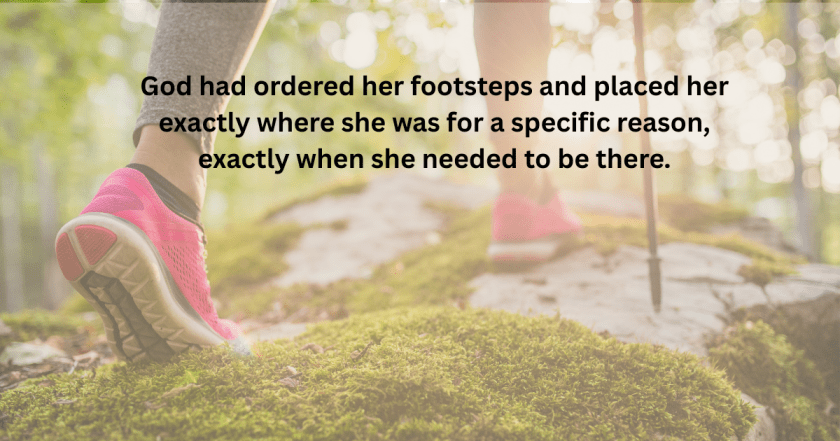
Friends, God ordered Esther’s footsteps as well. He placed her exactly where she was for a specific reason, exactly when she needed to be there. We will explore this further in the days to come, but for now, please do not miss the seemingly small things we see in Esther chapters 1 and 2, particularly verse 9 or chapter 2.

Reflection and Application

List out the ways you see God ordering the steps of Esther in 2:9?

Write down a time you remember when God clearly ordered your steps.

The More We Know

Posted in Bible study, Devotion, For Such A Time As This, From the Insideout, Journey Through The Word, LGG Study, Prayer Starters, Quiet Time

A Fairy Tale Ending

From the pages of, For Such a Time as This, by Love God Greatly

Read: Esther 9:23-10:3/SOAP: 10:3

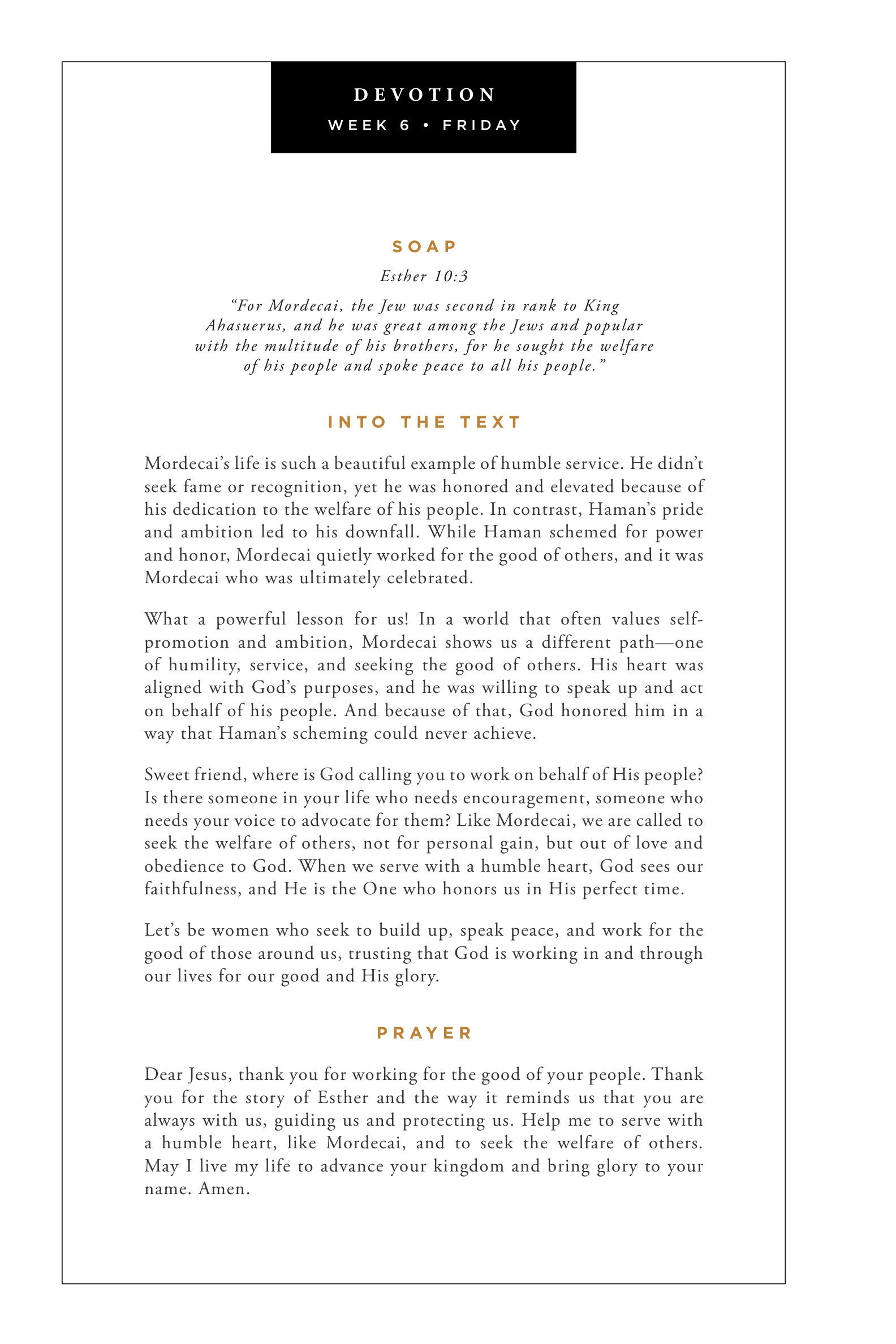
 Mordecai the Jew was second only to King Ahasuerus. He was the highest-ranking Jew, and he was admired by his numerous relatives. He worked enthusiastically for the good of his people and was an advocate for the welfare of all his descendants.

Esther 10:3

The Book of Esther is far from a fairy tale, but boy, does it read and end like one. Esther, a Jewish maiden, through a series of events that led to the previous queen being ousted, becomes Queen of Persia. She not only became the queen, but God used Esther, “for such a time as this,” to rescue her people from a murderous plot to annihilate them. I have thoroughly enjoyed retracing the details of this story, bit by bit, and have been blessed by the example of Esther’s faith and commitment to God in action. I hope you have too.

I pray you’ve enjoy our time with Esther and Mordecai and seeing the fingerprints of God’s sovereignty in and for the lives of His beloved people. If you have enjoyed it, I invite you to leave a comment. Today’s LGG Journal entry is a wonderful closure for this sessions journey – You won’t want to miss it.

The More We Know

Want to know even more about Esther? Check out this wonder summary by Gotquestions.org

Posted in Bible study, Devotion, For Such A Time As This, From the Insideout, Journey Through The Word, LGG Study, Prayer Starters, Quiet Time

Celebration

From the Journal, For Such A Time As This, p185/by Love God Greatly

Read: Esther 9:11-22 and SOAP: Psalm 71:24

All day long my tongue will also tell about your justice,
for those who want to harm me will be embarrassed and ashamed.

Psalm 71:24

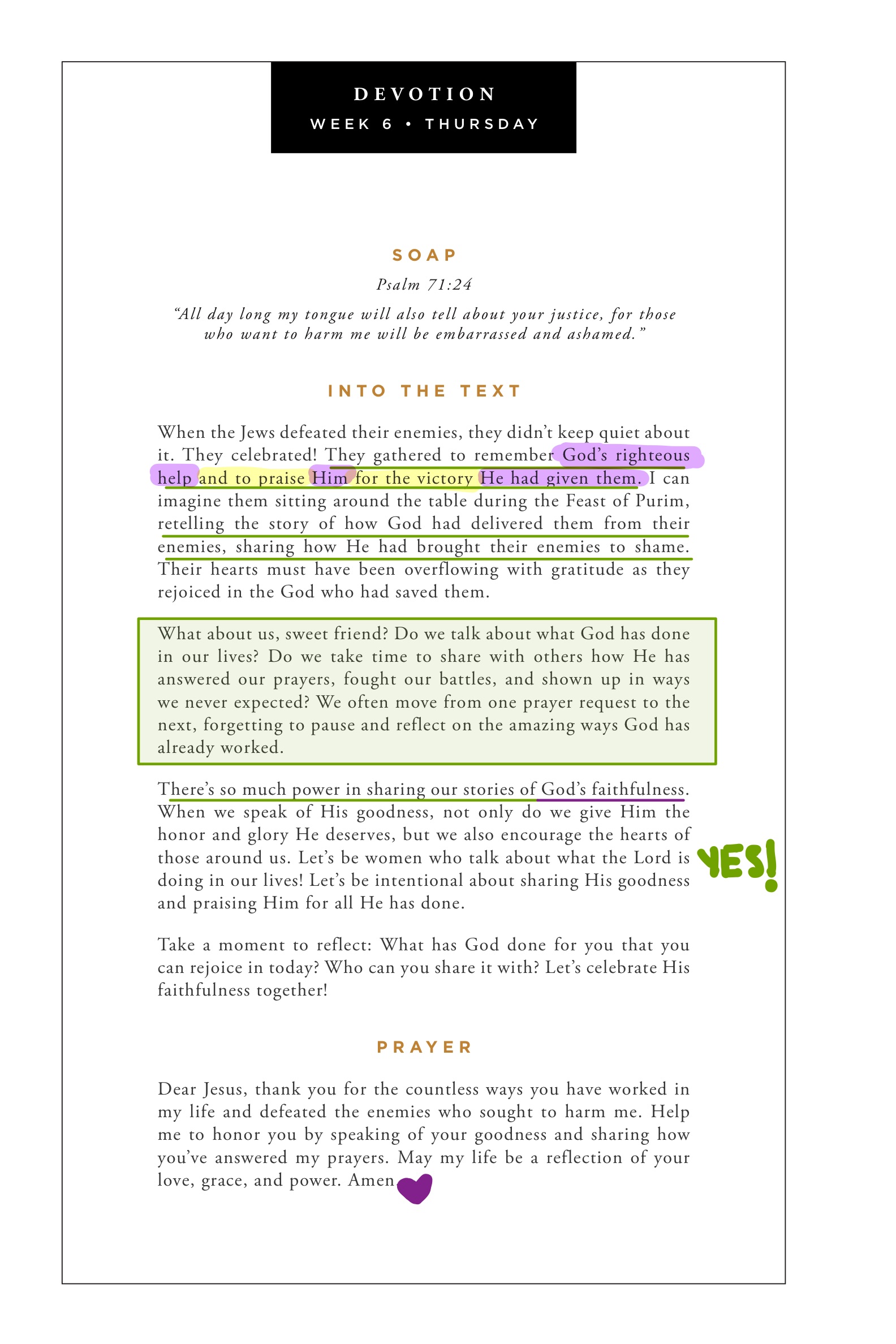
From the time I was a little girl, I have treasured the extended family gatherings. The food was wonderful, but the stories were the best part. Tales of those long gone, stories that brought both laughter and tears, and sometimes discussions about which way it really happened kept me drawn like a moth to a flame. Many of the stories remain etched in my mind, but the story of my dad’s leg getting infected with gangrene when he was a young boy is one of the top ten. It happened after a bike accident and became serious very quickly. While I don’t recall all of the details, I do remember this: someone in the family started a prayer chain for my father, and his leg, the doctor thought would have to come off, began to heal during the night, and eventually, except for the scar, recovered fully.

My grandmother’s story always included how they all celebrated then, and I can tell you that every time the story was told in my presence, there was testifying and rejoicing over God’s goodness and the power of prayer. I realize that the celebration of the Jews was on a much larger scale, namely their miraculous deliverance from the decreed annihilation, and the power they were given over their enemies, but the purpose of a yearly celebration brought about a time to tell the story again and again so that generation after generation would know the goodness and faithfulness of God. Oh, friends, may we daily look for the fingerprints of God in and around our lives and the lives of others, and may we be faithful to remember and quick to tell others what God has done.

Enjoy today’s journal entry by Love God Greatly –

Posted in Bible study, Devotion, For Such A Time As This, From the Insideout, Journey Through The Word, LGG Study, Prayer Starters, Quiet Time

Against All Odds

from the Love God Greatly Journal, For Such A Time As This, p1811

Read: Esther 9:1-10 and SOAP: Psalm 71:13

Bring disgrace and destruction on my accusers.
    Humiliate and shame those who want to harm me.

Psalm 71:13 NLT

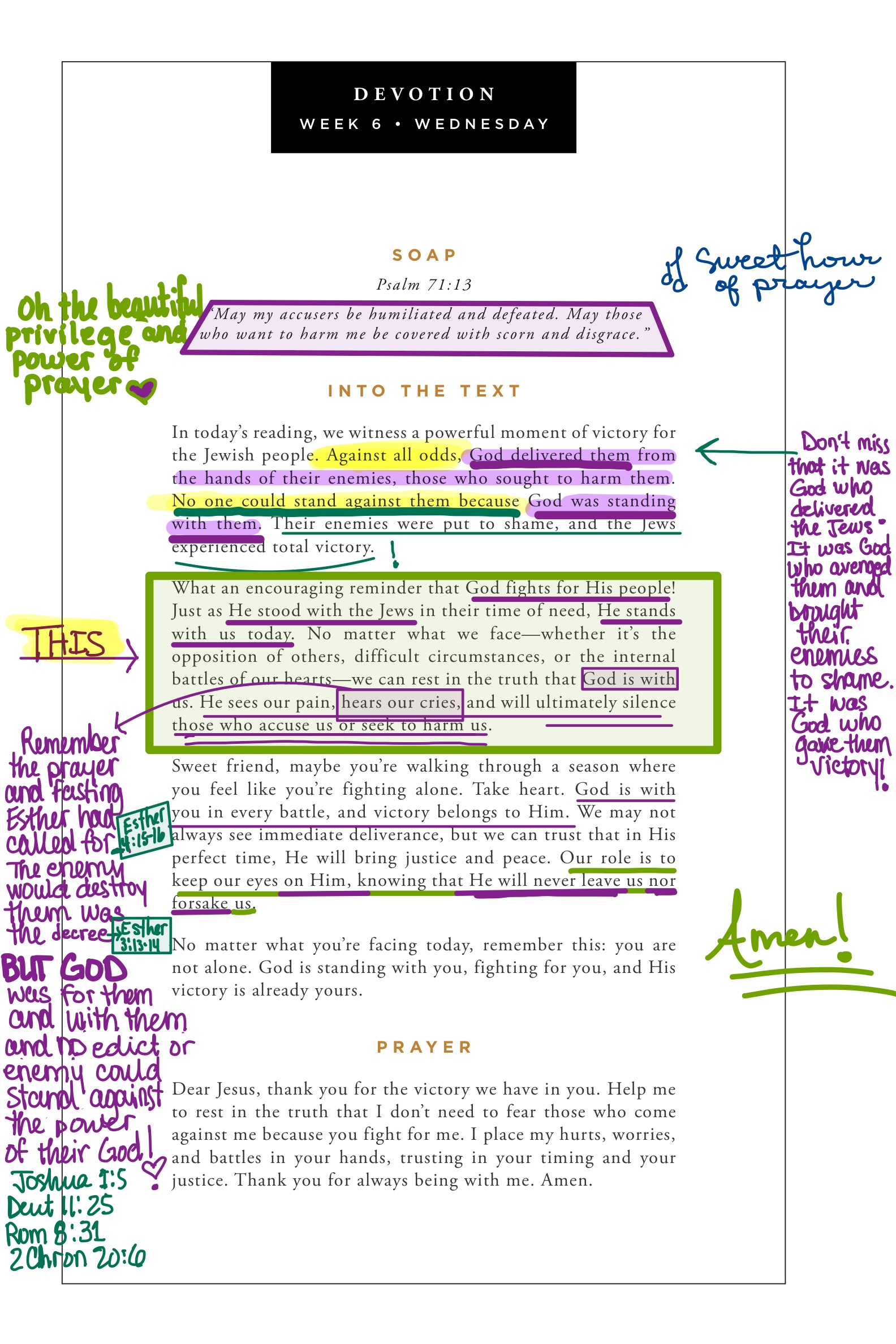
I love the “BUT GOD” moments of everyday life and consider them nuggets of gold when I find them in His Word. I’ve even been compiling a list of them from my own life for years. I especially love today’s moment where it is written, “In the twelfth month (that is, the month of Adar), on its thirteenth day, the edict of the king and his law were to be executed. It was on this day that the enemies of the Jews had supposed that they would gain power over them. But contrary to expectations, the Jews gained power over their enemies (Esther 9:1).

Haman’s edict to kill all of the Jews was scheduled for this day. But God, through His sovereign power, intervened, and the Jews were not only spared, but they also put to death their enemies, including the sons of Haman (Esther 9:1, 5-10). With this in mind, when I read Psalm 71:13, I couldn’t help but wonder if perhaps Esther or Mordecai, or any number of the other Jews who prayed and fasted in those three days before Esther approached the King, prayed a prayer similar to David’s prayer. Did they ask God for Haman and the others rising up against them to be humiliated and defeated? Did they pray for those who wanted to harm them to be covered with scorn and disgrace? From the outcome of death and shame that came to Haman, his family, and the others who rose up against the Jews, it seems very possible, or at least quite plausible, to think this is exactly how they prayed.

May we not lose heart in our battles. May we remember that contrary to expectations, the Jews who were supposed to die at the hands of wicked men, instead, (surely by Your hands), gained power over their enemies and lived to celebrate the triumph and deliverance You gave to them. May our eyes be open to see Your fingerprints and all the ‘but God moments’ of our own lives – and may we be quick to celebrate and rejoice – giving God all the glory.

Today’s devotional by Love God Greatly is below (I apologize for marking it up so much but it is exceptionally good and inspiring). Soak it in, then ask God to remind you of a but God moment in your life and share it in the comment section. 💕

The More We Know

A question that came to my mind as I thought about this prayer was, how should we pray for those who rise up or plot against us today? A couple of verses came to mind as I considered this question, the first being Matthew 5:44, where Jesus taught that we are not only to love our enemies but pray for them. The second verse that came to mind was Romans 12:19, where Paul used a quote from Deuteronomy to remind the people that vengeance belongs to God. – May God guide us in our battles with the enemy/enemies of our lives. May our prayers be based on love and the knowledge that vengeance belongs to the Lord. May we trust God to stand with us and fight for us and deal with the enemy as He sees fit.

But I say love your enemy and pray for those who persecute you.

Matthew 5:44

Do not avenge yourselves, dear friends, but give place to God’s wrath, for it is written, “Vengeance is mine, I will repay,” says the Lord.

Romans 12:19
  1. Journal entry by Love God Greatly; embellishments/notes by me ↩︎

Posted in Bible study, Devotion, For Such A Time As This, From the Insideout, Journey Through The Word, Know These Truths, LGG Study, Prayer Starters, Quiet Time

Delivered by Grace

From the journal of the LGG Study, For Such A Time As Thisp177/w6d2

Read: Esther 8:1-17 and SOAP: Proverbs 28:20

A faithful person will have an abundance of blessings,
but the one who hastens to gain riches will not go unpunished.

Proverbs 28:20

What an appropriate picture Proverbs 28:20 gives us of Esther’s story. Esther and Mordecai acted faithfully even in the face of certain death and the annihilation of their people. Haman, however, sought the riches of fame and fortune at all costs. I can’t help but pray this prayer found on page 174 of this session’s journal: “Give me the courage to live for You and invest my life for Your glory not mine.”

Let’s recap our story thus far and trace the fingerprints of God: Queen Vashti was dethroned in a fit of the King’s anger … A search was set in motion throughout all the kingdom’s provinces for a new queen … Esther. a Jew lived within the radius of the search and fit all of the specifications, and won the favor of the King … Mordecai, Esther’s relative who raised her, sat in the King’s gate and overheard not only a threat against the King’s life but word of the edict to annihilate the Jews … Mordecai sent word through Esther of the threat against the King. The King’s life was spared and Mordecai was eventually honored for this … Mordecai also made Esther aware of the edict which led to a time of prayer and fasting by the Jews and courage for Esther to approach the King and seek his help for her people … Esther’s courage and wisdom are testimonies to God’s guidance, and clearly answers to the prayer and fasting.

The deliverance we read about in today’s portion of the story could only come from the hand of God! The wicked Haman, who sought wealth and fame through his conniving ways with the King and a treacherous plot against Mordecai and the Jews, was rightfully put to death; and now his estate was handed over to Esther, and the King’s signet ring, once given to Haman for the edict against the Jews, was now given to Mordecai. So while the edict could not be rescinded, the King pointed out that they could write a decree according to what they believed to be right for the Jews. Oh, the creative plans and power of our God. While His name is not on the pages we’ve read, surely His fingerprints are everywhere in Esther’s story.

I was caught up in the miraculous deliverance of the Jews, and in the story of their rejoicing and celebrations, I couldn’t help but think of our own cause for rejoicing and celebration. From the beginning of time, in the garden, the cost of our sin has been death.1 This decree was not rescinded, for Paul wrote in Romans 6:23 that “wages of sin is death…2” Yet, just as God did for the Jews in Esther’s story, He made a way for us where there seemed to be no way. John’s declaration that God loved the world so much that He gave His only begotten Son so that whoever believes in Him will not perish but have eternal life is a testament of that Way3. For, as John went on to explain, “God did not send His Son into the world to condemn the world but in order that the world might be saved through Him.” (John 3:16-17). Paul later attests to this in his letter to the Church in Rome, when he wrote, “There is now no condemnation for those who belong to Christ Jesus” (Romans 8:1). – To which my heart resounds with the chorus … “Grace, grace, God’s grace, Grace that will pardon and cleanse within; Grace, grace, God’s grace, Grace that is greater than all our sin!

Father, thank You – that as Your people rejoiced in the day of Esther for Your miraculous deliverance from death to life, we, too, can rejoice. For Your marvelous, matchless grace has been poured upon our lives! We celebrate Your loving kindness that has come to us because of Jesus Christ! Oh, what a joy to know Your grace! – May we demonstrate this in all we do and say. In the name of Jesus – Amen!

The More We Know

From today’s journal entry by LGG, p177

  1. Then the Lord God commanded the man, “You may freely eat fruit from every tree of the orchard, 17 but you must not eat from the tree of the knowledge of good and evil, for when you eat from it you will surely die.” Genesis 2:16-17 ↩︎
  2. For the wages of sin is death but the free gift of God is eternal life through Christ Jesus our Lord. Romans 6:23 ↩︎
  3. Jesus replied, “I am the way, and the truth, and the life. No one comes to the Father except through me. John 14:6 ↩︎

Posted in Bible study, Devotion, For Such A Time As This, From the Insideout, God is good, Journey Through The Word, LGG Study, Quiet Time

A Victorious God

From the journal of the LGG Study, For Such A Time As Thisp171

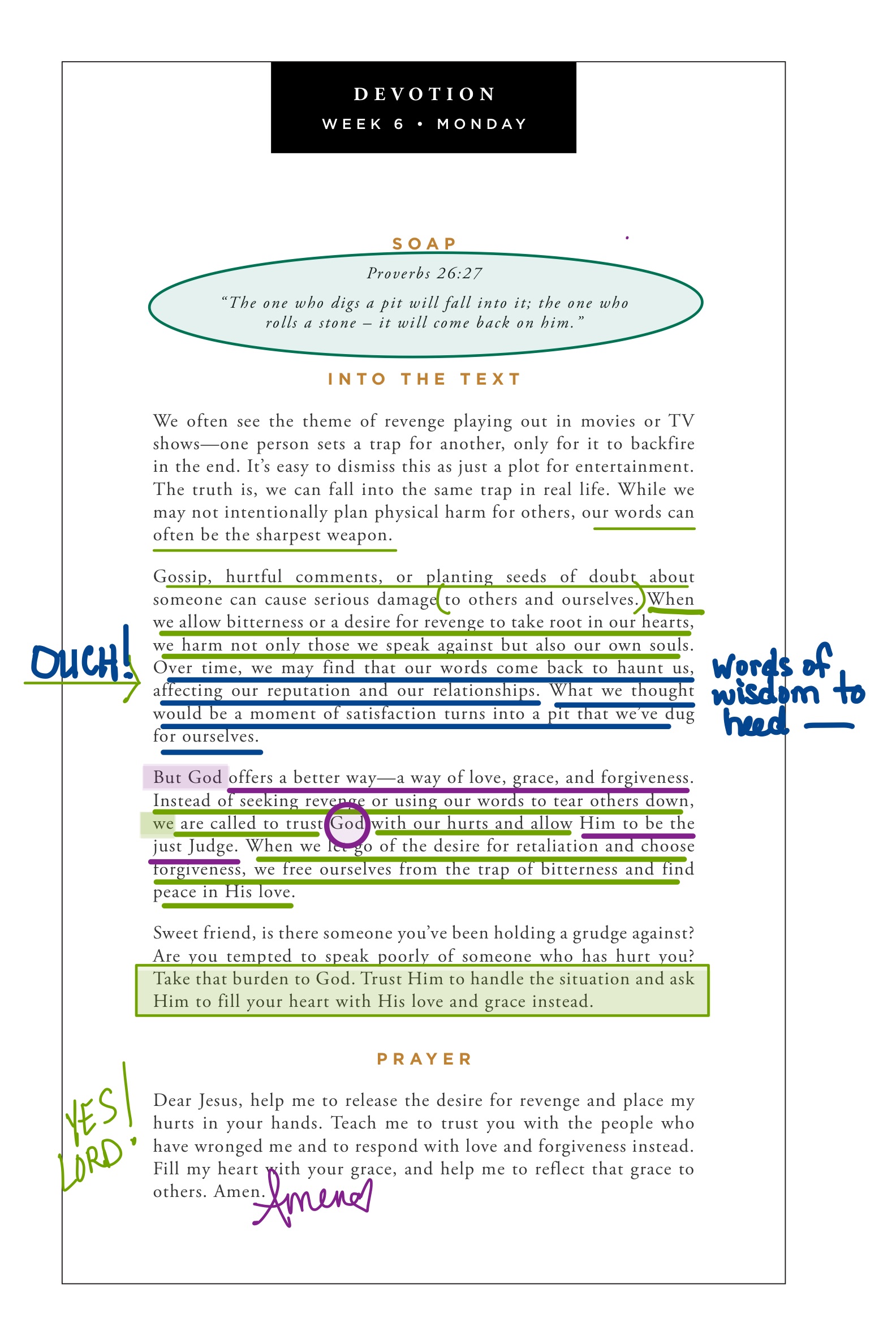
Read: Esther 7:9-10 and SOAP: Proverbs 26:27

If you set a trap for others,
    you will get caught in it yourself.
If you roll a boulder down on others,
    it will crush you instead.

Proverbs 26:27

It never gets old seeing God so visibly at work and/or seeing His Word played out in our own lives or on the pages of Scripture. What perfect correlation is seen in Haman hanging on the gallows he had built to hang Mordecai from, and the words of today’s Proverb: If you set a trap for others, you will get caught in it yourself. If you roll a boulder down on others, it will crush you instead.

As I read through today’s micro portion of Esther’s story, I found myself rejoicing when I read the words: “They hanged Haman on the very gallows that he had prepared for Mordecai.” However, I immediately felt bad for celebrating the demise of another person, but in searching my heart, I was reminded I wasn’t celebrating the death of a man but the victory of our God over the wicked enemy. As battles loom around or in us, what a blessing to know that our God is fighting for us. He goes before us, comes around, and behind us. Isaiah shared this message from God: “Do not be afraid, for I am with you. Do not be discouraged, for I am your God. I will strengthen you and help you, I will hold you up with my victorious right hand.1 We can rest assured, no matter the enemy or the battle, our God is with us and in perfect control. There is no enemy He cannot defeat nor battle He cannot win.

As today’s journal entry points out, when we look beyond the story of Haman’s demise, we will find a warning that we would be wise not to miss. Check it out below. (Note this entry is also available at lovegodgreatly.com)

Posted in Bible study, Devotion, For Such A Time As This, From the Insideout, Journey Through The Word, LGG Study

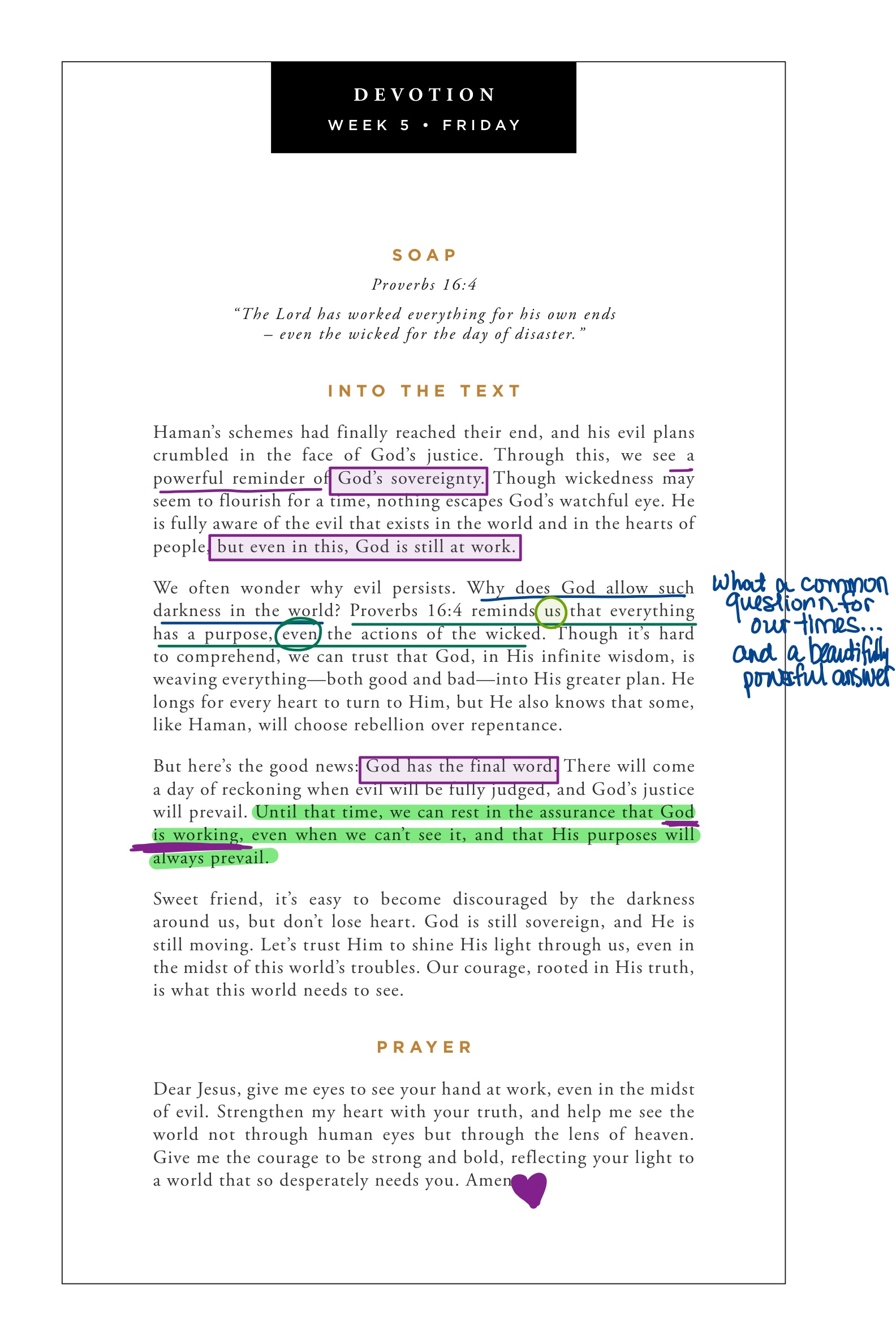
God Has the Final Word

From the journal of the LGG Study, For Such A Time As Thisp161

Read: Esther 7:7-8 and SOAP: Proverbs 16:4

The Lord has worked everything for his own ends—
even the wicked for the day of disaster.

Proverbs 16:4

I believe this is the first time I’ve read Esther’s story broken up into short segments. However, I must say that I’ve appreciated digesting it like this. It has helped me not only focus on specific actions, words, and reactions, but it has also helped me to visualize God’s sovereignty in micro detail rather than just the bigger picture. Something I noticed and shared yesterday bears repeating today: God’s presence is indisputable.

And we know that God causes everything to work together for the good of those who love God and are called according to his purpose for them.

Romans 8:28

”Romans 8:28 is one of my life verses and perhaps one of the reasons I am, more often than not, aware of and/or looking for God’s fingerprints throughout every day and situation. While I’m not certain this verse correlates with Proverbs 16:4, what I do know is that Esther and Mordecai loved God and were used and/or called, for such a time as this, to fulfill God’s purpose to save His people from Haman’s wicked plot to destroy the Jews. Not only that, but consider Mordecai’s presence at the gate of the King at just the right time to hear the plot to kill the king1 and later the plot to destroy the Jews.2 Consider also the fact that while many captives had returned to their homes,3 Esther and Mordecai were still within the radius of the search for a new queen, and out of all that were brought to the palace, it was Esther who totally captivated the King’s heart and was positioned by God to save His people from annihilation.

Posted in Bible study, Devotion, For Such A Time As This, From the Insideout, Journey Through The Word, LGG Study, Quiet Time

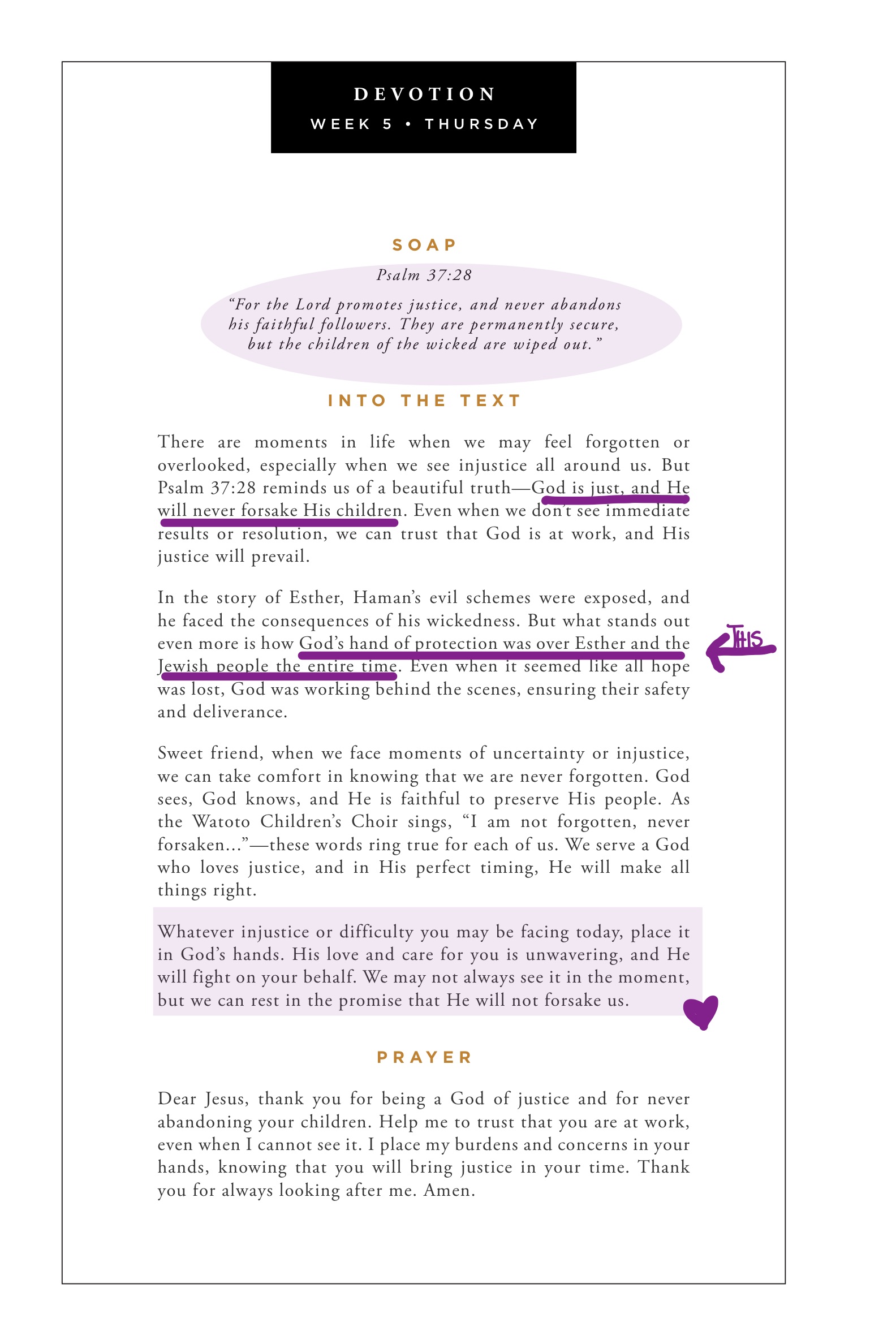
God’s Indisputable Presence

From the journal of the LGG Study, For Such A Time As This, p157

Read: Esther 7:5-6 and SOAP: Psalm 37:28

For the Lord promotes justice,
and never abandons his faithful followers.
They are permanently secure,
but the children of the wicked are wiped out.

Psalm 37:28

If we were to backtrack on our journey through Esther’s story, we would see that there was a time when telling the king about her heritage was not on Esther’s agenda. However, when Mordecai pushed her on the issue with his “for such a time as this” speech, she acquiesced with the condition that the people would pray and fast for a period of three days, and she would do the same.1 As we have seen. While God’s name has not been mentioned, the evidence that He not only heard the prayers but answered them is indisputable.

 Mordecai sent this reply to Esther: “Don’t think for a moment that because you’re in the palace you will escape when all other Jews are killed. 14 If you keep quiet at a time like this, deliverance and relief for the Jews will arise from some other place, but you and your relatives will die. Who knows if perhaps you were made queen for just such a time as this?”

Esther 4:13-17

Today’s journal entry says it best …