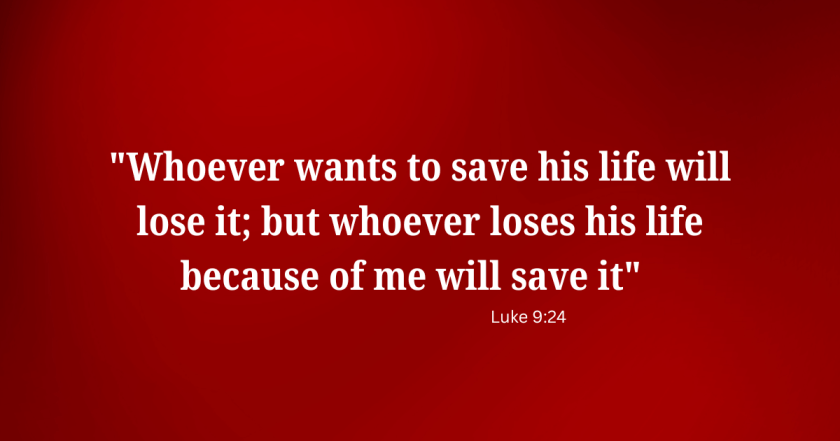
If you’ve heard the story, you already know the outcome; if you haven’t, then you may be surprised at the King’s first suggestion and the vastly different reactions of the women. Whether the story is new to you or well-known, we must be careful not to brush it aside as irrelevant to us today. Our circumstances and life choices may never place us in the exact scenario of the two mothers, but throughout our lifetime, we will inevitably face difficult choices – choices that make us choose right from wrong, good or evil, love or hate, gain or loss – and in all of these, we must choose carefully. Our decisions must be made with a heart yielded and committed to God’s glory (the righteous choice), even if it means suffering great loss. After all, Jesus told His disciples (including us): whoever wanted to follow Him would need to deny themselves daily and take up their cross, which, as explained by one commentary1, means to: “accept the rejection of the world for turning to Jesus and following him. Discipleship involves a death that is like a crucifixion (Gal. 2: 20 and 6:14).” This is why Jesus went on to say: “Whoever wants to save his life will lose it; but whoever loses his life because of me will save it” (Luke 9:24).
Solomon could not tell from their words which woman was telling the truth. Instead, he issued a shocking command: “Bring me a sword. . . . Cut the living child in two and give half to one and half to the other”
Leave a comment below with another example of someone willing to suffer great loss for God’s glory.
The More We Know
The chapter’s final verse notes the effect that Solomon’s unorthodox methods had on the kingdom: “When all Israel heard the verdict the king had given, they held the king in awe, because they saw that he had wisdom from God to administer justice” (1 Kings 3:28). Solomon’s wisdom had been given by God when Solomon requested it (verse 5). The account of Solomon’s handling of the case of the two prostitutes showed that he had indeed been granted wisdom from God. ~ (Got questions.org)
Dear reader, if you do not know Jesus… if you have never professed your faith in Him, I invite you to explore “Know These Truths” where you will discover the Way to everlasting life and an indescribable joy. It is available to all who believe.
Biblegateway.comsn Only Luke mentions taking up one’s cross daily. To bear the cross means to accept the rejection of the world for turning to Jesus and following him. Discipleship involves a death that is like a crucifixion; see Gal 6:14. ↩︎
based on the LGG Study, Living Faithful in a Faithless Land / w4d2
Scripture: God’s Road Map for Our Journey / Daniel 5:17-30 (23b)
For you have proudly defied the Lord of heaven and have had these cups from his Temple brought before you. You and your nobles and your wives and concubines have been drinking wine from them while praising gods of silver, gold, bronze, iron, wood, and stone—gods that neither see nor hear nor know anything at all. But you have not honored the God who gives you the breath of life and controls your destiny! – Daniel 5:22-23
Observations and Applications
Every day, we make choices. I’m not talking about what’s for dinner choices, though I guess that could be a critical decision for some, but I’m referring more to this would be right vs this would be wrong decision. Decisions like, should we do this, go there, say that, watch this, hang out with them … or not? We have a 2-year-old in the family now, the ripe age of testing boundaries, which means we are often teaching him right and wrong and encouraging him to obey. Recently, at preschool, he did something that he had been told not to do. When his teacher told him he shouldn’t have done it – he replied, “I know.” So she asked him why he did it, and he answered, “I just wanted to.” It was tempting to snicker at this, but its cuteness fades when we remember the reality of today’s story about Belshazzar’s costly decision to live like he wanted rather than how he knew he should.
In our previous day’s journey, the king of Babylon’s party was suddenly interrupted by the fingers of a human hand writing on the plaster wall of the king’s palace. Daniel is summoned to tell the king what it means and does so, neither sugar-coating nor cajoling the king. He boldly relates what the message said, what the king could expect, and why. Yet, before the meaning was given- Daniel, in what I would call righteous indignation, courageously scolded the king with what some have described as a “scathing indictment”. He gives him a history lesson of sorts, telling him nothing new, for as a descendant of Nebuchadnezzar, the king would have already known these things. Instead, Daniel said it all as a reminder that Belshazzar should have known better and chosen the way of Nebuchadnezzar. Instead, he had used the things of God for idolatrous purposes and would now, along with all of Babylon, pay for the drunken, blasphemous actions.
Babylon had conquered Jerusalem and taken Daniel and others captive, but God moved Belshazzar to honor one of those captives, and very soon He would use the Persians to conquer Babylon. God works in wondrous ways to accomplish His will.
Bibleref.com
Important and helpful commentary for understanding/appreciating this part of our journey through Daniel –
After reminding the king about the experience of Nebuchadnezzar (Daniel 4:28–33; 5:18–21), Daniel now addresses the event which God’s supernatural sign interrupted (Daniel 5:1–5).
Belshazzar’s inebriated, blasphemous actions are described as direct rebellion against “the Lord of heaven.” Though he knew about Nebuchadnezzar’s encounter with the God of Israel, Belshazzar still chose to use Jewish holy objects (Daniel 5:1–2) as toys for drinking, and tools for idolatry. Failure to learn from Nebuchadnezzar’s example was one thing, but to actively desecrate the name of Israel’s God and use His objects (Exodus 30:22–29) to worship idols was even worse.
A deep contrast can be seen in the reaction of New Testament converts in Thessalonica. When they heard the gospel, they “turned to God from idols to serve the living and true God” (1 Thessalonians 1:9). Belshazzar’s refusal to see what God made clear (Romans 1:18–20; John 5:39–40) displayed his arrogance. Only when that brutally direct rebuke has been made does Daniel explain why it inspired God to send a sign, and what that sign means (Daniel 5:24–28).
Scripture does not record how Belshazzar took this news. It simply notes that the king made good on his promise. Daniel is immediately dressed in finery and proclaimed the “third ruler.” Scholars believe this is because Belshazzar was acting as a regent—second-in-command—while his father, Nabonidus, the “first ruler” and true king, was away. It is remarkable that a pagan Gentile ruler would elevate Daniel, a Hebrew and captive exile (Daniel 1:3–7), to such a prominent position. However, God was working in the situation to make this happen. It’s possible the king was trying to appeal to Daniel for forgiveness. He may have thought he could appease the Lord…but it was too late. As the next verse notes, Belshazzar met his death that very night (Daniel 5:30).
Babylon had conquered Jerusalem and taken Daniel and others captive, but God moved Belshazzar to honor one of those captives, and very soon He would use the Persians to conquer Babylon. God works in wondrous ways to accomplish His will.
Prayer of Response to our Journey
Father, we have Your word and the history of others before us who, like Daniel and the Apostle Paul, have faithfully followed after You despite the challenges and dangers. Likewise, we have those who have gone before us or are around us today who have chosen the way of the world and their own desires- Please help us to learn from the message Daniel gave to Belshazzar, who, through the life of Nebuchadnezzar, knew that he should humble himself before God but instead chose to exalt himself against the Lord of heaven. Help us to remember that the choices we make always affect others and to make them in light of Your Word and Will rather than our desires or feelings at the moment. Help us to stay sober and alert, as our enemy, the devil, is always on the prowl looking for someone to devour. Thank You for the reminder that You are sovereign, ruling from Heaven, working in wondrous ways to accomplish Your will. – In the name of Jesus – Amen!
Reflection for the Journey
So, what’s your criteria when making decisions? Is it based on what feels/looks/seems good to you, or is it based on what you know is right/wrong in God’s eyes?
The More We Know About the Journey
For further reading: Luke 12:15-21
Then he said, “Beware! Guard against every kind of greed. Life is not measured by how much you own.”
16 Then he told them a story: “A rich man had a fertile farm that produced fine crops. 17 He said to himself, ‘What should I do? I don’t have room for all my crops.’ 18 Then he said, ‘I know! I’ll tear down my barns and build bigger ones. Then I’ll have room enough to store all my wheat and other goods. 19 And I’ll sit back and say to myself, “My friend, you have enough stored away for years to come. Now take it easy! Eat, drink, and be merry!”’
20 “But God said to him, ‘You fool! You will die this very night. Then who will get everything you worked for?’
21 “Yes, a person is a fool to store up earthly wealth but not have a rich relationship with God.”
Do you ever find yourself distracted by the actions of others – your mind caught up in their behavior and pelted with anger? Or maybe you awaken to thoughts of your past that are hurtful and bring sorrow, or shameful and evoke guilt which in turn evokes lies and/or captivity that leads you away from God instead of toward Him. Whatever your trigger point is to thoughts that disrupt your peace and unity with God – He makes it clear through His Word that our minds are to be fixed on Him. He promises in the Old Testament as well as the New that when our minds are set or fixed on Him we will know His perfect peace.
You will keep in perfect peace all trust in You, all whose thoughts are fixed on You.
Isaiah 26:3
Don’t worry about anything; instead, pray about everything. Tell God what you need, and thank Him for all He has done. 7 Then you will experience God’s peace, which exceeds anything we can understand. His peace will guard your hearts and minds as you live in Christ Jesus.
Philippians 4:6-7
Paul’s instructions to the believers didn’t stop with prayers that would bring peace. Instead, he encouraged them to fix their thoughts on other things – things that would replace the “anxious” thoughts so that God’s peace would continue to guard their hearts and minds as they lived in Christ Jesus.
And now, dear brothers and sisters, one final thing. Fix your thoughts on what is true, and honorable, and right, and pure, and lovely, and admirable. Think about things that are excellent and worthy of praise. 9 Keep putting into practice all you learned and received from me—everything you heard from me and saw me doing. Then the God of peace will be with you.
Philippians 4:8-9
It strengthens us to take thoughts that are not beneficial or pleasing to Him captive, making them obedient to Jesus Christ – who holds the power over sin and death.
Fixing our thoughts on Him is a Spiritual discipline that takes effort and practice. It is part of the Spiritual training mentioned in 1 Timothy 4:8 that promises benefits not only in this life but in the life to come. Fixing our thoughts on Him not only fills us with His peace but as 2 Corinthians 10:5 teaches, it protects us from arguments and pretensions that set themselves up against the knowledge of God. It strengthens us to take thoughts that are not beneficial or pleasing to Him captive, making them obedient to Jesus Christ – who holds the power over sin and death.
Father, my mind is sometimes a battleground and I plead for You, in Your mighty, omnipotent, omniscient power, to guard it. Block all thoughts that invoke unrighteous anger and bitterness toward others, and protect me even from the righteous anger that arises so that it does not take my thoughts captive and distract me from Your voice, Your guidance, and Your presence. Keep me from judgmental thoughts and the critical words they provoke. Guard me from fearful thoughts or thoughts of the past that provoke shame and regret, and all other erroneous thoughts that do not bring You glory and ultimately hinder a right relationship with You, diminishing the light of Your presence in me, which is meant to be evident in my life – both in the deeds that I do and the words that I speak.
Instead, as Paul wrote to the Colossians, help me to make allowance for other’s faults and to forgive anyone who offends me, help me to remember You have forgiven me and set me forever free from the past. I pray that You would empty my mind of what doesn’t belong and instead – fill it with and fix it on things that are true and honorable, and right and pure, and lovely and admirable. Whatever is excellent or worthy of praise, Father, help me to think on these things. 💜🙏 In Jesus’ Name – amen! ❣️
Let the Words of my mouth and the meditation of my heart be pleasing to You oh Lord, my Rock and Redeemer.
Psalm 19:14
Make allowance for each others faults and forgive anyone who offends you. Remember the Lord forgave you, so you must forgive others.
Are you holding on to the past? Maybe you’re so lost in the good memories that you’re missing out on enjoying the present opportunities to make new ones. Or, perhaps there are pieces from your past that haunt you and taunt you – invoking emotions of fear or resentment and regret – or even anger or bitterness. These emotions can stem from past decisions or words spoken or things left undone. They can also stem from things others have said or done to you. Whatever they are and wherever they come from they are not meant for us to dwell on.When writing about making peace with your past, Criswell Freeman said it like this: “Since we can’t change the pains and disappointments of the past, why do so many of us insist upon replaying them over and over again in our minds? … Obviously we can’t change the past. It is what it was and forever will be. The present of course is a different matter. Today is filled with opportunities to live, to love, to work, to play, and to celebrate life.” To the Israelites, God said it like this: “Do not remember the past events, pay no attention to things of old, look, I am about to do something new…” (Isa 43:18)
If we allow the past to take us captive we will miss all of these opportunities. We will get caught up with trying to recreate or undo or find ourselves trembling in fear or seeking revenge. The apostle Paul had many things to regret in his lifetime but he also said he had many reasons to put confidence in his flesh – he describes both in the third chapter of Philippians but concludes with this summation: “Brothers and sisters, I do not consider myself to have attained [perfection], instead I am single-minded: forgetting what is behind and reaching out for the things that are ahead, with this goal in mind, I strive toward the prize of the upward call of God in Christ Jesus.” (Phil 3:13-14). I know of no better way of making peace with my past or not living in past accomplishments or enjoyments than to fix my mind on God and the opportunities He sets before me today in living out His call on my life and the hope of eternity. Concerning the former, Criswell Freeman concluded: “Instead, live in the precious present, where opportunities abound and change is still possible.”
Father, thank you for the reminder this morning that holding onto or living in the past – for whatever reason – only serves to keep my mind distracted from You. The enemy’s goal is to steal and kill and destroy. He knows that if I am distracted from You I will not know Your peace and instead will follow after my own desires or wallow in sorrows or bitterness or anger and regrets. Christ came so that I might have life and have it to the full – but this is only possible when my mind is stayed on You – for in You there is perfect peace. So, help me to not dwell on the past events of my life, or pay attention to the things of old but instead fix my eyes on You – so that I do not miss where you lead or what You do 💜 In Jesus’ Name –
Question of the day: Obviously, as believers, we are to imitate what is good, but how do we know the difference between good and evil? Check out Hebrews 5:14 for the answer. To encourage others and help us grow in our faith and understanding please be sure to read and/or share your comments about today’s question or passage in the reply bar at the bottom of the page. Let’s spur one another on to love and good deeds.
9 I wrote something to the church but Diotrephes who loves to be first among them, does not acknowledge us. 10 Therefore, if I come, I will call attention to the deeds he is doing—the bringing of unjustified charges against us with evil words! And not being content with that, he not only refuses to welcome the brothers himself, but hinders the people who want to do so and throws them out of the church!11 Dear friend, do not imitate what is bad but what is good.The one who does good is of God; the one who does what is bad has not seen God.
12 Demetrius has been testified to by all, even by the truth itself. We also testify to him, and you know that our testimony is true.
13 I have many things to write to you, but I do not wish to write to you withpen and ink. 14 But I hope to see you right away, and we will speak face to face. 15 Peace be with you.The friends here greet you. Greet the friends there by name.
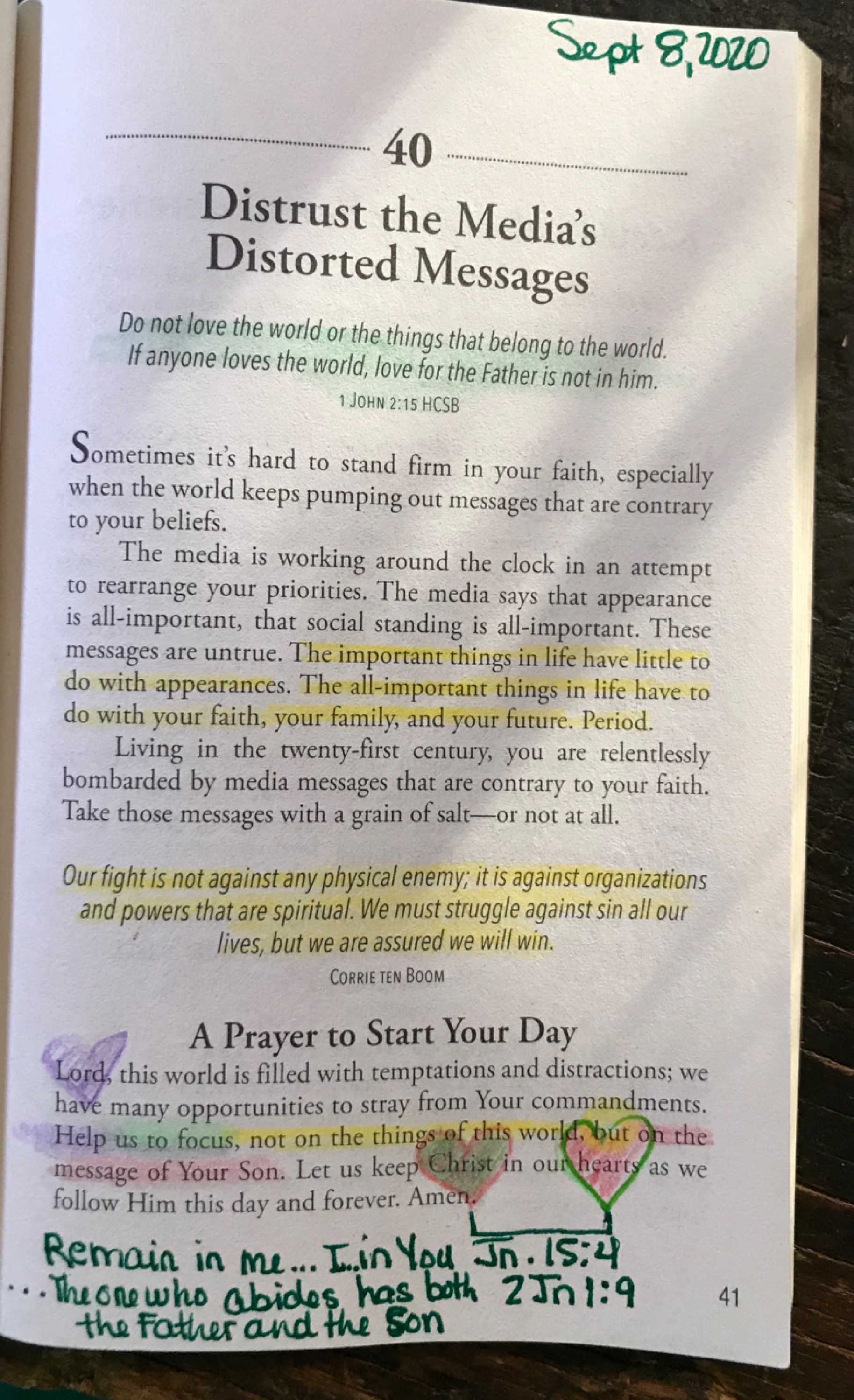
The Following Prayer Starter is shared from “Prayers to Start Your Day” by Criswell Freeman, Smith Freeman Publishing.
Good morning ☀️ for the sake of peace I almost skipped this particular prayer starter – but seeing how it feeds so perfectly into our current “Know Love” study I am trusting it is meant to be shared. I am praying for openness as you read and an understanding that this is not meant to bash “the media” – not to focus our attention in the media but rather to remind us where our true focus is to be. I believe that media can be, and is often, used for good. However, there is no denying the truth of the statement that it can distort the truth and draw our mind to focus on the world. In this “2020 culture” may our prayer daily echo this mornings starter: “Lord, help us to focus not on the world’s [message], but on the message of Your Son.” 
I am currently doing the Love God Greatly study on Joshua. This morning’s scripture was from Joshua 13:1-8 and Isaiah 66:3-4 and lead me to these thoughts …
Our choices matter to Him
We put ourselves and our relationship with Him in great jeopardy when we choose our own ways over His
The same is true when we attempt to align His will with ours or come up with a combination of the two instead of fully aligning our will with His
When He calls He wants us to answer
When He speaks He wants us to listen
My child pay attention to what I say, listen carefully to My words. Don’t lose sight of them for they bring life to those who find them … Proverbs 4:20-22
In this world we will face situations everyday where we must choose our way or His. The question is how do we consistently make the right choice?
As children of God and joint-heirs with Christ we must be careful and intentional with our choices. We must strive to faithfully make God – His Word and Spirit – our guide and priority over what we see and feel and desire.
His will, His pleasure, His ways … should be our utmost criteria.
cri·te·ri·on
noun
plural noun: criteria – a principle or standard by which something may be judged or decided.



 Good morning ☀️ for the sake of peace I almost skipped this particular prayer starter – but seeing how it feeds so perfectly into our current “Know Love” study I am trusting it is meant to be shared. I am praying for openness as you read and an understanding that this is not meant to bash “the media” – not to focus our attention in the media but rather to remind us where our true focus is to be. I believe that media can be, and is often, used for good. However, there is no denying the truth of the statement that it can distort the truth and draw our mind to focus on the world. In this “2020 culture” may our prayer daily echo this mornings starter: “Lord, help us to focus not on the world’s [message], but on the message of Your Son.”
 Me From the Inside Out