Posted in Bible study, Devotion, From the Insideout, Journey Through The Word, Quiet Time, She, Volume 4

Evidence of Sarah’s Faith

adapted from She, delighting in the examples of women in the Bible, volume 4, pp. 71 and 72

Today’s Scripture Reading: Genesis 21:1-8, 22:2, and 23:1-2; Hebrews 10:23 and 11:11-12,

“Let us hold fast the profession of our faith without wavering; (for He is faithful that promised;)”. Hebrews 10:23

The Promise

We’ve been journeying through Sarah’s story for five days now, so the question begs to be revisited: What was the promise, and who made it?” We find the answer in Genesis 17, where God is conversing with Abraham, expounding on a promise He had made in chapter 12, in which He called Abraham to leave his father’s family and his country for a new country. He wasn’t even told where he was going, only that he was to leave and go to a land God would show him. Abraham, along with Sarah, his wife, answered the call.1 The call God made came with a promise2, which is where today’s journey picks up:

God Gives More Details

I will make you very fruitful; I will make nations of you, and kings will come from you. 15 Then God said to Abraham, “Regarding Sarai, your wife—her name will no longer be Sarai. From now on, her name will be Sarah. 16 And I will bless her and give you a son from her! Yes, I will bless her richly, and she will become the mother of many nations. Kings of nations will be among her descendants. 17 Then Abraham bowed down to the ground, but he laughed to himself in disbelief. “How could I become a father at the age of 100?” he thought. “And how can Sarah have a baby when she is ninety years old?” 18 So Abraham said to God, “May Ishmael live under your special blessing!” 19 But God replied, “No—Sarah, your wife, will give birth to a son for you. You will name him Isaac, and I will confirm my covenant with him and his descendants as an everlasting covenant. 20 As for Ishmael, I will bless him also, just as you have asked. I will make him extremely fruitful and multiply his descendants. He will become the father of twelve princes, and I will make him a great nation. 21 But my covenant will be confirmed with Isaac, who will be born to you and Sarah about this time next year.”  Genesis 17:6, 15-21

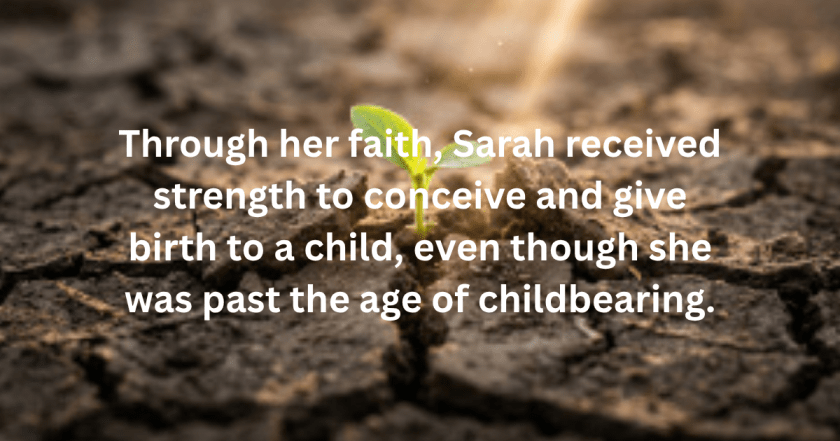
Sarah, who was barren, had laughed when she heard God tell her husband, Abraham, that through his descendants a great nation would arise, but God still placed her in the ‘Hall of Faith’ that we find in Hebrews chapter 11. Yes, “Even though she laughed, even though she was afraid, she is still known for her faith.3” Actually, Scripture tells us that it was through her faith that Sarah received strength to conceive and give birth to a child, even though she was past the age of childbearing. The author of Hebrews writes, “…she judged God faithful who had promised;” and because she did, God opened her womb, and she gave birth to a son, just as God had promised, and his name was Isaac. From Isaac, the seed of Abraham and Sarah, came descendants as numerous as the stars in the sky and the sand on the seashore. Again, this was just as God had promised (Genesis 22:17).

When I look at my daughters (Annie, who battled childhood cancer but now is married with two children of her own…and Abi, who was born with crippled feet but now runs on two healthy feet, I rarely see them without also seeing God’s mercy, love, and grace, and His hand of miraculous power. So I can only imagine that every time Sarah looked at Isaac, she would have remembered God’s faithfulness to keep His promises.

Friends, remembering God’s faithfulness is not only an encouragement to stay faithful to Him, but it is the weapon we need to use in our warfare with the enemy, when fears rise up to surround us, or sorrows keep us inward focused, or following God’s call on our lives seems too risky… It is why we are told throughout Scripture to keep our eyes on Him. Or, paraphrasing one commentary, recalling God’s guidance through the wilderness and His protection from enemies, anchors our current trust in His past faithfulness.

Consider the words of the Psalmists and others in the Bible:

Psalm 77:11-12: “I will remember the deeds of the LORD; yes, I will remember your wonders of old. I will ponder all your work, and meditate on your mighty deeds.”


1 Chronicles 16:12: “Remember the wondrous works that he has done, his miracles and the judgments he uttered.”


Psalm 103:2: “Bless the LORD, O my soul, and forget not all his benefits.”

And may we never forget the words of the Apostle Paul which guide us to a peace that passes all understanding:

Philippians 4:8-9: “And now, dear brothers and sisters, one final thing. Fix your thoughts on what is true, and honorable, and right, and pure, and lovely, and admirable. Think about things that are excellent and worthy of praise. Keep putting into practice all you learned and received from me—everything you heard from me and saw me doing. Then the God of peace will be with you.”

Father, help us continually remember Your faithfulness, and, in response, may we remain faithful to You, even in the seasons of waiting we face along the way. Thank you for the beautiful examples you have given us throughout Your Word. ~ Strengthen us, as the author of Hebrews wrote, to hold fast to the profession of our faith without wavering, knowing that You who promised are faithful. ~Amen and Amen

Reflection and Application

Why do you think Sarah was included in the Hall of Faith in Hebrews chapter 11? ~ I believe it is because her faith points us to The One in whom we are to place our faith – The One Who is the most faithful Promise Keeper we will ever know. ~What are your thoughts?

The More We Know

Paul Weighs In

Even when there was no reason for hope, Abraham kept hoping—believing that he would become the father of many nations. For God had said to him, “That’s how many descendants you will have!” And Abraham’s faith did not weaken, even though, at about 100 years of age, he figured his body was as good as dead—and so was Sarah’s womb. Abraham never wavered in believing God’s promise. In fact, his faith grew stronger, and in this he brought glory to God. He was fully convinced that God is able to do whatever he promises. And because of Abraham’s faith, God counted him as righteous. Romans 4:18-22 NLT

  1. The Lord had said to Abram, “Leave your native country, your relatives, and your father’s family, and go to the land that I will show you. Genesis 12:1 ↩︎
  2. I will make you into a great nation. I will bless you and make you famous, and you will be a blessing to others. I will bless those who bless you and curse those who treat you with contempt. All the families on earth will be blessed through you.” ↩︎
  3. She, delighting in the examples of women in the Bible, volume 4, pp. 71 ↩︎

Posted in Bible study, Devotion, From the Insideout, Journey Through The Word, Quiet Time, She, Volume 4

Sarah’s Visit from the LORD

adapted from She, delighting in the examples of the women of the Bible, Volume 4/pp69-70

Today’s Scripture: Genesis 18 and 21:1-3; Isaiah 64:4; Psalm 56:3

For since the world began, no ear has heard and no eye has seen a God like you, who works for those who wait for him! Isaiah 64:4 NLT

Genesis 18 is filled with details that are helpful, if not necessary, for understanding and truly appreciating this part of Sarah’s story and the blessing that she and Abraham experience.

Bibleref.com sums the first portion up like this: “The events of Genesis 18 take place not long after God’s visit with Abraham in chapter 17. However, this visit from the Lord is quite different. It’s not clear, at first, if Abraham even recognizes the three men who appear outside of his tent as the Lord and two angels in human form. In either case, Abraham runs to show them deep respect and hospitality. He tells Sarah to bake them bread and has a young calf slaughtered for them to eat as they rest in the heat of the day.

Once the meal is over, the Lord fully reveals Himself, in a conversation He conducts with Sarah through Abraham while she remains hidden and listening in the tent. First, the Lord asks where Sarah is and then reveals to her what He had said to Abraham in the previous chapter: by this time a year from now, she will have a son.

by this time a year from now Sarah will have a son.

Genesis 18:10

Part of the story hasn’t changed, Sarah is still barren and advanced in age…but now she knows her waiting is about to come to an end. As we read in Genesis 21:1, the Lord keeps His promise – regardless of how difficult a thing may seem in human eyes or understanding – nothing is too difficult for our God! We are not told exactly how the promise comes about – only that “the Lord visited Sarah as He had said, and the Lord did unto Sara as He had spoken. For Sarah conceived, and bare Abraham a son in his old age, at the set time of which God had spoken to him. And Abraham called the name of his son that was born unto him, whom Sarah bare to him, Isaac” (Genesis 21:1-3).

How would you say you wait? Patiently…Impatiently…Excitedly…Nervously…Doubtfully…? I would venture to say that for most – if not all of us, it depends on what we’re waiting for. My four-year-old grandson is working on waiting patiently to have our attention if we are already talking to someone else. Sometimes he waits really well, but if what he wants to say is super exciting or important, the wait becomes nearly impossible for him. Sometimes I wait well, but waiting on a doctor’s report or a job position may turn into waiting nervously, waiting on my smoothie at McDonald’s when I’m running late for work may stir up the impatient side of me, and the eight years of waiting on a baby ran the gamut from waiting patiently to impatiently to excitedly and nervously and eventually doubtfully. The fact of the matter is, waiting is generally not easy, so when you’re talking 25 years of waiting, which is approximately the amount of time that Sarah and Abraham waited on the promise God had made concerning Sarah having a child, specifically a male child who would be the first seed of the great nation God had told Abraham he would one day father.

As we have seen through our journey with Sarah, it wasn’t an easy wait for her, and subsequently not an easy wait for Abraham either. However, “the longer she waited, the more of a miracle her situation became.” Why? Because the older she and Abraham became, the possibility of conceiving and giving birth, humanly speaking, diminished. Sarah understood this, which is why she laughed at the very thought of it being true – it is also why God’s rebuttal to her laughter was a question: “Is anything too hard for the LORD?” (Genesis 18:14). It was a pointed reminder then and remains so today, that nothing, absolutely nothing, can limit or hold back the power of God.

“Waiting sometimes causes us to fear the unknown. However, there is no need to fear when we trust in Him.”

She, study guide, volume 4, p70

Friends, I don’t know if waiting ever becomes easy. However, I have found that the more life has required me to wait, the more God has strengthened/deepened my roots of faith. Waiting teaches us to depend on God, to look to Him for help when we grow weary and/impatient, to confess our weariness and trust Him even in the midst of humanly impossible situations that raise shadows of doubts. … Yes, as today’s journal entry states: “Waiting sometimes causes us to fear the unknown. However, there is no need to fear when we trust in Him.1

The More We Know

The Wait for Isaac

Genesis 12 begins the story of Abraham (then called Abram) and his barren wife, Sarah. Verses 1 through 4 record God’s first words to him about a homeland for his offspring. Even though the gift of a son is not directly mentioned in this first communication, God hinted at His plan for Abram. Abraham was 75 years old when he first received the promise, and Genesis 21:5 tells us he was 100 years old when Isaac was born. Sarah was 90. So Abraham and Sarah waited 25 years for the fulfillment of God’s promise.

In those 25 years between the time that Abram was promised a son and the birth of Isaac, Abram and Sarah had certain ideas of how they might facilitate the keeping of the promise. One was that Abraham’s steward, Eliezer, would become the heir of Abraham’s household (Genesis 15:2–3). Another idea was that Abraham could have an heir through a son conceived by Sarah’s slave, Hagar (Genesis 16:1–2). In both cases, God rejected those men as Abraham’s heirs, pointing Abraham and Sarah to a literal, miraculous fulfillment of the promise.2

  1. She, study guide, volume 4, p70 ↩︎
  2. Gotquestions.org ↩︎
Posted in Bible study, Devotion, From the Insideout, Journey Through The Word, Quiet Time, She, Volume 4, Uncategorized

Sarah

adapted from the study She, delighting in the examples of the women of the Bible, volume 4/pp63-64

Today’s Scripture Reading: Genesis 17, Genesis 18:11-12, and Jeremiah 32:17

Ah Lord GOD! behold, thou hast made the heaven and the earth by the great power and stretched out arm, and there is nothing too hard for thee:”

This is our third day’s journey with Sarah, or Sarai, as she has been known until now, when God gives her a new identity. It wasn’t a drastic change, simply one letter, but when God changed someone’s name, there was always a reason. According to gotquestions.org, “it was usually to establish a new identity. In this case, Sarai, meaning ‘my princess‘, became ‘Sarah’, meaning ‘mother of nations (Genesis 17:15).”

It has been said before, but the ‘elephant’ (as they say) is still in the room: Whether she is called Sarai or Sarah she is still not pregnant and there is literally no human hope or physical possibilities of her being able to conceive. So, why would God grace her with this new identity? “Mother of nations? Seriously? She wasn’t even the mother of one. She had been barren for decades and well beyond childbearing age. This was more than Sarah’s opinion it was physical reality for we read in Genesis 18:11-12 that Abraham and Sarah were both very old by this time, and Sarah was long past the age of having children. 12 So she laughed silently to herself and said, “How could a worn-out woman like me enjoy such pleasure, especially when my master—my husband—is also so old?” It would take a miracle for Sarah to give Abraham a son now ~ and that’s exactly what happened. As just “one year later, God’s supernatural restoration of Sarah’s womb and Abraham’s vitality resulted in the promised son, Isaac.  Abraham and Sarah’s moment of too much inward focus and not enough focus on God’s ability to do the impossible was a brief interlude to an otherwise trusting and believing relationship, as the author of Hebrews attests.1

By faith Sarah herself received power to conceive, even when she was past the age, since she considered him faithful who had promised. Therefore from one man, and him as good as dead, were born descendants as many as the stars of heaven and as many as the innumerable grains of sand by the seashore.

(Hebrews 11:11–12)

Reflection and Application

How have you doubted God before? Is there something you are doubting Him about now?

The More We Know

What’s in a Name?

God changed Abram’s name, meaning “high father,” to “Abraham,” meaning “father of a multitude” (Genesis 17:5). At the same time, God changed Abraham’s wife’s name from “Sarai,” meaning “my princess,” to “Sarah,” meaning “mother of nations” (Genesis 17:15). This name change took place when God gave Abraham the covenant of circumcision. God also reaffirmed His promise to give Abraham a son, specifically through Sarah, and told him to name his son Isaac, meaning “laughter.” Abraham had another son, Ishmael, through Sarah’s handmaiden, Hagar. But God’s promise to bless the nations through Abraham was to be fulfilled through Isaac’s line, from whom Jesus descended (Matthew 1:1–17Luke 3:23–38). Isaac was the father of Jacob, who became “Israel.” His twelve sons formed the twelve tribes of Israel—the Jews. The physical descendants of Abraham and Sarah formed many nations. In a spiritual sense, their descendants are even more numerous. Galatians 3:29 says that all who belong to Jesus Christ—Jew, Gentile, male, or female—are “Abraham’s offspring, heirs according to promise.”

  1. Answer in Genesis ↩︎
Posted in Bible study, Devotion, From the Insideout, Journey Through The Word, LGG Study, Quiet Time, She, Volume 4

Sarah~[Sarai], part 1

adapted from the study She, delighting in the examples of the women of the Bible, volume 4/pp63-64

Today’s Scripture Reading: Genesis 11:27-32, Genesis 12, and Genesis 18:14

God was repositioning Abraham and Sarah according to His perfect plan and they followed where He led.

Me~ from the InsideOut🦋

When we first read of Abraham and Sarah, they are living with Abraham’s family in Ur of the Chaldeans, but they moved away from there, intending to move to the land of Canaan. However, Terah, Abraham’s father, settled the family in Haran. Abraham and Sarah stayed with his family until God spoke to Abraham, telling him to move out of the country, away from his father’s family. While this move requried blind faith (for God simply said, move to a land that I will show you), it came with an amazing promise of blessing, which included him being made into a great nation, fame, God’s protection, and becoming a blessing to others. God was repositioning Abraham and Sarah according to His perfect plan and they followed where He led. Keep in mind that Abraham was at 75 years old when God called him out of Haran. Yet, Scripture doesn’t tell us that Abraham struggled with this call on his life. He and Sarah had made a home in Haran for at least 50 years. It was where their family was, but we read of no debate or conversation between Abraham and Sarah about whether to go or stay – only that Abraham (still called Abram at the time) departed as the Lord had instructed.

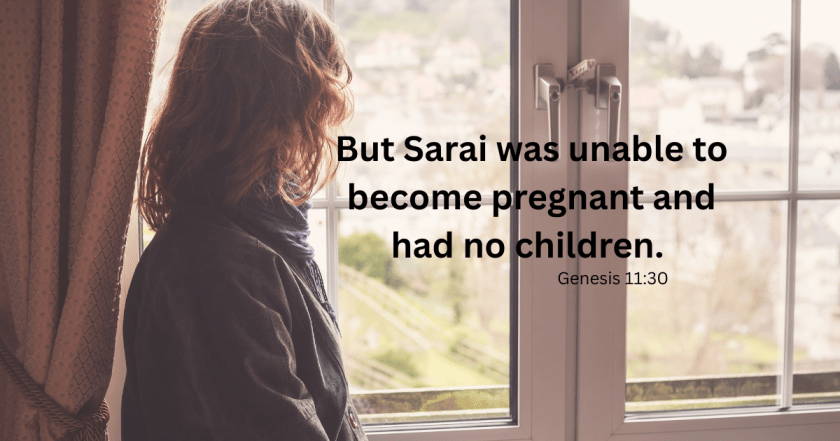
If you’re reading this account of Abraham and Sarah for the first time, or if you’ve read it more than a dozen times yet find yourself amazed yet again at God’s timing in the things He discloses before they even happen, you may be wondering how the promise of making Abraham into a great nation and giving land to his “descendants” could ever happen, especially since Sarah was barren, (Genesis 11:30) … but rest assured friends, it happens just as God said it would. Join me tomorrow and in the week ahead as we explore Sarah’s story, which includes her handmaid named Hagar, Sarah’s plan to have a baby despite being barren. and God asking Abraham the questions: “Why did Sarah laugh? Why did she say, ‘Can an old woman like me have a baby?’ 14 ‘Is anything too hard for the Lord?’ I will return about this time next year, and Sarah will have a son.”

A Prayer of Response

O Sovereign Lord, may we never doubt what You have said, but instead always stand amazed at the reality we see time and time again in Your Word, that nothing is too difficult for You.You gave sight to the blind, You made the lame walk, and You raised Your only begotten Son from the grave that we might have everlasting life! Absolutely nothing is too difficult for You. 💜

Reflection and Application:

  1. What is God positioning you for? Are you ready to follow where He leads/calls you to go?
  2. Is there something that seems impossible to you right now?
    • Health situations?
    • Finances?
    • An unsaved loved one?
    • The return of a prodigal child?

~ Ask the Lord to help you have faith in Him today, remind yourself often throughout the day(s) ahead that “NOTHING, absolutely nothing is too difficult for our God.”

The More We Know

Sarai began her life in the pagan world of Ur, in the land of the Chaldees, which was located in the area now known as Iraq. She was the half-sister, as well as the wife, of Abram, who would be called Abraham. Sarai and Abram had the same father but different mothers, according to Genesis 20:12. In those days, genetics were purer than they are today, and intermarriage was not detrimental to the offspring of unions between relatives. Also, since people tended to spend their lives clustered together in family units, it was the natural course to choose mates from within their own tribes and families.

When Abram encountered the living God for the first time, he believed Him (Genesis 12:1–415:6) and followed after Him, obeying His command to leave his home to go to a place he had never heard about, much less seen. Sarai went with him.

Their journey brought them to the area called Harran (Genesis 11:31). Abram’s father, Terah, passed away in this city, and Abram, Sarai, and their nephew Lot and their retinue continued their journey, allowing God to lead and guide them. With no housing and no modern conveniences, the journey must have been very difficult for all, especially for the women. During their journey, there was a famine in the land, prompting Abram and Sarai to go to Egypt (Genesis 12:10). When they did, Abram feared that the Egyptians would kill him because Sarai was beautiful and they would want her as a wife. So he asked Sarai to tell everyone that she was Abram’s sister—which was technically true but also meant to deceive. Sarai was taken into Pharaoh’s house, and Abram was treated well because of her. But God afflicted Pharaoh’s house, and the couple’s lie was revealed. Pharaoh returned Sarai to Abram and sent them on their way (Genesis 12). Sarai and Abram came back to the land now known as Israel. They had acquired many possessions and a great deal of wealth in their travels, so Lot and Abram agreed to split up in order that the massive herds of cattle would have adequate ground for grazing (Genesis 13:9).

Gotquestions.org

Posted in Bible study, Devotion, From the Beginning to Forever, From the Insideout, Journey Through The Word, Know These Truths, LGG Study

A Beautiful Love Story ~ of Faith and Provision

Based on the LGG Study, From the Beginning to Forever/w2d3

Read: Genesis 22:1-14; SOAP verse 13

1Some time later, God tested Abraham’s faith. ‘Abraham!’ God called. ‘Yes,’ he replied. ‘Here I am.’

2Take your son, your only son — yes, Isaac, whom you love so much — and go to the land of Moriah. Go and sacrifice him as a burnt offering on one of the mountains, which I will show you.’

3The next morning Abraham got up early. He saddled his donkey and took two of his servants with him, along with his son, Isaac. Then he chopped wood for a fire for a burnt offering and set out for the place God had told him about. 4On the third day of their journey, Abraham looked up and saw the place in the distance. 5Stay here with the donkey,’ Abraham told the servants. ‘The boy and I will travel a little farther. We will worship there, and then we will come right back.’

6So Abraham placed the wood for the burnt offering on Isaac’s shoulders, while he himself carried the fire and the knife. As the two of them walked on together,

7Isaac turned to Abraham and said, ‘Father?’ ‘Yes, my son?’ Abraham replied. ‘We have the fire and the wood,’ the boy said, ‘but where is the sheep for the burnt offering?’

8God will provide a sheep for the burnt offering, my son,’ Abraham answered. And they both walked on together.

9When they arrived at the place where God had told him to go, Abraham built an altar and arranged the wood on it. Then he tied his son, Isaac, and laid him on the altar on top of the wood. 10And Abraham picked up the knife to kill his son as a sacrifice.

11At that moment the angel of the Lord called to him from heaven, ‘Abraham! Abraham!’ ‘Yes,’ Abraham replied. ‘Here I am!’

12Don’t lay a hand on the boy!’ the angel said. ‘Do not hurt him in any way, for now I know that you truly fear God. You have not withheld from me even your son, your only son.’

13Then Abraham looked up and saw a ram caught by its horns in a thicket. So he took the ram and sacrificed it as a burnt offering in place of his son. 14 Abraham named the place Yahweh-Yireh (which means ‘the Lord will provide’). To this day, people still use that name as a proverb: ‘On the mountain of the Lord it will be provided.’

Genesis 22:1-14 NLT or KJV

What a beautiful love story of faith and provision we see in Abraham’s life and his ongoing encounters with God.

Abraham had placed his faith in God many years before this experience. He had remained in, and even grown in, his habit of listening for and responding to God obediently. Because of this, when the call came for Abraham to sacrifice his son – the son God had promised him – the son through whom the ‘rescuer’ would come -the son through whom would come a great nation and make the name of Abraham great … he did not hesitate to answer obediently, despite what it meant. Keep in mind, Abraham’s obedience wasn’t because he knew the exact outcome; he obeyed because he loved God more than family and self, and because he knew he could trust Him.

Abraham had not forgotten God’s promises. He had even seen some fulfilled, and he lived and hoped accordingly.

Me from the Inside~out🦋

Friends, throughout the six decades of my life, I have seen the hand of God. I have known His goodness, seen His protection, been blessed by His provision, been comforted by His compassion, experienced the realities of His promises, and in both the chaos and fear of anxious-filled moments or the unsettled stillness of a long night, I have heard His ‘still small voice’. Each event has drawn me closer to Him and helped (even caused) me to trust Him more. Don’t get me wrong, doubts and fears still arise – like when I can’t see a way out of a problem, or a health crisis arises; and I’m still prone to drag my feet when He leads in a direction out of my comfort zone… but this one thing I know, like Abraham, I may not know the exact outcome of any situation, but I know I can trust in the name of the Lord my God.

My prayer for you, dear readers, is that you will remember how He has shown Himself to you. I pray you will watch for Him daily and listen for His still small voice. May we, like Abraham, respond to His call, whatever it may be, with obedience, trusting that God is in complete and perfect control.

The More We Know

Consider these words of encouragement from today’s LGG Journal entry:

“While God never again asked anyone to kill their child, He was willing to sacrifice His very own Son, Jesus Christ, to rescue and redeem humanity from their sin. He gave of His very self, perfectly paying the price we deserve.

Do you trust God to the point that you’d be willing to give up everything, even the things you value most? As God did not hold anything back for us, we, too, are to be willing to give everything to Him.”

LGG Journal/From the Beginning to Forever, p77

Do you know the God of Abraham? I invite you to read, Know These Truths, at the link below.

Posted in Bible study, From the Insideout, Journey Through The Word, LGG Study, Quiet Time, The Armor of God

Declared Righteous

based on the LGG Study, The Armor of God, w2d4

Scripture: Genesis 15:1-6; Romans 4:1-5/ SOAP: Romans 4:3

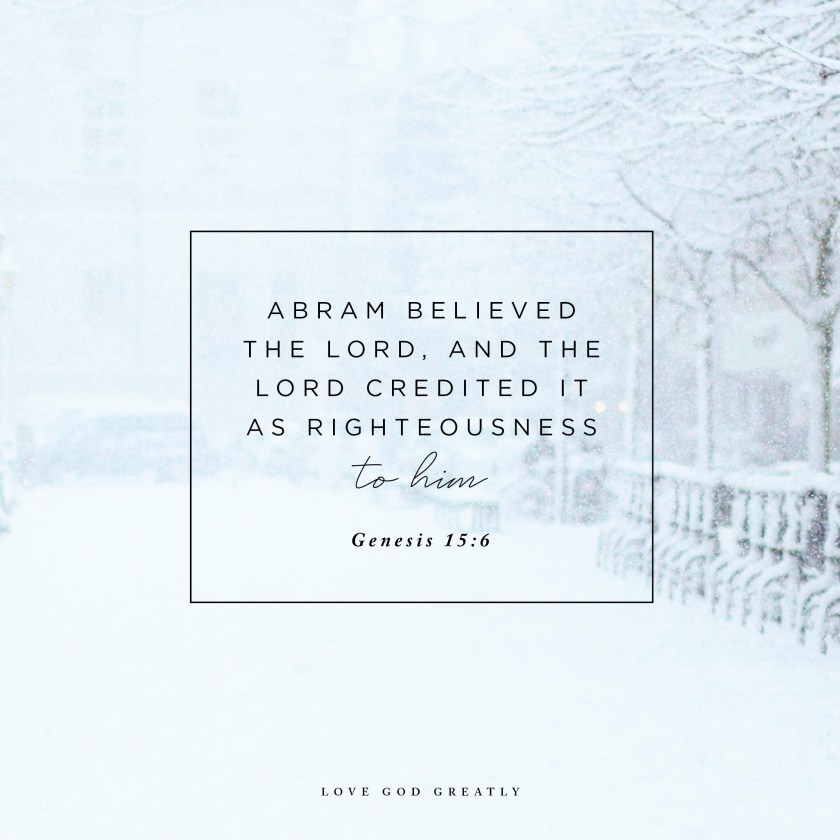
For what does the scripture say? “Abraham believed God, and it was credited to him as righteousness.”

Romans 4:3

Oh the joy I find diving into God’s Word! I marvel as I travel from the Old Testament through the New Testament reading messages of the redemptive stories of those, who, by no merit of their own – were saved by grace through faith. Today’s Scripture reading is an example of this, as we read that Abram (later named Abraham) who was credited with the righteousness of Christ, not because of anything he had done but because of his faith. Verse six of chapter fifteen says that “Abram believed the LORD, and the LORD credited it as righteousness to him.” We should note that this is not the first evidence of his belief in God. We find that part of the story in Genesis chapter twelve, verse four, when he leaves country, home, and family to follow God’s command.

Go out from your country, your relatives, and your father’s household to (the land) that I will show you. Then I will make you into a great nation, and I will bless you, and I will make your name great, so that you will exemplify divine blessing. I will bless those who bless you, but the one who treats you lightly I must curse, so that all the families of the earth may receive blessing through you.” 4 So Abram left, (read the rest of the story)

Genesis 12:1-4

I hope you won’t skip through the Genesis portion to focus on the SOAP verse. A walk through the story of Abram – who left all he knew for an unknown location and a promise that he could not see – much less understand – reveals much. In Abram we see both faith and curiosity, that some would say was born of doubt; and if you look carefully you will even see the evidence of what appears to be fear in Abram(v1). In God we see, comfort and encouragement as well as personal interaction as He answers Abram’s questions and goes a step further with a beautiful and demonstrative sky-gazing moment of the promise yet to come. Finally, we see first-hand evidence(v6) of the account that Paul speaks of in Romans chapter four. As the old saying goes, “stop and smell the roses”, so to speak, before moving on to Paul’s account. Let yourself imagine walking in Abram’s shoes (for an even better understanding back up to chapter twelve), consider his questions – and then close your eyes and imagine the vision in verses four and five. Hear God say, “But look,” Do you feel the hope? Do you hear it in these two little words and in the message that follows? Visualize walking outside with him and looking up into the sky at the countless stars and hearing God say that Abram’s descendants would be as numerous as the stars. – I love that we serve a God who understands who we are and what we are thinking or feeling and responds with such compassion and such an excitement for what is ahead that He infuses hope into our hearts and minds that helps us to press on.

Fast Forward

There is no one righteous, not even one,
11 there is no one who understands,
there is no one who seeks God.
12 All have turned away,
together they have become worthless;
there is no one who does good, not even one.

Romans 3:10-12

In today’s focus passage, Paul picks up right where we left off with Abram. Keep in mind that Paul had just announced that “man” can be justified/saved (which is to be made right with God) by something other than the law, (Rom 3:21-26). Now, with this one question, he takes them back to Abraham/Abram to show them how. The question was perfect, for anyone who knew of Abram knew the answer. God had credited Abram with righteousness simply yet profoundly because He had “believed God“. Paul goes on to give an example that teaches the people that FAITH is greater than works when it comes to righteousness. The outcome of work is an obligatory payment or accolade – but what comes from belief/faith in God is His gracious gift of a righteousness that covers all of our sin and shame. It was the righteousness of His only son, given to take the sins of the world on himself and die on a cross that did not belong to him – but to each of us. – Now this is love and grace at their greatest!

Reflection for the Journey
  • What does Romans 4:3 teach us about the relationship between faith and righteousness?
  • How doe it challenge the lie that we must earn righteousness through what we do?
Going Further

How It All Began

Posted in Bible study, LGG Study

Everlasting Covenant: The Promised Land

Today’s Scripture: Genesis 15:7-21; Hebrews 11:8-10 (S.O.A.P. Hebrews 11:9-10)

Then the Lord told him, “I am the Lord who brought you out of Ur of the Chaldeans to give you this land as your possession.”

But Abram replied, “O Sovereign Lord, how can I be sure that I will actually possess it?”

The Lord told him, “Bring me a three-year-old heifer, a three-year-old female goat, a three-year-old ram, a turtledove, and a young pigeon.” 10 So Abram presented all these to him and killed them. Then he cut each animal down the middle and laid the halves side by side; he did not, however, cut the birds in half. 11 Some vultures swooped down to eat the carcasses, but Abram chased them away.

12 As the sun was going down, Abram fell into a deep sleep, and a terrifying darkness came down over him. 13 Then the Lord said to Abram, “You can be sure that your descendants will be strangers in a foreign land, where they will be oppressed as slaves for 400 years. 14 But I will punish the nation that enslaves them, and in the end they will come away with great wealth. 15 (As for you, you will die in peace and be buried at a ripe old age.) 16 After four generations your descendants will return here to this land, for the sins of the Amorites do not yet warrant their destruction.”

17 After the sun went down and darkness fell, Abram saw a smoking firepot and a flaming torch pass between the halves of the carcasses. 18 So the Lord made a covenant with Abram that day and said, “I have given this land to your descendants, all the way from the border of Egypt[a] to the great Euphrates River— 19 the land now occupied by the Kenites, Kenizzites, Kadmonites, 20 Hittites, Perizzites, Rephaites, 21 Amorites, Canaanites, Girgashites, and Jebusites.”

Hebrews 11:8-10

It was by faith that Abraham obeyed when God called him to leave home and go to another land that God would give him as his inheritance. He went without knowing where he was going. And even when he reached the land God promised him, he lived there by faith—for he was like a foreigner, living in tents. And so did Isaac and Jacob, who inherited the same promise. 10 Abraham was confidently looking forward to a city with eternal foundations, a city designed and built by God.

Posted in Bible study, LGG Study

Everlasting Covenant

Today’s Scripture: Genesis 15:1-6; Galatians 3:15-18 (S.O.A.P. Genesis 15:6)

The Lord’s Covenant Promise to Abram

Some time later, the LORD spoke to Abram in a vision and said to him, “Do not be afraid, Abram, for I will protect you, and your reward will be great.”

But Abram replied, “O Sovereign LORD, what good are all Your blessings when I don’t even have a son? Since You’ve given me no children, Eliezer of Damascus, a servant in my household, will inherit all my wealth. You have given me no descendants of my own, so one of my servants will be my heir.”

Then the LORD said to him, “No, your servant will not be your heir, for you will have a son of your own who will be your heir.” Then the LORD took Abram outside and said to him, “Look up into the sky and count the stars if you can. That’s how many descendants you will have!”

And Abram believed the LORD, and the LORD counted him as righteous because of his faith.

Posted in LGG Study

Jesus Our Everything: Week 5, Day 4

Question of the Day: How did Abraham obey? What does verse 11 tell us was the secret to his faith?

Today’s Scripture: Hebrews 11:8-22 (S.O.A.P. Hebrews 11:8)

By faith Abraham obeyed when he was called to go out to a place he would later receive as an inheritance, and he went out without understanding where he was going. By faith he lived as a foreigner[a] in the promised land as though it were a foreign country, living in tents with Isaac and Jacob, who were fellow heirs[b] of the same promise. 10 For he was looking forward to the city with firm foundations,[c] whose architect and builder is God. 11 By faith, even though Sarah herself was barren and he was too old,[d] he received the ability to procreate,[e] because he regarded the one who had given the promise to be trustworthy. 12 So in fact children[f] were fathered by one man—and this one as good as dead—like the number of stars in the sky and like the innumerable grains of sand[g]on the seashore.[h]13 These all died in faith without receiving the things promised,[i] but they saw them in the distance and welcomed them and acknowledged that they were strangers and foreigners[j] on the earth. 14 For those who speak in such a way make it clear that they are seeking a homeland. 15 In fact, if they had been thinking of the land that they had left, they would have had opportunity to return. 16 But as it is,[k] they aspire to a better land, that is, a heavenly one. Therefore, God is not ashamed to be called their God, for he has prepared a city for them. 17 By faith Abraham, when he was tested, offered up Isaac. He had received the promises,[l] yet he was ready to offer up[m] his only son. 18 God had told him, “Through Isaac descendants will carry on your name,”[n]19 and he reasoned[o] that God could even raise him from the dead, and in a sense[p] he received him back from there. 20 By faith also Isaac blessed Jacob and Esau concerning the future. 21 By faith Jacob, as he was dying, blessed each of the sons of Joseph and worshiped as he leaned on his staff.[q]22 By faith Joseph, at the end of his life,[r] mentioned the exodus of the sons of Israel[s] and gave instructions about his burial.[t]