Posted in Bible study, Devotion, From the Insideout, Journey Through The Word, Quiet Time

Walking By Faith Not By Sight

I love verses that stick with you. Verses like:

  • When I am afraid I will trust in You (Ps 56:3)
  • Don’t be anxious about anything. Instead pray about everything… (Phil. 4:6-8)
  • You will keep in perfect peace all who trust in You, all who put their hope in You. (Isa. 26:3)
  • Do not be discouraged for I am your God. Do not be afraid, for I am with you; I will strengthen you and help you; I will hold you up with my victorious right hand. (Isaiah 41:10)
  • Give thanks to the Lord for He is good … (Ps 13)
  • Trust in the Lord with all your heart. Do not lean on your own understanding. In all your ways acknowledge Him, and He will direct your path. (Prov 3:5-6)
  • He has given you everything you need for life and godliness through our knowledge of Him who called us by His own glory and goodness. Through these He has given us His very great and precious promises so that you may participate in His divine nature, having escaped the corruption in this world caused by evil desires. (2 Peter 1:3-4)
  • I can do everything through Christ who strengthens me. (Phil 4:13)

Today’s ‘verse of the day’ from my reading plan is another of those verses. When the thing you have been called to do, or life itself, seems futile, filled with anxiety, difficult, disappointing, or brings suffering; when you can’t see how things are going to turn out, when it looks like there’s no hope, or your head is barely above the water, Paul’s declaration and encouragement is to walk by faith and not by sight. Elsewhere, he tells his readers to set their minds on things above, not on earthly things (Col. 3:2), and to others he wrote, think about things that are true and noble and pure and right and lovely and admirable. He tells them, if there is anything excellent or praiseworthy, to think about those things. (Phil 4:8)

The devotion I read about this verse explains that Paul wrote these words while his body was literally breaking down. He was wrestling with an unnamed affliction- failing eyesight; he had been beaten and shipwrecked. He was dealing with churches that were splitting, the betrayal, abandonment, and desertion of close friends and fellow missionaries, and prison walls. Yet, through it all, he held on to his faith.

Friends, I don’t know about you, but I’m thankful for the reminder that faith isn’t pretending everything is fine – it’s trusting God even when everything is not fine … when the way is too dark to see – or the the storm blows so hard we can’t stand – or we don’t know where the money will come from – or how the “story” will end… As I read in my devotional, “Faith is knowing that what we see is temporary, but what we can’t see is eternal.”

I am so thankful for all the ways God has shown me that I can trust Him … for all the times I couldn’t see how things would work out, but I could tell He was near … and for all of the fears that were squelched by His peace that truly passes all understanding. I’m thankful that He has taught me to surrender my desperate need to know how things will work out … and to wait for His perfect timing when answers or outcomes don’t come quickly. The sweetness of being able to place all of the unknowns and concerns of this life in His trustworthy and capable hands is an unexplainable blessing for this previously impatient and anxiety-ridden creature. The other reminder that grabbed my heart and mind today was the comfort of knowing that even when I cannot see His hand, it is still there holding mine. ~ Friends, rest assured we can trust His heart of love and His never-ending faithfulness.

Reflection and Application

Let’s consider these words from Bibleref.com regarding Paul’s words, “We walk by faith, not by sight”, and ask ourselves if we are making a habit of walking by faith and not by sight. Do we so thoroughy believe the gospel and find that the struggles we face are not the most important concern in our lives? Can we truly say that we count the unseen things waiting for us with Christ as more real than the suffering of the moment? ~ If we aren’t there yet – what are some things we can do to foster this mindset?

* Quote on graphic is by Søren Kierkegaard
Posted in Bible study, Devotion, God is good, Journey Through The Word, Know These Truths, Love, prayer, Quiet Time

A Life of Prayer

Devote yourselves to prayer, keeping alert in it with an attitude of thanksgiving.

Colossians 4:2

Yesterday’s Scripture Reading from ourdailyverse.com was Colossians 4:2. “Devote yourselves to prayer, keeping alert in it with an attitude of thanksgiving.” What a gracious gift God has given us through these words of Paul. We have been invited into a life of prayer. He doesn’t demand it but graciously offers us the privilege to not only come boldly before His throne but to come often – actually to stay in an attitude of prayer, making it the “heartbeat of our existence.”

Through the years of knowing/quoting this verse, God has trained my heart to hear His voice, to be alert not only to the guiding hand and voice of His Spirit, but to watch with expectation for His answer and to discern His purposes unfolding in and around me. It has been in the watching and the staying alert, as Paul instructed his readers to do, that my prayers have morphed into not just requests but offerings of thanksgiving and praise. This way of praying becomes a way of living and has the power to change us from the inside out. It changes not only the way we think but the way we live and how we respond to life, to others, and to God.

Posted in Bible study, Devotion, Journey Through The Word, Know These Truths, prayer, Quiet Time

Continuing On In Focus, Faith, and Prayer

12 I don’t mean to say that I have already achieved these things or that I have already reached perfection. But I press on to possess that perfection for which Christ Jesus first possessed me. 13 No, dear brothers and sisters, I have not achieved it, but I focus on this one thing: Forgetting the past and looking forward to what lies ahead, 14 I press on to reach the end of the race and receive the heavenly prize for which God, through Christ Jesus, is calling us. Philippians 3:12-14

Using the analogy of a runner, Paul teaches us to press on … to continue on by keeping our focus on the goal, which he identifies as “the prize of the upward call of God in Christ Jesus.” He encourages his readers to “forget the past” and keep moving forward by focusing on what we can do today and in the days ahead to live for Christ until we meet with Him ~ whether through death or His return.1

He wrote a similar message to Timothy (2 Timothy 3:14) – telling him to remain faithful, despite the evil that was around him, to continue on in the things he knew to be true, the things of faith which he had learned and been assured of and professed to others.

To the Colossians, he wrote that they were to continue in prayer, to be devoted to it. He wanted those he was writing to understand that prayer was an essential part of their faith and should be a constant in their lives, not just something scheduled for certain times or places. As one commentary explains, “It is meant to be an ongoing dialogue with the Lord.” Paul reiterates this in his letter to the Thessalonians when he tells them to “pray without ceasing” (1 Thessalonians 5:17)

Paul mentions two important aspects of prayer. First, believers are to be “watchful” in prayer. This carries the idea of standing guard, or staying awake at night to make sure a location is safe. Prayer demands ongoing attention, just like the guard at a city gate. In practical terms, this means prayer is not supposed to be a careless, casual, or frivolous act. We should pray with specific purpose and with deliberate intent. Bibleref.com

John also writes to believers about continuing on in their faith… specifically to keep (continue, remain…) abiding in His love (John 15:9-11) and to abide (continue, remain…) in Him (John 15:4-7). Only when we choose to remain (continue on) in Him will we know the fullness of His joy and bear spiritual fruit for His glory.

Friends, continuing on isn’t always easy. It wasn’t in the days of Paul and John, and it isn’t in the days and times we live in now. Yet it is the calling of Jesus on our lives and the example He (and His disciples) set before us – even to the cross that Christ hung on and the unimaginable deaths that many of His followers faced. – May our God of grace and mercy help us to press on to the “mark of His high calling in Christ Jesus”. May we remember that He has given us everything that we need for life and godliness (2 Peter 1:3-4) and that through Him nothing is impossible.

Reflection and Application
  • What is the key to pressing (or continuing) on in our faith, even in this sin-infested world?
  • What is the key to remaining in Christ?
  • How can we encourage others to continue on in the faith?
  • What is the prize we press on for?

The More We Know

  1. adapted in part from Bibleref.com ↩︎
Posted in Bible study, Devotion, From the Insideout, Journey Through The Word, prayer, Prayer Starters, Quiet Time, She, Volume 4

Rebekah, Part 4 ~ More than we ask or imagine

Adapted from She, Volume 4/pp 57-58

Today’s Scripture Reading: Genesis 25 and Ephesians 3:20

From being barren for twenty long years to a complicated pregnancy to delivering twins, the road to having children was not an easy one for Rebekah and Isaac.1 Unlike today, barrenness in the days of Isaac and Rebekah came not only with the disappointment women experience today but with the added stigma of social shame and disgrace. This was in large part due to the cultural beliefs that childbearing was equated with a blessing from God and/or a woman’s worth. So, like Hannah and others2 we have studied in our journey through the women of the Bible, barrenness could frustrate marriages or have crushing mental effects on a woman who struggled to conceive.

I particularly appreciate one of the commentaries by Biblehub.com, which points out (and I paraphrase) that the stigma not only affected the barren woman but also her husband and extended family. However, as the commentator points out, God often used these situations “as a backdrop for miraculous divine intervention.” I know the reality of this statement from my own years of barrenness, and I am forever grateful for God’s sovereign timing (divine intervention) in opening not only my womb but my mind and heart to His saving grace and mercy. These gifts (mercy and grace) led me out of the physical barrenness, but also out of the hopelessness and spiritual wilderness I had been wandering in for far too long.

While our focus is on Rebekah in this part of our journey through God’s Word, it should also be noted, as the my study journal points out that Isaac prayed for his wife because she was barren and the Lord heard Isaac’s plea and God gave them even more than they asked for, or, as He so often does ~ He gave them exceedingly abundantly more than he asked or even imagined (Eph 3:20). When it came time for her to deliver she delivered twin boys. In Genesis 25:23 the Lord had described them to her as “two nations…two manner of people would come from her…one would be stronger and the other would serve the younger. Of course, if you know the story of Jacob and Esau, you know that every word God spoke to Rebekah about her babies was proven true, they could not have been more different.

Reflection and Application

  • How did Rebekah go from barren to doubly blessed? (list out all the ways/things that you can think of that played into it.)
  • Think of ways God has blessed or doubly blessed you and/or someone else you know and why it happened.

The More We Know

  1. Rebekah did not have an easy pregnancy and Scripture tells us that she talked to the Lord about the difficulty (Genesis 25:22) ↩︎
  2. Notable matriarchs who wrestled with the stigma of barrenness include:
    Sarah (Sarai): She endured years of childlessness before God miraculously enabled her to conceive Isaac in her old age (Genesis 11:30, Genesis 21:1-2).
    Rachel: She famously cried to her husband Jacob, “Give me children, or I’ll die!” (Genesis 30:1).
    Hannah: Mocked by her husband’s other wife due to her infertility, she poured out her anguish in prayer to God, eventually giving birth to the prophet Samuel (1 Samuel 1:6-8, 1 Samuel 1:20).
    Elizabeth: In the New Testament, she was publicly disgraced for being childless, but gave birth to John the Baptist in her old age (Luke 1:7, Luke 1:24-25). ↩︎
Posted in Bible study, Devotion, From the Insideout, Journey Through The Word, Quiet Time, She, Volume 4

The Woman with a Spirit of Infirmity

adapted from the study, She, delighting in the examples of women of the Bible, volume 4/pp95-96

Today’s Scripture Reading: Luke 13:10-17 and Romans 5:20

He Touched Me

I do not remember how old I was, but I do remember where I was and who I was with when I first remember hearing this song. I was most likely between the ages of 10 and 12, sitting on the piano bench with my grandmother while she was playing and singing. Whether it was her singing or her playing that caused the song to grab my attention and my heart, I do not know – I only know that it captivated me. Little did I know just how much it would define my life and soul until nearly two decades later, when Jesus began calling/leading me out of “the wilderness”… out of the muck and mire of my own load of guilt and shame of sin that ensnared me. Bill Gaither could have written no truer words to describe this time/season of my life than the ones he penned in the chorus of this song: “Something wonderful happened, and now I know – He touched me and made me whole.”

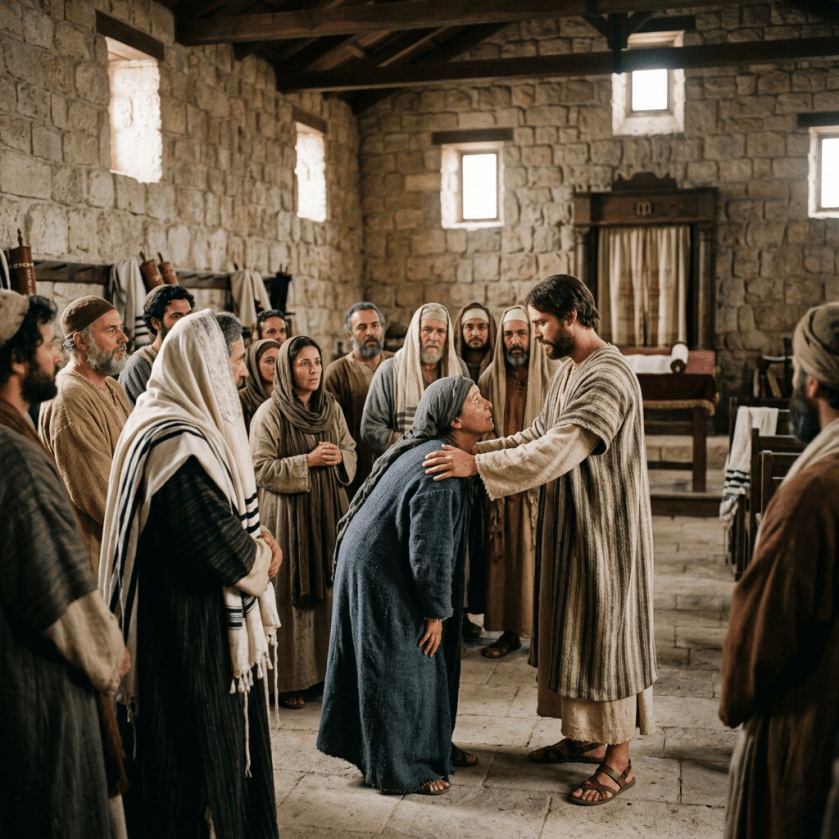
 One Sabbath day as Jesus was teaching in a synagogue, 11 he saw a woman who had been crippled by an evil spirit. She had been bent double for eighteen years and was unable to stand up straight. 12 When Jesus saw her, he called her over and said, “Dear woman, you are healed of your sickness!” 13 Then he touched her, and instantly she could stand straight. How she praised God!

Luke 13:10-13 NLT

Needless to say, I can so imagine this woman with the infirmity hearing Jesus call her to come, and how she must have felt when she heard the words of healing and experienced the compassion that followed: ‘Dear woman, you are healed of your sickness!’ “Then he touched her, and instantly she could stand straight!” Can you just imagine how she must have felt? Oh, the joy that must have flooded her soul! For not only had Jesus seen her, but He called her to Him, spoke healing over her, and then He touched her and made her whole! She was no longer crippled and bound by the power of the demon, but set free ~ standing straight and glorifying God.

Friends, as today’s study journal points out, “We were all bound in sin before we met Jesus.” I’m here to tell you, sadly from experience, we must be careful after we meet Him, lest we become caught up in those chains again. This is why Paul warns believers to “be alert, because our enemy, the devil, prowls around looking for someone to devour.” Satan can never take us from God, but he wants nothing more than to cripple us, binding us up in the mindset and chains of this world. Remember, though, when we belong to Jesus, we have been set free from the chains of sin and death, and Satan no longer has authority over us.

Reflection and Application

The More We Know

In His rebuttal to the angry ruler of the synagogue, commentator David Guzik writes, “Jesus did not respond with gentleness.” Instead, He called the ruler a “Hypocrite!” Guzik continues, “With authority, Jesus confronted the ruler of the synagogue who valued extreme extensions of Biblical commands more than the compassionate and life-changing power of Jesus to heal a long-afflicted woman.”

(Luke 13:15-17)


“Jesus gave several compelling reasons why it was appropriate to show her mercy, and more appropriate than helping a distressed animal.” The first two reasons centered on the ruler himself:

Hypocrite! “Jesus did not respond with gentleness,” but “With authority he confronted the ruler of the synagogue who valued extreme extensions of Biblical commands more than the compassionate and life-changing power of Jesus to heal a long-afflicted woman.”

i. “Thou hypocrite to pretend zeal for God’s glory, when it is only the workings of thy malicious, unfeeling, and uncharitable heart.” (Clarke)

b. Does not each one of you on the Sabbath loose his ox or donkey from the stall, and lead it away to water it? Jesus’ reply was simple. If you can help an animal on the Sabbath, why can’t you also help a suffering person on the Sabbath?

…and then the last four, in compassionate defense of the woman:

· She was a woman – made in the image of God and now long-afflicted

· She was a daughter of Abraham, a Jewish woman, with a covenant connection to Abraham. This may also indicate that she was a woman of faith, as well as her attendance at synagogue.

· She was one whom Satan had bound, and every day is a good day to oppose the work of Satan and to set free his captives.

· She was afflicted for eighteen years, long enough to suffer greatly and to draw forth the compassion of Jesus and others.

Posted in Bible study, Devotion, From the Insideout, Journey Through The Word, Quiet Time, She, Volume 4

The Widow With Oil

Adapted from the study, She, delighting in the women of the Bible, Volume 4/pp89-90

Today’s Scripture for the Journey: 2 Kings 4:1-7

I read this and found myself so sorrowful for the widow. Death had robbed her of her husband, and now, because of her financial situation, a creditor was coming to take her two sons. Thankfully she sought godly wisdom The second book of Kings records that she spoke to Elisha concerning the situation, and his response ended in a miracle of abundant provision. It is important for us to note that Elisha didn’t simply speak to her about one jar of oil and make it many; instead, he prompted the widow to exercise her faith and borrow more vessels from her neighbors. I can’t help but wonder if she was confused at his instruction, for she had told him she had only one container of oil and nothing else, yet Elisha was telling her to get more vessels, empty vessels, and pour out what she had into them, and to keep on pouring until they were full and set them aside.

Friends, we do not read that she questioned him, or that she doubted him, or that she looked to someone else for a different answer; instead, we read that she did what he said to do. As confusing or crazy as it may have seemed to her – she acted in faith and obedience and was richly blessed – not only her but her sons too.

From one vessel of oil and from faith that caused her to act in obeidience and borrow more vessels, to pouring out what she thought was the last of her oil, the oil continued to flow until all of the vessels were full. They were not only full but there was encough oil now in all of the vessels to not only pay off the creditors and save her sons from being taken away, but there was enough left over to live on. Oh, the goodness, the absolute goodness of our God that allowed her to see Him provide exactly what she needed!

This is our God! This is what He does ~This is our God, this is who He is, He loves us, This is our God, this is what He does ~ He saves us… 1He meets us right where we are, and provides exactly what we need.

Reflection and Application

David Guzik points out that “Elisha made this woman commit herself in faith to God’s provision.” Borrowing a container from your neighbor may not seem like a big deal to us, but Guzik goes on to explain that for her “to borrow vessels in this manner would have invited awkward questions, but she did as the word of God through His prophet commanded her.” Because she did, her faith was well rewarded, and now stands as an example for us to remember that God can and does provide exactly what we need.

  • How have you seen the Lord provide for you before?

“God’s miracles are designed to work with our faith and effort, not to excuse our faithfulness. When we cooperate with God’s direction through obedience and trust, we position ourselves to receive His abundant provision beyond what we ask.” A summary of Guzik’s commentary

The More We Know

David Guzik emphasizes how Elisha’s miracles required those he was helping to have active faith – alongside God’s power.

  1. Lyrics to Phil Wickham’s song, This is our God ↩︎

Posted in Bible study, Devotion, From the Insideout, Journey Through The Word, Know These Truths, Quiet Time, She, Volume 4

The Queen of Sheba

adapted from the Bible Study: She, Delighting in the example of the women of the Bible, Volume 4

Today’s Scripture: 1 Kings 10:1-131 and Matthew 12:322 and James 1:5-6

I knew that the Queen of Sheba was in the Bible, but she is another of the women I don’t remember hearing much about or studying. However, after spending some time reading through 1 Kings 10, where we find the largest part of her limited story, I am both inspired and convicted by her. While it isn’t an extensive story, it is evident in the few details we are given that she is meant to be an example of how we should seek the Lord diligently and with determination to know all that we can about Him, and also the encouraging hope that when we do, we will find Him.

The Queen of Sheba, according to the biblical narrative, was a woman of great wealth, beauty, and power. Sheba, believed to be either in Ethiopia or Yemen by most biblical scholars, was a well-established city, and, although there is little evidence outside the Bible as to the nature of the monarchy and how it was established, it is clear that the Queen of Sheba ruled alone and was not enamored with the religions in her own land. ~Gotquestions.org

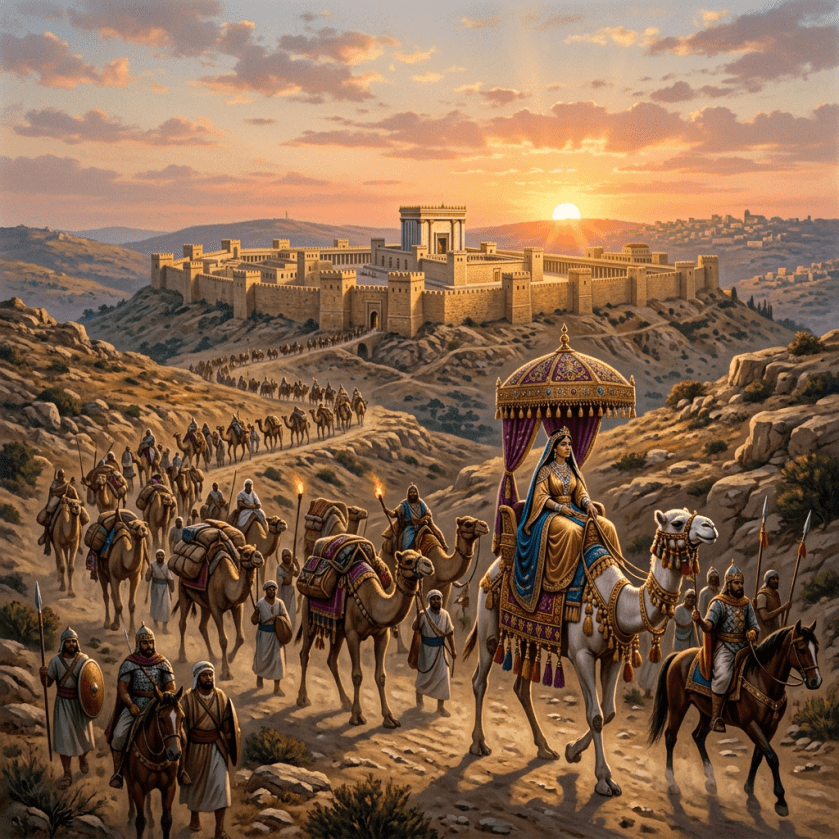
As the story goes, when the queen heard of Solomon’s fame, she also heard of the fame of the LORD. Her interest was more than mere curiosity. So great and serious was her interest in Solomon and his relationship to the LORD that it is said she traveled over 1500 miles to Jerusalem so that she could not only meet him but also question him with “hard questions” (1 Kings 10:1). I love that God’s Word makes it clear that Solomon was not offended or angered by her questions, but without offense or difficulty answered them all. She was more than impressed with Solomon’s answers and all that she saw, as the author of 1 Kings writes, “she was overwhelmed,” or as one translation puts it and David Guzik explains, “She was left breathless 3 by not just Solomon’s wealth, but the happiness, organization, and wisdom of the people he governed.” [1]

She set the bar high ~ leaving us to ask: Do we to such great lengths and search with such great diligence to know the King of kings? Do we long to know His wisdom, greatness, and verify the truths of what we’ve heard?

mefromthensideout

As short as her story is in 1 Kings, a total of a mere 13 verses, she is mentioned again by Jesus in the New Testament, although He refers to her as “Queen of the South” (Matthew 12:42; Luke 11:31). He uses her as an object lesson to “illustrate the point that despite being originally pagan in belief and Gentile in race, the Queen of Sheba recognized the truth and reality of Gosd unlike the religious leader who opposed Jesus. As such, they would be condemned for their ignorant and defiant nature. 4

Reflection and Application

Gotquestions.org suggests that “two lessons can be learned from the story of the Queen of Sheba. First, like King Solomon, believers are to show evidence of God’s favor in their lives, whatever their role, profession, or environment. Second, the reputation of believers should precede them by their godly words and actions, for we are ‘Christ’s ambassadors'” (2 Corinthians 5:20). However, I would offer a third and very valuable lesson to that list. We should seek the Lord diligently and with determination. More specifically, we should make every effort to know all about Him, giving persistent attention to His words, imitating His actions, studying His likes and dislikes, and living accordingly. Like the queen, we should also seek/listen to the wisdom of others who know Him, asking the hard questions, pressing in to understand and know the truths concerning Him. When we pursue Him with such audacity, not only will we find Him, but like the Queen of Sheba, we will discover that He is far greater than we could have even imagined.

Jesus himself used the Queen of Sheba as an example of a seeker (Matthew 12:42), challenging later generations to seek Him with at least the same determination she showed in seeking Solomon. (AI overview of David Guzik’s commentary)

Friends, Let’s live in such a way that when others look at us, they see Jesus and the relationship that we have with Him, and may we be ready with answers for the hope that is within us (1 Peter 3:15).

Prayer of Response: I pray that when others see me or hear me speak, that they see and hear Jesus in me. I pray that they will ask me about my Jesus and find what they have seen and heard from me, not only to be true, but to be better than they even imagined.

  1. parallel passage 2 Chronicles 9:1-12 ↩︎
  2. parallel passage Luke 11:31 ↩︎
  3. (“no more spirit in her”) ↩︎
  4. gotquestions.org ↩︎
  5. David Guzik ↩︎
Posted in Bible study, Devotion, From the Insideout, Journey Through The Word, Quiet Time, She, Volume 4

Miriam

Adapted from the study, She, delighting in the examples of women of the Bible, Volume 4, pp. 45-46

Today’s Scripture Reading: Numbers 12 and 32:23; Exodus 15:20-21

I imagine Miriam is best known as the sister of Moses and Aaron. She was used in the plot to save Moses from certain death, as she watched over her baby brother, Moses, among the bulrushes on the banks of the Nile. Their mother had hidden Moses in a basket on the riverbank to protect him from Pharaoh’s decree to throw all Hebrew baby boys into the river (Exodus 1:22—2:4). Oddly enough, (or perhaps – perfect as planned) as Miriam watches, it is Pharaoh’s daughter who discovers and pities Moses. Miriam quickly intervenes to ask if the Egyptian princess would like a Hebrew woman to nurse the child for her. The princess agrees, and Miriam quickly gets her mother, Jochebed. Not knowing that Jochebed was Moses’ mother, Pharaoh’s daughter commands her to nurse him and bring him back to her when he is older. By the sovereign grace of God, Miriam was used not only to keep Moses safe from the waters but to ensure that Jochebed was the one who nursed and cared for him in the early years of his life (Exodus 2:5–10).

While those are the better-known highlights of Miriam’s story, did you know that she was called a prophetess and led the women of Israel in praising the Lord for His deliverance through the Red Sea? Perhaps you recognize or maybe even have sung the chorus before: “Sing to the Lord, for he has triumphed gloriously; he has hurled both horse and rider into the sea.”

I will sing unto the LORD,
for he has triumphed gloriously,
the horse and rider thrown into the sea.
I will sing unto the LORD,
for he has triumphed gloriously,
the horse and rider thrown into the sea.
The LORD, my God, my strength and song,
has now become my victory.
The LORD, my God, my strength and song,
has now become my victory.
The LORD is God, and I will praise him,
our covenant God, and I will exalt him.
The LORD is God, and I will praise him,
our covenant God, and I will exalt him.

However, as we read in Numbers 12, Miriam’s story isn’t without its troubling moments, particularly after Moses’ marriage to an Ethiopian woman, a Cushite. For some unknown or unnamed reason, Miriam is displeased with the marriage and nudges Aaron to join in her displeasure, as today’s journal entry points out. Her jealousy and criticism of Moses aroused the Lord’s anger, “and He departed, and the cloud also departed from off the tabernacle. When the cloud was gone, Miriam became leprous, white as snow, and she was shut outside the camp for seven days.”1 We may never know why Miriam was so upset over the marriage between her brother and the Cushite, but God makes it clear that her leprous condition is a direct punishment for Miriam’s sin, emphasizing the seriousness of speaking against Moses, His chosen leader. The punishment was meant to serve as a warning against rebellion and slander. As gotquestion.org explains, “the punishment of leprosy was a graphic illustration of sin’s destructive power,” not only to the sinner but to the body of Christ as a whole. In this situation, while Miriam was sequestered outside of the camp for seven days, the people had to postpone traveling on until she had completed the seven days of separation that the Lord had commanded before she could be accepted back inside the camp.

Friends, I have learned the hard way more than once in my lifetime that our thoughts and emotions easily and often direct our words. Whether it is anger, bitterness, jealousy, or some other emotion, we would be wise to heed God’s warning to let our words be those that encourage and build up rather than slander and tear down. As we see in this example of Miriam, this is even more important when we are talking about or “speaking out against” God’s chosen servants.2

The More We Know

  1. Instructions on leprosy ↩︎
  2. Numbers 12:6-9 ↩︎

Posted in Bible study, Devotion, From the Insideout, Journey Through The Word, Quiet Time, She, Volume 4

Lot’s Wife

adapted from the study: She, Delighting in the examples of the women of the Bible, pp39-40

Before we meet Lot’s Wife, let’s familiarize ourselves with Lot. He is the nephew of Abraham. When Abraham and Sarah obeyed the Lord’s call to leave Haran and go to Canaan, Lot went with them. Eventually, their families parted ways, and Lot settled his family near the land of Sodom, a very sinful city.1 

As for Lot’s wife, Scripture does not tell us her name, nor when they met and married. Though some have suggested that “Lot met and married her within the cesspool of Sodom.” Which is exactly where we find them living in our story today. 

Her Story

It is a horrid story and not easy to read, yet to truly understand the story of “Lot’s wife,” it is helpful, if not necessary,  to understand the place and people she has been living among, perhaps her entire life, as some commentators think that this may be where she lived when Lot met and married her. Verses four and five paint a vividly depraved picture of just how steeped in sin the people of Sodom were. Notably, Lot went to great, shocking, even questionable lengths to protect the angels from the riotous mob at his door (6-9). Yet, we must not miss the difficulty Lot and his family had in leaving the city, to the point that the angels had to physically grab hold of their hands and pull them to safety outside of the city. They had been warned that the city would be destroyed and that if they stayed, they would be swept away with it, yet somehow they still struggled to leave.

BUT GOD, in his mercy, had heard the request of Abraham to spare Lot and his family, and the angels delivered them safely outside of the destruction. Before they left them, the angels instructed the family to run for their lives, without looking back or stopping anywhere in the valley. They were to escape to the mountains in order not to be swept away. (vv 1822). 

A Pillar of Salt

Sadly, as Lot led his daughters from the city, his wife “looked back.” As one commentator writes, “She turned her focus to what she was losing instead of looking forward to God’s offer of salvation” (Genesis 19:1–26).

Gotquestions.org points out that “Lot’s wife lagged behind.” While Scripture does not indicate that this was purposeful, it does say that she was following behind Lot (Genesis 19:26). Whatever the reason, she disobeyed God’s instructions through the angels and “looked back.” Because of this, she was “turned into a pillar of salt.” As Bibleref.com explains, “Whether this is a literal, supernatural transformation, or a poetic way of indicating that she was caught up in the destruction due to her delay, the text gives no further details. In either case, God does not let her sin stand.”2

“If we choose to reject the salvation that the Lord has given us, we too will become a pillar of regret.”3

Lot’s wife chose the old over the new, the world over God and His ways, sinful pleasures over the will of God…the way of death over the way of new life. Friends, when we are tempted to ‘look back’(clinging to ways, or people, or things that displease God) we would be wise to “remember Lot’s wife,” just as Jesus said to do (Luke 17:32). May she be a reminder for us to keep our eyes fixed on Jesus, the perfecter of our faith…” so that we do not ‘look back’ and become stuck in our longings for sinful pleasures or regrets of our past. Consider the Israelites,

  • who looked back and longed for the food of Egypt, or as one commentator puts it, “When the Israelites wandered in the wilderness, they often romanticized their past. Despite enduring brutal slavery, they longed for the predictability and familiar foods of Egypt (like fish, cucumbers, and garlic) when faced with the harsh realities and uncertainties of desert life.” [1, 2, 3]

Or this example from my own life,

  • The enemy sometimes assaults me with reminders of the sins of my past, causing my mind to be filled with shame and regret. If I do not quickly turn the thought into a praise of gratitude for God’s mercy and grace, I can get stuck in the muck and mire of regret and lose sight of the blessing of joy in His love and forgiveness. Praise God, the Spirit reminds me that God’s children are not meant to live in shame and regret but in the fullness of joy found in the salvation that is ours through Christ Jesus.  


Jesus’ instruction to “remember Lot’s Wife was meant to serve as a reminder for those who will be among the remnant in the last days. “It is a warning not to seek rescue through things of the world, or to prioritize one’s life over obedience. Even as we trust Jesus’ promises, we must be willing to lose our physical lives, knowing Jesus gives us eternal life” (Luke 17:33). “many will be caught off guard, living normal lives like those in the days of Noah and Lot; Jesus’ followers need to watch the signs and be ready.” As Lot led his daughters from the city, his wife “looked back.” She turned her focus to what she was losing instead of looking forward to God’s offer of salvation (Genesis 19:1–26).

“The language used here might suggest Lot’s wife gazed intently; the point is not that she merely allowed her eyes to take in the catastrophe. The implication of the passage is that in looking back, Lot’s wife was expressing her continuing affection for the sinful culture of Sodom (Luke 17:31–32).4” Jesus’ reminder is meant to help the remnant in that day not make the same mistake.

The More We Know

quotes and added details from gotquestions.org and bibleref.com

Abraham’s plea for the righteous within Sodom … After God indicates His intent to destroy Sodom and Gomorrah for their sins, Abraham tries to convince God to consider the righteous people who might live there. In truth, God already knows that Sodom is doomed, and has no need to justify Himself to Abraham. However, using human language, He has allowed Abraham to discuss sparing the city if a small number of people there are not involved in the city’s pervasive sins (Genesis 13:13; Ezekiel 16:49–50).

Abraham concludes his negotiation with the Lord here, with another request that the Lord not be angry with him, and a promise not to push any further after this. If the Lord finds 10 righteous people in Sodom, will He spare the city for the sake of those 10 people? This particular number was probably Abraham’s goal all along, with the intent of sparing his nephew, Lot, from death in the judgment against Sodom.

Once more, the Lord agrees to Abraham’s request. He will not destroy the city if 10 righteous people are found. Of course, the Lord already knows how many righteous people He will find in Sodom and Gomorrah. He knows what’s coming. Still, He has been gracious and kind to endure Abraham’s pointed questions and requests. In the end, Abraham will know that the Lord is both just in His judgment and merciful in His approach.

We’re fortunate to receive similar warnings. Ephesians 4:22-24 tells us to take off the old self that is ruled by sin and be renewed, putting on the new self that is in the likeness of God. Similarly, 1 John 5:16 says that willful, deliberate sin can lead to death. Lot’s wife wasn’t able to accept that. What she chose to value in her heart led her to sin, which led to her “death”.

The Bible isn’t clear whether Lot’s wife was covered in the salt that rained down with the brimstone or if her remains were dusted with a coating of salt later. But it is interesting that she is described as a “pillar.” The Hebrew for “pillar” refers to a garrison or a deputy, that is, something set to watch over something else. The image of Lot’s wife standing watch over the Dead Sea area—where to this day no life can exist—is a poignant reminder to us not to look back or turn back from the profession of faith we have made, but to follow Christ without hesitation and abide in His love (Luke 17:32).

  1. https://www.gotquestions.org/Lot-in-the-Bible.html ↩︎
  2. Bibleref.com on Genesis 19:26 ↩︎
  3. She, Delighting in the examples of the women of the Bible, p40 ↩︎
  4. quotes in the last two paragraphs from Bibleref.com ↩︎

Posted in Bible study, Devotion, From the Insideout, Journey Through The Word, Know These Truths, Prayer Starters, Quiet Time, She, Volume 4

Herodias

Adapted from the study, She – volume 4/pp33-34.

Unlike most of the women we have journeyed with, Herodius is not a woman we would want to pattern our lives after. We meet her in our story today as the wife of Herod; however, Herod was not her first husband. Before marrying Herod, or Antipas1 as he was also known, Herodias was married to Herod’s half-brother, Philip. The more troubling part of the family connection is that she was also the daughter of Herod’s and Philip’s half-brother Aristobulus, making her their niece. Gotquestions.org states that when Herod was visiting Philip, he met Herodias and fell in love with her. Long story short, she divorces Philip and marries Herod Antipas.

As the study journal describes her, Herodias was one of the most wicked women. While there is no reference in the Bible comparing her to Jezebel,2 many commentators write that she was the “Jezebel of the New Testament”, using a variety of reasons, such as:

  • The Prophet vs. The Queen: Just as Jezebel fiercely opposed and sought the life of the prophet Elijah (1 Kings 19), Herodias held a deep grudge against John the Baptist and ultimately succeeded in having him beheaded. [1, 2, 3]
  • The “Elijah” Connection: Theologically, John the Baptist is recognized as coming in the “spirit and power of Elijah” (Luke 1:17). This makes Herodias’s hostility toward John an exact New Testament mirror of Jezebel’s hostility toward Elijah. [1, 2, 3, 4]
  • Controlling Wives: Both women were highly ambitious and manipulated their weaker husbands (King Ahab and King Herod Antipas, respectively) into carrying out their malicious goals. [1, 2, 3]
  • Using Their Daughters: Both used familial relationships—Jezebel using her daughter Athaliah and Herodias using her unnamed daughter—to achieve their wicked objectives. [1, 2, 3]

The last point (using her daughter) in the list of reasons that she was compared to Jezebel is where we find Herodias in our journey today. You see, Herodias bore a grudge against John the Baptist 3, because he had told Herod that their marriage was unlawful. 4 Herodias wasn’t just bothered by John’s declaration; her grudge was so strong that she wanted to kill him, but without Herod’s approval, she was powerless to do so.5 Herod, while not a fan or friend of John, “knows John is a righteous man and he fears him, plus he liked to listen to John. So, since Herodias is trying to kill John, Antipas holds him in the one place she can’t reach: prison.6

Then his daughter, also named Herodias, came in and performed a dance that greatly pleased Herod and his guests. ‘Ask me for anything you like,’ the king said to the girl, ‘and I will give it to you.’

Mark 6:22

One would think that John’s imprisonment would have appeased Herodias, but prison did not satisfy her; she wanted him dead. So she came up with an evil plan and used her daughter to manipulate Herod when she danced for him at his birthday celebration. Whether the dance was meant to arouse his lust or simply play with his emotions, Harod was so pleased with the dance that he offered her anything she wanted. The girl asked her mother what she should request, and Herodias seized the opportunity and replied: “The head of John the Baptist.” Without hesitation, Herod ordered it done, and John was not only beheaded, but his head was delivered to Herodias’ daughter on a tray, who took it to her mother.

Reflection and Application

Friends, from Herod’s lustful7 desire for his brother’s wife to Herodias’ hurt/angered pride aroused by John’s condemnation of their marriage and the sin of murder that ensued because of the lust and pride ~ is it any wonder that we are warned in Scripture that pride goes before destruction,8 and to “get rid of all bitterness, rage, anger, harsh words, and slander, as well as all types of evil behavior. Instead, we are to be kind to each other, tenderhearted, forgiving one another, just as God through Christ has forgiven us.” 9? Oh, let us not be like Herodias, manipulating an end that we desire – but may our hearts and minds be forever yielded to God, slow to anger, abounding in love, and quick to repent of our sins.

Practical Applications by Bible Hub

• Expect resistance when confronting sin with truth.

• Guard your heart from grudges; unresolved resentment breeds greater evil.

• Public righteousness may cost temporal safety but garners eternal reward (Matthew 5:11-12).

• The gospel calls even Herodias-like sinners to repentance; Christ’s resurrection proves that forgiveness is available to the hardest heart.

Summary

Herodias harbored a grudge against John the Baptist because his uncompromising proclamation of God’s law threatened her illicit marriage, her ambition, and her conscience. Her reaction—rooted in pride, political calculation, and spiritual darkness—culminated in John’s execution, fulfilling the biblical motif of prophetic suffering and underscoring the peril of resisting revealed truth.

The More We Know

  1. The family history of Herod the Great is twisted and confusing. This is especially true given that “Herod” means “king” and seems to have been used as a family name by several members, whether they were recognized as kings by the Roman emperor or not. Herod Antipas is one of at least eight sons. Upon the death of Herod the Great, the kingdom was split into four tetrarchies, and Antipas the Tetrarch was given rule over Galilee, north of Samaria, and Perea, across the Jordan River from Judea. Antipas married the daughter of the king of Nabatea, a nation which bordered southeast Perea, and settled down to a life of irritating the Jews. ↩︎
  2. https://www.gotquestions.org/life-Jezebel.html ↩︎
  3. John the Baptist, the cousin of Jesus, not John the disciple of Jesus. John was related to Jesus, as their mothers were relatives (Luke 1:36). In fact, when the angel Gabriel told Mary that she would give birth to Jesus, he also told her about John. When Mary was carrying Jesus in her womb, she visited Elizabeth, and John leapt in his mother’s womb for joy at the sound of Mary’s voice (Luke 1:39-45).

    Although his name implies that he baptized people (which he did), John’s life on earth was more than just baptizing. John’s adult life was characterized by devotion and surrender to Jesus Christ and His kingdom. John’s voice was a “lone voice in the wilderness” (John 1:23) as he proclaimed the coming of the Messiah to a people who desperately needed a Savior. He was the precursor for the modern-day evangelist as he unashamedly shared the good news of Jesus Christ. He was a man filled with faith and a role model to those of us who wish to share our faith with others.  ↩︎
  4. Mark 6:17-18 ↩︎
  5. Gotquestions.org ↩︎
  6. Gotquestions.org ↩︎
  7. Lust is an intense, overwhelming desire, craving, or enthusiasm. While most commonly associated with strong, uncontrolled sexual attraction, the term is also frequently used to describe a powerful, often obsessive longing for something—such as a “lust for power,” wealth, or adventure. [1, 2, 3, 4] ↩︎
  8. https://www.bibleref.com/Proverbs/16/Proverbs-16-18.html ↩︎
  9. Ephesians 4:31-32 (NLT) ↩︎

Dear Reader: Do you know the Lord of Heaven and earth, the one whom John the Baptist so faithfully proclaimed? If not, I invite you to follow the link to know the truths about who He is, and how He loves you and can save your soul.