3Don’t be concerned about the outward beauty of fancy hairstyles, expensive jewelry, or beautiful clothes. 4You should clothe yourselves instead with the beauty that comes from within, the unfading beauty of a gentle and quiet spirit, which is so precious to God.
1 Peter 3:3-4
We know Peter was addressing wives specifically in this section of his letter, instructing them on how to live. However, the instruction is applicable to all women. To be clear, Peter was not teaching that they should abstain from outward adornment, but rather that they should focus more on inner beauty. This would be the beauty of the heart. Or, as David Guzik explains: “It isn’t something you wear or primp before a mirror to have. It is something you are.” Friends, our inner beauty comes from Christ in us. After all, the presence of His Spirit produces the very fruit of the Spirit we have been exploring: love, joy, peace, patience, kindness, goodness, faithfulness, gentleness, and self-control.
“It isn’t something you wear or primp before a mirror to have. It is something you are.“
According to GotQuestions.org, the term gentle does not imply weakness, but rather self-restraint. If someone is told to be gentle, it implies they can choose not to be gentle. The woman has strength and expresses Christlike strength in meekness or gentleness toward her husband. Peter adds that the godly wife is not only gentle but also has a quiet spirit (1 Peter 3:4). She has a peaceful, well-ordered spirit that allows her to speak and behave in a peaceful, well-ordered way. Peter is not suggesting that low volume is necessary, but rather a character of peacefulness.
The source of our true beauty is to be Christ in us.
Friends, a gentle and quiet spirit is precious to God; this should be our utmost desire. Just as we have to care for and maintain our hair and outward appearance, we must care for our Spiritual life as well. A hairbrush, make-up, and nice, clean clothes go a long way in shaping an outward appearance, but the inner self, the heart, is best kept/maintained by asking God to adorn us with the beauty of gentleness and a quiet spirit. We can’t stop there, though; we must actively maintain a healthy relationship with God, being filled with His Spirit, spending time with Him in prayer, and walking in the light of His Word. When we are filled with His thoughts, His ways, His love, His light, and His Spirit of gentleness and peace, Then, not only will we be precious in His sight, but His gentle and quiet spirit will be evident in us, and those around us will be drawn to Him.
Reflection and Application
So what does cultivating that kind of beauty look like practically? It looks like spending more time reading God’s Word than in front of the mirror. It looks like asking God to tend to the condition of your heart the way you tend to your appearance. It looks like choosing stillness and trust in the moments when anxiety wants to take over.1
Response of Prayer
Holy Spirit, You are welcome here, that we might be women clothed with the beauty that comes from within, the unfading beauty of a gentle and quiet spirit, which is so precious to You and a tool that wins husbands to you and inspires others to give You glory. ~ In Jesus’ name, amen.
The More We Know
Peter instructs married women to show submission to their husbands (1 Peter 3:1). In this case, the purpose is so that even husbands who are not obedient to the Word might be won over by the purity of their wives’ attitude and behavior (1 Peter 3:2).2
LGG, The Fruit of the Spirit, digital journal, p157↩︎
A gentle answer deflects anger, but harsh words make tempers flare.
Proverbs 15:1 NLT
I don’t know about you, but I have had to learn this lesson more times than I can count throughout my life. I have also been the recipient of both kinds of words and can testify to the truth of the proverb ~ and the wisdom of its teaching. Can you?
Friends, whether we’re speaking to a child throwing a temper tantrum, a frustrating spouse, a friend, or a stranger, we would be wise to remember this valuable warning. Words have the power to build up or tear down. They can encourage or discourage, and they can cause irreparable hurt. They can calm a situation or add fuel to the fire. Words matter ~ but delivery (how they are spoken) is equally important and often the greater cause of harm. Consider this: you’re in a conversation with a friend; you aren’t seeing eye to eye; frustration is turning to anger, but the friend speaks calmly to the situation, and tempers cool; no harsh words are spoken. Twist the scenario to heated words, filled with accusations, and undoubtedly the outcome would have been different.
Words matter, but so does the attitude in which they’re said.
A gentle answer can alter not just conversations but emotions. On the contrary, harsh words will not only stir up anger; they will destroy relationships. We must choose our words carefully and use them wisely, caring more about others than saying whatever is on our mind. We must be sensitive to the Spirit and would be wise to daily pray the prayer of the Psalmist, who wrote: “Take control of what I say, O Lord; and guard my lips” (Ps 141:3).
So friends, I’ll leave you with the question that today’s journal entry poses: “What does this look like in your everyday life? I find their answer most helpful and pray you will too – and that all of us will take it to heart.
It looks like taking a breath before you respond to the text that made you mad. It looks like lowering your voice instead of raising it when a conversation starts to heat up. It looks like choosing to listen before you defend yourself.
None of those responses come naturally. Each one requires the Holy Spirit to work in and through us.
Gentleness doesn’t mean you don’t speak. It means you speak in a way that opens doors instead of slamming them shut. And that kind of gentleness, rooted in the Spirit, has the power to turn entire conversations around.1
28 “Come to me, all you who are weary and burdened, and I will give you rest. 29 Take my yoke on you and learn from me because I am gentle and humble in heart, and you will find rest for your souls. 30 For my yoke is easy to bear, and my load is not hard to carry.”
Matthew 11:28-30 NLT
In His infinite knowledge, God knew that those who chose to follow Jesus would carry heavy burdens and need rest. Jesus Himself told those (this includes us today) who wanted to follow Him that they would have to turn from their selfish ways and take up their cross daily. They would have to hate what is wrong and cling to what is good. These requirements aren’t easy for us today, and they certainly weren’t easy when Jesus and His disciples walked this earth. Because of this, God not only sent Jesus to die on the cross for our sins; He also offers His followers, including us, a rest only Jesus can give. We have this rest through the power of His Spirit, who enables us to carry out God’s call on our lives.
It is not only helpful but necessary to understand that Jesus is speaking to a crowd. Some, perhaps many, of the people would have been Jews. “These Jews,” according to bibleref.com, “would have been struggling to know God the Father. Their religious leaders had placed enormous burdens on them (Matthew 23:4), and they were laboring to carry those burdens in hopes of being approved by God. Jesus has just said that He can reveal His Father to anyone, and He immediately offers rest to everyone who is weighed down.”
The rest for the soul that Jesus offers is an internal, spiritual respite, peace of mind, and emotional stability rather than the removal of physical work or life’s trials.
Leslie Schmucker
Core Aspects of Jesus’ Soul Rest (source unknown)
Dimension
Description
Biblical / Theological Meaning
Nature of Rest
Inward calm and refreshment (anapauo)
It relieves the exhaustion of fear, worry, grief, sin, and self-reliance.
The Giver’s Character
Gentle and lowly in heart
Jesus does not shame or crush the weary; He offers a compassionate, steady presence.
The Method (The Yoke)
Taking Christ’s yoke and learning from Him
Walking alongside Jesus as a partner in a shared, balanced load rather than carrying life alone.
The Result
Peace of mind and heart (zoe)
It replaces performance pressure, perfectionism, and heavy legalistic burdens with grace.
Jesus describes the rest not as a physical rest, but as “rest for your souls.” Bibleref.com explains it like this:
The path to the Father through Jesus is not one of weary labor and heavy work. Jesus’ earlier analogy about the path to life being narrow and “difficult” (Matthew 7:14) is entirely separate, and speaking from a different perspective. From the view of the world, following Christ means taking on difficult circumstances and giving up worldly pleasures. From the view of eternity—of salvation—following Christ means giving up the impossible task of carrying our own sin. Christ does not say it here, but the gospel will reveal that Jesus is offering to carry the burden and do the work in order to lead those who come to Him—those who are “yoked” to Him—to the Father (Matthew 11:30; John 6:29).
Bibleref.com/Matthw 11:28
THE PERSPECTIVE OF ETERNITY
What Jesus refers to here, however, is the perspective of eternity. Compared to the impossible task of earning one’s own salvation (Romans 3:20; Galatians 2:16), Jesus offers something infinitely “easier” (Matthew 11:30). By making this comment, Jesus is not offering freedom from commitment. His yoke is still a yoke: it still comes with demands from a holy God. But the apostle John will later write that obedience to the God we love is not burdensome (1 John 5:3). This is true in part, the gospels will reveal, because Jesus will carry the ultimate burden of our sin for us and will provide power in the Holy Spirit to carry out His will. ~Bibleref.com
COMPARED TO
EARNING ONE’S OWN SALVATION
Jewish people described living under obedience to the Law as having a yoke upon them. In Jesus’ time, the Pharisees made that load even heavier by adding manmade requirements and regulations on top of the law of Moses (Matt 23:4)
Friends, Jesus’ offer to swap yokes meant our sins would be placed on Him, and His “yoke and burden”, described as “easy and light”, would be placed on us. ‘While Jesus offers rest and partnership, accepting his yoke still means living under the authority and demands of a holy God, though his grace and strength make them bearable.’1 But these demands (obedience to the God we love) are not burdensome. When we truly understand what God has done for us, what He requires of us, and what comes from following Him, we see that following Him is not a burden but a privilege we do out of love for what He has done for us.
Scripture makes it clear that we are saved by grace, not by works, but through faith in Jesus Christ (Eph 2:8-9). However, Paul goes on to explain that we are God’s masterpiece. He has created us anew in Christ Jesus,2 so we can do the good things he planned for us long ago. So while salvation is a free gift, it comes with a commitment to God,3 but this commitment is not a burden but rather a privilege, as Jesus “carries the burden, the yoke of our sin for us and provides power in the Holy Spirit for us to live out the commitment.”
We must come as disciples to learn, willing to be guided by His yoke – not merely to receive something. 4
· The yoke of Jesus is easy and light as compared with the yoke of others.
· The yoke of Jesus is easy and light as long as we do not rebel against it.
· The yoke of Jesus has nothing to do with worries that are forbidden to us.
· The yoke of Jesus does not include the burdens we choose to add to it.
Jesus is Gentle and Humble in Heart
Jesus knew that gentleness was what weary people needed most. They don’t need more demands, pressure, or performance. Rather, they need a gentle, humble Savior who sees their exhaustion and says, “Come. I’ll take that. Rest here.”
Jesus doesn’t just model gentleness for us. He invites us to learn it from Him. Gentleness is something we absorb as we stay close to Jesus and watch how He treats people. His gentleness toward us shapes our gentleness toward others.
Are you weary today? Come to Him first. Let His gentleness toward you fill you back up. The gentleness you extend to others will always flow from the gentleness you have first received from Him. You cannot give what you have not received. So receive it today. He is waiting.5
d. For I am gentle and lowly in heart: Jesus revealed His nature when He described Himself as gentle and lowly of heart. It is His servant’s heart, displayed throughout His ministry, making Him qualified to be the one who bears our burdens.
e. And you will find rest for your souls: Jesus described His gift to His followers as rest for your soul. This unmatchable gift – both powerful and profound – should be considered the birthright of those who come to Jesus and are His followers. They should believe that something is wrong if they don’t experience rest for their souls.6
Response of Prayer
Lord, I was weary and burdened, and I came to You, and You gave me rest for my soul…Rest from striving, from shame, and so much more through the years. You have taken my yoke, the sin and heavy burdens of my life, upon You, and You have allowed me to experience the ease and privilege of Your yoke, Your gentleness, and Your gentle and humble heart in so many ways. I am most blessed to belong to You and pray that You will help me imitate Your gentle, humble, servant’s heart to the world around me. ~ Amen and Amen
i. “You will find rest for your souls is an echo of the Hebrew text of Jeremiah 6:16, where it is the offer of God to those who follow his way; Jesus now issues the invitation in his own name!” (France)
inspired by the LGG Study, The Fruit of the Spirit / w5d1
Today’s Roadmap for our Journey
Read Numbers 12:1-8
SOAP: Numbers 12:3
Reflections and Application of Today’s Passage
Miriam and Aaron, Moses’ sister and brother, became disgruntled with Moses. They gave the reason for their attitude as his marriage to an Ethiopian woman. However, their words reveal that their real problem was pride and/or jealousy because they had not been recognized as equal leaders with Moses over Israel.
So they said, “Has the LORD indeed spoken only through Moses? Has He not spoken through us also?”And the Lord heard it. ~Numbers 12:21
Of course the Lord heard what they said. God hears everything we say; nothing escapes His attention. Whispered, spoken, shouted, or written on a piece of paper and thrown into the fire, our words and thoughts are always known. God not only heard what they said; He knew the intent of their hearts and called them out on it. When I read this verse, “The LORD spoke immediately to Moses, Aaron, and Miriam: ‘The three of you come to the tent of meeting.’…” I jotted down in the margin of my journal that they were called to the principal’s office. He made it very clear to Miriam and Aaron that their words were offensive. He put them in their place by reminding them that Moses had not elevated himself as leader over Israel, but that He (the LORD) had chosen and called Moses to serve Him in this capacity. Friends, while this is not our focus today, it is a good reminder that we are not to speak against those whom God has called to teach and preach. In fact, we should be afraid to do so; as God points out, they were not only disrespecting Moses, but they were disrespecting God and His authority.
As David Guzik points out in his commentary on this passage, Aaron and Miriam had the pride problem, not Moses, who is identified here as very humble, more so than any man on the face of the earth.2 And this is the focus of today’s journey. Because not every reader uses the same translation of Scripture, note that commentators also define the word for humble as gentle, or meek. These terms, as we understand them, are evident in Moses’ life, particularly in his response to Miriam and Aaron’s words. As today’s journal entry points out, “Moses doesn’t defend himself. He doesn’t retaliate. He doesn’t use his position to put them in their place. He simply remains quiet and lets God handle it.” Some may see this as weakness, but, as the journal also points out, it is a sign of “a strong, settled, surrendered gentleness that doesn’t need to prove itself.” In other words, it is a gentleness (humbleness) that comes from knowing God. More specifically, in reference to our focus on the ‘fruit of the Spirit’, it grows in us through the presence of God’s Spirit. Because His Spirit lives in us, we are no longer to be filled with anger or bitterness; we are not to use harsh words, repay evil for evil, or seek vengeance on those who hurt us. Instead we are to love others as Christ has loved us and we are to forgive as God forgives.3
Just like Jesus, Moses could not deliver when he lived in the palaces of glory. He had to come down off the throne, away from the palace and into a humble place before he could deliver his people.
David Guzik points out in his commentary on Exodus 2:12 that Moses, like Jesus, had to step away from the palace. Jesus left His place of glory with the Father to take on the life of a servant. Moses left his palace as a prince of Egypt to “identify with the people of Israel rather than his Egyptian prestige and opportunity.5”
By faith Moses, when he became of age, refused to be called the son of Pharaoh’s daughter,choosing rather to suffer affliction with the people of God than to enjoy the passing pleasures of sin,esteeming the reproach of Christ greater riches than the treasures in Egypt; for he looked to the reward. (Hebrews 11:24-26)
Friends, I leave you with this question and answer application from today’sjournal entry: “So what does this look like in your everyday life? It looks like pausing before you respond when someone pushes your buttons. It looks like choosing a soft answer in a tense conversation. It looks like letting God defend you instead of scrambling to defend yourself. And sweet friend, the world around you is desperately in need of women who are gentle, just like Moses.”6
Response of Prayer
Father, thank You for Your Word, which is living and active, sharper than any double-edged sword, penetrating every part of us and judging the thoughts and attitudes of our hearts. Thank You for being a loving Father who makes us aware of our sins so we can turn from them and walk in a way that pleases You. Guard our hearts, O God, from pride and jealousy. Help us to live a humble life in the fashion of Moses. Help us, like Jesus and Moses, to step away from those places and things that keep us from reaching the people You have called/sent us to reach for You. Help us to get rid of all anger, rage, bitterness, and harsh words. Guard us from defending ourselves, and instead let You defend us. ~ In the Name of Jesus ~ Amen
Response of Worship
The More We Know
In full disclosure, I am not completely familiar with or affiliated with this speaker and/or his church. I simply found this segment a compelling addition to today’s journey and an interesting insight into Moses and how he dealt with Miriam and Aaron’s complaint.
“More than all men who were on the face of the earth: This statement, if written by Moses, seems to be self-contradictory. It doesn’t seem to be proper for a very humble man to write of his great humility. Though Moses wrote the first five books of the Bible, it is likely that someone added this comment after the death of Moses – perhaps Joshua, who would have known Moses well.” (David Guzik/Enduring Word/Numbers 12:3,b ↩︎
based on the LGG Study, The Fruit of the Spirit, w4d5
Today’s Roadmap for the Journey: Psalm 23: SOAP verse 6
Surely your goodness and unfailing love will pursue meall the days of my life,and I will live in the house of the Lordforever. Ps. 23:6 NLT
Surely goodness and mercy shall follow me all the days of my life: and I will dwell in the house of the Lord for ever. Ps. 23:6 KJV
This is the very first passage of Scripture I remember my dad having me memorize. I’m sure I knew others, but this one will forever stick in my mind as my first memory verse(s). I don’t recall how old I was, but it has stuck with me through the years and has been a pillar of my life. God is not just God to me, for I know Him as a shepherd who has cared for me through the years. His rod and his staff have comforted me more times than I can count or tell. He has led me to green pastures, walked with me through the deepest valleys, and used the crook of His staff to pull me from many pits. Despite the turmoils of this life, whether dangers, deaths, diagnoses, heartaches, unmet needs, or battles with the enemy, I have known both His goodness and faithfulness. Even in times of great need, my cup has been full and often overflowing.
If you’re more familiar with the KJV and/or NKJV, you may be wondering why I’m talking about “goodness and mercy” rather than “goodness and faithfulness.” The answer is simply a slight difference in translations. However, when we look up the meaning of “mercy” in this verse, we find that it is the same covenant-word translated as ‘steadfast love’ elsewhere… Together with goodness, it suggests the steady kindness and support that one can count on in the family or between firm friends. (Kidner)1Other commentators use the term “twin angels” when referring to the term “goodness and mercy”.2 While I have never heard this phrase or description before, I must say I love it! Picturing God’s goodness and mercy/steadfast love always with me, pursuing me, gives me strength and encouragement for all my days ~ whatever they may hold. The ‘twin angels’, goodness and mercy as they have been called, serve as beautiful and powerful reminders that with God as my Shepherd ~ I have nothing to fear for He is always with me…caring, providing, leading, protecting, refreshing and attending to my needs. Or, as Meyer suggested, “we are well escorted” through this life/world3, “with a Shepherd in front and these twin angels behind.”
“We are well escorted, with a Shepherd in front and these twin angels behind!” (Meyer)
“These twin guardian angels will always be with me at my back and my beck. Just as when great princes go abroad they must not go unattended, so it is with the believer.” (Spurgeon)
Enduring Word / Psalm 23:6
Worship Response
Reflection and Application
Looking back over your life, where have you seen God’s goodness and faithfulness pursuing you even in the seasons when you didn’t recognize it at the time?
The More We Know
Derek Kidner (1913–2008) was a British Old Testament scholar, Anglican clergyman, and warden of Tyndale House, Cambridge. His works are widely celebrated for combining concise, reliable scholarship with rich devotional and pastoral insight. [1, 2, 3] ↩︎
Other Beautiful and helpful commentary concerning Psalm 23:
i. “In the Old Testament world, to eat and drink at someone’s table created a bond of mutual loyalty, and could be the culminated token of a covenant… So to be God’s guest is to be more than an acquaintance, invited for a day. It is to live with Him.” (Kidner)
ii. “While I am here I will be a child at home with my God; the whole world shall be his house to me; and when I ascend into the upper chamber I shall not change my company, nor even change the house; I shall only go to dwell in the upper story of the house of the Lord for ever.” (Spurgeon)
The More We Know
Other Beautiful and helpful commentary concerning Psalm 23:
Based on The Fruit of the Spirit study by LGG, week 4/day 4
Roadmap for the Journey: Proverbs 3:1-6; SOAP: Proverbs 3:5-6
Trust in the Lord with all your heart; do not depend on your own understanding. 6 Seek his will in all you do, and he will show you which path to take.
Proverbs 3:5-6. NLT
Friends, trust is not a fruit of the Spirit, but as today’s verses show us, trust is fueled by faithfulness. When we know God, when we make His Word part of our life, learning from His teaching, seeing His love and faithfulness, we grow to trust Him. The proverb encourages us not simply to trust Him but to trust Him with all of our heart, not relying on our own understanding but seeking the Lord, our God, in all our ways. Whether it’s health, finances, jobs, marriage, school, friends, home, church, thoughts …we are to seek (or pray) God’s will in every area of our lives. When we do this, He will answer, showing us His will, providing for us, guiding us, helping us … and, as the proverbs says, He will make the path clear.
Faithfulness is something we wear or carry deep within our hearts. It is something we allow to shape us from the inside out.
The Fruit of the Spirit / digital journal, p131
Today’s LGG Journal poses and answers the question: So what does faithfulness lived out look like? “It looks like opening God’s Word even when you don’t feel like it. It looks like keeping your word when it would be easier to back out. It looks like showing up for the people God has placed in your life, even when no one is watching or clapping. It looks like choosing obedience over convenience, day after day after day.”
Friends, as the journal goes on to say: “Our faithful steps today are not wasted, even when you cannot see where they are leading. Keep showing up. Keep choosing obedience. Keep walking with GOd one quiet, faithful step at a time. He is with you on your journey.” ~ So let’s keep this in mind and keep on keeping on. We do this best when we keep our minds fixed on God, not on the circumstances and/or desires of our lives.
Reflection and Application
In what area of your life do you most struggle to trust God’s direction rather than relying on your own understanding? What would full surrender in that area look like?
Based on the LGG Study, The Fruit of the Spirit / w4d3
Road Map for the Journey: Lamentations 3:19-26; SOAP: Lamentations 3:21-23
21This I recall to my mind, therefore have I hope. 22It is of the Lord’s mercies that we are not consumed, because his compassions fail not.
23They are new every morning: great is thy faithfulness.
Lamentations 3:21-23 ESV
I’ve had these verses tucked in my heart since my senior year of high school, and over the years, God’s sweet Holy Spirit has brought them to mind more times than I can count. They have chased away fears, given me strength to stand when the ground around me felt like sinking sand, and calmed many regrets and disappointments. They have comforted me in times of grief and anchored me in hope when life’s storms raged around me. Seriously, friends, there is great power for every believer who doesn’t just know that God is faithful but stands upon this unfailing truth.
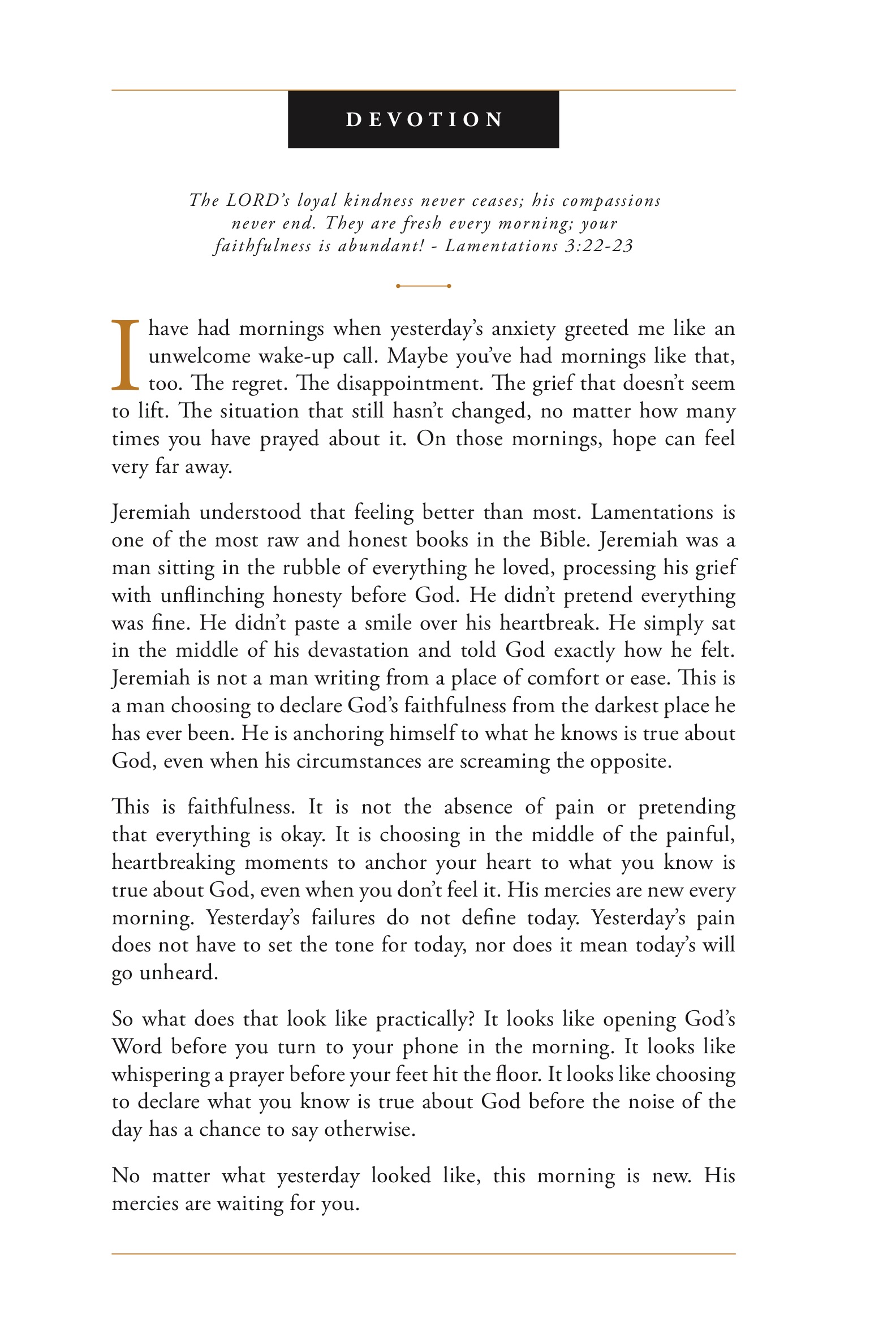
This is faithfulness. It is not the absence of pain or pretending that everything is okay. It is choosing in the middle of the painful, heartbreaking moments to anchor your heart to what you know is true about God, even when you don’t feel it. His mercies are new every morning. Yesterday’s failures do not define today. Yesterday’s pain does not have to set the tone for today, nor does it mean today’s will go unheard.
The Fruit of the Spirit, digital journal, w4d3/LGG
Check out this beautiful devotion by the Love God Greatly Team. I find them sweet, powerful, and encouraging reminders of God’s faithfulness. I’m praying you will too. If you are reading this and don’t know the God of this promise, I invite you to visit the link “Know These Truths” below.
Inspired by the LGG Study, The Fruit of the Spirit/w4d1
Read 1:8-18; SOAP: Ruth 1:16
But Ruth replied, “Stop urging me to abandon you! For wherever you go, I will go. Wherever you live, I will live. Your people will become my people, and your God will become my God.
Rulth 1:16/NLT
Goodness is virtue and holiness in action. It results in a life characterized by deeds motivated by righteousness and a desire to be a blessing. It’s a moral characteristic of a Spirit-filled person. The Greek word translated “goodness,” agathosune, is defined as “uprightness of heart and life.” Agathosune is goodness for the benefit of others, not goodness simply for the sake of being virtuous.
Someone with agathosune will selflessly act on behalf of others. Confronting someone about a sin demonstrates goodness. So do giving to the poor, providing for one’s children, visiting the sick, volunteering to clean up after a storm, and praying for an enemy. Expressions of goodness are as varied as the Spirit is creative.
Gotquestions.org/The Fruit of the Holy Spirit – What is goodness?
“In a world where walking away has never been easier, there is something beautiful and rare about a person who chooses to stay. Someone who shows up when things get hard. Someone who loves without conditions and gives without keeping score. Ruth is one of the best examples of it in Scripture.” Ruth had nothing to gain and everything to lose. She was choosing poverty, uncertainty, and a foreign land. She stayed anyway because her love for Naomi was not conditional, and her commitment was not based on convenience. Their relationship is goodness put on display. Real, costly, Spirit-produced goodness that shows up not only when it is easy but especially when it is hard.
LGG Journal / The Fruit of the Spirit, p112
Although the dialogue between Ruth and Naomi doesn’t mention goodness, according to gotquestions.org’s definition, I believe it was on full display in both women. Both women beautifully expressed goodness in action by yielding to what would benefit the other. Naomi understood that Ruth, a Moabite widow in a foreign land, had no certainty of provision, so she set her free to stay with her Moabite family. At the same time, Ruth understood that Naomi was returning to her people as a widow with no immediate family and no certainty for the future, so she insisted on going with Naomi.
Whether Ruth stayed out of loyalty to or love for Naomi, her words declared devotion to both Naomi and her God (the God of Israel). This was not simply an act of kindness or an attempt to do ‘the right thing’; I believe it was an outward act of selfless love and goodness to her mother-in-law, who, as a widow herself, had no independent income or legal standing, even when she returned to her people.1
Ruth had nothing to gain and everything to lose. She was choosing poverty, uncertainty, and a foreign land. She stayed anyway because her love for Naomi was not conditional, and her commitment was not based on convenience. Their relationship is goodness put on display. Real, costly, Spirit-produced goodness that shows up not only when it is easy but especially when it is hard. LGG Journal / The Fruit of the Spirit, p112
gotquestions.org, explains that “Goodness is not a quality we can manufacture on our own. James 1:17 says, ‘Every good thing given and every perfect gift is from above, coming down from the Father of lights.’ This certainly includes a life characterized by goodness. In letting the Holy Spirit control us, we are blessed with the fruit of goodness. As others see our good works, they will praise our Father in heaven (Matthew 5:16).” Friends, may this be our desire and goal.
Reflection and Application
Is there a relationship or situation in your life right now where God is calling you to show up with Ruth-like goodness to stay when leaving would be easier?
Response of Prayer
Father, I confess it isn’t always easy to be selfless, to be other focused – forgive me when I fall short of living out or showing ‘goodness’. Thank You for Your Spirit in me who is able to make goodness abound in me. May goodness be a virtue that others see displayed in my life and may they give You the glory that You deserve. ~Amen
The More We Know
If a widow was a foreigner who had married into an Israelite family, her situation was doubly perilous. She lacked the local kinship network that might otherwise step in out of charity. Additionally, certain groups (like the Moabites) faced strict religious and social integration prohibitions. [1, 2, 3]
For a foreign widow to survive, she either had to return to her biological family in her pagan homeland (as Naomi urged Ruth and Orpah to do) or rely completely on the community’s adherence to God’s commands regarding the compassionate treatment of the ger (stranger/foreigner). [1, 2] ↩︎
Based on The Fruit of the Spirit Study, by LGG / W3D4
Today’s Road Map for the Journey: Ephesians4:29-32; SOAP: Ephesians 4:31-32
31 Get rid of all bitterness, rage, anger, harsh words, and slander, as well as all types of evil behavior. 32 Instead, be kind to each other, tenderhearted, forgiving one another, just as God through Christ has forgiven you.
Ephesians 4:31-32. NLT
If we want to be kind, we must first “put away” or get rid of everything that stands in the way or in opposition to kindness. Paul shares a whole list of negative attitudes and actions we must eliminate from our lives to truly be able to show kindness to others.
The old saying/song, “accentuate the positive, eliminate the negative,” came to mind as I was writing the previous sentence. A good oldie that is described as: “a classic American standard structured like a sermon that encourages listeners to focus on the affirmative.” Warning: it’s one of those that gets in your head and keeps on going.
This Scripture reveals a blanket principle for all people: “…our words always eventually reveal what’s going on inside of us. There’s no such thing as an unimportant act or an unimportant word.”(bibleref.com/Matthew12:36)
“Out of the mouth flows the overflow of the heart,” is another statement that comes to mind…for if my mind and heart are filled with bitterness, rage, and anger, the overflow will not be kindness but harsh words and/or slander. Even if I’m not angry with you, if my mind/heart is saturated with anger, it will control me; it will interfere with, if not completely block, any positive attitudes, actions, and words. (see Bibleref.com)
I’ve known some angry people in my lifetime. They weren’t necessarily angry at “something or someone”; under the right circumstances, they could be kind, helpful, and caring. However, there was almost always an edge about them. Something in life had left them battling bitterness and anger. These attitudes simmered somewhere beneath the surface of their being and seeped into their conversations and demeanor. The littlest thing could set them off, leaving those around them wondering what happened. On the flip side, I have seen how a kind deed or word can make a bad day better or even soften an angry person’s heart and actions. As today’s LGG Journal entry points out, “kindness has a way of doing what nothing else can.”
Paul knew we would need a reason to choose kindness when it felt hard. So he gave us the best one there is. Be kind and compassionate, forgiving each other, just as God forgave you. It is not because the other person deserves it. It is because you have already been on the receiving end of a kindness you didn’t deserve either. This truth changes everything.
Freely given. Completely undeserved. That is the kindness Jesus models for us. And His kindness has the power to change every relationship, room, and heart it touches.
LGG Journal/The Fruit of the Spirit/p98
Response of Prayer
Father, this world, and the people and situations we encounter in it, often give us ample reasons to be bitter and/or angry. But Your Word instructs us to put away bitterness, anger, and other less-than-godly attitudes. Instead, we are to be kind to each other, tenderhearted, forgiving one another, just as You, through Christ, have forgiven us. It isn’t always easy, but as we have mentioned many times on our journeys, we have been filled with His Spirit and able to do all things through Christ who strengthens us. May kindness define us so others will see Jesus in us. ~Amen and Amen!
Reflection and Application
Is there a relationship in your life where bitterness has quietly taken root? What would it look like to begin the process of choosing kindness and forgiveness in that relationship?
Based on The Fruit of the Spirit Study, by LGG / W3D2
Today’s Road Map for the Journey: Romans 5:1-5; SOAP: Romans 5:3-4
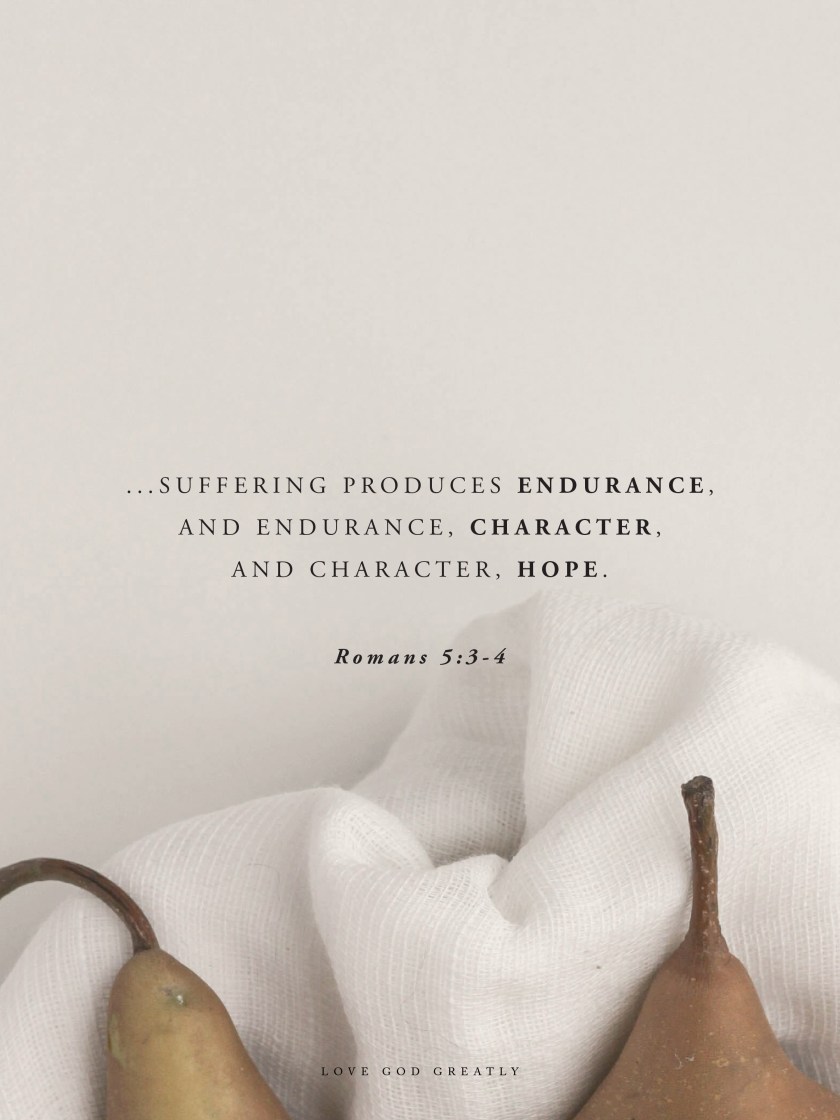
3Not only this, but we also rejoice in sufferings, knowing that suffering produces endurance, 4and endurance, character, and character, hope.
Romans 5:3-4
My daughter’s cancer diagnosis was not a cup I would have chosen, but I know that it is one that God used to develop, deepen, and strengthen my faith. Her illness and all of the suffering that came with it were used to teach and convince me that God is good, full of compassion, and abounding in love and grace. Through that difficult time, I experienced firsthand how intimately involved He is in His people’s lives. I saw just how purposeful, timely, and faithful He truly is. Without question, the suffering produced endurance as I learned to persevere through each day, every test, setback, and hospital stay. Little did I know then that, through it all, God was teaching me to trust Him on a different level, and that this new level of faith was producing in me a desire to live more faithfully for Him, to please Him in every aspect of my life. I believe this is what Paul refers to, in the passage of our journey today, as “character”.
While Annie’s suffering eventually ceased and life returned to ‘normal’, my trust in God has continued to deepen through a variety of other trials, each with its own source of suffering, developing an unshakable hope that God will do all He has promised. No matter what comes my way, I am fully convinced that my “ultimate end will be sharing in the glories of God forever1“. Instead of fearing the next ‘bad or difficult thing,’ I strive to keep my eyes on Him, convinced – along with Paul2 – that regardless of what trouble may come, neither height nor depth nor anything else in all creation will be able to separate me from the love of God that is mine in Christ Jesus. These years and the lessons that came from Annie’s suffering and my suffering as her mother weren’t wasted, nor were they cruel. They were moments, some better than others, but they all taught and trained me and reshaped me from the inside out, so that I’m not who I used to be.
Hope implies some level of certainty that we will receive God’s good forever. Hope defines the baseline or a “bottom line” for a Christian’s thoughts and emotions. No matter what comes along, we are fully convinced that our ultimate end will be sharing in the glories of God forever.
Bibleref.com
During those three+ long years, He broke countless chains, reshaped my thought processes, and solidified my faith with roots that are planted deep and growing deeper still. He was literally making me into a new creation! He taught me to trust and love… to wait and watch… To listen…To hunger for and study His Word… To love others more than self and Him most of all… To walk in His light, His truth, His way, and not the world’s darkness or my own desires. He showed me what Christian friendship looks like and how to be a friend to others. He taught me the gift of prayer is not just an item on a to-do list but one of the greatest privileges we have been given.
Refelction and Application
What season of waiting or suffering in your life right now could God be using to develop patience and Christlike character in you?
Response of Worship ~
I’ve included the lyrics because I think they are a beautiful and powerful message that we would do well to adopt as a mantra/song in the storms of this life.
Day by day, I’m learning how to stay In the middle of the storm I’m learning where to lay my head And step by step, I’m learning how to listen In the middle of the noise I will listen for Your still small voice
[Chorus 1] So let the thunder roll And I won’t be afraid, ’cause You roll the thunder And let the rain beat hard Upon my roof, and I’ll dance to its rhythm And let the mighty wind Blow between the oak trees As I let You steady me ‘Cause You’re right here in the whisper Of my heart
[Verse 2] Breath by breath, I’m learning what You say When You told me I could trust Even when the storm is raging on And song by song, I will sing of Your great love While You’re singing it back to me With the very voice that calmed the sea
[Bridge] So say peace be still To every beat of my heart Say peace be still To every thought in my head I know Your voice, and I will listen and obey Every time You call, in the night
[Chorus 2] So let the thunder roll And I won’t be afraid, ’cause You roll the thunder And let the rain beat hard Upon my roof, and I’ll dance to its rhythm And let the mighty wind Blow between the oak trees As I let You steady me ‘Cause You’re right here in the whisper You’re right here in the whisper You’re right here in the whisper Of my heart
[Outro] You’re right here in the whisper You say peace be still Say peace be still