Posted in Bible study, Devotion, From the Insideout, Journey Through The Word, Know These Truths, Love, Quiet Time, She, Volume 3, The Gospel

The Woman Caught In Adultery

Adapted from the She Study, delighting in the examples of the Women of the Bible, volume 3, pp 87-88

Today’s Scripture: John 8:1-11 and 2 Corinthians 5:17; Roman 8:1

Have you ever been ‘caught’ in a sin? You’ve said something you shouldn’t have, and others heard it…you’ve lost your temper, and others saw your outburst of anger…you’ve lied and been caught in its web…you’ve treated someone unkindly, and others saw it…? I would dare say that everyone reading this has at one time or another spoken words you shouldn’t have … reacted in anger … lied … and/or been unkind … for the Bible says that “all have sinned and fall short of the glory of God.” However, we are not always ‘caught in the sin’. While we may breathe a sigh of relief to have escaped ‘being caught’ by others, it is crucial to remember that nothing escapes the eyes or ears of our Heavenly Father. Forgetting this truth can lead to danger as the theory that “no one knows or cares” makes it far easier to continue in the sin and find ourselves held captive by it.

God is considered omniscient, meaning He knows absolutely everything—past, present, future, and all possibilities. This includes knowing every thought, action, and secret of every person ~

Billy Graham Evangelistic Association1

As he was speaking, the teachers of religious law and the Pharisees brought a woman who had been caught in the act of adultery. They put her in front of the crowd. They said to him, “Teacher, this woman has been caught in the act of adultery.Now in the Law, Moses commanded us to stone such women. So what do you say?”

John 8:3-5

It should be noted here that while this woman was at some point “caught in the act of adultery,” it is believed by some commentators that she had not just “been caught” and brought immediately before Jesus, but had, at some point been caught, and was known to be an adulterer.2 Here, she was being used as a pawn by the Pharisees, who were attempting to prove that Jesus was not following God’s law. The Pharisees make many mistakes in their failed attempt to discredit Jesus, which bibleref.com verse-by-verse commentary points out in more detail.3 However, we would be wise to pay attention to how Jesus uses their trap not only to silence his accusers but to set this woman free from the condemnation of sin and death that her sin required.

They kept demanding an answer, so he stood up again and said, ‘All right, but let the one who has never sinned throw the first stone!’Then he stooped down again and wrote in the dust. When the accusers heard this, they slipped away one by one, beginning with the oldest, until only Jesus was left in the middle of the crowd with the woman.
~

John 8:7-94

Jesus appears to ignore them at first (v6), and “when they continue asking him, he lifted up himself, and said unto them, ‘He that is without sin among you, let him cast a stone at her'” (v7-8). Verse nine of John chapter eight, says that “When the accusers heard this, they slipped away one by one, beginning with the oldest, until only Jesus was left in the middle of the crowd with the woman.” Which, by the way – it is worth noting that the woman cound have fled with her accusers but instead, she remained in the presence of Jesus.

Then Jesus stood up again and said to the woman, ‘Where are your accusers? Didn’t even one of them condemn you?’
~
‘No, Lord,’ she said. And Jesus said, ‘Neither do I. Go and sin no more5.’

Friends, while the words Jesus spoke to the woman, “Neither do I condemn thee…” offer her mercy and pardon for her sin, they granted her freedom from the condemnation of the sin and death required by the law. They also offered hope of freedom from the sin itself, as He told her: “Go and sin no more.” Sweet friends, hear me when I say – that as one who has been held captive by sin before, I can tell you that there are few other hopes as meaningful and freeing as this one. Even as I write this my heart fills with the words from an old hymn that is my life’s story: ….“Mercy there was great, and grace was free; pardon there was multiplied to me; There my burdened soul found liberty, at Calvary.”

Reflection and Application

  • How do we become “a new creation”?
    • 2 Corinthians 5:17

The More We Know

While we don’t know what Jesus wrote, we do see how He turns the hypocrisy of these Pharisees against them. They were not wrong to seek justice under the Law. However, they are clearly not following it fully; they have only brought half of the guilty ones. Also, God’s law prioritized mercy over blind punishment (Proverbs 21:10Zechariah 7:8–9Matthew 23:23).

  1. https://billygraham.org/answers/does-god-know-everything-i-think-and-do ↩︎
  2. If the woman was caught “in the act,” then so was the man she was with—so where is the guilty man? This entire episode is an attempt by Pharisees to show that they follow the Law and Jesus does not. But even their trap fails that test: they’ve only brought half of the guilty parties (Leviticus 20:10Deuteronomy 22:22).
    The act of “placing her in the midst” is part of the Pharisees’ intended drama. This is meant to be as public as possible. That means Jesus’ response can be given as much publicity as possible. Of course, that strategy assumes Jesus is about to make a serious public-relations error. This assumption is once again false. ↩︎
  3. bibleref.com ↩︎
  4. ~ ‘No, Lord,’ she said. And Jesus said, ‘Neither do I. Go and sin no more.↩︎
  5. Go and sin no more: Jesus sent her away with a call to stop her sin, and to continue stopped in regard to that sin. He sent her away without ever approving of or accepting her sin.
    i. “The form of the command implies a ceasing to commit an action already started: ‘Stop your sinful habit’. And the ‘no more’ points to the thought of no return.” (Morris)
    ii. Jesus did several things with these powerful words.
    · He recognized that what the woman had done was sin, because He told her to stop sinning.
    · He told her to repent, and to not continue her sin.
    · He gave her hope that her life could go on in freedom from sexual sin.
    · He gave her a word of hope to speak against the shame that would later likely threaten to overwhelm her life.
    iii. The woman needed hope because the consequences of her sin would be severe enough. After this she would likely be shunned by her community, and rejected by her husband, perhaps even divorced (assuming she was married or betrothed). ↩︎
Posted in Bible study, Devotion, From the Insideout, Journey Through The Word, Know These Truths, Prayer Starters, Quiet Time, She, Volume 2

Ruth, Part 3

Adapted from She, Volume 2, pp 67

Read: Ruth 2:14-23

There is a version/translation of the Scriptures called the Message. I’m assuming most are at least familiar with it but if you aren’t it is, as Christianbooks.com describes it, “a unique, contemporary paraphrase of the Bible that captures the heart, tone, and vibrant imagery of Scripture in everyday language—making it an inspiring choice for personal devotion, fresh insights, and connecting with God’s Word in a relatable, emotionally engaging way that speaks powerfully to both new believers and longtime readers alike.” ~While I do not use the Message as a study Bible, I do appreciate its tone and imagery – particularly in books like Ruth, as it seems to capture the heart and voice of the characters and the all-encompassing love and personal care of our God.

14 At the lunch break, Boaz said to her, “Come over here; eat some bread. Dip it in the wine.”

So she joined the harvesters. Boaz passed the roasted grain to her. She ate her fill and even had some left over.

15-16 When she got up to go back to work, Boaz ordered his servants: “Let her glean where there’s still plenty of grain on the ground—make it easy for her. Better yet, pull some of the good stuff out and leave it for her to glean. Give her special treatment.”

17-18 Ruth gleaned in the field until evening. When she threshed out what she had gathered, she ended up with nearly a full sack of barley! She gathered up her gleanings, went back to town, and showed her mother-in-law the results of her day’s work; she also gave her the leftovers from her lunch.

19 Naomi asked her, “So where did you glean today? Whose field? God bless whoever it was who took such good care of you!”

Ruth told her mother-in-law, “The man with whom I worked today? His name is Boaz.”

20 Naomi said to her daughter-in-law, “Why, God bless that man! God hasn’t quite walked out on us after all! He still loves us, in bad times as well as good!”

Naomi went on, “That man, Ruth, is one of our circle of covenant redeemers, a close relative of ours!”

21 Ruth the Moabitess said, “Well, listen to this: He also told me, ‘Stick with my workers until my harvesting is finished.’”

22 Naomi said to Ruth, “That’s wonderful, dear daughter! Do that! You’ll be safe in the company of his young women; no danger now of being raped in some stranger’s field.”

23 So Ruth did it—she stuck close to Boaz’s young women, gleaning in the fields daily until both the barley and wheat harvesting were finished. And she continued living with her mother-in-law.

Ruth 2:14-23 ~The Message

What a beautiful love story that unfolds on the pages of Scripture as God leads Ruth to the field of Boaz, one of their Kinsman Redeemers, and the heart and actions of Boaz respond with tender compassion and protection for Ruth and her mother-in-law.

Equally as beautiful is the visible melting of Naomi’s bitterness when she hears what God has done for them and declares, “Why, God bless that man! God hasn’t quite walked out on us after all! He still loves us, in bad times as well as good!” (Ruth 2:20).

Friends, this is such an important truth for us to know and remember throughout all of life. Even when life is overwhelming and the way ahead seems uncertain, we have the promise of God’s never-ending love and wisdom. We have the promise that He will never leave us or forsake us, and that He will lead us and guide us by His Spirit and His Word.

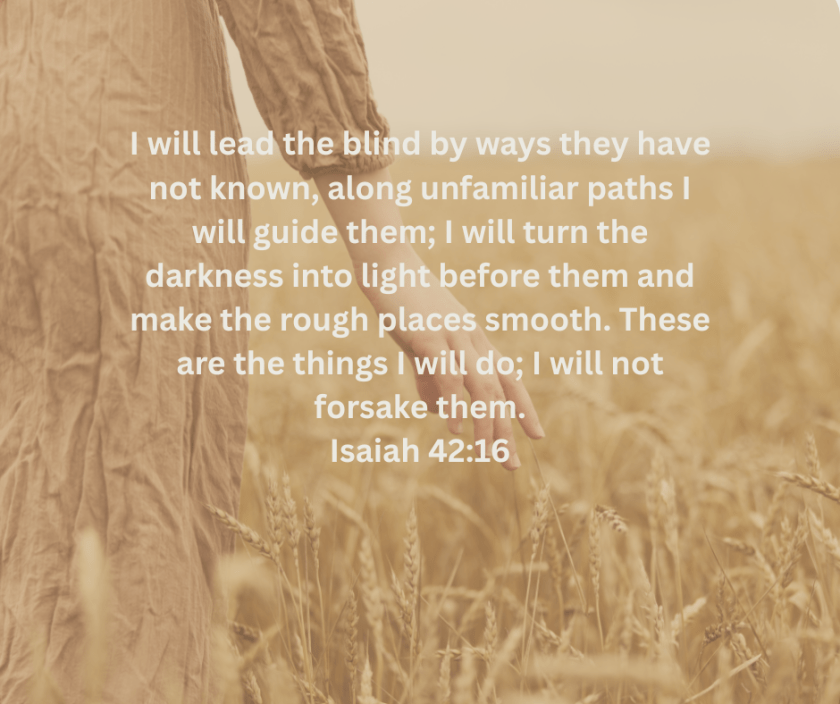
I will lead the blind by ways they have not known, along unfamiliar paths I will guide them; I will turn the darkness into light before them and make the rough places smooth. These are the things I will do; I will not forsake them.

Isaiah 42:16

Isaiah 42:16 was the passage of a morning devotion I recently read, and it came to mind as I was working on today’s journey through Ruth chapter 2, where Ruth knew no one and was desperately trying to help provide for herself and Naomi. There is no indication that she knew which fields were safe or who they belonged to. There is, however, overwhelming evidence that God was guiding her along unfamiliar paths, turning her darkness into light, and making the rough places smooth. Ruth had chosen to leave her pagan gods and family behind, committing herself not only to Naomi but to her true and living God, the faithful God of Israel. Now, she would begin to realize His love and personal involvement in her life as He provides not only safety but the attentiveness of a kinsman redeemer and the handfuls of barley purposefully dropped along the path for her to pick up as she gleaned.

She returned home to Naomi with the reserve of barley, and the amount sparked the interest of her mother-in-law.1

The passages (Ruth 2:14-23 and Isaiah 42:16) are worth rereading, for they reveal the absolute beauty of God leading, guiding, planting … us where He wants us, both for our good and His purpose and glory. Even the Isaiah passage is evidence of that truth in my own life, as I had not gone looking for the verse, the people who post the daily verses do not know me or what I would be studying – nor do I believe it is a mere coincidence, but rather the beautiful direction and timing of our lovingly purposeful, sovereign God.

May God continually open our eyes and hearts to behold all the wonderful things in His Word and His work in and around our lives. May we, as Naomi, trust, see, and declare that, regardless of how difficult our days and situations may be, God has not abandoned us, He still loves us – “in the bad times as well as good,” and may we bless His Holy Name.

Why, God bless that man! God hasn’t quite walked out on us after all! He still loves us, in bad times as well as good!” Naomi went on, “That man, Ruth, is one of our circle of covenant redeemers, a close relative of ours!”

Ruth 2:20

I love that we not only see Naomi’s scales of bitterness falling away, but we can hear the restored hope in her words to Ruth (2:20). We can also hear the beautiful evidence that she truly considered Ruth her daughter. As we move toward the end of our journey with Ruth over the next day or two, we will see that those around Ruth could see these truths as well.

Reflection and Application

What have you recently gleaned from the Word of God?

The More We Know
  1. She, Volume 2/p67 ↩︎
  2. She, Volume 2/p67 ↩︎

Posted in Bible study, Devotion, From the Insideout, Journey Through The Word, Quiet Time, She, Volume 2

Ruth, Part 1&2

Adapted from She, Volume 2, pp 63-66

Read: Ruth 1-2:13

In yesterday’s journey, we focused on Naomi, who, along with her husband and sons, had left their Bethlehem home during a drought to dwell in the land of Moab. While they were there, not only did Naomi’s husband die, but her sons, who had married Moabite women, also died. For at least ten years, Naomi continued on in Moab with her widowed daughters-in-law, Orpah and Ruth. Our journey picks up today with the story of Ruth, who, when Naomi decided to return to Bethlehem, left all that she knew behind and committed herself not only to her mother-in-law but to her God.

Ruth replied, “Don’t ask me to leave you and turn back. Wherever you go, I will go; wherever you live, I will live. Your people will be my people, and your God will be my God. 17 Wherever you die, I will die, and there I will be buried. May the Lord punish me severely if I allow anything but death to separate us!”

Ruth 1:16-17

Ruth did not have to do this; Naomi had released both of her daughters-in-law from any obligation they may have felt by cultural tradition or allegiance to her sons that they owed her. She encouraged them to return to the homes of their own mothers. Orpah chose to do so, but Ruth, as Scripture bears witness, chose to leave not only her family but the gods of Moab behind.

Ruth was strong, courageous, bold, brave, and determined.

She, Volume 2, p64

As today’s study journal points out, Ruth was not only strong but she was also courageous, bold, brave, and determined. As we journey through her story, we will see how God used these characteristics to accomplish not only His purpose for her life but also for His people. We will watch Naomi’s bitter spirit come alive with joy, and we will see God divinely direct Ruth’s path to a “happily ever-after, purpose-filled ending”. Though I’m sure it didn’t seem that way to her at first.

Ruth is new to town, widowed, along with her widowed mother-in-law, who is admittedly struggling with bitterness. “They have no man to protect or provide for them, and no source of income,1” but Ruth does not shy away from doing what is necessary to survive and provide. It would not have been uncommon, in their situation, for her to have to beg, become a prostitute, sell herself as a slave, or glean.2 However, as God would have it, Ruth and Naomi arrived in Bethlehem at the beginning of the barley harvest, so Ruth sought Naomi’s approval to glean. While gleaning sounds like the best of the options the women had, it came with its own problems and dangers, and, depending on the field you found to glean in, there was little to no promise of a profitable haul, as gleaners were limited not only in what would be left but in what they could take. In addition to these hurdles, there was the added challenge that Ruth was a Moabite and may not find a field where the owner would allow her to glean. There was also the real and present danger of assault because she was not only a young widow but a foreigner.

“There is nothing safe about Ruth going to glean in an Israelite’s field. She is wise to request permission from the harvest manager.”

I am a firm believer that there are absolutely no coincidences with God. So when we read that Ruth ended up in the field of Boaz, a relative of her dead father-in-law, Elimelech, we are allowed to see that she was divinely directed by God to this particular field.

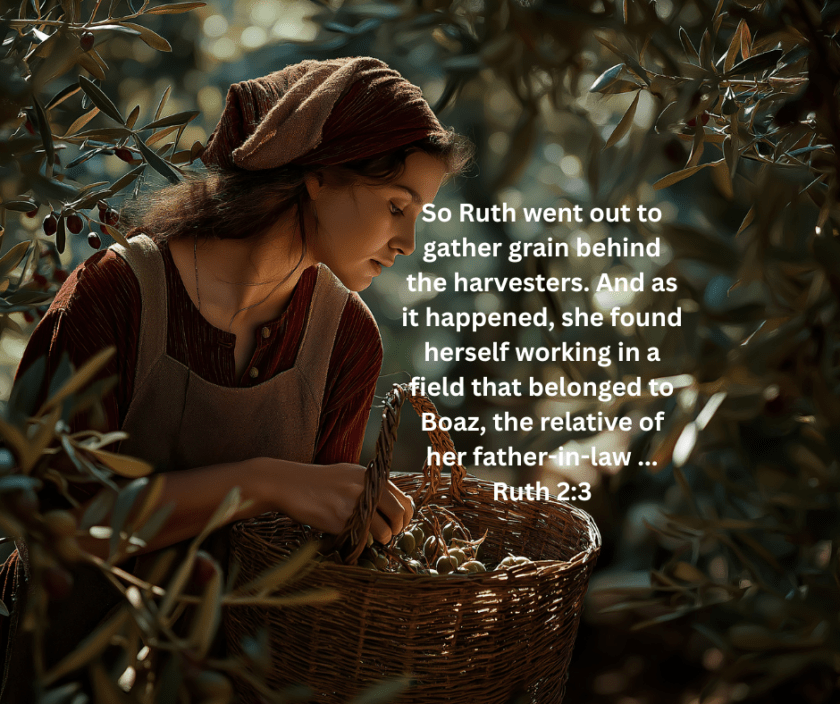
So Ruth went out to gather grain behind the harvesters. And as it happened, she found herself working in a field that belonged to Boaz, the relative of her father-in-law, Elimelech.

Ruth 2:3

When Boaz arrives and sees Ruth, he is curious and talks to his foreman about her. The foreman explains who she is and gives a glowing report of her work, which moves Boaz to talk to Ruth and encourage her to stay and work with them, telling her she will be safe and enjoy the privilege of water to drink and food to eat. Ruth is so moved by his kindness that she fell at his feet with gratitude, and asked him, “Why have I found grace in thine eyes, that thou shouldest take knowledge of me, seeing I am a stranger?

Boaz gave Ruth his field to glean from freely.
God has given us His Word and He shares it with us freely.


May we be mindful of where we are spending our time, and from what (whose) field(s) we are gleaning.

She, Volume 2, p66

As we read in verses 15 and 16, Boaz also made sure she would have good success in her gleaning. She had so much success that when she arrived home, Naomi’s surprise and joy were evident as she gathered details from Ruth about the day and how the Lord had blessed them by sending her to Boaz’s field.

That man is one of our closest relatives, one of our family redeemers.

Ruth 2:20

Friends, it is worth noting that if Ruth had returned to her mother’s home as Naomi had encouraged her, she might never have met Boaz and known the blessing of God’s hand on her life in the days and years to come.

It was no accident that God directed her to the field of Boaz.

“she went”
God gave her the faith to go.
“and came”
God directed her steps of where she should go.
“and gleaned”
God provided exactly what she needed, when and where she needed it.

She, Volume 2/p45
The More We Know

I love that the journal for today points out that not only did Boaz encourage Ruth to stay, but that he knew no other field could meet her need, and that “the field” is a picture of the Word of God. Oh may we continually glean3 from His Word.

Posted in Bible study, Devotion, From the Beginning to Forever, From the Insideout, Journey Through The Word, LGG Study

Listen and Obey

Based on the LGG Study, From the Beginning to Forever/w3d4

Read: Ex 20:1-21 and Deuteronomy 6:4-15; SOAP Deuteronomy 6:5

“Listen, O Israel! The Lord is our God, the Lord alone. And you must love the Lord your God with all your heart, all your soul, and all your strength. And you must commit yourselves wholeheartedly to these commands that I am giving you today. Repeat them again and again to your children. Talk about them when you are at home and when you are on the road, when you are going to bed, and when you are getting up. Tie them to your hands and wear them on your forehead as reminders. Write them on the doorposts of your house and on your gates. Read More

Deuteronomy 6:4-15

“When the Israelites had crossed through the Red Sea, God gave them rules by which to live. This is known as the law. The law was meant to reveal the people’s sin and show their need for God’s grace. It was also meant to show them what a holy life looks like.”

From the Beginning to Forever/p107

These rules and this message are specifically to the people of God. A message that emphasized the importance of God’s people loving Him. It wouldn’t be an easy command to keep because it wasn’t simply a feel-good type of love. For Israel, God’s children, this love required every part of them ~all of their mind, all of their being, and all of their strength. They were not only to obey the commandment to love like God with their whole being, but they were also not to forget the commandment. Again, not as easy as it may sound because they weren’t just to obey the commandment(s), but they were to “keep them in mind, teach them to their children, speak of them (verse 6) all throughout the day and evening. They were to be written down and put in places where they would be seen and remembered easily.

God knew that the people could never fully uphold the law. This is why they needed a Rescuer.

From the Beginning to Forever/p107

So, why were these words of instruction so important? Why is there a mandate to remember them, talk about them, and teach them to the children? The answer is found, at least in part, in Deuteronomy 6:12-15 – where we read: be careful not to forget the Lord, who rescued you from slavery in the land of Egypt. 13 You must fear the Lord your God and serve him. When you take an oath, you must use only his name. 14 “You must not worship any of the gods of neighboring nations, 15 for the Lord your God, who lives among you, is a jealous God. His anger will flare up against you, and he will wipe you from the face of the earth. However, David also addresses the purpose/benefit of remembering the commandment(s) when he wrote: “I have hidden Your Word in my heart that I might not sin against You.” (Psalm 119:11)

Obedience isn’t always easy. My grandson experienced that at preschool today when he ended up in time-out more than a time or two. For a three-year-old, he is typically a very well-behaved, kind, and respectful little boy (and, for the record, I would say that even if I weren’t his Oma ☺). You see, it wasn’t that he didn’t know how to obey; it was that he got caught up in what he saw or wanted to do, and he forgot the importance of remembering, listening, and obeying.

Friends, let’s ask God to help us keep His Word in mind, to teach His Word(s) to our children, speak of them (verse 6) all throughout the day and evening. Let’s write them down and put them in places where they will be seen and remembered easily. Let’s be ‘all-in’ in our relationship with God, making every effort to love the Lord our God with all our heart, all our soul, and all our strength.

You must warn each other every day, while it is still “today,” so that none of you will be deceived by sin and hardened against God. ~ Hebrews 3:13

Posted in Bible study, Devotion, From the Beginning to Forever, From the Insideout, Journey Through The Word, Know These Truths, LGG Study

The Ark of Grace

based on the LGG Study, From the Beginning to Forever/w1d4

Read Genesis 6:11-14 and 17-22 or KJV; SOAP: Genesis 8:1

Now God saw that the earth had become corrupt and was filled with violence. 12 God observed all this corruption in the world, for everyone on earth was corrupt. 13 So God said to Noah, “I have decided to destroy all living creatures, for they have filled the earth with violence. Yes, I will wipe them all out along with the earth!

14 “Build a large boat from cypress wood and waterproof it with tar, inside and out. Then construct decks and stalls throughout its interior.

“Look! I am about to cover the earth with a flood that will destroy every living thing that breathes. Everything on earth will die. 18 But I will confirm my covenant with you. So enter the boat—you and your wife and your sons and their wives. 19 Bring a pair of every kind of animal—a male and a female—into the boat with you to keep them alive during the flood. 20 Pairs of every kind of bird, and every kind of animal, and every kind of small animal that scurries along the ground, will come to you to be kept alive. 21 And be sure to take on board enough food for your family and for all the animals.”

22 So Noah did everything exactly as God had commanded him.

Genesis 6:11-14, 17-22 NLT

I recently went with a friend to the “Sights and Sounds” production of Noah, so it is very fresh in my mind, making today’s portion of the journey a bit more 3-D in my mind’s eye. Watching it play out on the big screen certainly made me realize, at least in some small way, the depth of courage, faith, and work it must have taken for Noah and his family to actually live through the reality of it…not to mention the fear and agony of knowing the earth would be destroyed and all life with it. The unknown factors, such as whether the boat would truly keep them safe, and what would happen afterwards, not to mention the thought of being trapped on an enclosed vessel for that long, would have been added concerns, at least for me. Reading the story on the pages of Scripture has never been less than a marvel, but seeing it portrayed in the theater, was an impressive revelation to Noah’s complete trust in God, his commitment to this strange call of God, and his family’s commitment to work with him and follow Noah’s lead despite the unknowns.

While the theatrical production embellished the story for effect, the reality is we only know the short version of what God tells us in His Word, where we see God’s utter disappointment in humans and what they had become and what they had done to His once tranquil and beautiful creation. Adam and Eve’s sinful choice to trade life for death had indeed brought about death and destruction, except for Noah and his family, because Noah had found grace in the eyes of the Lord. As I poured these words out on the pages of my journal, I couldn’t help but thank God for the grace He has shown to me/us, through the righteousness of Christ alone, and the salvation extended to all who abide in Him.

In the show about Noah, there were a few scenes where he would warn others about what was coming. He pleaded with them to listen, so that they would not perish. Whether or not this is how it actually happened, in the years it took to build the ark, possibly 120 years, Noah certainly had the time to “preach righteousness1” Gotquestions.org points out an interesting and convicting truth, saying: “In addition to Noah’s proclamations to the unbelieving world of his day was hiswordless preaching.” In the very construction of the ark, Noah bore witness to righteousness. Every hammer blow, every pounding of a nail was a call to repentance and a declaration that judgment was coming.

May our hearts be burdened for those who are lost and in danger of perishing. May God find us faithfully sharing His message of love and gift of grace, and bearing witness to righteousness – so that no one will perish.2

Friends, as Noah’s family entered into the Ark, trusting God to save them, we must enter into a relationship with God by placing our faith in Jesus Christ. When we do this, we receive the promise of eternal life, the Holy Spirit comes to live in us, enabling us to abide (live in) Christ. Because of this act of love and grace, when this earth is again destroyed,3 those who are found “in” Christ will be saved from the destruction to live with God for eternity. 4

The More We Know

Jesus called out the fact that Noah’s contemporaries ignored the message that would have saved them. At the same time, the Lord warned us of making the same mistake: “Just as it was in the days of Noah, so also will it be in the days of the Son of Man. People were eating, drinking, marrying and being given in marriage up to the day Noah entered the ark. Then the flood came and destroyed them all” (Luke 17:26–27).

The point of Peter referencing Noah and others like him in his second epistle is that, if God did not spare the ancient world who rejected Noah’s warnings, how much less can He be expected to spare those who dismiss His calls to repentance today?

Gotquestions.org

Posted in Bible study, Devotion, From the Insideout, Journey Through The Word, Know These Truths, LGG Study, Prayer Starters, Quiet Time, Secure In Christ

A Servant of the Gospel

based on the LGG Study, Secure in Christ/ w3d2

Read: Ephesians 3:7-9; SOAP: verse 8

I became a servant of this gospel according to the gift of God’s grace that was given to me by the exercise of his power. To me—less than the least of all the saints—this grace was given, to proclaim to the Gentiles the unfathomable riches of Christ and to enlighten everyone about God’s secret plan—the mystery that has been hidden for ages in God who has created all things.

Ephesians 3:7-9 NET or (KJV)

Oh, friends, that we might understand that we are “servants of the gospel.” Paul got it. He was well aware of His past life. He was a persecutor of Christians, not just persecuting their beliefs, but also seeking their arrest and imprisonment, and even death if they refused to deny Christ (Acts 26:10-11). That is, until he encountered Jesus on the road to Damascus1. He was radically changed from the chief of all sinners, as he defined himself, into a minister sent to take the gospel of Jesus to the Gentiles. His mission was to help them understand that God had made a way for them to be saved and numbered among the children of God. What a privilege and a challenge this must have been for Paul.

Our stories of salvation may not all be like Paul’s on the road to Damascus, with bright lights and temporary blindness. My Damascus Road was actually in a hospital room the night my first daughter was born.2 Friends, wherever we encounter Christ and put our faith in Him, we are saved by God’s grace and commissioned to “proclaim His grace and the ‘unfathomable riches of Christ'” to the world. May we be faithful, like Paul, to proclaim the message boldly, that everyone may be enlightened.

But God is greater than all of our shortcomings and failures. He can redeem anything and anyone. No one is too far gone or disqualified from His grace and service. This is why Paul writes that he is “less than the least of all the saints.” He knows what his life looked like before Christ, yet Jesus called him to His great mission. … Your resume doesn’t disqualify you. Instead, it qualifies you as a recipient of His grace to love watching world.

LGG Journal/p97

Do you remember what your life looked like before Christ? Do you understand the privilege of being called by Jesus to carry out His commission to share His message and love with others? If so, I invite you to share your story in the comments; if not, I invite you to visit the “Know these truths” link below.

Posted in Bible study, Devotion, From the Insideout, Journey Through The Word, LGG Study, Prayer Starters, Quiet Time, Secure In Christ

The Mystery of Christ

based on the LGG study, Secure in Christ, w3d1

Read: Ephesians 3:1-6: SOAP: verse 6

For this reason I, Paul, the prisoner of Christ Jesus for the sake of you Gentiles if indeed you have heard of the stewardship of God’s grace that was given to me for you, that by revelation the mystery was made known to me, as I wrote before briefly  When reading this, you will be able to understand my insight into the mystery of Christ (which was not disclosed to people in former generations as it has now been revealed to his holy apostles and prophets by the Spirit), namely, that through the gospel the Gentiles are fellow heirs, fellow members of the body, and fellow partakers of the promise in Christ Jesus.

Ephesians 3:1-6 NET or (KJV)

The third week of our journey picks up right where Paul left off. So the statement, “for this reason,..,”at the beginning of Ephesians chapter three, is a transition statement moving his readers from the teaching of salvation, grace, and Christ’s power to information on how to live as a follower of Christ. In other words, if we are to be a part of the whole building that Paul referenced in Ephesians 2:19-22, then we must know how to live like Christ and in unity with the rest of “the building,” the body of Christ.

Paul’s obvious desire, after being so radically changed by the gospel was to share the good news, build up the church, and challenge the believers to rightly seek after Christ. He even did this from a prison cell.1 As today’s journal entry points out, “Paul could have easily given into despair for his prison sentence, yet he chose to view himself as a prisoner for Christ. He looked at his circumstances as another opportunity to witness to those around him, pray for the churches he had founded, visited, or heard of, and to train up new believers.”

  • Paul identifies himself as “the prisoner of Christ Jesus for the sake of you Gentiles.”
  • He clarifies that he had been given the responsibility to share the Gospel (the message of God’s Grace) with them.
  • Paul shares the insight he was given into the mystery of Christ, which was that Jews and Gentiles now shared in the same promises of God in Christ Jesus. Specifically, the gift of salvation through the blood of Christ.
    • We share in the inheritance of Jesus Christ. (fellow heirs)
    • We belong to the same body (fellow members) (see also Rom 12:3-4).
    • We all share in the promises of God through/in Christ Jesus our Lord (fellow partakers).
      • It should be noted that in each of these points, the pronoun “we” refers to those who belong to God, through faith in Jesus Christ (Rom 1:16).

Friends, the Gospel – namely, the mystery of Christ, “changes everything. I know it did for me and we can see from Paul’s letters that it radically changed him. The journal leaves us with this question: “Have you been so changed by the gospel of Jesus that you can’t help but share it with others?” -and these words of encouragement: “Let’s not waste our days but diligently seek to share Christ wherever we may be.”

Consider this beautiful and helpful reminder from last week’s journey through Ephesians chapter 2:

The Church is being built and joined together on the foundation of Jesus, the apostles, and prophets. This foundation will last no matter what circumstances are faced. This foundation is unshakable and cannot be moved.

Knowing that Christ is the head of the Church, what, then, is the Church? The Church is made up of believers of all nations, tribes, people, and languages. It will remain solid and sturdy even in eternity (Revelation 7:9).

Our belief in Jesus is aligning and joining each of us together so that we form the temple of God. Each believer, whether you know it or not, has a purpose to serve through his or her spiritual gift. These spiritual gifts are given for the purpose of serving God and bringing glory to His name (1 Peter 4:10-11).

Believers are joined together as part of God’s family by grace through faith, regardless of our past or present circumstances.

LoveGodGreatly.com/blog post/August 15, 2025

“So as you come to him, a living stone rejected by men
but chosen and precious in God’s sight, you yourselves, as living stones,
are built up as a spiritual house to be a holy priesthood…”

(1 Peter 2:4)
The More We Know

Insightful Explanation of Ephesians 3:6

For more insight into today’s journey, read today’s LGG Blog Post –> HERE

Want to know how to share in the mystery of Christ? Click Here

  1. Secure in Christ journal entry/p93 ↩︎
Posted in Bible study, Devotion, From the Insideout, Journey Through The Word, Know These Truths, LGG Study, Prayer Starters, Quiet Time, Secure In Christ

A Good Man …

Based on the LGG Study, Secure in Christ, w2d2

Read Ephesians 2:6-10; SOAP: Ephesians 2:8-9

 For by grace you are saved through faith, and this is not from yourselves, it is the gift of God; it is not from works, so that no one can boast.

Ephesians 2:8-9 (KJV)

I read, quote, and pray these verses often, but for some reason, as I read the passage today, I was reminded of Mr. Perry. When I was a teenager, I used to witness to Mr. Perry, who went to my church. He was a weekly, (nearly) every service church-goer, but he wasn’t saved. He sat in the same pew week after week, listening to the sermons. He interacted with the people, attended the fellowship dinners and other church-wide events, and supported the teen choir when we had car washes. However, whenever I talked to him about Jesus and salvation, he would tell me: “Sweetheart, I’m a good man, and God knows it, so don’t you worry about me getting to heaven.”

We didn’t see each other much after I grew up and changed churches. When we did, he kept the conversation to ~”I’m good, sweetie, don’t you worry about me.” It made me sad to think that, after all the years of sitting in church and being involved with Christians on a regular basis, he had never gotten past the belief that his goodness/good works were enough. I wanted so much for my friend to understand that salvation is based on nothing he had done, or could ever do. I longed for him to trust Jesus as His savior and to understand that no amount of goodness and kindness could ever make up for our sins. Ultimately, I was reminded by a mentor that I wasn’t responsible to save him, only to share the gospel, live it out, and pray that he would come to believe the message that he continually heard preached in church and shared by those who witnessed to him personally.

Mr. Perry passed away about five years ago. My heart was filled with sorrow at his passing. However, joy soon followed when I learned that at the time of his death, he wasn’t just a ‘good man’ but a believer saved by grace.

The More We Know

Who can you tell about Jesus and God’s grace? Who can you pray for that isn’t saved or believes that their good works are enough? Ask God to use you and don’t stop praying for them. – Need help sharing the message? Feel free to use or share the following page.

Posted in Bible study, Devotion, From the Insideout, Journey Through The Word, Know These Truths, LGG Study, Prayer Starters, Quiet Time, Secure In Christ

No Longer Dead

Based on the LGG Study, Secure in Christ, w2d1

Read Ephesians 2:1-5; SOAP: Ephesians 2:4-5

But God is so rich in mercy, and he loved us so much, that even though we were dead because of our sins, he gave us life when he raised Christ from the dead. (It is only by God’s grace that you have been saved!)

Ephesians 2;4-5

There are a lot of “but God” moments in my life and in the Bible, but verse 4 of Ephesians 2 is perhaps the biggest “but God” statement ever. Paul writes that “we were dead in our trespasses and sins…but God made us alive!” This wasn’t a transformation earned or deserved, but rather an act of mercy and love, a gift of grace. Paul wrote something similar to the Corinthians, telling them, “If anyone is in Christ, he is a new creation; what is old has passed away—look, what is new has come!” As Paul explains it to the Ephesians, God gave us life when He raised Christ from the dead.

What are some “But God” moments in your life?

Have you ever noticed the “but God” moments in your day-to-day life? Sometimes they are more obvious than others, but I guarantee they are there. Ask God to help you see them, to be alert to what He is doing in your life or that of your family and friends. Write them down and read them often, look for them in Scripture. Take time to praise Him for them, remembering they are precious and priceless acts of His mercy, love, and/or grace.

  • When I was five years old, when no one was looking, I disobeyed my parents, climbed into my brother’s Batmobile car, and rolled right out into the street. I was hit by a car…but God spared my life.
  • My daughter Annie was diagnosed with leukemia on her 10th birthday…she faced many difficult battles and was in and out of the ICU for several years…but God healed her.
  • My daughter Abi was born with crippled (club) feet…but God healed her.

These are just a few of my life’s bigger “but God” moments. There are plenty more, including the day-to-day “but God” moments of seeing things like His protection from a wreck or His provision of a necessity when I saw no way for it to happen. All of them, the ‘big’ and the ‘day-to-day’, remind me of His goodness and His faithful love, mercy, and grace. Yet none can compare to the truth of Paul’s statement in my own life – for I was dead in my trespasses and sins…but God…gave me life and now I live!

Good news, good news, Christ died for me, Good news, good news, if I believe, Good news, good news, I’m saved eternally. That’s wonderful, extra good news!

CEF/children’s song

While the Spirit directed my thoughts/writing to the “but God” phrase Paul used, it is crucial to note and understand the significance of Paul’s words in verse 5: that even though we were dead because of our sins, he gave us life when he raised Christ from the dead. (It is only by God’s grace that you have been saved!). Today’s journal entry by Love God Greatly sums it up nicely:

Paul writes the truth of our state before God. He states that we were dead in our offenses and sins. Sin is anything we think, say, or do that is not pleasing or honoring to God. Our sin completely separates us from our holy God. Not only were we dead in our sins, but we chose to sin. We indulged in our desires and were deserving of wrath. There was nothing we could do in our broken, depraved state.

It isn’t that God gave us a hall pass to be forgiven. No, He took our dead state and made us completely new. The old has gone and the new has come (2 Corinthians 5:17). This is why the gospel of Jesus Christ is such good news! You have been made alive and new!”

Secure in Christ Journal/p67

Thank you, God, for loving us so much. Thank You for your rich mercies and amazing grace, and for Jesus Christ, who died so we could live!

Oh, what love, no greater love
Grace, how can it be
That in my sin, yes, even then
He shed His blood for me

O the Blood/Kari Jobe
Posted in Birthdays

Celebrating Sixty-Three

This is the Day

Earlier this week, someone sweetly wished me an early happy birthday, followed by: “You’ll be thirty right?” I laughed at the comment but quickly and gladly claimed my real age. While I may wish my body felt like it did at the age of thirty, I have never minded celebrating another year of life. Celebrating sixty-three years of life is a blessing I embrace today. It is a gift of grace from God, given with a purpose and a plan for each day to carry out the works He prepared in advance for me to do (Eph 2:10). I don’t always do it well, and I have grown more and more weary of this world in the past year or two. I have whispered, ‘Come quickly, Lord Jesus,’ more than ever. Yet, with all my heart, I welcome each new day that He wakes me up to, saying with the Psalmist, “This is the day that the Lord has made, I will rejoice and be glad in it” (Psalm 118:24).

When I come to the end of one year, I typically do some reflecting before embarking on the next one; and invariably, this little children’s song comes to my mind 💜🎂

Hey, if you missed my post from yesterday … check out my first birthday present!