Posted in Bible study, From the Insideout, Journey Through The Word, Prayer Starters, Quiet Time

The World-vs-Your Soul

Today’s Verse: Mark 8:36

“For what will it profit a man if he gains the whole world, and loses his own soul?” Mark 8:36

Have you ever known someone that was never satisfied? You know, the person who seems to have everything going for them but they’re just never content. Their lack of satisfaction or contentment motivates them to grasp at the next best thing “the world” offers with the thought or the hope that “it” will make them happier. A better car… a bigger house… a better relationship…a better job… more money… more status… more accolades… more happiness… you get the picture. The list is endless and exhausting, and according to today’s verse – it can be dangerous.

Don’t get me wrong, none of these things in themselves are bad – but the danger comes when our motive is based on what the world offers or says is best rather than on the reality of what God has given us. For God has graciously gifted us with “life to the full”(John 3:16 and 10:10). This gift includes the Kingdom of Heaven and an eternity in paradise with Him! There is nothing better or anything in the world that can make our joy and contentment fuller than this.

Check out today's inspiration for this post @ 'our daily verse'

Posted in Bible study, From the Insideout, Journey Through The Word, Prayer Starters, Quiet Time

Created for Good Works

Today’s Verse: Ephesians 2:10

 For we are God’s handiwork, created in Christ Jesus to do good works, which God prepared in advance for us to do

Ah, to know that we are fearfully and wonderfully made is a great encouragement but to know that we are “God’s handiwork, created ‘in’ Christ Jesus to do good works” is an added blessing. As it is another reminder that God is intimately involved in our lives from birth to rebirth and even to death – as we know that He alone has “numbered our days”, (Psalm 139:16 and Job 14:5). It is also a beautiful invitation or clarification that He wants us, even expects us, to be actively involved with Him in His work.

Understandably, to know that God created “good works” for us to do can also be a bit daunting and challenging – both in concept and in the reality of knowing what those good works are – and carrying them out. However, we must remember that what He has called us to do – He has also equipped us to do, (2 Peter 1:3-4).

By his divine power, God has given us everything we need for living a godly life. We have received all of this by coming to know him, the one who called us to himself by means of his marvelous glory and excellence. And because of his glory and excellence, he has given us great and precious promises. These are the promises that enable you to share his divine nature and escape the world’s corruption caused by human desires.

2 Peter 1;3-4
Check out today's inspiration @ 'our daily verse'

Going Further

What does Ephesians 2:10 mean?

Ephesians 2:8–9 is an extremely popular passage of Scripture. Since those two verses are so often quoted, many miss out on verse 10 when seeking to understand God’s salvation by grace through faith. However, this important statement offers tremendous insight into what God desires after salvation. God calls us His workmanship or His artwork, from the Greek word poiēma. We are something crafted, with skill and a purpose, by God, for His purposes.

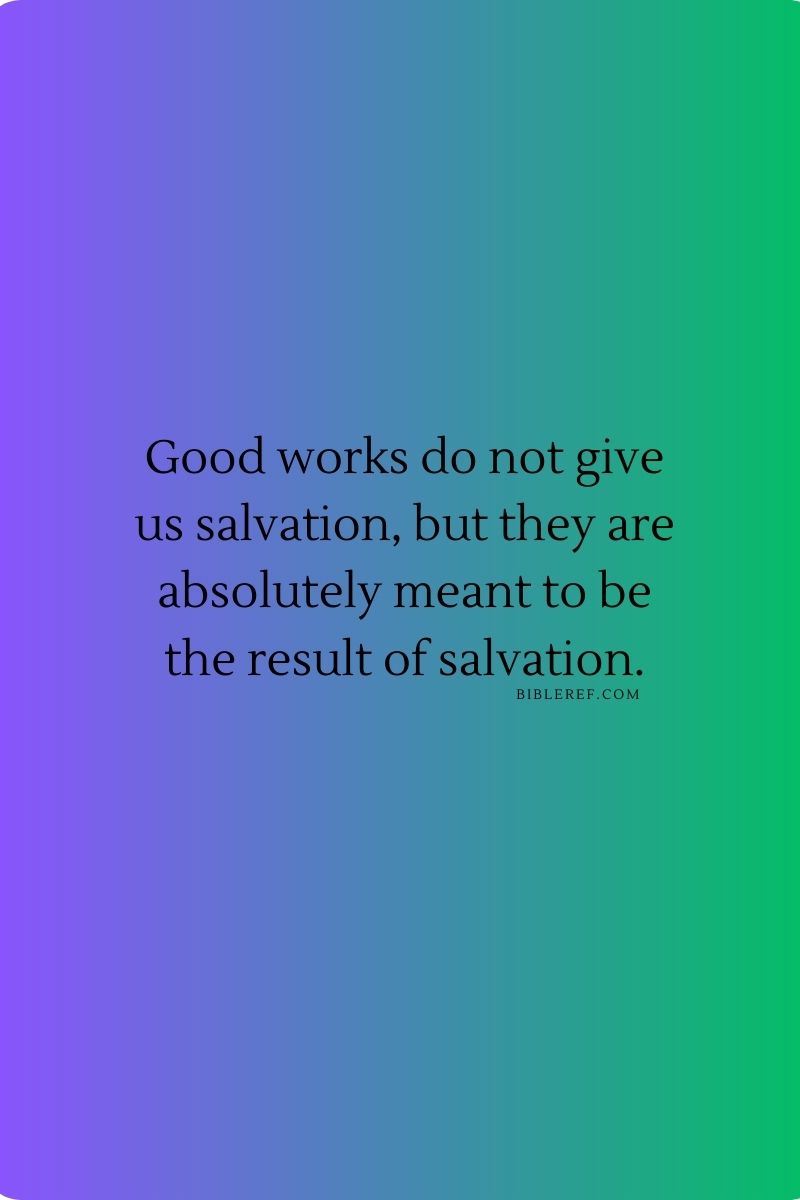
Specifically, we are “created in Christ Jesus for good works.” Good works do not give us salvation, but they are absolutely meant to be the result of salvation.

Interestingly, God prepared what He wanted us to do for Him long ago. He has already planned what He wants us to do with our lives. We do not need to copy what someone else has done or is doing. He has a unique plan for each of us to serve Him in this world. This includes certain spiritual gifts and the work of the Holy Spirit in our lives to lead us in service to Him.

Bibleref.com
Posted in From the Insideout, God is good, Prayer Starters, Quiet Time

Meditate On It

Based on Joshua 1:6-9

Study this Book of Instruction continually. Meditate on it day and night so you will be sure to obey everything written in it. Only then will you prosper and succeed in all you do.

Joshua 1:8 NLT

Father, You are good. You are good to encourage us with Your Word – good to guide us by It – to equip us and empower us with It. Blessed are we when we meditate in It day and night – that we may observe to do all that is written in It. For then will our way be made prosperous and we will, by It, have good success. – Yes Father God – You are good! 💜

Posted in Bible study, Come, Lord Jesus, Come, From the Insideout, LGG Study

Being Intentional

Day 1, Week 6 of Come, Lord Jesus Come (A Love God Greatly Study) Encourage as the Day Draws Near!

Scripture Reading: Hebrews 10:19-25 (SOAP – Hebrews 10:24-25)

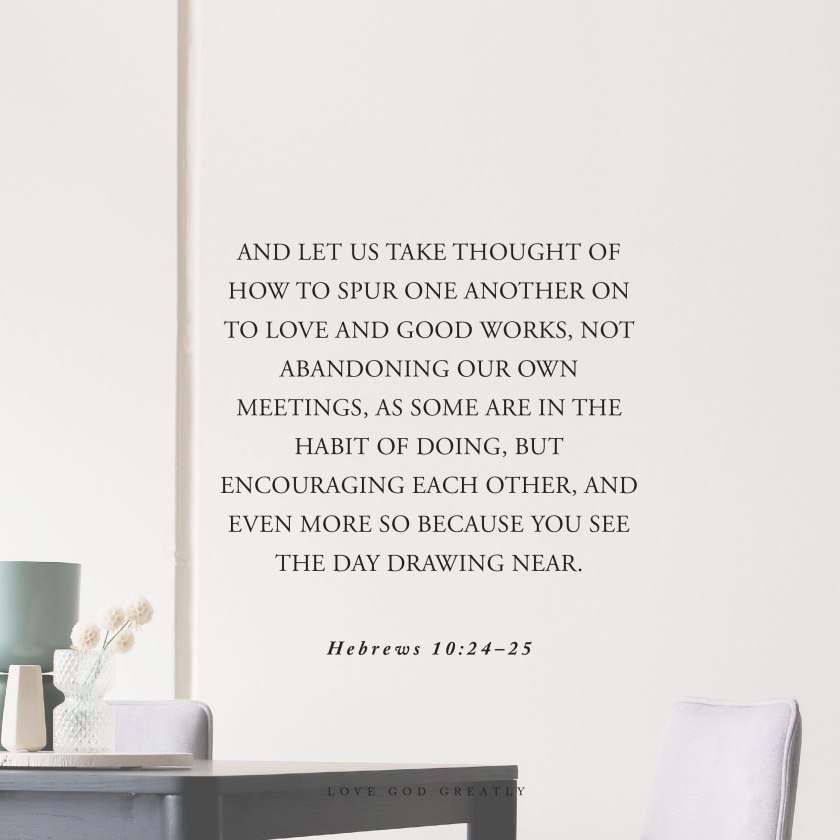
24 And let us take thought of how to spur one another on to love and good works 25 not abandoning our own meetings, as some are in the habit of doing, but encouraging each other, and even more so because you see the day drawing near. Hebrews 10:24-25 NET

Observations:

With the exception of one trusted translation, which says “and so”, in all of the translations I study from, this passage (19-25) opens with the word “[having] therefore“. When we are studying the Scriptures this is one of many key words that should cause us to look back to see what came before. In this case, the author has been writing an explanation concerning the Covenant God had made with His people that ensured them that, by faith in the work of Jesus on the cross, they had been given the promise of entering into God’s presence with confidence. (You’ll find it below and it’s worth the read)

For since the law has but a shadow of the good things to come instead of the true form of these realities, it can never, by the same sacrifices that are continually offered every year, make perfect those who draw near. 2 Otherwise, would they not have ceased to be offered, since the worshipers, having once been cleansed, would no longer have any consciousness of sins? 3 But in these sacrifices there is a reminder of sins every year. 4 For it is impossible for the blood of bulls and goats to take away sins. 5 Consequently, when Christ came into the world, he said, “Sacrifices and offerings you have not desired, but a body have you prepared for me; 6 in burnt offerings and sin offerings you have taken no pleasure. 7 Then I said, ‘Behold, I have come to do your will, O God, as it is written of me in the scroll of the book.’” 8 When he said above, “You have neither desired nor taken pleasure in sacrifices and offerings and burnt offerings and sin offerings” (these are offered according to the law), 9 then he added, “Behold, I have come to do your will.” He does away with the first in order to establish the second. 10 And by that will we have been sanctified through the offering of the body of Jesus Christ once for all. 11 And every priest stands daily at his service, offering repeatedly the same sacrifices, which can never take away sins. 12 But when Christ had offered for all time a single sacrifice for sins, he sat down at the right hand of God, 13 waiting from that time until his enemies should be made a footstool for his feet. 14 For by a single offering he has perfected for all time those who are being sanctified. 15 And the Holy Spirit also bears witness to us; for after saying, 16 “This is the covenant that I will make with them after those days, declares the Lord: I will put my laws on their hearts, and write them on their minds,” 17 then he adds, “I will remember their sins and their lawless deeds no more.” 18 Where there is forgiveness of these, there is no longer any offering for sin. Hebrews 10:1-18

Our confidence, mentioned throughout the chapter, is explained best in verse 19, as coming from the blood of Jesus; and in verse 22, it is defined as belonging to those who by faith have assurance of salvation through the forgiveness of sins, once and for all, (11-18).

We can “hold unwaveringly to [this] hope” because God is trustworthy, (23).

It is important to understand these verses because they are the essence of why we can and should “spur one another on to love and good works”, which God created us in Christ1 Jesus to do2.

1So then, if anyone is in Christ, he is a new creation; what is old has passed away—look, what is new has come! 2 Corinthians 5:17 NET

2For we are his creative work, having been created in Christ Jesus for good works that God prepared beforehand so we can do them. Ephesians 2:10 NET

Our focus/SOAP passage (24-25) follows this promise of good news with instructions to think about, in other words be intentional in looking for ways to encourage “one another”, those belonging to the body of Christ, on to live out the love3 and good works God created us for. For this reason it is wise to not give up meeting together, especially as the day of Christ’s return draws closer. One side note on this observation is since we don’t know the day or hour we should make it a habit to encourage “one another” often, in a formal meeting or outside of a formal meeting, so that we will not stop living and loving3 as He created us to.

 3“I [Jesus] give you a new commandment—to love one another. Just as I have loved you, you also are to love one another. John 13:34  

3Jesus answered, “The most important is: ‘Listen, [people of God], the Lord our God, the Lord is one30 Love the Lord your God with all your heart, with all your soul, with all your mind, and with all your strength.’ 31 The second is: ‘Love your neighbor as yourself.’ There is no other commandment greater than these.” Mark 13:29-31 NET

Application: So What Does This Mean For Us?

While this is a very familiar passage to me, as I’m sure it is to many who are reading this, I am convicted that this should be a passage we read often so that we don’t lose sight of why believers can and should have confidence in the work of Christ and the promised gift of salvation through our faith.

It is also a great reminder that we should be sharing the hope of our faith with others, but especially that we should encourage other believers often with this hope that is ours in Christ. Our salvation does not rest on our shoulders or our work but on the work of Jesus Christ4 and the grace of God5.

So, stand firm in the confidence that God has given us in Christ Jesus so that you do not stop showing love and doing good

(4) See Hebrews 10:1-18 above

(5) 8For by grace you are saved through faith, and this is not from yourselves, it is the gift of God; it is not from works, so that no one can boast. Ephesians 2:8-9 NET

Prayer: Response to God’s Word

Father, thank You so much for the confidence You have given us through Your grace and Your promises to those who have believed in Christ Jesus, Your Son! You are indeed a trustworthy God and we have the full assurance of Your forgiveness through our faith in Him. For You have said whoever believes is forgiven once and for all, and no longer being condemned we are saved through His blood and have both the confidence to draw near to You now and the guarantee of a place in Your presence – in Your kingdom yet to come. Help us to faithfully stand firm in this hope and encourage one another often with these truths that are ours through Christ. And may we not fail to share these truths with those who still have no hope until He comes again. – In Jesus’ powerful name – amen and amen!!

 For this is the way God loved the world: He gave his one and only Son, so that everyone who believes in him will not perish but have eternal life. 17 For God did not send his Son into the world to condemn the world, but that the world should be saved through him. John 3:16-17 NET

Reflections: Your turn

What are some ways you can encourage others in your life today?

Posted in Bible study, Come, Lord Jesus, Come, LGG Study

Come, Lord Jesus, Come

A Love God Greatly Study: Preview for Week 1, In The Last Days

Our Verse for the Journey: Hebrews 10:24-25

For this journey our verse(s) come from week 6 of our study. I encourage you to write the verses down on a note card or even several cards so that you have one in your car, your kitchen, your bedroom, your desk at work …. wherever you frequently find yourself. Read it at least 3 times every day, and over the course of the 6-week journey, begin trying to remember the words or phrases without looking. Lean on the Spirit for help – after all, John 14:26 says that our advocate, the Holy Spirit, was given, not only to teach us all things but to REMIND us of all He said.

A Slight Change In Plans:

PREVIEW TODAY – AND – DAY 1 TOMORROW

[I regret this unavoidable change but have been wrapped up with a family emergency for the last 7 days and counting. Your prayers are appreciated for my family- and myself.]

I hope you enjoyed the first week of Come, Lord Jesus, Come. From words of encouragement to insight on the last days and reasons to hold on to the HOPE that we have in Christ – it’s just the beginning of what I believe will be a wonderful journey toward His return. If you haven’t read week one, I invite you to scroll back through the recent posts for this study, beginning October 2, 2022, and glean from them in preparation for week 2 which starts tomorrow.

Your Turn: What was your favorite day or most notable quote or Scripture that inspired you to hold on to the hope that is ours in Christ Jess.

Jesus was faithful in proclaiming His return, which is why in week 2 we will continually read the statement, “I will come” or “I am coming” … followed by the word back or soon. The words belong to Jesus and to every believer that hears them – they offer encouragement and hope. Look for them, soak them up so that you might cling to the hope that is ours in Christ Jesus, and then imitate Him by faithfully sharing them with others. In this He will be honored and others will share in our hope, and to God will be the glory!

Me, from the inside-out

WEEK 2 CHALLENGE: Jesus promised that He is coming back. This week, write out how this promise influences how you live.

  • Does it make you more intentional?
  • Dose it help you to have greater hope for the future?
  • Does it place more passion and urgency on your days as you know the time draws near?

Verse For the Journey: How are you doing with our verses from Hebrews 10:24-25? Remember, the Bible says we are “temporary residents and foreigners” and to “keep away from worldly desires that wage war against your very souls.” (1 Peter 2:11-12) To do this in any measure of obedience or success, we must know and hold fast to God’s Word.

Want to know more about Jesus? Please message me via the comment bar or email me at mryelnb@aol.com. I would love to share with you the reason for the hope that is within me, the hope I cling to when times are hard, or life is disappointing, or fears arise. There is no greater source of hope in all the world – of this, I am convinced.

Posted in Bible study, From the Insideout, Prayer Starters, Quiet Time

So if there is any encouragement in Christ, any comfort from love, any participation in the Spirit, any affection and sympathy, complete my joy by being of the same mind, having the same love, being in full accord and of one mind. Do nothing from selfish ambition or conceit but in humility count others more significant than yourselves. 4 Let each of you look not only to his own interests, but also to the interests of others.

Philippians 2:1-4 ESV

In this portion of his letters to the Philippians believers Paul was encouraging them to live in unity with each other. So important was their unity that he equated it with completing his joy, as one who had mentored them in the faith. When believers are motivated by the same love, the love of Jesus Christ – when they are motivated by the same purpose or cause, salvation for those who are lost – when they are full of compassion and affection for each other …. when we think more about someone else more than we do ourselves – only then will there will be true joy in the midst of us all, and perhaps especially for those who are teaching or shepherding us in the faith. This type of unity won’t always be easy but Paul gives the perfect pattern for success as he encourages the believers to consider their attitude … namely, the same attitude of Christ (vs 5-8) who, though He was God, didn’t consider equality to God something to be grasped … instead He took on human flesh, and in the form of a servant He humbled Himself – even to the point to death on a cross +

Me, from the Inside-out💙

Posted in Bible study, From the Insideout, Prayer Starters, Quiet Time

Change is Beautiful

For everything that was written in former times was written for our instruction, so that through endurance and through encouragement of the scriptures we may have hope. Now may the God of endurance and comfort give you unity with one another in accordance with Christ Jesus, 6 so that together you may with one voice glorify [praise and worship] the God and Father of our Lord Jesus Christ.  Romans 15:4-6

I recently purchased a sign for my home with a saying that is now engrained in my mind and is etching it’s way into my heart. “Fall is proof that change is beautiful”. Perhaps you’ve heard it before but it is new to me and I love it. While I am a creature of habit and don’t necessarily go looking for change, it has never really bothered me – with the exception of senseless or absurd change – but that’s a discussion for another day. I think the reason this statement grabbed at my heart and ended up in my shopping cart is because many people in my life either battle change or are weathering the storm of age and change can almost be detrimental to them. Somehow this writes a different story though, maybe not for all change but it is certainly true of the change that comes with fall, especially here in my native West Virginia. God bedazzles the hillsides and the mountaintops year after year with extraordinary colors that are great competition for my beloved green buds of spring or the flower filled yards of summer. I’m not a fan of snow. However, despite the chaos it can cause, I must admit, even it can be beautiful when it is stretched out across the hills and valleys like a down-comforter piled high upon the earth.

As I have contemplated the truth of the statement on my new sign, I began to realize that in actuality it could be said of every season – for to those who adore the snow, or the beautiful colors of spring and summer the meaning would no doubt take on the same wonder it has for me when applied to fall. However, it also strikes me that God’s Word offers the same truthful reality that change is beautiful. After all, was it not His spoken word that brought creation into being?1 The dark sky lit with stars and a captivating full moon, or the blue sky and its dazzling display of fluffy clouds, or the billowing waves of the ocean riding in on the shore. John refers to Christ as being the Word that was with God in the beginning and then later says that same Word became flesh and dwelt with man on the earth – and boy, did that bring some beautiful change and hope to a lost and dying world. Because, as John goes on to write, “we have all received from his fullness one gracious gift after another.  For the law was given through Moses, but grace and truth came about through Jesus Christ.”2 That grace and truth changed everything!3 It set the captives free4 and has turned darkness into light,5 and death into life 6– for those who believe.7 Which brings us to our verse for today – and the written Word of God, which Paul says was given for our instruction and our encouragement through the Scriptures to not only help us endure but so that we might have HOPE. For me, the change that comes with the seasons is the constant reminder for believers that God, our God, is radiantly beautiful and this is made clear through His creation8. Likewise, the change that comes through His written Word in us9 changes us from the inside-out10 and by it we grow into radiant lights11, living testimonies12, savory salt13, and beautiful messengers of the good news14 that brings faith, hope, and love to the world.15

 For what can be known about God is plain to them, because God has shown it to them. For his invisible attributes, namely, his eternal power and divine nature, have been clearly perceived, ever since the creation of the world, in the things that have been made. So they are without excuse.

Romans 1:19-20

1Genesis 1 … 2John 1:1-18 … 3Ephesians 2:8-9 … 4Romans 6:14 … 51 Peter2:9, John 8:12, & Ephesians 5:8 … 6 Romans 6:23 … 7John 3:16-17 … 8 Romans 1:19-20 … 9 Romans 15:4-6 … 10 2 Corinthians 5:17 & Jeremiah 15:6 … 11 Matthew 5:14 12 Matthew 5:16 … 13 Matthew 5:13 … 14 Romans 10:15 … 15 John 3:16-17

Posted in Bible study, Choosing God Instead of the World, LGG Study

Keeping the Covenant

Week 3, Day 3 of Choosing God Instead of the World, A Love God Greatly Study

Scripture Reading: Genesis 35 and Deuteronomy 30:16-20 (SOAP: Deuteronomy 30:15-16)

15 “Now listen! Today I am giving you a choice between life and death, between prosperity and disaster. 16 For I command you this day to love the Lord your God and to keep his commands, decrees, and regulations by walking in his ways. If you do this, you will live and multiply, and the Lord your God will bless you and the land you are about to enter and occupy. Deuteronomy 30:15-16 NLT
Observation:

In our Deuteronomy passage we hear Moses encouraging the Israelites. Were we to listen to the whole “farewell speech” we would hear him reminding the people of all God had done for them and of what He had promised to do for them. Here in this section – what we hear is the reminder that God has set a choice before them – and what He expects their choice to be. They can choose life and prosperity or death and disaster. This makes me think of Jesus’ words to the Pharisees in John 10:10, when He told them He had come that the sheep, [believers] might have a rich and satisfying life, but the thief [the ruler of this world] comes to steal, and kill, and destroy – that certainly sounds like death and disaster to me. It also reminds me of Paul’s declaration, in Romans 6:23, that the wages of sin is death but the gift of God is eternal life in Christ Jesus our Lord! Seems to me that while Moses was making a specific speech to the Israelites in Deuteronomy, God, through Christ has made the same offer available to the world today. We can choose the wages of our sins – or – His gracious and merciful gift of eternal life. To put it another way – we can choose Him [God] or the world.

Application: How then should we Live?

Life or death? Prosperity or disaster? God instead of the world? The answer to all of these questions seems crystal clear – doesn’t it? Yet so many have chosen option ‘b’ to each of the questions – even as believers who have chosen life over death by placing our faith in Jesus – we still find it difficult at times to choose option ‘a’ as the answer to the second and third questions. We choose ‘life’ through faith in Christ but then choose the world instead of His ways more often than not. In doing so we forego the prosperous and blessed life and relationship with God that Christ came to give, John 10:10. This kind of living comes with a warning from Matthew’s Gospel, where he recorded the Lord saying, “I never knew you”.

21 “Not everyone who says to me, ‘Lord, Lord,’ will enter the kingdom of heaven, but the one who does the will of my Father who is in heaven. 22 On that day many will say to me, ‘Lord, Lord, did we not prophesy in your name, and cast out demons in your name, and do many mighty works in your name?’ 23 And then will I declare to them, ‘I never knew you; depart from me, you workers of lawlessness.’

Matthew 7:21-23

One other note on this application and the “fire-insured Christian”, a believer with one of his/her feet in heaven and the other running after the world. The verses we find just prior to 21-23 seem to provide another good reminder not to treat salvation like an insurance policy. For rest assured, The Lord will be the one to judge whether or not your ‘policy’ is creditable or not.

So, every healthy tree bears good fruit, but the diseased tree bears bad fruit. 18 A healthy tree cannot bear bad fruit, nor can a diseased tree bear good fruit. 19 Every tree that does not bear good fruit is cut down and thrown into the fire. 20 Thus you will recognize them by their fruits.

Matthew 7:17-20 ESV

How then should we live if we want to bear fruit? Since I love a list when it comes to ‘how tos’ and ‘to dos’, let’s make a list so we can see how we are doing …

  • We should love the Lord our God with all of our heart, mind, soul, and strength. (Mark 12:29-31)
  • We should walk in His ways, keep His commandments, statutes, and ordinances If you’re wondering what Moses meant by the words, according to gotquestions.org they are all Hebrew words referring to commands from God to be obeyed by God’s people regardless of the situation you are in.
  • We should be enjoying His blessings of life and provision (property, in the case of the Israelites)
Prayer: My Response to God’s Word

Oh LORD, my God – You are to be loved, imitated and obey. Help me to live this way – so that I might find favor in Your eyes and know Your blessing – In Jesus’ name – Amen and Amen!

Your Turn:
  • What’s your prayer response?
  • How will you choose to follow God today?
  • What temptations are you feeling?
  • What is pulling you away from God and toward the things of the world?
Want More?

Visit LGG for today’s blog

Posted in Bible study, From the Insideout, LGG Study

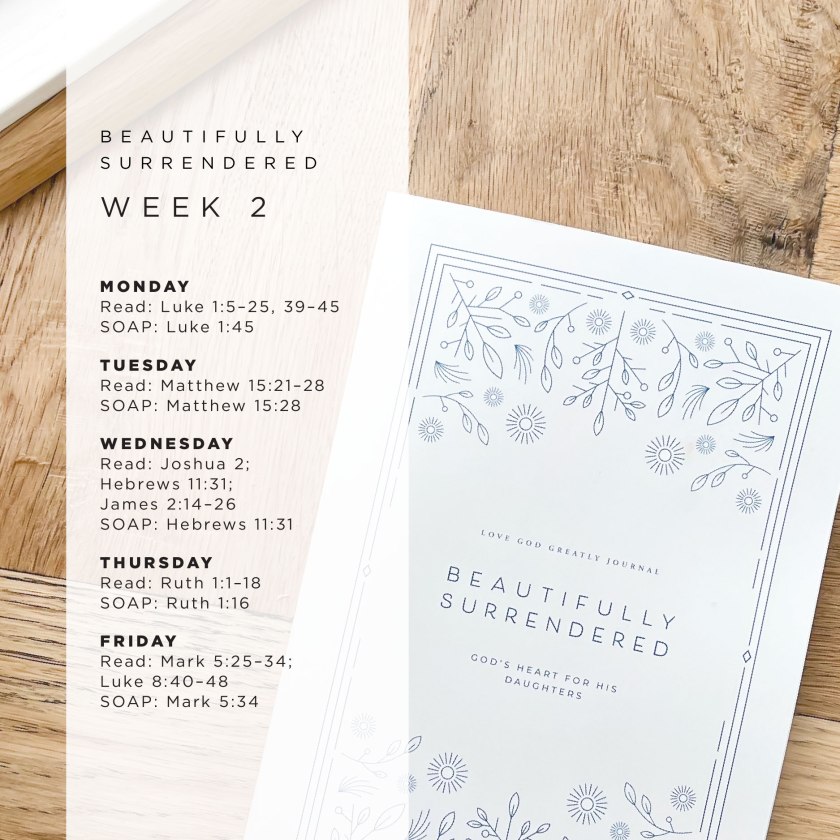
Reflections from Week 1 of Beautifully Surrendered

A Love God Greatly Bible Study about God’s Heart for His Daughters

From God's creation of Eve, Paul's introduction of Phoebe and instructions to on using our gifts, the promise that "ALL" are one in Christ, Jesus' concern for the widow at Nain, and the care He showed His mother even while hanging on the cross are all beautifully poignant reminders that women are loved, seen, and cherished by God. 

References: Gen 2:18-24; Rom 6:1-2; 1 Cor 12:12-26; Gal 3:24-29; Luke 7:11-17; John 19:20-30

If you missed any or all of the week’s study check out the Scripture references listed above and/or find the blogs and all the details and links at mefromthensideout.com or by clicking on the links above.

Week 2 Preview: Women of Great Faith

Now that we have laid the foundation of God’s love and concern for us as women we will press forward looking at how God has use and worked through the lives of women in Scripture. The first week we will focus on “Women of Great Faith”. Women like Elizabeth, Rahab, Ruth and others.

Our focus/memory verse is found in Luke 1:45 and is a beautiful statement of encouragement from Elizabeth to Mary. We will study the verse tomorrow and work on remembering it throughout the week.

Our challenge comes from the focus verse as well: Who in your life has shown great faith like the women we are reading about? Take time this week and reach out to her. Encourage her with your words, either spoken or written, and share how her faith has helped increase your faith.

Posted in Bible study, Devotion, From the Insideout, Journey Through The Word, Uncategorized

A Lasting Impact

Women’s History Month and a Look at Women of Faith through the Pages of the Scriptures

Eve … Noah’s wife (Na’amah) … Lot’s wife … Sarah … Naomi … Ruth … Esther … Tamar … Rahab … Moses’ mother (Jochebed) … Miriam … Rebekah … Rachel … Hannah … Deborah … Mary and Martha … Anna … and so so many more.

Women from history … the history of God’s people … written down, remembered for sinful disobedience, mistakes, faith, hurts, heroics, deceit, loyalty, obedience, and lineage. All of them, created by, used by, and for God’s purposes. All of them — memorable to most who are familiar with the Scriptures, and some, like Eve, are known to those who have little or no real knowledge of Scripture. Some are inspirations of hope when there appeared to be no hope, like Esther, who was used to save a people who were facing annihilation. Others, invoke courage, like Jochebed, who defied the edict that her infant son must be put to death, or Rahab, who hid the spies on her rooftop and helped them escape certain death. Eating forbidden fruit, looking back when you were told not to, trickery, deceit, and manipulation are all things that come to my mind when I remember some of these women. While we might be tempted to sweep their stories under the carpet, so to speak, it’s important that we don’t miss how God used them and the invaluable lessons we can learn from them. We may think they aren’t appropriate to share, or at least not all of their sordid details, with those outside “the family,” but I would disagree – consider the impact they make on the gospel story when God is not just seen as someone who saves but someone who saves prostitutes and liars and those who have no hope of salvation. I cannot help but think of the hope these women might bring when those who have tarnished pasts hear how our God, the one true living God, uses the disobedient or outcast to accomplish great things. How much hope might a woman who has endured pain and suffering from abuse or broken promises gain when she hears the story of Tamar and how God worked all things together for the good of His people, or of the devastating losses of Naomi and God’s amazing provision? Think of the inspiration to pray boldly and with confidence that comes from Hannah’s story, or the desire to sit at the feet of Jesus and listen to His teaching like Mary, or to reach out in faith like the woman who had the bleeding problem. Oh, the stories, the examples, the fingerprints of God through the women He chose to make known to us through His Word. The Bible is rich with history, and women are a great part of it. May we be inspired by their faith, learn from their mistakes, practice what God saw and pointed out as good, and share them with others as lights in a world full of crooked and perverse people who need to know the truth and love of our God, a love that knows no boundaries. Ladies, may we, like Queen Esther, hear the words and challenge of Mordecai, who said, “And who knows whether you have not come to the kingdom for such a time as this?” The people around us who do not know Jesus face an eternal hell when their life here on earth is over, but we have been given the opportunity to make the truth known – our king has given us the power we need – for such a time as this.

Eve, “The woman who was instrumental in sin entering the world and from whom we can learn what not to do”. She was the first women created by God from Adam’s rib … placed in the Garden of Eden as a helpmate to her husband. Given the privilege of God’s company of knowing His goodness and the beauty of His creation prior to sin entering the world. She could be the poster child for Peter’s warning to be self-controlled and alert, because our enemy, the devil, prowls around like a roaring lion (or in Eve’s case, like a serpent) looking for someone to devour.

Noah’s wife, (Na’amah), walked onto an ark with only her family. Following the leadership and faithful obedience of her husband, she left all that she knew behind because God said He was going to send a flood. [Genesis 7:7 And Noah and his sons and his wife and his sons’ wives with him went into the ark to escape the waters of the flood.]

Lot’s wife, unnamed in the Scriptures but known for becoming a pillar of salt after looking back when they were fleeing the destruction of Sodom and Gomorrah. Jesus cites this story in Luke 17, as He describes a future event: “It was the same in the days of Lot. People were eating and drinking, buying and selling, planting and building. But the day Lot left Sodom, fire and sulfur rained down from heaven and destroyed them all. It will be just like this on the day the Son of Man is revealed. On that day, no one who is on the housetop, with possessions inside, should go down to get them. Likewise, no one in the field should go back for anything. Remember Lot’s wife! Whoever tries to keep their life will lose it, and whoever loses their life will preserve it” (verses 28–33).

Sarah, the wife of Abraham and mother of Isaac, who failed to trust God when His promise to give her a child did not happen quickly enough. Her lack of faith brought great trouble to her life and to our world today as she instructed her handmaiden, Hagar, to sleep with Abraham and provide a child for them. God still honored His promise, and Sarah gave birth to Isaac at the age of 90, but the consequences that followed are still known today. We must not miss the example that Peter uses of Sarah, where he refers to her as “a holy woman who hoped in God”, 1 Peter 3:5-6. Sarah willingly left her home and stepped out into the unknown to follow Abraham, as he followed the directions of a God with whom she was unfamiliar at the time. She endured much to try to provide an heir for her husband and to keep her husband safe in dangerous lands. In the end, she had faith enough to believe that she and her husband, at the ages of 90 and 100, would produce the promised heir, Isaac. Although she lived in a world of danger and confusion, Sarah stood firm in her commitment to her husband and to God, and her commitment was rewarded with a blessing.

Naomi and Ruth, whose lives are testimonies to God bringing good out of something tragic, or bitter, as Naomi’s story infers. When a famine hits Judea, Elimelech and Naomi and their two boys relocate to Moab (Ruth 1:1). There, Mahlon and Kilion marry two Moabite women, Orpah and Ruth. After about ten years, tragedy strikes. Elimelech dies, and both of Naomi’s sons also die, leaving Naomi, Ruth, and Orpah widows (Ruth 1:3–5). Naomi, hearing that the famine in Judea was over, decides to return home (Ruth 1:6). Orpah stays in Moab, but Ruth chooses to move to the land of Israel with Naomi. The book of Ruth is the story of Naomi and Ruth returning to Bethlehem and how Ruth married a man named Boaz and bore a son, Obed, who became the grandfather of David and the ancestor of Jesus Christ.

Esther, the Jewish maiden who became queen of Persia and rescued her people from a murderous plot to annihilate them. Her story is recorded in the Old Testament book bearing her name. Esther was the cousin of a Benjamite named Mordecai, who was also her guardian, having adopted her as his own daughter when her parents died. Mordecai held some type of official position within the Persian government (Esther 2:19). When Esther was chosen as a candidate for queen, Mordecai instructed her not to reveal her Jewish background (verse 10). He also visited the king’s harem daily to see how Esther was doing (verse 11). She won the grace and favor of the king, according to Esther 2:17; he loved her more than all the others and made her queen. As the story progresses, it becomes evident that God was at work through the whole process. For you see, some time after she became queen, Mordecai heard about a plot against the king’s life and made it known to Esther, and later, a plot to annihilate her people, the Jews. Esther’s bravery and faith in God are a testament to the trust this young woman had in the living God. Her life is a lesson in God’s sovereignty over His creation. God maneuvers every aspect of life to position people, governments, and situations for His plan and purpose. We may not know what God is doing at a particular moment, but a time might come when we realize why we have gone through certain experiences or met certain people or lived in certain areas or shopped in certain stores or taken certain trips. The time may come when everything comes together, and we look back and see that we, too, were in the right place at the right time, just as Esther was. She was in the harem “for such a time as this.” She was made queen “for such a time as this.” She was strengthened and prepared to intercede for her people “for such a time as this” (Esther 4:14). And she was faithful to obey. Esther trusted in God and humbly served, no matter what it might cost. Esther is truly a reminder of God’s promise, as written in Romans 8:28: “And we know that God causes all things to work together for good to those who love God, to those who are called according to His purpose.”

Tamar, the daughter-in-law of Judah Jacob’s son Judah (patriarch of the line of Judah) had three sons: Er, Onan, and Shelah. A woman named Tamar married Er, but then Er died, leaving her a widow. Since it was required that the next of kin care for a brother’s widow, Tamar was given to Onan, but he also died. Shelah was still a boy and could not marry Tamar, so Judah asked her to return to her father’s house and wait until Shelah was grown up. However, once Shelah was old enough, Judah did not honor his promise. Tamar remained an unmarried widow. Tamar then went into town disguised as a prostitute, tricked Judah, and got him to sleep with her. She then became pregnant by Judah and bore twin sons named Perez and Zerah. The story is recorded in Genesis 38. It was through Perez’s son Hezron that King David and, eventually, Jesus Christ descended.

Rahab a prostitute who places her faith in the true living God and saves the two men Joshua sent in to spy out the land. Gotquestions.org refers to her as “one of the most thought-provoking and astonishing heroines of the Old Testament”. Her story is found in Joshua 2-6, but lives on in the story of Jesus, whose legal father was Joseph, a direct descendant of Ruth.

You see, once the spies safely escaped the city, they returned to Joshua and reported that the “whole land was melting with fear.” The Israelites crossed the Jordan into Canaan, where they laid siege to the city of Jericho. The city was completely destroyed, and every man, woman, and child in it was killed. Only Rahab and her family were spared. Ultimately, Rahab married Salmon, an Israelite from the tribe of Judah. Her son was Boaz, the husband of Ruth.

Jochebed, the mother of Moses, who found a way to protect her son (Ex 1:17-19 and 2:3) from the edict of Pharaoh that all infant boys be put to death (Ex.1:6-18)

Miriam, who did as her mother, Jochebed, instructed and was used in the plot to save Moses from certain death. Miriam watches over her baby brother Moses among the bulrushes on the banks of the Nile. Their mother had hidden Moses in a basket on the riverbank to protect him from Pharaoh’s decree to throw all Hebrew baby boys into the river (Exodus 1:22—2:4). As Miriam watches, Pharaoh’s daughter discovers and pities Moses, and Miriam quickly intervenes to ask if the Egyptian princess would like a Hebrew woman to nurse the child for her. The princess agrees, and Miriam quickly gets their mother. Pharaoh’s daughter commands Moses’ biological mother to nurse him and bring him back to her when he is older. By the grace of God, Miriam helps save the infant Moses (Exodus 2:5–10).

Rebekah, the wife of Isaac and the mother of Esau and Jacob. Rebekah’s marriage to Isaac was the result of God’s providence, her pregnancy was an answer to prayer, and the lives of her sons fulfilled prophecy. Rebekah’s choice to lie and deceive her husband is an example of how wrongdoing in human beings does not thwart the plans of God and how God can ultimately bring about His will, through His mercy and wisdom, despite our sin (see Genesis 50:20).

Hannah, who was barren and prayed to God out of her “great anguish and grief,” was soon given a son. She named him Samuel and dedicated him to the Lord as a Nazarite, fulfilling the promise she had made in her prayer (Numbers 6:1-8). In Hannah’s prayer, God is presented as the One who helps the weak. She begins her prayer with “My heart exults in the Lord; my strength is exalted in the Lord.” Hannah recognized that her strength came from God and not from herself. She was not proud in her strength but rejoiced in God’s ability to make a weakling strong. Her story also teaches us that God can use human weakness to accomplish great things. Samuel, Hannah’s son, grew up to be a great man of God – the final judge and the prophet who anointed the first two kings of Israel. But why was Hannah’s story necessary? Why not just start with Samuel in the tabernacle or at the start of his judgeship? Why not simply let him be born to a God-fearing couple and send an angel to tell them to dedicate their son to God? In short, why involve Hannah’s grief? Because God is glorified in Hannah’s story. Her weakness, her trust in God as she turned to Him, the fervency of her desire, and her faithfulness in bringing Samuel to God as promised are all evidence of God working in Hannah’s life. Her tears were ordained to be part of the glorious story of what God was doing in Israel’s history. Every person experiences desires that will not be quenched and circumstances that cause grief. Many times, we simply do not understand these things. But in the life of Hannah, we see that God knows our story from beginning to end, that everything has a purpose, and that trust in Him is never misplaced.

Rachel, a major character in the early Old Testament; she was a daughter of Laban, sister of Leah, favored wife of Jacob, and mother of two of Jacob’s children, but not before much anguish. In order for Jacob to be able to marry Rachel he had to work for her brother for seven years, after which time Laban tricked him and put his daughter Leah in Rachel’s place at the wedding. Rachel and Jacob’s tale is one of the great love stories of the Bible. Jacob preferred her sons, Joseph and Benjamin, over his other children. He loved Joseph particularly (Genesis 37:3), and, although his preferential treatment of Joseph was wrong, it eventually led to the Hebrews’ move to Egypt. All of this was part of God’s plan for His people to prepare them for the coming of the promised Messiah, Jesus.

Deborah was one of the judges of Israel during a time of oppression. She is called a prophetess and the wife of Lappidoth. The Lord spoke through her as she held court under a tree called “the Palm of Deborah” in Ephraim. The Lord also used her to set her people free and defeat the king of Canaan. Deborah’s story is found in Judges, chapters 4 and 5. We can see that God’s power is what matters, regardless of the instrument He chooses to use. Man or woman, strong or weak, confident or hesitant – all are strong when they are moved by God’s Spirit and filled with His strength. We can also see in Deborah a picture of God’s tender care for His people. As a mother cares for her children, so Deborah led and nurtured Israel (Judges 5:7).

Martha, a significant New Testament figure, a personal friend of Jesus, and someone with whom many women today identify. She was quite the spirited woman, rebuking Jesus when she found her sister, Mary, sitting at the feet of Jesus while she was busy serving. Martha’s life was changed by her friendship and encounters with Jesus. Through her stories (Luke, 10, John 11 and 12) we see the importance of balancing service with worship, of trusting the Lord even when all seems lost, and of using our material resources for the glory of God.

Mary (of Bethany), Martha’s sister, is considered one of the most beautiful women in Biblical history. She had a heart’s desire to be near her Lord. What we see in her in every occasion (Luke, 10, John 11 and 12) is a sweet Spirit focused on Christ and not herself or the other situations or people around her. If we, like Mary, make sitting at the feet of Jesus and listening to Him our priority, we will have her depth of understanding, her passion for Christ, and her complete faith in His plan for our lives. We may not have Jesus sitting in our living rooms in person, but we have His Word, the Bible, and from it we have all the knowledge and understanding we need to live a life of secure and confident faith like Mary of Bethany.

Anna , another of the few prophetesses mentioned in the Bible. “She never left the temple but worshiped night and day, fasting and praying” (Luke 2:37). After becoming a widow, Anna dedicated herself wholly to the Lord. She never left the temple in Jerusalem but spent her time worshiping, fasting, and praying. What stands out is that her devotion was constant for the majority of her life, and her devotion was rewarded with a face-to-face encounter with her Savior. Her many years of sacrifice and service were worth it all when she beheld the Messiah, the One for whom she had waited so long ….