“The least of you will become a thousand, the smallest a mighty nation. I am the Lord; in its time I will do this swiftly.” Isaiah 60:22
Whether it is the result of a medical test, the birth of a baby, the answer to a job interview, or a pressing need not yet provided – waiting is difficult. For many of us, it is the most difficult part of life – as it causes anxiety to rise and holds us back from living while we wait.
Our verse today speaks hope to this anxiety and promise that graces us with the strength to go on living – despite the wait. Why? Because God knows when it is time for Him to act – and He will do so swiftly.
“For what will it profit a man if he gains the whole world, and loses his own soul?” Mark 8:36
Have you ever known someone that was never satisfied? You know, the person who seems to have everything going for them but they’re just never content. Their lack of satisfaction or contentment motivates them to grasp at the next best thing “the world” offers with the thought or the hope that “it” will make them happier. A better car… a bigger house… a better relationship…a better job… more money… more status… more accolades… more happiness… you get the picture. The list is endless and exhausting, and according to today’s verse – it can be dangerous.
Don’t get me wrong, none of these things in themselves are bad – but the danger comes when our motive is based on what the world offers or says is best rather than on the reality of what God has given us. For God has graciously gifted us with “life to the full”(John 3:16 and 10:10). This gift includes the Kingdom of Heaven and an eternity in paradise with Him! There is nothing better or anything in the world that can make our joy and contentment fuller than this.
For we are God’s handiwork, created in Christ Jesus to do good works, which God prepared in advance for us to do
Ah, to know that we are fearfully and wonderfully made is a great encouragement but to know that we are “God’s handiwork, created ‘in’ Christ Jesus to do good works” is an added blessing. As it is another reminder that God is intimately involved in our lives from birth to rebirth and even to death – as we know that He alone has “numbered our days”, (Psalm 139:16 and Job 14:5). It is also a beautiful invitation or clarification that He wants us, even expects us, to be actively involved with Him in His work.
Understandably, to know that God created “good works” for us to do can also be a bit daunting and challenging – both in concept and in the reality of knowing what those good works are – and carrying them out. However, we must remember that what He has called us to do – He has also equipped us to do, (2 Peter 1:3-4).
By his divine power, God has given us everything we need for living a godly life. We have received all of this by coming to know him, the one who called us to himself by means of his marvelous glory and excellence. 4 And because of his glory and excellence, he has given us great and precious promises. These are the promises that enable you to share his divine nature and escape the world’s corruption caused by human desires.
Ephesians 2:8–9 is an extremely popular passage of Scripture. Since those two verses are so often quoted, many miss out on verse 10 when seeking to understand God’s salvation by grace through faith. However, this important statement offers tremendous insight into what God desires after salvation. God calls us His workmanship or His artwork, from the Greek word poiēma. We are something crafted, with skill and a purpose, by God, for His purposes.
Specifically, we are “created in Christ Jesus for good works.” Good works do not give us salvation, but they are absolutely meant to be the result of salvation.
Interestingly, God prepared what He wanted us to do for Him long ago. He has already planned what He wants us to do with our lives. We do not need to copy what someone else has done or is doing. He has a unique plan for each of us to serve Him in this world. This includes certain spiritual gifts and the work of the Holy Spirit in our lives to lead us in service to Him.
David is right, the body is an intricate creation – unique from all of God’s other creations, and a true testimony of His wonderfully, amazing, miraculous works. Let’s get real though – do you sometimes read this verse and roll your eyes or grimace, knowing you don’t feel wonderfully made? I mean in these days of increasing aches and pains of age and less than stellar care that I have given this particular vessel through the years – I am grimacing! Don’t get me wrong, it is good to be reminded that when God “formed me in my mother’s womb”, I was “wonderfully made”. It is an encouraging truth and a wonderful reminder of the power and creativity of God – but, I admit this body doesn’t always feel like it.
More Like a Mess –
I don’t know about you, but I find myself seeking His mercies and strength more and more as I weather the consequences of the lack of self care and/or good habits, or simply the aging process on this earthly body. I pray for His help and healing of what feels more like a mess than a fearfully and wonderfully made body. While I know I cannot undo the aging process or the role my choices have played on this body, I am equally certain that to live in regret and fear or misery is not glorifying to God and only robs me of the rich and satisfying life that Christ came to give, which is exactly what the enemy wants. His purpose is to steal, kill, and destroy. He wants us to be miserable and to turn away from God.
Satan Has No Authority Here
Even as I was writing about the enemy’s purpose – I was reminded of an old song that declares satan has no authority over me, for this habitation was created by God and for God’s glory. All authority belongs to God – who fearfully and wonderfully created us. And, this same Creator works all things, including our messes and poor choices, together for the good of those who love Him and are called according to His purpose – and this for His glory.
“Whoever dwells in the shelter of the Most High will rest in the shadow of the Almighty.” Psalm 91:1
Day after day God hides us, His children, under His wings, where they can safely abide. Whether in storms, trials, or sorrows God’s protective love shelters them. For, as His children, we rest in Jesus where we are forever safe. Through Jesus we are brought close to God. He is our fortress, the God in whom we trust. We find refuge under His wings – for His faithfulness is a protective shield!
About thirty years ago I was looking for the Scripture reference to a song that had been introduced at church. I had never heard it before but the words, “He will give His angels charge over you …” captured my attention so I started looking for the reference. Psalm 91 was one of the passages that I found linked to the words. The Psalmist declared it and I believe it and claim it to be true! God has given His angels charge over us – to protect us in all our ways. When we set our heart on Him – He will deliver us because we know His name. When we call out to Him, He will hear us and answer us. He will be with us in trouble. He will rescue us ,for He has – by grace – through faith – given us life everlasting in Christ Jesus!
In these TRUTHS I find HOPE and JOY and STRENGTH! In these TRUTHS, I find PEACE and REST, knowing we are safe in His shadow. — Blessed assurance Jesus is mine!
Don’t be afraid, for I am with you. Don’t be discouraged, for I am your God. I will strengthen you and help you. I will hold you up with my victorious right hand.
Have you ever wondered just how personally God is involved in your life? I have. However, not often – because there are mornings, or times, like this morning more often than not when He reveals that He is more involved than I can even imagine. – Allow me to paint the picture …
I woke one morning last week to find this verse in my inbox from ‘ourdailyverse.com’ in my inbox. I subscribed to these verses a while back as a means of having a prayer starter for my mornings, but more times than I can count they have been exactly what I have needed for that moment of the morning or at sometime throughout the day.
This particular morning happened to follow a night of struggling greatly with fear – after waking from a dream. The fear pinned me to the ‘ground’ and truly shook me! I called on God, I whispered His name and the name of Jesus – over and over. Peace and sleep eventually came and the voice of the enemy ceased – but when I woke he sought to shake me again with the reminder of the dream – but God met me with this verse – these beautiful words that reminded me that not only is God with me, and will strengthen me throughout any given day, and hold me up with His victorious right hand – but that He always knows just what i need and when! This was more than a reminder that He cares and goes before me through life’s battles. It was a vivid reminder that God is greater than anything that makes me anxious!
Worship and Prayer
*As I was panting this picture for today’s post – this song of worship came to mind and turned into my morning prayer – May it be a blessing💜
For the Spirit God gave us does not make us timid, but gives us power, love and self-discipline.
In Paul’s day, it was Timothy that seemed to need the encouragement that God didn’t want him to live in fear of doing the work He was called to do. Instead, Paul reminded Timothy, that the Spirit God had given them, and all believers, was one that filled them with power, love, and self-discipline. In other words, Timothy had no reason to be timid for he had been empowered to live out His calling. The same is true for us today.
My first remembered experience with this verse was at VBS, not one that I attended but one I was co-leading. I was tired and stressed from some personal things going on in my life, I wasn’t feeling prepared, and definitely not strong enough to lead, love, and deal with all that goes into VBS as I had committed to do. Today’s verse “just happened to be” the theme verse for the week. God knew that just like Timothy, I needed to remember that while I might be nervous and feel too weak to lead, He had given me His Spirit – equipping me with not only the power to lead, but with love for the kids and all involved, as well as the discipline to stay committed and focused on Him, and boldly share the Gospel with the children. And, as a bonus, He daily renewed my strength and filled me with immeasurable joy when I was able to personally lead one of the children to the Lord.
About a month ago I subscribed to “Our Daily Verse” – which is simply that, a daily verse I receive in my inbox every morning around 6:30. Each verse comes with a short comment from the host as well as a quote, song, and picture of the day. I use the verse as a morning prayer prompter, and then I watch for ways that God chooses to use it in or through me during the day. In full disclosure, depending on the busyness of the day, I sometimes forget the verse by mid-morning or afternoon, but at the close of the day I try to circle back to it and reflect on how it may have applied to my day or been used to encourage someone else.
– To bridge the gap between studies and keep us journeying through the Word – I will be sharing one of these daily verses and a link to their content, past or present, for the next two weeks. I believe you will find them a blessing and look forward – with hope – to hearing your comments, thoughts, or questions.
Verse of the Day: Philippians 4:13
I started this morning reflecting on this empowering truth from Philippians 4:13 …
The thoughts and prayers it prompted …
Father, you are good! You have given me Jesus and You have given me Your Spirit and through them I can not only draw near to You but I can do all “this” — All that You have called me to and/or allow in my life. You – Father, Spirit, Son – You are my STRENGTH, my SONG, my HOPE and my JOY! Oh, how I worship You.
You make me brave when I am afraid – You whisper peace and You give grace for each moment and fresh mercies every morning! When I am weak You are strong – When I don’t know the way You show me – When I hurt You comfort me – When my body fails I look to You for healing power – When I am tempted You show a way of escape – And when the storms come You walk with me through the waters and hold me up so I that I am not overcome by them!
I rejoice in these words by Oswald Chambers –
“God does not give us overcoming life: He gives us life as we overcome.”
Through Christ You empower me to live – to endure – and to walk in confident HOPE that all of Your promises are “Yes and Amen in Him” who has overcome the grave; and through whom I can do all things!
We have this hope as an anchor for the soul, sure and steadfast, which reaches inside behind the curtain,where Jesus our forerunner entered on our behalf, since he became a priest forever in the order of Melchizedek.
Last days of a study are always bittersweet for me. While I’m anxious to move on to the next adventure of our journey through God’s Word – I most often want to linger in the present adventure – soaking up more of the insight and wisdom in our current study. However, today’s final destination is such a perfect ending. We end on a grand note of encouragement that offers confidence in this and in everything we will study moving forward in the journeys still ahead of us.
I invite you to read the larger passage (Hebrews 6:10-20) and consider what a powerful message of enduring hope we have been given. –
Put together, these separate images create a powerful message of reassurance. Christ has “anchored” our hope of “refuge” in the very presence of God: the “inner place.” Prior verses pointed out the absolute and unchanging value of God’s promises.
Bibleref.com / Hebrews 6:19
Observations
This message is to believers / followers of Jesus Christ. The author says that we “have” this hope … indicating that it is a given rather than something we might have, can have, or will have someday.
When we choose to believe in Jesus Christ, we are anchored securely in the “very presence of God.”
The word hope has been mentioned over and over throughout our study and we have focused on many of its different aspects in Scripture. Today we end our study with the reminder and the truth of who “this hope” is.
For God so loved the world that He gave His only begotten son, that whosever believes in Him should not perish but have everlasting life. -John 3:16
We know that Christ, being raised from the dead, will never die again; death no longer has dominion over him.– Romans 6:9
And this is the promise that he made to us—eternal life. -1 John 2:25
Looking to Jesus, the founder and perfecter of our faith, who for the joy that was set before him endured the cross, despising the shame, and is seated at the right hand of the throne of God. – Hebrews 12:2
by canceling the record of debt that stood against us with its legal demands. This he set aside, nailing it to the cross. He disarmed the rulers and authorities and put them to open shame, by triumphing over them in him. –Colossians 2:15-16
God’s Word makes it clear that Jesus is our Anchor; and equally clear, that in the midst of life’s storms and trials our Anchor holds secure! Having cancelled our debt, through His death, Jesus is our trusted refuge and redeemer, our source of Truth and Righteousness – the HOPE of our faith – through whom we endure.
Jesus has anchored us – literally, placed us securely in God. We can have no greater hope than this. It is a hope that, when we keep our eyes on Jesus, will surely endure to the end.
To KNOW Jesus is to LOVE Him – to LOVE Him is to TRUST Him – and – to TRUST Him is to place our HOPE in Him.
Applications
I’ve read that sailors at sea intentionally fix their anchors out from the ship in a safe and secure location, and I believe that Scripture teaches that the same should be true of believers. We must intentionally fix our ‘anchor’, our hope, in Jesus who is seated in heaven at the right hand of God, the Father – rather than in this world or our circumstances. When our Hope is fixed in Jesus we will be more and more confident in the promises of our God.
Prayer: Response to God’s Word
Oh how I love Your Word God! How precious are its truths and the reminders of our sure and present Hope, namelyJesus. Thank You for all He did on our behalf – to secure us safely in You; and to give us confidence in Your promises – that are all yes and amen in Him, 2 Corinthians 1:20. There is truly no greater hope than this.
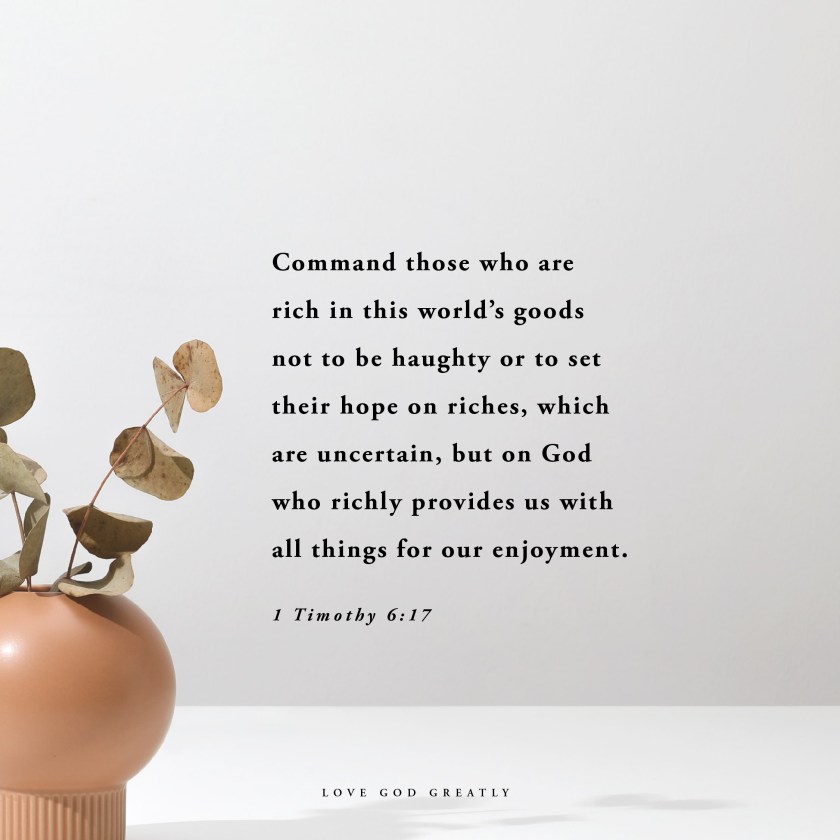
Command those who are rich in this world’s goods not to be haughty or to set their hope on riches, which are uncertain, but on God who richly provides us with all things for our enjoyment. 18 Tell them to do good, to be rich in good deeds, to be generous givers, sharing with others. 19 In this way they will save up a treasure for themselves as a firm foundation for the future and so lay hold of what is truly life.
It should be noted that Paul is giving instructions to Timothy about teaching wealthy believers how to live. That being said, the truth behind the teaching is good for all believers, wealthy or not. For every believer should put their hope in God and not worldly riches or possessions. Likewise, every believer is to do good and to share/give as generously as the Lord allows. And, in doing so – every believer is storing up for themselves treasures that truly matter and lead to what is “truly life”.
“Don’t store up treasures here on earth, where moths eat them and rust destroys them, and where thieves break in and steal. 20 Store your treasures in heaven, where moths and rust cannot destroy, and thieves do not break in and steal. 21 Wherever your treasure is, there the desires of your heart will also be.”
The focus of our hope is vital to our endurance. This is made clear by Paul’s words to Timothy. He doesn’t just give instructions about not setting their hope on riches (things, desires, treasures) of this world that are “uncertain” – but he immediately follows up with the good and profitable focus of their hope, which was “on God”. The contrast of the focus is – one is uncertain and the other is not only a sure and trustworthy ‘hope’ but also one who “richly provides”. Paul says that God provides those who hope in Him “with all things – not just for necessity but “for enjoyment”. In-turn, as recipients of His rich provisions we are to imitate Him by “doing good” and not just being good through obedience – but “to be rich in good deeds and generous in giving and sharing with others.” By doing this we are storing up for ourselves treasures in heaven where that which is “truly life” – Jesus, the hope of eternity – awaits us.
Application
I’m a list maker by nature and this is definitely one of those times where a list is beneficial –
Do not set your hope on riches that are uncertain.
Set your hope on God, who richly provides all things for our enjoyment.
Enjoy what He gives.
Do good.
Do an abundance of good deeds.
Give generously.
Share with others.
Store up for yourselves treasures in heaven... as you endure with hope
Prayer, Response to God’s Word
Father, giver of life and light and all that is good I praise You. I hope in You and seek to please You and to what is good and pleasing in Your sight. Help me to not be haughty or to set my hope on riches, which are uncertain, but instead, let them be set on You – who richly provides us with all things for our enjoyment. Help me to do good, to be rich in good deeds, to be a generous giver who shares with others.For in this way I will save up a treasure that is a firm foundation for the future and so lay hold of what is truly life – that which is eternal life in Jesus Christ my Lord. – In His name I pray and trust – amen and amen!
More for the Journey
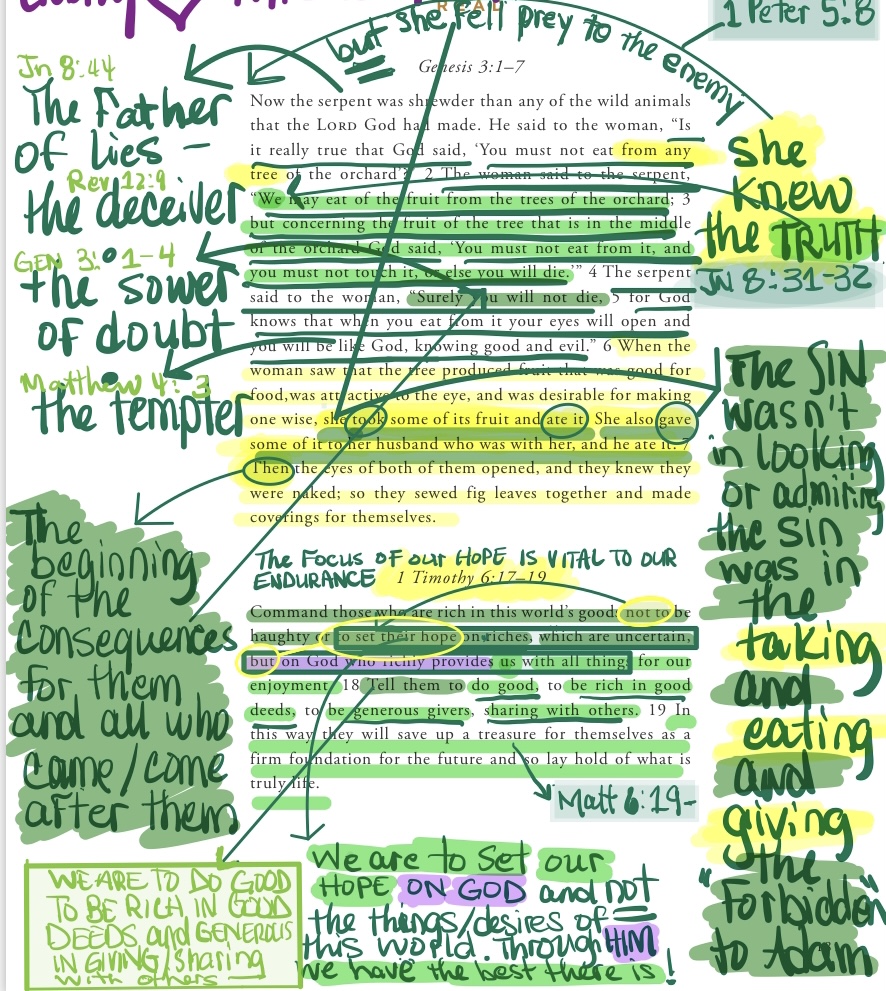
Today’s Scripture included a passage from Genesis chapter three. I have included the notes from my journal page on this passage. It always amazes me when such a familiar passage can seem so new and enlightening – but for me it was captivating. May we always be blessed by the Word of God – careful not to rush through it as though its a boring ‘rerun’. Rather, may we pray over it before reading, asking for fresh insight and understanding … and may we linger there so that we do not lose sight of it when we are finished.