For I am not ashamed of the gospel, for it is God’s power for salvation to everyone who believes, to the Jew first and also to the Greek.
Romans 1:16 NET
In our previous post, we explored many Scriptures that spoke about the faith of a woman with a bleeding issue. A faith inspired by hearing about Jesus, the man who had healed many people of their infirmities. So certain was she of what she had heard that when she learned where He was, she placed herself in the midst of the crowd that was following Him and worked her way closer and closer to Him, with the hope of being able to simply touch just the edge of His garment. She believed that even that would be enough for her to be healed – and, as we read in Luke 8:44, it was!
After all the doctors and all the money spent and all of the disappointments and growing problems, she touched the hem of His garment, and she knew immediately that she had been healed.
She came up behind Jesus and touched the edge of his cloak, and at once the bleeding stopped.
Luke 8:44 NET
Not only did she realize she had been healed, but much to her surprise, and I would imagine (because of the attention it drew to her) some embarrassment, Jesus also knew that someone had touched Him and at their touch power had gone out from Him.
And when the woman saw that she was not hid, she came trembling, and falling down before him, she declared unto him before all the people for what cause she had touched him, and how she was healed immediately.
Luke 8:47 KJV
45 Then Jesus asked, “Who was it who touched me?” When they all denied it, Peter said, “Master, the crowds are surrounding you and pressing against you!” 46 But Jesus said, “Someone touched me, for I know that power has gone out from me.” 47 When the woman saw that she could not escape notice, she came trembling and fell down before him. In the presence of all the people, she explained why she had touched him and how she had been immediately healed. 48 Then he said to her, “Daughter, your faith has made you well. Go in peace.
Luke 8:45-48 NET
Surely the beauty of this story is that her faith had brought about a miraculous healing, but by following the ‘breadcrumbs’ left by the other writers, we find credible evidence of at least the possibility that through her testimony, others came to Jesus, hoping for the same miraculous touch.
Matthew writes about a time when they had landed in Gennesaret, and “When the people there recognized Jesus, they sent word into all the surrounding area, and they brought all their sick to him. They begged him if they could only touch the edge of his cloak, and all who touched it were healed.” Some commentators speculate that the people may have requested this particular method of healing because they had heard the woman’s story. Friends, regardless of how they knew to ask to touch the hem of His garment, they knew. Regardless of how the woman with the issue of blood had heard enough about Jesus to place her faith in His power, she had heard and believed. The truth and the lesson we must not let pass us by is that it is important to tell others about Jesus. Yes, this means sharing the Gospel, but it also means sharing what He has done in your life, or what you have seen Him do in the lives of others. It’s about sharing the good news that our God changes lives when we call out to Him (or, as in the case of the woman today, reach out to Him) in faith.
Consider this:
Someone told you of your need for Jesus. where would you be if they chose not to share the Good News with you?
She, Volume 2/p98
Reflection and Application
Who told you about Jesus?
Thank them today.
Let’s commit to asking God daily to:
show us someone who needs to hear the good news about Jesus
help us see them
give us courage to stop and share Jesus with them
prepare their hearts to receive the message and believe in the Lord Jesus Christ
The More We Know
Dear reader, if you do not know Jesus… if you have never put your faith in Him, I invite you to explore “Know These Truths,” where you will discover the Way to everlasting life and an indescribable joy. It is available to all who believe. There is no greater hope for me concerning this website than for God to use it to lead others to Jesus, His only begotten Son, who came to earth so that you might enjoy everlasting life.
But a woman who had been suffering from a hemorrhage for twelve years came up behind him and touched the edge of his cloak. 21 For she kept saying to herself, “If only I touch his cloak, I will be healed.”
Matthew 9:20-21 NET
Desperation can cause us to do things we would not usually do; this is the case with today’s woman in the Bible. She is not named, but oh, how we need to know her story, share it with others, and let it affect our faith.
We are not told how she found out about Jesus (Mark 5:27) or how she came to believe that if she could only touch his garment, even the hem of it, she would be healed. Her disease wasn’t one that she could simply walk up to Him in public and talk about. It wasn’t a disease that any doctor or remedy she was given had been able to cure, but it was one on which she had spent all of her money in an attempt to find a cure, only to have the disease grow worse (see Mark 5:25–26).
As bad as those details sound, add to it “the Jewish Law that declared her to be ceremonially unclean due to her bleeding issue (Leviticus 15:25-27).” Which, as gotquestions.org explains, “meant that she would not have been permitted to enter the temple for Jewish religious ceremonies. According to the Law, anything or anyone she touched became unclean as well. The fact that she was in the crowd pressing around Jesus means that each person who bumped into her would have become unclean, too—including Jesus.” However, as has already been said, desperation can push us to do things we would never do otherwise. Such is the case here. “After twelve years of suffering, she was obviously desperate for a miracle.”So, “When she heard about Jesus, she came up behind him in the crowd and touched his cloak, because she thought, ‘If I just touch his clothes, I will be healed’” (Mark 5:27–28).
If I may but touch his garment, I shall be whole.”
Matthew 9:20 KJV
And so it was, just as she had believed. Scripture bears witness to us that the woman was made whole (Luke 8:47 and Mark 5:30). We could stop there with that testimony and celebrate both her faith and the victory that she experienced because of it. However, I can’t resist sharing the following commentary from gotquestions.org, which offers a wonderful bonus reason to lift our hands in praise for Jesus’ transforming power through her faith.
“As soon as the woman touches Jesus, her bleeding stops and she knows she’s been healed. In an instant, Jesus does what no doctor in twelve years had been able to. This proves the power of Christ, of course, but it also illustrates an important point about Jesus and the Law. In Leviticus 15:31 God says, “You must keep the Israelites separate from things that make them unclean, so they will not die in their uncleanness for defiling my dwelling place, which is among them.” In the Old Testament, the temple was where God dwelt among the Israelites, but in the New Testament, God dwelt among men in the person of Jesus Christ (see John 1:14). Through Jesus the penalties of the Law are reversed, and the contamination of this world had no effect on Christ. The woman did not make Jesus (God’s dwelling) unclean—He made her clean!”
Friends, I don’t know about you, but to that beautiful picture of ‘faith’s glorious victory’ I am shouting a loud amen and hallelujah!
Reflection and Application
What was so special about the garment Jesus was wearing?
The More We Know
Join me tomorrow as we look at another example of this woman with the issue of blood. It’s amazing what these women can teach us.
If you’ve heard the story, you already know the outcome; if you haven’t, then you may be surprised at the King’s first suggestion and the vastly different reactions of the women. Whether the story is new to you or well-known, we must be careful not to brush it aside as irrelevant to us today. Our circumstances and life choices may never place us in the exact scenario of the two mothers, but throughout our lifetime, we will inevitably face difficult choices – choices that make us choose right from wrong, good or evil, love or hate, gain or loss – and in all of these, we must choose carefully. Our decisions must be made with a heart yielded and committed to God’s glory (the righteous choice), even if it means suffering great loss. After all, Jesus told His disciples (including us): whoever wanted to follow Him would need to deny themselves daily and take up their cross, which, as explained by one commentary1, means to: “accept the rejection of the world for turning to Jesus and following him. Discipleship involves a death that is like a crucifixion (Gal. 2: 20 and 6:14).” This is why Jesus went on to say: “Whoever wants to save his life will lose it; but whoever loses his life because of me will save it” (Luke 9:24).
Solomon could not tell from their words which woman was telling the truth. Instead, he issued a shocking command: “Bring me a sword. . . . Cut the living child in two and give half to one and half to the other”
Leave a comment below with another example of someone willing to suffer great loss for God’s glory.
The More We Know
The chapter’s final verse notes the effect that Solomon’s unorthodox methods had on the kingdom: “When all Israel heard the verdict the king had given, they held the king in awe, because they saw that he had wisdom from God to administer justice” (1 Kings 3:28). Solomon’s wisdom had been given by God when Solomon requested it (verse 5). The account of Solomon’s handling of the case of the two prostitutes showed that he had indeed been granted wisdom from God. ~ (Got questions.org)
Dear reader, if you do not know Jesus… if you have never professed your faith in Him, I invite you to explore “Know These Truths” where you will discover the Way to everlasting life and an indescribable joy. It is available to all who believe.
Biblegateway.comsn Only Luke mentions taking up one’s cross daily. To bear the cross means to accept the rejection of the world for turning to Jesus and following him. Discipleship involves a death that is like a crucifixion; see Gal 6:14. ↩︎
While there is much we can learn from the story of the widow and her two mites, two things stood out to me the most. First, as gotquestions.org points out, “God sees what man overlooks. The big gifts in the temple were surely noticed by people; that’s probably what the disciples were watching. But Jesus saw what no one else did: He saw the humble gift of a poor widow. This was the gift that Jesus thought worthy of comment; this was the gift that the disciples needed to be aware of. The other gifts in the treasury that day made a lot of noise as they jingled into the receptacles, but the widow’s mites were heard in heaven.”
God sees what man overlooks.
Got questions.org
The widow mentioned by Mark and Luke is used by Christ to teach the disciples the difference of giving from your wealth and giving from your poverty. In other words there is more value in giving two small coins when you have nothing left to give and giving “large sums” with an abundance left over. Borrowing again from gotquestions.org, “The difference is one of proportion. The rich were giving large sums, but they still retained their fortunes; the widow “put in everything—all she had to live on” (Mark 12:44). Hers was a true sacrifice; the rich had not begun to give to the level of her sacrifice.
“Therefore I exhort you, brothers and sisters, by the mercies of God, to present your bodies as a sacrifice – alive, holy, and pleasing to God – which is your reasonable service.”
Romans 12:1 NET
“Truly I tell you, this poor widow has put more into the treasury than all the others. They all gave out of their wealth; but she, out of her poverty, put in everything—all she had to live on” (Mark 12:43–44; cf. Luke 21:1–4).
The widow with two mites serves as an example of how any sacrifice for Christ does not go unnoticed by Him.
She, Volume 2//90
Friends, let’s ask Jesus to help us see as He sees and to make much of even the smallest things done for or given in His name. May our gifts and works for God be ones of faith and sacrifice, rather than those born of duty or seeking notice.
While Sapphira is one of the lesser-known women of the Bible, she is most definitely one that we should acquaint ourselves with, so that we do not fall into the same trap of sin. But, exactly what was the sin?
Sapphira serves as an example of how dangerous it is for us to portray to be something we are not.
She, Volume 2/p78
Now a man named Ananias, together with Sapphira his wife, sold a piece of property. 2 He kept back for himself part of the proceeds with his wife’s knowledge; he brought only part of it and placed it at the apostles’ feet. 3 But Peter said, “Ananias, why has Satan filled your heart to lie to the Holy Spirit and keep back for yourself part of the proceeds from the sale of the land?4 Before it was sold, did it not belong to you? And when it was sold, was the money not at your disposal? How have you thought up this deed in your heart?You have not lied to people but to God!”
5 When Ananias heard these words he collapsed and died, and great fear gripped all who heard about it. 6 So the young men came, wrapped him up, carried him out, and buried him. 7 After an interval of about three hours, his wife came in, but she did not know what had happened. 8 Peter said to her, “Tell me, were the two of you paid this amount for the land?” Sapphira said, “Yes, that much.” 9 Peter then told her, “Why have you agreed together to test the Spirit of the Lord? Look! The feet of those who have buried your husband are at the door, and they will carry you out!” 10 At once she collapsed at his feet and died. So when the young men came in, they found her dead, and they carried her out and buried her beside her husband. 11 Great fear gripped the whole church and all who heard about these things.
Acts 5:1-11
She and her husband deceived people by agreeing together to surrender a part as if they had surrendered all.
She, Volume 2/p66
Friends, to understand the outcome of this story, it is important to look at all the details. Here’s what we know from the immediate passage: Saphira and her husband owned property and were free to do with it as they pleased. Together, as a couple, they decided to sell a portion of their property, and then they gave some of the money to the church. It’s a nice gesture, but from Peter’s conversation with them, the problem seems to be that, somewhere along the way, they indicated they had given the church all the money. As Peter points out, the property was theirs to do with as they wanted, and the same was true of the money they made from selling it. So the problem (aka ~ the sin) is not that they kept some of the proceeds for themselves, the grievous sin was that they “lied to God”. The following details from Bibleref.com shed a little more clarity on the situation and outcome.
Ananias and Sapphira sold some land and, apparently, promised God they would donate all the proceeds to the church. Before they gave the money to the apostles, they either changed their minds and kept some, or never really intended to give all of it. Rather than being honest, the pair seems to have chosen to lie about their generosity. Ananias brought the money earlier in the day, but because of his dishonesty, God struck him dead. Sapphira has now appeared and knows nothing of Ananias’ death (Acts 5:1–6).
Peter uses a technique God has used throughout history, starting with Adam and Eve. When God came to the garden after Adam and Eve ate the fruit, He called out, “Where are you?” He didn’t ask this because He didn’t know where they were. He was giving them an opportunity to engage in conversation (Genesis 3:9). He wanted them to admit what they had done so He could restore some of their relationship. God also asks questions when He wants to direct the course of the conversation. He used this tactic with Moses (Exodus 4:2), and Jesus used it with the woman with an issue of blood (Mark 5:30).
God condemned Ananias with death for his lie. Sapphira still has a chance to tell the truth. Peter invites her to do so by directing the conversation. She doesn’t have to follow her husband into sin—Abigail didn’t (1 Samuel 25). Unfortunately, Sapphira is as deceitful as Ananias. She repeats the lie, and God judges her for it.
Bibleref.com
Some stories in the Bible are not easy to hear, and the lessons that come with them are often even more difficult. This is definitely not a feel-good story/lesson, but we would be wise to not brush it aside but rather to learn from what Peter says to them and the serious consequences that followed. Remember, “All Scripture is God-breathed and is useful for teaching, rebuking, correcting, and training in righteousness…” We would also be wise to remember Paul’s warnings to not only submit ourselves to God but to resist the devil. If we do not, we will find ourselves entertaining the temptations of the great deceiver, leading us to make choices that will not only hurt us but also the Church and the people around us. This is best explained by gotquestions.org.
The case of Ananias and Sapphira illustrates the fact that even believers can be led into bold, flagrant sin. It was Satan that had filled their hearts to lie in this way (Acts 5:3) and “to test the Spirit of the Lord” (verse 9). Covetousness, hypocrisy, and a desire for the praise of men all played a part in their demise.
The sudden, dramatic deaths of Ananias and Sapphira served to purify and warn the church. “Great fear seized the whole church” (Acts 5:11). Right away, in the church’s infancy, God made it plain that hypocrisy and dissimulation were not going to be tolerated, and His judgment of Ananias and Sapphira helped guard the church against future pretense. God laid the bodies of Ananias and Sapphira in the path of every hypocrite who would seek to enter the church.
As someone who used to scheme and manipulate situations to get a desired result, the opening lines of Ruth chapter three catch my attention every time. Whether it was culturally acceptable to arrange marriages in that day and time, the conversation that ensues seems to fall under the plotting and scheming category of any generation or culture.
One day her mother-in-law Naomi said to Ruth, “My dear daughter, isn’t it about time I arranged a good home for you so you can have a happy life? And isn’t Boaz our close relative, the one with whose young women you’ve been working? Maybe it’s time to make our move.
Ruth 3:1-2
Naomi knew that Boaz was working in the threshingfloor,
It is worth noting that marriage arrangements were the custom of the day in which Naomi and Ruth lived. So, the argument could be made that they were simply following the lead or path that was opened when Boaz extended her the kindness, protection, and provision of gleaning in his field. As bibleref.com commentary explains, “Naomi has a problem. She wants Boaz, an older, highly honored Jewish man, to marry Ruth, her young Moabite daughter-in-law. Culturally, there is nothing about this scheme that makes sense. But Naomi knows Ruth deserves the best in life, and she’s resolved to make it happen. Naomi must balance several things all at once. She needs to figure out how Ruth can propose to Boaz while keeping safe and maintaining enough privacy that Boaz doesn’t lose face for talking with a foreign widow.”
Ruth Proposes
Ruth was a willing participant and followed all of the instructions Naomi gave her. After seeing/hearing all that Boaz had done thus far, there was no reason for either woman to doubt that Boaz, as a “near kinsman who could redeem them, would do what he could”2. Whether it is the man or woman who proposes, I think we would all agree that no one wants to hear the answer, ‘Yes, but…’. Unfortunately, however right he was, this is the answer that Boaz gives Ruth.
The Lord bless you, my daughter!’ Boaz exclaimed. ‘You are showing even more family loyalty now than you did before, for you have not gone after a younger man, whether rich or poor.3 Now don’t worry about a thing, my daughter. I will do what is necessary, for everyone in town knows you are a virtuous woman. But while it’s true that I am one of your family redeemers, there is another man who is more closely related to you than I am.
Ruth 3:10-12
Despite her Moabite heritage, Ruth had come to be known as a kind and virtuous woman, and even though another man was a closer redeemer than Boaz, Boaz was the one whom God had prepared to be her redeemer.
12 But while it’s true that I am one of your family redeemers, there is another man who is more closely related to you than I am. 13 Stay here tonight, and in the morning I will talk to him. If he is willing to redeem you, very well. Let him marry you. But if he is not willing, then as surely as the Lord lives, I will redeem you myself! Now lie down here until morning.”
14 So Ruth lay at Boaz’s feet until the morning, but she got up before it was light enough for people to recognize each other. For Boaz had said, “No one must know that a woman was here at the threshing floor.” 15 Then Boaz said to her, “Bring your cloak and spread it out.” He measured six scoops[a] of barley into the cloak and placed it on her back. Then he[b] returned to the town.
16 When Ruth went back to her mother-in-law, Naomi asked, “What happened, my daughter?”
Ruth told Naomi everything Boaz had done for her, 17 and she added, “He gave me these six scoops of barley and said, ‘Don’t go back to your mother-in-law empty-handed.’”
18 Then Naomi said to her, “Just be patient, my daughter, until we hear what happens. The man won’t rest until he has settled things today.”
Ruth 3:12-18
Ruth Waits … but not for long
While Naomi told Ruth she wouldn’t have to wait long, she also told her to “be patient.” Those two words can be very good advice, however they can also be a very annoying and often challenging statement. Yet, according to the commentary by Bibleref.com, just as Naomi had predicted, it is only a few hours later that Boaz goes to the city gates. Determined to do all he could to help care for Ruth and Naomi, Boaz follows the cultural demands of the day, which are described in the first twelve verses of Ruth, chapter four. They are a wonderful display of Boaz’s character, and I believe, his respect and heart’s desire to marry Ruth.
As today’s study guide points out, the sandal represents so much more than the transfer of property. It was a declaration that Boaz was now legally able to marry Ruth.
The Story of the Sandal
Boaz went to the town gate and took a seat there. Just then the family redeemer he had mentioned came by, so Boaz called out to him, “Come over here and sit down, friend. I want to talk to you.” So they sat down together. 2 Then Boaz called ten leaders from the town and asked them to sit as witnesses. 3 And Boaz said to the family redeemer, “You know Naomi, who came back from Moab. She is selling the land that belonged to our relative Elimelech. 4 I thought I should speak to you about it so that you can redeem it if you wish. If you want the land, then buy it here in the presence of these witnesses. But if you don’t want it, let me know right away, because I am next in line to redeem it after you.”
The man replied, “All right, I’ll redeem it.”
5 Then Boaz told him, “Of course, your purchase of the land from Naomi also requires that you marry Ruth, the Moabite widow. That way she can have children who will carry on her husband’s name and keep the land in the family.”
6 “Then I can’t redeem it,” the family redeemer replied, “because this might endanger my own estate. You redeem the land; I cannot do it.”
7 Now in those days it was the custom in Israel for anyone transferring a right of purchase to remove his sandal and hand it to the other party. This publicly validated the transaction. 8 So the other family redeemer drew off his sandal as he said to Boaz, “You buy the land.”
9 Then Boaz said to the elders and to the crowd standing around, “You are witnesses that today I have bought from Naomi all the property of Elimelech, Kilion, and Mahlon. 10 And with the land I have acquired Ruth, the Moabite widow of Mahlon, to be my wife. This way she can have a son to carry on the family name of her dead husband and to inherit the family property here in his hometown. You are all witnesses today.”
11 Then the elders and all the people standing in the gate replied, “We are witnesses! May the Lord make this woman who is coming into your home like Rachel and Leah, from whom all the nation of Israel descended! May you prosper in Ephrathah and be famous in Bethlehem. 12 And may the Lord give you descendants by this young woman who will be like those of our ancestor Perez, the son of Tamar and Judah.” Ruth 4:1-12
Then Boaz said to the elders and to the crowd standing around, “You are witnesses that today I have bought from Naomi all the property of Elimelech, Kilion, and Mahlon. 10 And with the land I have acquired Ruth, the Moabite widow of Mahlon, to be my wife. This way she can have a son to carry on the family name of her dead husband and to inherit the family property here in his hometown. You are all witnesses today.”
Ruth 4:9-10
Salmon was the father of Boaz (whose mother was Rahab). Boaz was the father of Obed (whose mother was Ruth). Obed was the father of Jesse. Matthew 1:5
Scripture paints a beautiful picture of the story, allowing us to see the amazingly personal hand of God carrying out His purposes and plans for generations upon generations to come.
So Boaz took Ruth into his home, and she became his wife. When he slept with her, the Lord enabled her to become pregnant, and she gave birth to a son. (Ruth 4:13) – Cue the water works and celebration, for Naomi (and Ruth) have been redeemed and restored!
Then the women of the town said to Naomi, “Praise the Lord, who has now provided a redeemer for your family! May this child be famous in Israel. 15 May he restore your youth and care for you in your old age. For he is the son of your daughter-in-law who loves you and has been better to you than seven sons!”
Ruth 4:14-15
She was given a legacy of redemption. And she serves as an example of the beautiful picture of redemption that Christ has provided for us.4
As the study journal points out, Ruth’s son would be the grandfather of King David of Israel. And fourteen generations after him, Jesus Christ would be born of the same lineage. ~ for even more details on the beautiful plan of God in and through the story of Ruth and the glorious arrival of Jesus, “in whom we have redemption through His blood, the forgiveness of sins, according to the riches of His grace5“, click here.
Reflection and Application
Why do we need a Redeemer?
What was the name of Ruth and Boaz’s son, and how does he play a part in the life of Jesus, our Redeemer?
The More We Know
Would you like to know more about Jesus, My Redeemer?
There is a version/translation of the Scriptures called the Message. I’m assuming most are at least familiar with it but if you aren’t it is, as Christianbooks.com describes it, “a unique, contemporary paraphrase of the Bible that captures the heart, tone, and vibrant imagery of Scripture in everyday language—making it an inspiring choice for personal devotion, fresh insights, and connecting with God’s Word in a relatable, emotionally engaging way that speaks powerfully to both new believers and longtime readers alike.” ~While I do not use the Message as a study Bible, I do appreciate its tone and imagery – particularly in books like Ruth, as it seems to capture the heart and voice of the characters and the all-encompassing love and personal care of our God.
14 At the lunch break, Boaz said to her, “Come over here; eat some bread. Dip it in the wine.”
So she joined the harvesters. Boaz passed the roasted grain to her. She ate her fill and even had some left over.
15-16 When she got up to go back to work, Boaz ordered his servants: “Let her glean where there’s still plenty of grain on the ground—make it easy for her. Better yet, pull some of the good stuff out and leave it for her to glean. Give her special treatment.”
17-18 Ruth gleaned in the field until evening. When she threshed out what she had gathered, she ended up with nearly a full sack of barley! She gathered up her gleanings, went back to town, and showed her mother-in-law the results of her day’s work; she also gave her the leftovers from her lunch.
19 Naomi asked her, “So where did you glean today? Whose field? God bless whoever it was who took such good care of you!”
Ruth told her mother-in-law, “The man with whom I worked today? His name is Boaz.”
20 Naomi said to her daughter-in-law, “Why, God bless that man! God hasn’t quite walked out on us after all! He still loves us, in bad times as well as good!”
Naomi went on, “That man, Ruth, is one of our circle of covenant redeemers, a close relative of ours!”
21 Ruth the Moabitess said, “Well, listen to this: He also told me, ‘Stick with my workers until my harvesting is finished.’”
22 Naomi said to Ruth, “That’s wonderful, dear daughter! Do that! You’ll be safe in the company of his young women; no danger now of being raped in some stranger’s field.”
23 So Ruth did it—she stuck close to Boaz’s young women, gleaning in the fields daily until both the barley and wheat harvesting were finished. And she continued living with her mother-in-law.
Ruth 2:14-23 ~The Message
What a beautiful love story that unfolds on the pages of Scripture as God leads Ruth to the field of Boaz, one of their Kinsman Redeemers, and the heart and actions of Boaz respond with tender compassion and protection for Ruth and her mother-in-law.
Equally as beautiful is the visible melting of Naomi’s bitterness when she hears what God has done for them and declares, “Why, God bless that man! God hasn’t quite walked out on us after all! He still loves us, in bad times as well as good!” (Ruth 2:20).
Friends, this is such an important truth for us to know and remember throughout all of life. Even when life is overwhelming and the way ahead seems uncertain, we have the promise of God’s never-ending love and wisdom. We have the promise that He will never leave us or forsake us, and that He will lead us and guide us by His Spirit and His Word.
I will lead the blind by ways they have not known, along unfamiliar paths I will guide them; I will turn the darkness into light before them and make the rough places smooth. These are the things I will do; I will not forsake them.
Isaiah 42:16
Isaiah 42:16 was the passage of a morning devotion I recently read, and it came to mind as I was working on today’s journey through Ruth chapter 2, where Ruth knew no one and was desperately trying to help provide for herself and Naomi. There is no indication that she knew which fields were safe or who they belonged to. There is, however, overwhelming evidence that God was guiding her along unfamiliar paths, turning her darkness into light, and making the rough places smooth. Ruth had chosen to leave her pagan gods and family behind, committing herself not only to Naomi but to her true and living God, the faithful God of Israel. Now, she would begin to realize His love and personal involvement in her life as He provides not only safety but the attentiveness of a kinsman redeemer and the handfuls of barley purposefully dropped along the path for her to pick up as she gleaned.
She returned home to Naomi with the reserve of barley, and the amount sparked the interest of her mother-in-law.1
The passages (Ruth 2:14-23 and Isaiah 42:16) are worth rereading, for they reveal the absolute beauty of God leading, guiding, planting … us where He wants us, both for our good and His purpose and glory. Even the Isaiah passage is evidence of that truth in my own life, as I had not gone looking for the verse, the people who post the daily verses do not know me or what I would be studying – nor do I believe it is a mere coincidence, but rather the beautiful direction and timing of our lovingly purposeful, sovereign God.
May God continually open our eyes and hearts to behold all the wonderful things in His Word and His work in and around our lives. May we, as Naomi, trust, see, and declare that, regardless of how difficult our days and situations may be, God has not abandoned us, He still loves us – “in the bad times as well as good,” and may we bless His Holy Name.
“Why, God bless that man! God hasn’t quite walked out on us after all! He still loves us, in bad times as well as good!”Naomi went on, “That man, Ruth, is one of our circle of covenant redeemers, a close relative of ours!”
Ruth 2:20
I love that we not only see Naomi’s scales of bitterness falling away, but we can hear the restored hope in her words to Ruth (2:20). We can also hear the beautiful evidence that she truly considered Ruth her daughter. As we move toward the end of our journey with Ruth over the next day or two, we will see that those around Ruth could see these truths as well.
Reflection and Application
What have you recently gleaned from the Word of God?
In yesterday’s journey, we focused on Naomi, who, along with her husband and sons, had left their Bethlehem home during a drought to dwell in the land of Moab. While they were there, not only did Naomi’s husband die, but her sons, who had married Moabite women, also died. For at least ten years, Naomi continued on in Moab with her widowed daughters-in-law, Orpah and Ruth. Our journey picks up today with the story of Ruth, who, when Naomi decided to return to Bethlehem, left all that she knew behind and committed herself not only to her mother-in-law but to her God.
Ruth replied, “Don’t ask me to leave you and turn back. Wherever you go, I will go; wherever you live, I will live. Your people will be my people, and your God will be my God. 17 Wherever you die, I will die, and there I will be buried. May the Lord punish me severely if I allow anything but death to separate us!”
Ruth 1:16-17
Ruth did not have to do this; Naomi had released both of her daughters-in-law from any obligation they may have felt by cultural tradition or allegiance to her sons that they owed her. She encouraged them to return to the homes of their own mothers. Orpah chose to do so, but Ruth, as Scripture bears witness, chose to leave not only her family but the gods of Moab behind.
Ruth was strong, courageous, bold, brave, and determined.
She, Volume 2, p64
As today’s study journal points out, Ruth was not only strong but she was also courageous, bold, brave, and determined. As we journey through her story, we will see how God used these characteristics to accomplish not only His purpose for her life but also for His people. We will watch Naomi’s bitter spirit come alive with joy, and we will see God divinely direct Ruth’s path to a “happily ever-after, purpose-filled ending”. Though I’m sure it didn’t seem that way to her at first.
Ruth is new to town, widowed, along with her widowed mother-in-law, who is admittedly struggling with bitterness. “They have no man to protect or provide for them, and no source of income,1” but Ruth does not shy away from doing what is necessary to survive and provide. It would not have been uncommon, in their situation, for her to have to beg, become a prostitute, sell herself as a slave, or glean.2 However, as God would have it, Ruth and Naomi arrived in Bethlehem at the beginning of the barley harvest, so Ruth sought Naomi’s approval to glean. While gleaning sounds like the best of the options the women had, it came with its own problems and dangers, and, depending on the field you found to glean in, there was little to no promise of a profitable haul, as gleaners were limited not only in what would be left but in what they could take. In addition to these hurdles, there was the added challenge that Ruth was a Moabite and may not find a field where the owner would allow her to glean. There was also the real and present danger of assault because she was not only a young widow but a foreigner.
“There is nothing safe about Ruth going to glean in an Israelite’s field. She is wise to request permission from the harvest manager.”
I am a firm believer that there are absolutely no coincidences with God. So when we read that Ruth ended up in the field of Boaz, a relative of her dead father-in-law, Elimelech, we are allowed to see that she was divinely directed by God to this particular field.
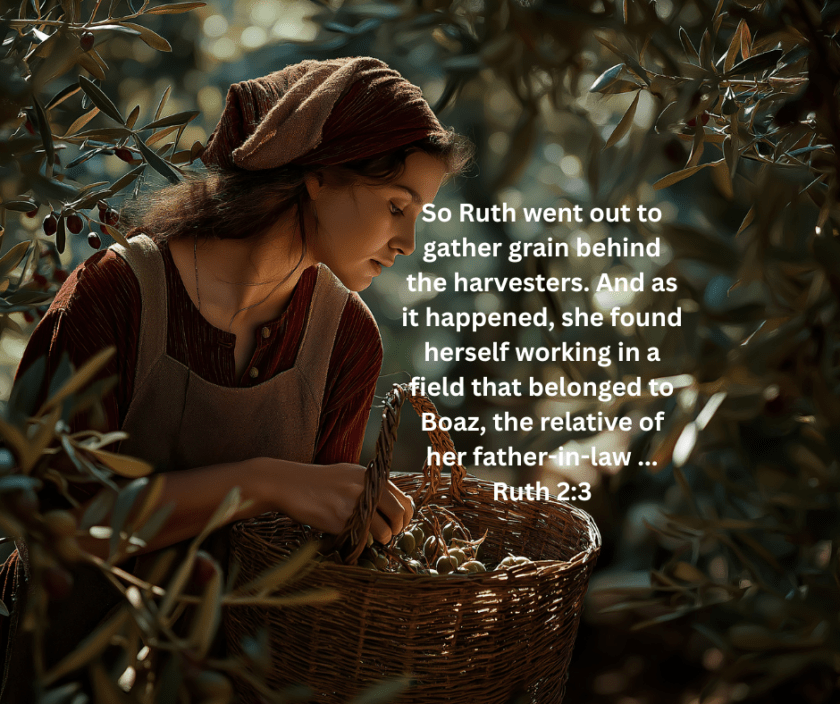
So Ruth went out to gather grain behind the harvesters. And as it happened, she found herself working in a field that belonged to Boaz, the relative of her father-in-law, Elimelech.
Ruth 2:3
When Boaz arrives and sees Ruth, he is curious and talks to his foreman about her. The foreman explains who she is and gives a glowing report of her work, which moves Boaz to talk to Ruth and encourage her to stay and work with them, telling her she will be safe and enjoy the privilege of water to drink and food to eat. Ruth is so moved by his kindness that she fell at his feet with gratitude, and asked him, “Why have I found grace in thine eyes, that thou shouldest take knowledge of me, seeing I am a stranger?“
Boaz gave Ruth his field to glean from freely. God has given us His Word and He shares it with us freely.
May we be mindful of where we are spending our time, and from what (whose) field(s) we are gleaning.
She, Volume 2, p66
As we read in verses 15 and 16, Boaz also made sure she would have good success in her gleaning. She had so much success that when she arrived home, Naomi’s surprise and joy were evident as she gathered details from Ruth about the day and how the Lord had blessed them by sending her to Boaz’s field.
That man is one of our closest relatives, one of our family redeemers.
Ruth 2:20
Friends, it is worth noting that if Ruth had returned to her mother’s home as Naomi had encouraged her, she might never have met Boaz and known the blessing of God’s hand on her life in the days and years to come.
It was no accident that God directed her to the field of Boaz.
“she went” God gave her the faith to go. “and came” God directed her steps of where she should go. “and gleaned” God provided exactly what she needed, when and where she needed it.
She, Volume 2/p45
The More We Know
I love that the journal for today points out that not only did Boaz encourage Ruth to stay, but that he knew no other field could meet her need, and that “the field” is a picture of the Word of God. Oh may we continually glean3 from His Word.
When a famine descended on the town of Bethlehem, Naomi and her husband, along with their two sons, left their home for Moab. Their intent was to dwell there for the duration of the famine, however they were there for at least ten years. During that time, Elimelech died, after which the sons both married Moabite women (which, for the record, Jewish law forbids).1 After they were married, the sons also died, leaving Naomi both widowed and childless, her only close family the two Moabite women, Orpah and Ruth. Not surprisingly, when Naomi received word that the famine was over in Bethlehem, she decided to return to her homeland, the land of God’s people.
With her two daughters-in-law she set out from the place where she had been living, and the took the road that would lead them back to Judah.
Ruth 1:7
Shortly into their trip, Naomi, willing to go on alone, urged both girls (the only family and connections to her sons that she had left) to return to their “mother’s house’, for they had dealt kindly with her through the years. I can only imagine the great sacrifice this was for Naomi.
Her explanation to them, found in Ruth 1:12-13, revealed that she felt that the Lord’s hand had gone out against her. However, as David Guzik notes in his commentary, “she still moved back toward Him (Jerusalem/Bethlehem) rather than further away. This was a sign of trust and drawing closer to God.”
Ruth’s Conversion
While Orpah chose to return home, Ruth chose to continue on with Naomi, declaring, “Don’t ask me to leave you and turn back. Wherever you go, I will go; and wherever you live, I will live. Your people will be my people, and your God will be my God” (Ruth 1:16). Ruth not only pledges herself to Naomi and her people, but to Naomi’s God – the true and living God of Israel.
Don’t ask me to leave you and turn back. Where ever you go, I will go; and where ever you live, I will live. Your people will be my people, and your God will be my God.2
Ruth 1:16
When they arrived back in Bethlehem, Naomi told those who greeted her not to use the name Naomi but to use Mara instead, explaining that the Lord had dealt very bitterly with her; she had gone away full but had returned empty. She no longer felt worthy of the name Naomi, which means ‘pleasantness’, because clearly bitterness had consumed her.
It is important to note, as the study guide points out, that there are many names changed by God throughout Scripture (Abram to Abraham, Sarai to Sarah, Jacob to Israel, Saul to Paul…), but here, Ruth changed her own name because she was convinced that “the Lord had testified against her and the Almighty had afflicted her.”
It is important to notice that Naomi wasn’t oblivious to the drastic changes that occurred in her life, which were having a great impact on her. One commentator points out that this is most evident in her statement that “the Almighty(supreme ruler) had afflicted her,” instead of using the more personal name of Yahweh (the God who cares).
I went looking for answers as my own mind started questioning if the suffering of Naomi and her family was due to sin, such as their leaving Bethlehem due to the famine, or dwelling in the pagan land of Moab instead of staying and trusting God to carry them through the famine.
Concerning Naomi’s belief in the trouble that had come to her family, commentator David Guzik points out:
i. It is hard to say that this was the direct hand of God’s judgment against them. It is sometimes difficult to discern why tragic things happen. What is certain is that the change of scenery didn’t make things better.
ii. We sometimes think we can move away from our problems, but find we just bring them with us. No matter where you go, you bring yourself with you – so the same problems can continue in a different place.
Reflection and Application
Reflection: Naomi serves as an example that:
Even after great pain and sorrow, we can return to where God would have us be.
Sorrow can change our character if we let it.
Application: Consider these questions:
How have you needed to return to the Lord in the past?
SHE WATCHED HIM DIE ON THE CROSS. SHE SAW HIS BODY BURIED INSIDE THE TOMB. SHE WAS THE FIRST TO SEE JESUS AFTER HE HAD RISEN.
SHE, VOLUME 2, P41
Mary Magdalene is the Mary from whom Jesus cast out seven devils (Mark 16:9), and according to Mark’s gospel (16:9), she was the first to see Jesus after He arose from the grave. Her master and teacher, whom she had seen brutally tortured and crucified, was no longer in the grave but standing behind her calling her name (John 20:16). She had seen HIm, but had mistaken Him for the gardener (Jn 20:15), until He said her name: Jesus saith unto her, “Mary,” and she immediately turned and called Him Master.
Jesus saith unto her, Mary. She turned herself, and saith unto him, Rabboni; which is to say, Master.
John 20:16
I love that the study guide for this journey points out that “He knew her name, just as He knows ours,” but I am just as moved and somewhat convicted by the evidence that even though she did not recognize Him when she saw Him, when He called to her, she recognized His voice. “Knowing the Lord’s voice indicates experiential knowledge through a relationship with Him.”1 This is an important lesson Jesus had taught the disciples earlier in His ministry. May we never be so busy or preoccupied with life that we fail to see Jesus, and may we always know His voice when He calls our name.
“…she stooped down, and looked into the sepulcher..”
Now on the first day of the week Mary Magdalene went to the tomb early, while it was still dark, and saw that the stone had been taken away from the tomb. 2 Then she ran and came to Simon Peter, and to the other disciple, whom Jesus loved, and said to them, “They have taken away the Lord out of the tomb, and we do not know where they have laid Him”
John 20:1-2
“Mary neglected to remember what Jesus had said would happen.”
We know from Mark’s writings that Jesus had taught His disciples that men would take Him and kill Him, but that He would rise again on the third day (Mark 9:31). However, when she found the tomb was empty, she forgot what had been said and panicked she found the tomb was empty. In her panic, rather than running with the jubilant cry that Christ had arisen, Mary Magdalene ran to tell the others His body had been stolen, and we do not know where He is.
Friends, we would be wise to learn from Mary Magdalene and not allow fear or other distractions to cause us to forget what we have heard and seen from Him.

 Me From the Inside Out