Posted in Bible study, Devotion, From the Insideout, Journey Through The Word, She, Volume 1

Mary of Bethany, Part 2

Adapted from She, Volume 1, p 41-42

Read: Mark 14:1-9

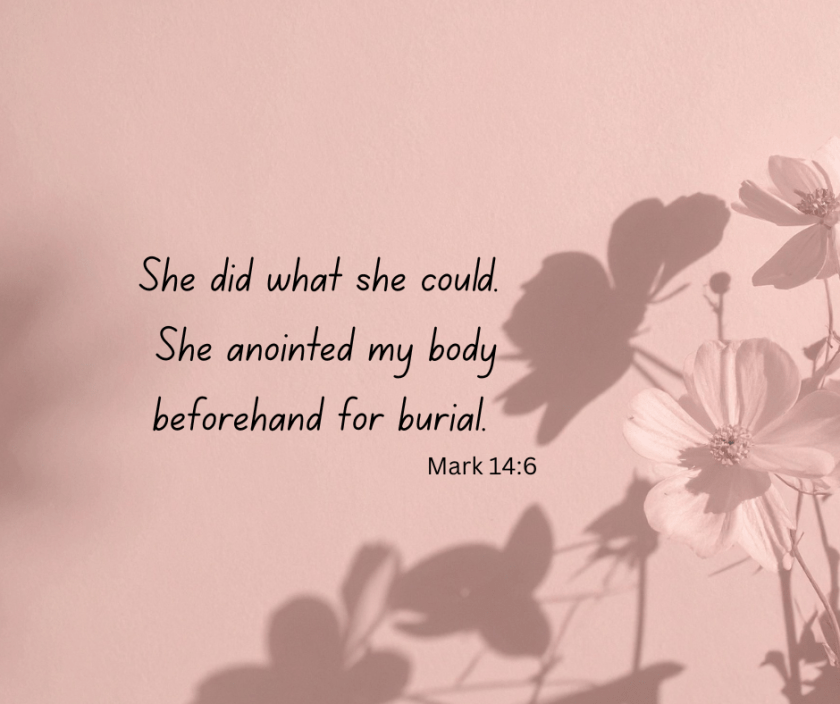
 Now while Jesus was in Bethany at the house of Simon the leper, reclining at the table, a woman came with an alabaster jar of costly aromatic oil from pure nard. … 8After breaking open the jar, she poured it on his head.She did what she could. She anointed my body beforehand for burial. I tell you the truth, wherever the gospel is proclaimed in the whole world, what she has done will also be told in memory of her.”

Mark 14:3, 8-9

For at least the second time, possibly the third (Luke 7:36–50John 12:1–8), a woman anoints Jesus with perfume. At the home of Simon the Leper, an unidentified woman anoints Jesus’ head on the day the Passover lambs are being anointed (Mark 14:3–9). Jesus praises her gracious act of worship that prepares Him for His burial the next afternoon. (bible ref.com)

Hey friends, if you read the previous post, you may think I’m repeating myself with this one as we continue to focus on a time when Jesus was anointed with perfume shortly before His sacrificial death and burial. While this post, in part, is repetitious as its focus is, again, on a woman anointing Jesus with oil, there are notable differences. The two that stand out to me are 1)the woman is not named (though, with good reason, she is still believed to be Mary of Bethany) and 2)she anoints his head rather than his feet (John 12:1–8). However, today we zero in on the truth and encouragement that she did what she could (v8).

Mary of Bethany considers worldly losses or gains nonsense compared to the spiritual treasure of having Jesus

Bibleref.com/Mark 14:8

As Bibleref.com points out, “Jesus often warns His followers to count the cost of following Him. ” While the disciples “are more interested in what they can gain (Mark 9:33-38; 10;35-41), Mary of Bethany considers worldly losses or gains nonsense compared to the spiritual treasure of having Jesus (Philippians 3:8).” Remember, this is the same Mary, who had upset her sister Martha by choosing to sit at Jesus’ feet and listen to Him instead of helping her with the duties of hospitality (Luke 10:38–42).

Jesus tells the disciples who question/criticize her actions to “Leave her alone”. He doesn’t stop there, though. He goes on to teach an important lesson for all of us, saying, “Why are you bothering her? She has done a good service for me. For you will always have the poor with you, and you can do good for them whenever you want. But you will not always have me! She did what she could. She anointed my body beforehand for burial.

Friends, I don’t know about you, but this one “stepped on my toes”, as I realized this isn’t just a lesson for the disciples of Jesus’ day but for all of His disciples. We are all to have this mindset, putting Him before our desires and above the cultural norm, living for Him, serving Him, sharing Him pleasing Him, loving Him and others as He has loved us … dying to self.

Mary did what she did, not so that others would remember her but to glorify and honor her Lord and master. Yet, to this day, just as Jesus said, she is still remembered for what she did. Which begs us to ask ourselves:

What will you be remembered for?

Mary gave what she had, and Jesus used her and her gift to point others to Him and what is important to His cause. The truth is, we do not glorify God or bring others to Jesus through pious acts or great knowledge and wealth. We bring others to Jesus through our worship of God, humility, humble acts of kindness, love, and obedience. When we honor the true and living God with our lives, others will see Jesus and have the opportunity to know Him.

We all have something to give

Our time
Our talents
Our service

She, Volume 1/p42

I believe that we are wise to remember – God doesn’t desire or need our wealth or wisdom; nor is He looking for outward beauty. His desire is our hearts, given and poured out for Him, our lives a testimony of His love and work on our behalf.

Reflection/Application
  • What is it that you can give?
  • How does Mary of Bethany’s sacrifice and service inspire you?
  • What do you hope to be remembered for?
Response of Worship

1 Living for Jesus a life that is true,
striving to please Him in all that I do,
yielding allegiance, glad-hearted and free,
this is the pathway of blessing for me.

Refrain:
O Jesus, Lord and Savior,
I give myself to Thee;
for Thou, in Thine attonement,
didst give Thyself for me.
I own no other master;
my heart shall be Thy throne.
My life I give, henceforth to live,
O Christ, for Thee alone.

2 Living for Jesus, who died in my place,
bearing on Calv’ry my sin and disgrace-
such love constrains me to answer His call,
follow His leading, and give Him my all. [Refrain]

3 Living for Jesus wherever I am,
doing each duty in His holy name,
willing to suffer affliction or loss,
deeming each trial a part of my cross! [Refrain]

4 Living for Jesus through earth’s little while,
my dearest treasure, the light of His smile,
seeking the lost ones He died to redeem,
bringing the weary to find rest in Him! [Refrain]

Source: Our Great Redeemer’s Praise #595

The More We Know
Posted in Bible study, Devotion, From the Insideout, Journey Through The Word, She, Volume 1

Mary of Bethany, Part 1

Adapted from She, Volume 1, p 39-40

Read: Matthew 26:1-13; Mark 14:1-9; John 12:1-8

I believe it is helpful to start with this bit of commentary from gotquestions.org:

All four gospels present an account of Jesus being anointed by a woman with a costly jar of perfume (Matthew 26:6–13Mark 14:3–9Luke 7:36–50John 12:1–8). Matthew and Mark relate the same event but do not give the woman’s name; Luke tells of a different woman, also anonymous, on an earlier occasion; and, in yet another event, the woman in John is identified as Mary of Bethany (John 11:2), sister to Martha and Lazarus. 

gotquestions.org

There are many women named Mary in the Bible, so it should be noted that Mary of Bethany, the woman mentioned in John’s account of the ‘alabaster box’, is also known to us as the sister of Martha and Lazarus (John 11:2). While Matthew and Mark did not identify the woman in their accounts by name, they related similar stories. Each story, though brief, is a beautiful display of an “extravagant act of worship”.1

The three women who anointed Jesus recognized Christ’s unequaled value and expressed their gratitude with unreserved love and devotion.  gotquestions.org

It is also worth noting that at least one of the disciples (if not all) complained about the woman’s act being extravagant and wasteful. In each of these accounts, Jesus corrects the disciples’ criticism/concern for what she had done for Him. My favorite response is found in Matthew 26:10:

“She has done a beautiful thing to me”. Christ explains that the anointing is to prepare His body for burial and that the woman’s act of love will forever be remembered wherever the good news is preached.

(Matthew 26:10)

Friends, to borrow a statement of prayer from the journal: “May we pour out our lives in service to Him.” May we worship Him with such reverence and awe that we hold nothing back ~ that He might say of us, “She has done a beautiful thing to me.”

Reflection and Application

(answers, thoughts, and questions may be left in the comment section below)

  • We may be criticized when we ‘pour it all out for Him’, but we must ask ourselves: Is quitting worth missing out on giving Him the glory He deserves?
The More We Know
Posted in Bible study, Devotion, For Such A Time As This, From the Insideout, Journey Through The Word, LGG Study, Quiet Time

Bowing Down

based on the LGG Study, For Such A Time As This, w2d4

Read: Esther 3:1-4 and SOAP: Psalm 95:6

Come, let us bow down and worship.
Let us kneel before the Lord, our Creator.

Psalm 95:6

This first portion of this Psalm is a reminder of who God is and what He has done but also who we, as God’s people, are in connection to Him. It is equally a beautiful invitation to not only consider who He is but to respond to Him in worship. The psalmist calls the people of God not necessarily to a particular physical posture but foremost to a posture of the mind and heart. For surely if God’s people recall that He has protected and delivered them, if they remember His greatness – His superiority to all other gods, and the fact that the earth and the seas are His – surely then – they will be moved to worship Him with every part of their being.

Come, let us sing for joy to the Lord.
Let us shout out praises to our
Protector who delivers us.
2 Let us enter his presence with thanksgiving.
Let us shout out to him in celebration.

3 For the Lord is a great God,
a great king who is superior to all gods.
The depths of the earth are in his hand,
and the mountain peaks belong to him.
The sea is his, for he made it.
His hands formed the dry land.

Come, let us bow down and worship.
Let us kneel before the Lord, our Creator.

For he is our God;
we are the people of his pasture,
the sheep
he owns.
Today, if only you would obey him.

Psalm 95:1-7a

In today’s journey through Esther, we find Mordecai still among the servants in the king’s gates. This position has proven helpful thus far, but now he finds himself in a place where he is called to bow down and pay homage (a show of great respect and honor) to Haman, the king’s highest official. I am always delighted to read that Mordecai not only refused to bow or pay homage, but he also let it be known to the other servants of the king that he was a Jew, which was the reason he would not bow. While his revelation of his lineage stood in contrast to his instructions that Esther stay silent about hers, there was a time and purpose for both, which, as we will see in the story, God uses and honors both.

Friends, living in the twenty-first century, we may not find ourselves sitting in a king’s gates or living with rulers who make us bow down to them or “pay homage.” However, I think we would be careless to miss the things and/or people who, in many ways, whether by coercion or following the cultural norms we do often “bow down to” or give more homage to than we do our God. Like Mordecai, as children of the one true living God, we are neither to worship nor bow down to any other (man or god). In light of the warning/reminder found in Psalm 95:7b-11, may we be careful and faithful to “bow down” (whether physically or in our attitude) and worship only before the Lord, our Creator. For He is our God, and we are the people of His pasture, the sheep He owns. Today, let us commit to living obediently with hearts and attitudes of honor and worship before Him.

Prayer

Father, there is no one like You, no other god, and no other man who compares to You. You are the true and living God who has loved us with an unfathomable love. You have lavished that love on us. We were prisoners on death row, and You offered us freedom through faith in Your Son, Jesus Christ. You have washed us white as snow and filled us with Your Spirit, empowering us to live and love like Jesus and to know You as a child knows his/her father. I am mesmerized by You and truly stand with hands raised and head bowed in awe of You. – Thank You for the example of Mordecai and for the reminder to bend our knees to no one and nothing else besides You. In the name of Jesus – for Your eternal glory, Amen!

You are Lord of creation
And Lord of my life
Lord of the land and the sea
You were Lord of the heavens
Before there was time
Lord of all lords You will be
… We bow down
And we worship You Lord
We bow down
And we worship You Lord
We bow down
And we worship You Lord
Lord of all Lords You will be

We Bow Down
The More We Know

Commentary on Psalm 95:6

The second portion of Psalm 95:6 is in part an invitation to remember what happens when we turn away from God; yet it is also a warning of sorts. The people had seen what God could do and would do on their behalf, and yet they challenged His authority and tried His patience with their disobedience and refusal to return to Him. They chose other gods and the ways of the people around them, and roused God’s anger against them. May we remember this warning from the Psalmist: not to be stubborn but obedient. May we not challenge His authority and try His patience, but remember the work of His hands and heart for His people. May we not disgust Him as that generation did, but instead bring Him honor by obeying His commands. Let us be careful not to rouse His anger but faithfully press on to the high calling and one day dwell with Him forever.

Today, if only you would obey him.
He says, “Do not be stubborn like they were at Meribah,
like they were that day at Massah in the wilderness,
where your ancestors challenged my authority,
and tried my patience, even though they had seen my work.
10 For forty years I was continually disgusted with that generation,
and I said, ‘These people desire to go astray;
they do not obey my commands.’
11 So I made a vow in my anger,
‘They will never enter into the resting place I had set aside for them.’”

Psalm 95:7b-11

Posted in Bible study, Devotion, From the Insideout, Journey Through The Word, Know These Truths, LGG Study, Living Faithful in a Faithless Land, Quiet Time

They Would Not Bow Down

based on the LGG Study, Living Faithful in a Faithless Land / w3d1

Scripture: Our Roadmap for the Journey / Daniel 3:1-18, (SOAP: 17-18); 1 Peter 1:3-8

If our God whom we are serving exists, he is able to rescue us from the furnace of blazing fire, and he will rescue us, O king, from your power as well. 18 But if he does not, let it be known to you, O king, that we don’t serve your gods, and we will not pay homage to the golden statue that you have erected.”

Daniel 3:17-18. NET / KJV
Observations and Applications

When we last observed King Nebuchadnezzar,1 he had proclaimed the God of Daniel to be the God of gods and the Lord of kings. Yet, here he is threatening Daniel’s friends with ‘death by fiery furnace’ – saying, “Now, who is that god who can rescue you from my power?” It is doubtful that the king had truly forgotten the god of Daniel and the interpretation of his dream, but rather that the king’s proclamation of “God of gods2” wasn’t necessarily an indication of a changed heart. This is proved true in today’s journey as he unveils a giant gold statue of himself and orders everyone to bow down and worship the statue.

I remember this story being played out on the flannelgraph boards of many Sunday School classes and/or Jr. Church hours of my childhood: the powerful King Nebuchadnezzar, the golden statue, Daniel’s three friends (Shadrach, Meshach, and Abednego), and, of course, the fiery furnace. But what hit me as I was reading the story today is that Daniel wasn’t part of the story. Where was he? Why wasn’t he being forced to bow or die?

After digging through the Scriptures and some trusted commentaries, it appears that while the Bible never addresses where Daniel was3, the most plausible explanation is that he was away on the King’s business and not subject to the command to bow to the statue. However, his friends were there, and they faced the king’s ultimatum: to worship the gods of the Babylonians and the golden statue or die. The king not only threatened the three young men, but he questioned the power of their God. Yet, the men stood firm in their beliefs and bold in their stand against the idols, the false gods, and the King’s ultimatum.

A deep-seated faith leads to a firm foundation,
which graces us with bold courage
in the face of real and present dangers.

Me from the inside-out 🦋

They refused to bow not once but twice, assuring the king that their God could rescue them from the fiery furnace and the king’s power. For me, the most impressive and inspiring part of their response was their bold declaration that even if God did not rescue them, they would still not serve the gods of the Babylonians nor pay homage to the golden statue.

When I heard this story as a child, I’m quite sure that I did not fully comprehend the lesson with the clarity that I have today. As the LGG journal entry4 points out, “… the world is constantly pulling at us to worship false gods. We often find ourselves worshiping beauty, money, success, fame, popularity, family, politics, entertainment, etc. The truth is that these things have no eternal value. We are called to so much more?”

The journal entry goes on to say, “It is not always easy to stand firm for our faith. But like Daniel’s friends, knowing who God is and trusting His ways, no matter the outcome, allows us to persevere through trials. What we experience here on earth is not the end. We have an eternal hope waiting for us.”

Prayer of Response to the Journey

May this hope help us to stay faithful even in this faithless land. Help us to worship You with all our hearts. Over the difficult circumstances of our lives, we pray, not our will, but yours will be done. Help us know we can trust You in all situations. May how we react to difficulties and trials show the genuineness of our faith in You alone. Amen

The More We Know About the Journey

For more insight into today’s journey, be sure to check out today’s LGG Blog Post.

Would you like to share in the faith of Shadrach, Meshach, and Abednego? Check out the Know These Truths Link –

Posted in Bible study, Devotion, From the Insideout, God is good, Journey Through The Word, Quiet Time

Off The Beaten Path

Day 3: Let’s Weave This Together”

Scripture: Psalm 20:1-5

In times of trouble, may the Lord answer your cry.
    May the name of the God of Jacob keep you safe from all harm.
May he send you help from his sanctuary
    and strengthen you from Jerusalem.
May he remember all your gifts
    and look favorably on your burnt offerings. Interlude

May he grant your heart’s desires
    and make all your plans succeed.

May we shout for joy when we hear of your victory
    and raise a victory banner in the name of our God.
May the Lord answer all your prayers.

Psalm 20:1-5

I have lived long enough, as I’m sure you have, to know that not all of the plans we make will succeed – at least not as we envisioned. However, as bibleref.com points out, “When we pray and worship God,  when we fully trust in the Lord and accept His will, He will guide us. David had not depended upon his own understanding as he prepared for battle. He had worshiped the Lord and sought the Lord’s will instead of his own (1 Samuel 23:1–2).” In order to not be disappointed in God when our plans do not succeed, we must understand that Ps 20 verse 4 is part of a congregational prayer on David’s behalf. When our desire is for the Lord’s will, we will be able to rejoice even when things don’t turn out quite as we planned or hoped.

Consider also these examples:

The apostle James counsels us not to plan what we will do tomorrow without seeking God’s will (James 4:13–15).

The Lord instructed Joshua to meditate on the Word of God and obey the God of the Word, and then he would be successful (Joshua 1:4–9).

Bibleref.com

Today’s devotion is from OurDailyVerse.com and offers much encouragement concerning our desires and God’s will:

Our hearts often burst with desires—some God-given, others perhaps our own creations. But here's the beautiful mystery: as we draw closer to our Creator, our desires begin to align with His ultimate design. It's not about God being a cosmic vending machine, dispensing wishes. It's about Him lovingly guiding us to want what's truly best.

the rest of the post, borrowed and shared from Our Daily Verse, as received via email on 7/23/24 can be found at the link below –

https://www.ourdailyverse.com/p/verse-day-psalm-204-2ad7

Posted in Bible study, From the Insideout, God is good, Journey Through The Word, Prayer Starters, Quiet Time, Thanksgiving

A Promise of Hope

It’s Tuesday friends and one day closer to the Thanksgiving Holiday and some time off with family and friends. If you’re like my daughters and are already enjoying a nice week-long break – I pray it is off to a good start. 🙂 Our new advent study, The Promised Messiah, begins next Monday (Nov.27) but for now let’s continue through our journey of Scriptures that prompt praise and worship for all God is and does.

Romans 8:28
What is the promise?

The promise is, for those who are saved, all things will indeed work together for good. “All things” should be taken to mean each and every circumstance one might experience, even pain or suffering. “Work,” or “work together,” must be understood in light of God taking action in the world. He is the one who causes all things to work together or, perhaps, works in and through all circumstances toward a specific end. What is that end? “Good.”

Bibleref.com

From Joseph being sold into slavery by his brothers to Jesus hanging on the cross for our sins this truth/promise brings us hope as it is played out in the lives of those who came before us and certainly in our own trouble or regrets. Is there anything in your past that you would do over if you could. Are there decisions you made then that have adversely affected your now? Take some time right now to remember or grasp hold of the truth from this verse of promise and hope – perhaps for the very first time. I used to think it said, “And we know all things work together for good…” and I remember the day and the place when I realized what it really said/meant: “…God causes everything to work together for the good of those who love Him and are called according to His purpose. Mistakes, regrets, things you had no control over, hurts, betrayal … these will surface in our minds from time to time – the enemy uses them as arrows but this powerful truth will combat them.

We must be careful to keep these words in the context Paul intended – and that was to bring hope to those believers who were struggling or suffering in life. He wanted them to remember that God is good and He is in perfect control on behalf of His children and according to His purpose, which by the way is perfect. Take hope in the encouragement that Paul’s words offer to those who belong to God – and trust that He truly has been and is continually working all things together for the good of those who love Him and have been called according to His purpose.💜

You intended to harm me, but God intended it all for good. He brought me to this position so I could save the lives of many people.

Joseph, to his brothers – Genesis 50:20
Your Turn
Worship Through Music

I do not own the rights to this music nor do I use it for any profit or gain –

Posted in Bible study, From the Insideout, Journey Through The Word, LGG Study, Quiet Time, The Armor of God

Silencing the Enemy

based on the LGG Study, The Armor of God / w6d4

Scripture: Matthew 4:1-11 / SOAP: 10-11
Matthew 4:10-11

I love love love this example from the life and trials of Jesus. Don’t get me wrong, I don’t love that He had to suffer the temptations of Satan, but seeing how Jesus handled it has been a life-saver and an encouragement to me over and over again. Our temptations may not always be the same but the way to handle them is. When we speak God’s Word to the enemy he will flee. James says, “Resist the devil and he will flee from you -” which I assure you is a tried and true promise I have experienced. The key is knowing how to resist the devil. I have found the only way to truly resist him – is to do as Jesus did and draw on the strength we find in God and His Word. I have also found and experienced the reality of praise silencing the enemy, as we read in Psalm 8:2 – where the Psalmist declares: “You have taught children and infants to tell of your strength, silencing your enemies and all who oppose you.”

So humble yourselves before God. Resist the devil, and he will flee from you.

James 4:7

Verses ten and eleven of Matthew chapter four are beautiful words of encouragement and a testimony of how the enemy responds when we hit him, the father of lies, with the Truth. However, they are even more beautiful in the context of verses one through nine. If you missed them go back and read them – better yet open your Bible so that you can highlight or make note of Jesus’ response to every temptation that Satan hurled at him. Note how the enemy came at him at a time when Jesus would have been ‘famished’, as the NET version puts it. Read each verse and watch as Jesus uses God’s Word to stand firm against the enemy’s schemes and lies and note how Jesus had great victory in the battle – heard clearly in the words of verse eleven – “Then the devil left him”. We can have this same victory when we know and use the Word of God to put the devil in his place.

What’s it look like in the day to day?
  • Note cards with verses
  • Sticky notes on the car dashboard or the inside of the refrigerator at home
  • Praise and worship music playing in your car or your ear
  • Regular quality time with God in His Word
  • Praying the Word back to God
  • Working on memorizing God’s Word
  • Church
  • Small Groups
  • Bible Studies and/or discussions with others
  • Anything that gets you into God’s Word and God’s Word in you
Prayer of Response to God’s Word

Father, thank You for showing us ways to combat the enemy and not just showing us ways but equipping us with the armor and empowering us with Your Spirit and for the praise that flows from just knowing You as our God! There is power in Your name, power in Your Word, power in Praise, power in prayer, power in resisting the devil though the power of Your Spirit! Help us to faithfully spend time with You in Your Word and with Your people so that we might stand faithfully firm against the evil one. Help us to remember that he has no power over us for we belong to You. Help us to remember the words of John, who said – that greater is He that is in us than the one who is in the world! Help us to stay alert and stand ready in body, mind, and soul – to Your glory – Amen – in Jesus’ name.

Reflecting on the Journey
  • How did Jesus stand against temptation in the wilderness?
  • What does this teach you about how to stand against temptation in your life?
  • What are some practical and/or supernatural ways we can defeat the enemy?
Going Further in the Journey
Read More…. https://www.gotquestions.org/resist-the-devil.html

Posted in Bible study, Enduring Hope, From the Insideout, Journey Through The Word, LGG Study, Quiet Time

The Privilege of Prayer

based on the LGG Study / Enduring Hope w5d4

Today’s Scripture: 2 Corinthians 1:3-11; SOAP / 9-11

Indeed we felt as if the sentence of death had been passed against us, so that we would not trust in ourselves but in God who raises the dead. He delivered us from so great a risk of death, and he will deliver us. We have set our hope on him that he will deliver us yet again, 11 as you also join in helping us by prayer, so that many people may give thanks to God on our behalf for the gracious gift given to us through the help of many.

2 Corinthians 1:9-11
Observations

So often in our suffering we are brought to the end of ourselves so that we remember to not trust in ourselves but rather in God – the One who is able to raise the dead.

Paul moves from talk of his suffering to a focus on God and how He delivered them from death and the confidence that God would continue to deliver them. –

Paul credits the Corinthians for their gift of prayer and the help it was to him and his team, urging them to give thanks to God on their behalf.

In reference to suffering – No one likes to suffer, but if Paul and his team had not suffered, people would not have prayed and seen or rejoiced in the answer. Sometimes our suffering is about more than us.

Application

Prayer is described in the Bible as seeking God’s favor (Exodus 32:11), pouring out one’s soul to the Lord (1 Samuel 1:15), crying out to heaven (2 Chronicles 32:20), drawing near to God (Psalm 73:28, KJV), and kneeling before the Father (Ephesians 3:14).

gotquestions.org / prayer

As noted by the underlined words in the above definition of prayer, by gotquestions.com, prayer should be an active part of every Christian’s life. It is thoughts and words, spoken or whispered, standing or sitting, or as Paul says – “kneeling”. It is born from a hope set in God and out of a desire to talk to Him, to seek His help or forgiveness in some matter – or to simply adore Him and praise Him for who He is and/or what He has done. It can be as simple as a sentence, a word, or a thought, or it can be detailed and involved and as long as it takes to pour your heart out to Him, as Hannah did (1 Samuel 1:8-15).

Prayer and the deliverance or answers it brings is a gift to both those who are praying and the ones they are praying for.

Praying offers us the opportunity to rejoice in what God does and allows us to be a part of His work. Let’s commit to being people who faithfully seek the Lord in prayer.

Another benefit of suffering is found here. When believers turn to God for help in suffering and see how He provides exactly what is needed, their faith is strengthened. They continue to rely on him and grow confident in God’s willingness and ability to save them.

Bibleref.com / 2 Corinthians 1:10
Prayer – Response to God’s Word

Father, this awesome privilege of prayer can so often be viewed and/or used selfishly to petition You only for our own needs, wants, fears, or complaints – but help us to remember that prayer is so much more than this. It is the privilege to fellowship with You or to give You praise or to pray for others in need, be it spiritual, physical, or material need. It is, above all, the privilege of drawing near to You and the window of opportunity to see You work, be it the sweetest, smallest answer, or the great and miraculous! There is great comfort in prayer, as well as peace, and joy, and rejoicing when we draw near to You and when we sense You drawing near to us, as is Your promise. And Father, as we are seeing in this study, it is through prayer that we find the strength and hope to endure. Help us, as Your children, to be faithful in drawing near to You in prayer – to embrace this opportunity and privilege to walk with You and talk with You through life. Let us live lives of prayer – keeping our eyes and our faith fixed on You – praying continually as Paul wrote – for in this alone will we have an enduring hope and a strengthened faith – Amen, in Jesus’ name!

Going Deeper

What is prayer?

What is the purpose of prayer?

Worship Through Song: The Prayer
Posted in Bible study, From the Insideout, God is good, Prayer Starters, Quiet Time

You’re Beautiful to Me

based on today’s Scripture reading – 2 Corinthians 3:12-18

18 So all of us who have had that veil removed can see and reflect the glory of the Lord. And the Lord—who is the Spirit—makes us more and more like him as we are changed into his glorious image.

2 Corinthians 3:18

Father, You are good! You are Holy and glorious to behold – whether in Your creation, Your works, or Your Word – 💜 – O Lord, You are beautiful to me! May the light of Your Presence and the counsel of Your Word daily transform me – more and more – into the image of Your Son – by the power of Your Spirit in me 💙 So that I reflect Jesus to the world around me – Amen+

But do you know there are some scriptural beauty treatments? Peter said that true beauty comes from “the hidden person of the heart, with the incorruptible beauty of a gentle and quiet spirit” (1 Peter 3:4). Solomon said, “A happy heart makes the face cheerful” (Proverbs 15:13, NIV). Ecclesiastes 8:1 says, “A man’s wisdom makes his face shine.”

As we absorb God’s light, we’ll reflect Jesus to the world around us. We must constantly behold the glory of the Lord and be transformed into His image by the Holy Spirit. People will notice how different we are. Take a look in the mirror. Is your face reflecting Christ?
 
Character in a saint means the disposition of Jesus Christ persistently manifested.
Oswald Chambers

Commentary by David Jeremiah, as posted on Turning Point – May 15, 2023

Hope you enjoy this beautiful song that came to mind as I was writing the above prayer – May it lead you into deeper worship of Him – who is worthy of our adoration 💗

This song does not belong to me, but is shared from a link found on Youtube