Adapted from She, Volume 2, pp 63-66
Read: Ruth 1-2:13
In yesterday’s journey, we focused on Naomi, who, along with her husband and sons, had left their Bethlehem home during a drought to dwell in the land of Moab. While they were there, not only did Naomi’s husband die, but her sons, who had married Moabite women, also died. For at least ten years, Naomi continued on in Moab with her widowed daughters-in-law, Orpah and Ruth. Our journey picks up today with the story of Ruth, who, when Naomi decided to return to Bethlehem, left all that she knew behind and committed herself not only to her mother-in-law but to her God.
Ruth replied, “Don’t ask me to leave you and turn back. Wherever you go, I will go; wherever you live, I will live. Your people will be my people, and your God will be my God. 17 Wherever you die, I will die, and there I will be buried. May the Lord punish me severely if I allow anything but death to separate us!”
Ruth 1:16-17
Ruth did not have to do this; Naomi had released both of her daughters-in-law from any obligation they may have felt by cultural tradition or allegiance to her sons that they owed her. She encouraged them to return to the homes of their own mothers. Orpah chose to do so, but Ruth, as Scripture bears witness, chose to leave not only her family but the gods of Moab behind.
Ruth was strong, courageous, bold, brave, and determined.
She, Volume 2, p64
As today’s study journal points out, Ruth was not only strong but she was also courageous, bold, brave, and determined. As we journey through her story, we will see how God used these characteristics to accomplish not only His purpose for her life but also for His people. We will watch Naomi’s bitter spirit come alive with joy, and we will see God divinely direct Ruth’s path to a “happily ever-after, purpose-filled ending”. Though I’m sure it didn’t seem that way to her at first.
Ruth is new to town, widowed, along with her widowed mother-in-law, who is admittedly struggling with bitterness. “They have no man to protect or provide for them, and no source of income,1” but Ruth does not shy away from doing what is necessary to survive and provide. It would not have been uncommon, in their situation, for her to have to beg, become a prostitute, sell herself as a slave, or glean.2 However, as God would have it, Ruth and Naomi arrived in Bethlehem at the beginning of the barley harvest, so Ruth sought Naomi’s approval to glean. While gleaning sounds like the best of the options the women had, it came with its own problems and dangers, and, depending on the field you found to glean in, there was little to no promise of a profitable haul, as gleaners were limited not only in what would be left but in what they could take. In addition to these hurdles, there was the added challenge that Ruth was a Moabite and may not find a field where the owner would allow her to glean. There was also the real and present danger of assault because she was not only a young widow but a foreigner.
“There is nothing safe about Ruth going to glean in an Israelite’s field. She is wise to request permission from the harvest manager.”
I am a firm believer that there are absolutely no coincidences with God. So when we read that Ruth ended up in the field of Boaz, a relative of her dead father-in-law, Elimelech, we are allowed to see that she was divinely directed by God to this particular field.
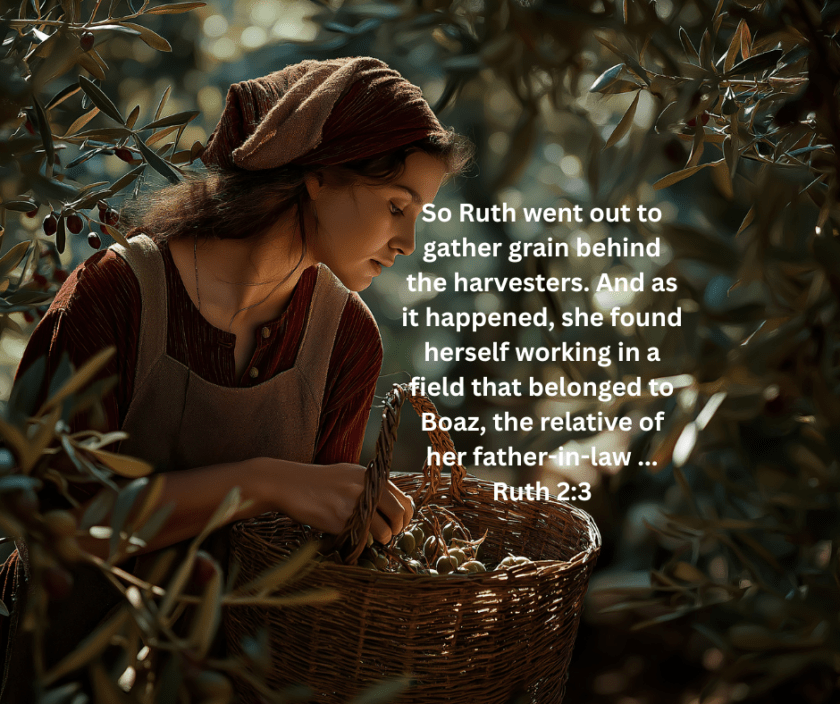
So Ruth went out to gather grain behind the harvesters. And as it happened, she found herself working in a field that belonged to Boaz, the relative of her father-in-law, Elimelech.
Ruth 2:3
When Boaz arrives and sees Ruth, he is curious and talks to his foreman about her. The foreman explains who she is and gives a glowing report of her work, which moves Boaz to talk to Ruth and encourage her to stay and work with them, telling her she will be safe and enjoy the privilege of water to drink and food to eat. Ruth is so moved by his kindness that she fell at his feet with gratitude, and asked him, “Why have I found grace in thine eyes, that thou shouldest take knowledge of me, seeing I am a stranger?“
Boaz gave Ruth his field to glean from freely.
She, Volume 2, p66
God has given us His Word and He shares it with us freely.
May we be mindful of where we are spending our time, and from what (whose) field(s) we are gleaning.
As we read in verses 15 and 16, Boaz also made sure she would have good success in her gleaning. She had so much success that when she arrived home, Naomi’s surprise and joy were evident as she gathered details from Ruth about the day and how the Lord had blessed them by sending her to Boaz’s field.
That man is one of our closest relatives, one of our family redeemers.
Ruth 2:20
Friends, it is worth noting that if Ruth had returned to her mother’s home as Naomi had encouraged her, she might never have met Boaz and known the blessing of God’s hand on her life in the days and years to come.
It was no accident that God directed her to the field of Boaz.
She, Volume 2/p45
“she went”
God gave her the faith to go.
“and came”
God directed her steps of where she should go.
“and gleaned”
God provided exactly what she needed, when and where she needed it.
The More We Know
I love that the journal for today points out that not only did Boaz encourage Ruth to stay, but that he knew no other field could meet her need, and that “the field” is a picture of the Word of God. Oh may we continually glean3 from His Word.






 Me From the Inside Out