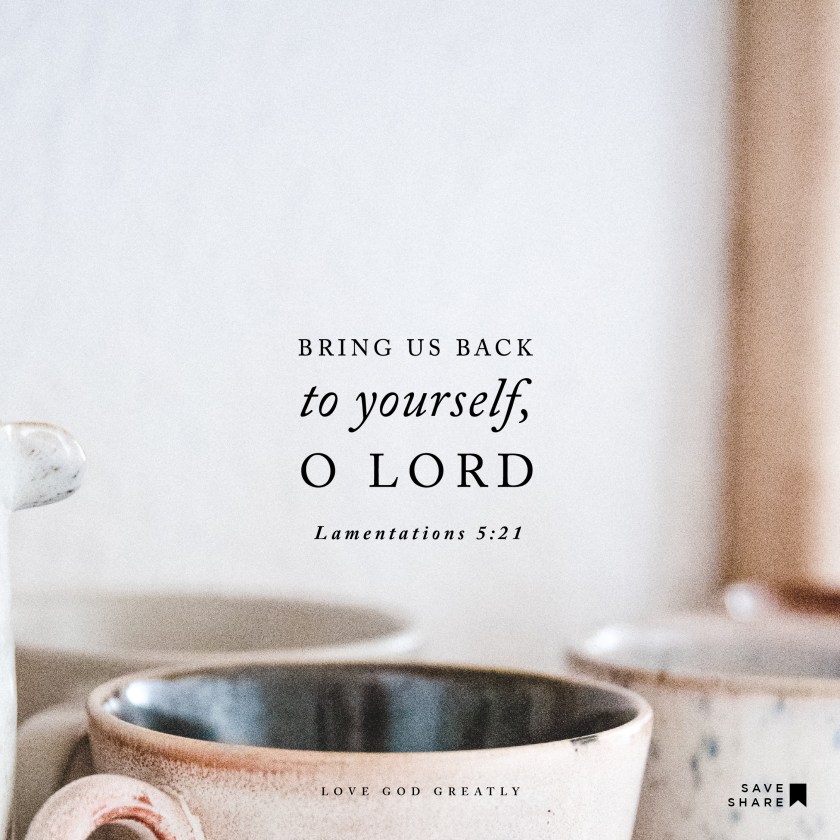
Bring us back to yourself, O Lord, so that we may return to you; renew our life as in days before,
Lamentations 5:21
But You, O LORD
Don’t miss the “but You” moment in verse 19. Similar to that of chapter 3, verse 21 – where in the throes of lament Jeremiah says – “But this I call to mind”. Here, he is lamenting the degradation of the city and the plight of the people when it seems the knowledge and the faith of his hope turn his inward thoughts back toward God. This time he says, “But You, O LORD, reign forever. Your throne endures from generation to generation. Remembering these truths seems to prompt both the question and the plea that follow and the words you can almost hear him stammering over in verse 22, “unless You have utterly rejected us and are angry with us beyond measure”.
The Confusion and questions
Because Jeremiah knows the goodness of God and His faithfulness to all generations he cries out hoping to understand why God hasn’t come to their aide.
Why do You keep on forgetting us? Why do You forsake us so long?
Lamentations 5:20
The Plea!
In response to his own questions Jeremiah prays a prayer of restoration and renewal and includes a purpose that he knew would align with God’s will for his people and the city. “Bring us back to Yourself, O LORD, so that we may return to You;” – not just to what we knew but first and foremost to You. He went on to pray, “Renew our life”. The plea is not for God to create a new life for them but specifically for restoration to “as in days before” – days when they had a crown and their city stood strong, when they were joyful and dancing. Restored to a time when their elders sat in the city gates and their young men played music. They longed to go back to the day when they weren’t hungry or in danger or living enslaved but to a day when they knew prosperity and success and respect for who they were.
What Can We Learn? – The Application –
What can we learn from these statements of prayer and truth? I think we can take a lesson from Jeremiah’s reasoning and pray prayers that keep God first. I think we should be inspired to watch that our desire is return to Him when we have fallen away, and to pray big prayers without letting them become greedy prayers.
Prayer Prompt
Father, when I lament may my mind and eyes and heart always return to or stay on You. May my chief desire be You and my heart be for ‘renewal’ rather than bigger and better.” Let me not lose heart but when it fades, help me remember You reign forever and Your throne from generation to generation.
Go Deeper
Don’t forget to checkout today’s LGG Blog Post and explore their site to see what God is doing through them.
This fourth lament moves through a depiction of Jerusalem’s devastating suffering. From the loss of all they had and were, to starvation of women and children, punishment that exceeded that of Sodom, appearance that went from white as snow to darker than soot, and the thought that those who died by the sword were better off than those wasting away from hunger. With these pictures in mind is it any wonder that Jerusalem continually watched for an ally, most likely Egypt, to rescue them from their suffering? Yet, as Jeremiah had predicted they watched in vain for a nation that could not protect them.
What Happened?
What happened to this once thriving and powerful city and people? Scripture answers this for us in Lamentations 1:5, “The LORD afflicted her because of her many acts of rebellion.” God’s will is for us to not sin but to love Him and obey His commandments, John 14:15. Our acts of rebellion against the LORD our God will always have disciplinary consequences because He is a good Father who despises sin, (John 3:16), and loves His children, (Hebrews 12:5–6; cf. Proverbs 3:11–12); (Hebrews 12:8) and (Hebrews 12:10).
How Do We Apply This Verse?
Of course we cannot directly apply this passage of Scripture for we do not live in exile waiting to be rescued. However, we certainly have problems that cause us, from time to time, to watch and wait and hope that someone will come to our rescue. We would be wise during these times to set our eyes continually on the Lord, the only One who can truly help us. Watching for Him to rescue us will never be in vain. The One who made us and calls us His own will never turn His back on us. He is our protector and does not sleep or become too busy to notice we have need of His help. In Psalm 118:13-14 The Psalmist said that he was pushed back and about to fall but the Lord helped him, and he went on to say that He was his strength and salvation.
God, You are a good good father. This doesn’t mean you will overlook our sinful behavior but that You love us enough to deal with it according to Your steadfast love. Throughout Your Word we are told to keep our eyes on You. Help us to do this continually, not only when we are in trouble but when we are tempted to sin, for we know that it will not be in vain. For Your Word promises that when we are tempted You will not allow us to be tempted beyond what we can bear but you will rescue us by showing us a way of escape so that we can remain faithfully obedient to You.
22 The Lord’s loyal kindness never ceases; his compassions never end. 23 They are fresh every morning; your faithfulness is abundant! 24 “My portion is the Lord,” I have said to myself, so I will put my hope in him.
Lamentations 3:22-24 (NET)
Jeremiah Lament Turns Personal
Lamentations 3 appears a more personal lament of Jeremiah’s. In the previous laments he has focused on the city, the destruction, the responsibility, God’s wrath, and a few personalized comments. However, chapter 3 there are a lot of “I” and “my” statements like:
“I am the man who has experienced affliction”
“He drove me into captivity”
“He made my moral skin waste away”
“He has shut out my prayer”
“To me he is like a bear lying in ambush”
“I have become the laughingstock of all people”
“He ground my teeth in grave”
“I have lost all hope of deliverance from the LORD”
“I am depressed”
Then the lament changes from despair to hope (21-24) and it wasn’t because his situation had changed – but because Jeremiah had purposefully made himself remember truths about God that countered the fears of the circumstances.
God is faithful
His kindness never stops
His compassions won’t fail
His faithfulness is great
He remembers that God (not the circumstances or people around him) is the source of his happiness and blessing
Please notice that Jeremiah’s and Jerusalem’s situation had not changed what changed were his thoughts and the attitude of his heart. In the middle of the lament he determines to list out the goodness of the LORD. He purposes to keep his hope in the LORD and replaces what he had declared as lost in verse 18 with an attitude that seems to mirror the Psalmist’s in Ps 73:26.
My flesh and my heart may grow weak, but God always protects my heart and gives me stability.
Applying this requires being purposeful and determined like Jeremiah, who after lamenting he was depressed said, “yet this I call to mind and therefore I have hope.” At perhaps the lowest point of his lament, hopeless and depressed the thought of God’s goodness, the knowledge of His great love, the remembrance of His daily, unending mercies, and His great faithfulness flowed through Jeremiah’s mind like a song and restored his hope. I wonder if he ever imagined that his lament and recorded resurgence of hope written for all of time and used by God to change people’s life in the 21st century? I know they certainly changed mine more than 32 years ago and they continue to make a difference today.
When depression and hopelessness set in I learned to think about the truths that Jeremiah listed in verse 22-24. Consider writing them down or reading them often so that they become part of your thinking.
Look for and remember ways that you have seen God like this in your life
Say to myself/yourself, I will put my hope in the LORD because He is my “portion”, my true and lasting source of happiness and blessing.
Prayer Prompt
Father the circumstances of life and the choices we’ve made are often a bitter poison. They will easily rob us of hope and joy unless we purposefully call to mind Your kindness, compassion, mercies, faithfulness, and sufficiency. Help us, even in our laments, to be determined to know and be quick to call these truths to mind whether in times of trouble or everyday living. – and in this may others see and hear of You – for Your glory – In Jesus’ Name – Amen!
My eyes are worn out from weeping; I am churning within. My heart is poured out in grief
because of the destruction of my dear people, because children and infants faint in the streets of the city.
Lamentations 2:11
Destruction Takes a Toll
Jeremiah weeps at the destruction but he isn’t simply crying. He is physically and emotionally impacted because of the destruction of his people. This is personal and Jeremiah is greatly affected.
Applying the Word
Like Jeremiah, we should be greatly affected when God’s people or His work are impacted by suffering, regardless of where the suffering comes from. We should mourn and experience great emotional and even physical unease. Jesus taught in Matthew that those who mourn like this over sin will be blessed, Matthew 5:4. Whether it is over our own sin or the sin of others we should be broken by anything that breaks the heart of God. When we mourn like this we will find ourselves caught up in the lament and we will be moved, like Jeremiah, to pray or to call on others to pray.
Prayer Prompt
Father, break our hearts for what breaks Yours! May we not fail to pour ourselves out before You – for only You can heal and make right ! We believe this in Jesus Name, Amen!’
Yes, I will remember the amazing things you did long ago.
Psalm 77:10-11 NET
Asaph’s Confidence
I love the heading for this Psalm in the Holman Christian Standard Bible, “Confidence in a Time of Crisis”. It is certainly fitting from start to finish of this Psalm of ‘lament’ by Asaph and I think an equally fitting way to start this study on “Trusting God in the Midst of Suffering” (by LGG).
Suffering is part of the believer’s life and to survive it we must learn how to deal with it in a godly way. While we most often learn best from experience it is beneficial and God’s plan according to (2 Timothy 3:16-17 to learn from the examples in His Word. Today’s reading provides one such example. Let’s take a look.
The Lament
Asaph’s lament begins in verse 1 with no clear reason what prompted it but clearly he is facing a crisis of some kind. Notice though from the get-go, even in the throes of the crisis his faith is active. He didn’t run from or turn from God but ran to Him and was resolved to cry out to Him in prayer and thought and faith.
I will cry out to God and call for help. I will cry out to God and he will pay attention to me. 2 In my time of trouble I sought the Lord. I kept my hand raised in prayer throughout the night. I refused to be comforted. 3 I said, “I will remember God while I groan; I will think about him while my strength leaves me.” (Selah) 4 You held my eyelids open; I was troubled and could not speak. 5 I thought about the days of old, about ancient times. 6 I said, “During the night I will remember the song I once sang; I will think very carefully.”
Psalm 77:1-6 NET
From Lament to a Song of God’s Extraordinary Deeds
However, don’t miss that the longer Asaph cried out with the problem that was causing him to “groan”, the more panic and heartache seemed to rise within him. In turn these created the threat of doubt and the fear that God would cease to be active in his life. This is where we find him in our focus/soap passage today. He couldn’t bare to think that God would become “inactive”, to the point that it “sickened” him. Yet, this is the very thing that turned his lament into a new song of God’s goodness and activity in times past. Asaph resolved to recall God’s greatness and power over all things. With this resolve, Asaph’s cry changed from “I will” to “O God, Your deeds are extraordinary … You are the God who does amazing things! You have revealed Your strength … You delivered Your people … You walked through the sea; You passed through the surging waves … You led Your people like a flock of sheep …”
The Change
It’s important as we move forward in “Trusting God in the Midst of Suffering” to notice the change came with Asaph’s resolve to remember and what he chose to remember. He made the choice to fix his mind – not on the ‘crisis’ or the rising doubt and fears but rather on “the works of the LORD …” and this seemed to change everything – well, perhaps not the ‘crisis’ (Scripture doesn’t make this clear) – but certainly his reaction to the ‘crisis’ changed. Perhaps this is an example of why Paul taught the Philippians to fix their thoughts on things that are excellent and worthy of praise, Phil 4:8.
What this mean for us: The Application
I believe this is where we find our application today, choosing to fix our mind on the things of God and not the things of the world that make us anxious and problem centered rather than God centered. This is not to mean that we can’t pray or cry out to God in lament. Actually, looking again to Paul’s teaching in Philippians 4:6-7, we see that when he warns the believers not to be anxious about anything he also says, “instead, pray about everything and thank God for what He has already done.” He says that when they do this they will experience the peace of God which exceeds anything they can understand. I can tell you from experience – when you apply the power of truth that is in these verses to your life it changes everything.
What’s Your Plan?
What is the resolve of your life? What will you do when the crisis comes? Clearly Scripture teaches us to have a plan that is rooted in God (Father, Son, and Spirit) and in His Word. Here are some helpful tips …
Know Him – this comes from prayer and staying in His Word daily
Don’t trust, lean on, or stay in your own emotions but trust in the Lord (Proverbs 3:5-6)
Sing of His goodness(what we listen to guides our thoughts)
Write down what He’s done (have journal or use your phone at the end of each day to write down 1-3 things that you saw Him do or remember He has done in the past … something as simple as a much needed parking space to His amazing gift of salvation, acts of grace or mercy, His forgiveness for the unspeakable things of your life, His love despite those unspeakable things, His Spirit’s power in You, your hope of eternity, and any number of amazing deeds you have witnessed from Him)
Prayer Prompt
Father, help us to turn our laments into songs of joyful praise. How often have I lamented before You – crying out for You to hear, waiting on You to answer, trusting You to not forget or become inactive. Like Asaph I have found myself clinging to You through the waves and heard You whisper – “Be still and know that I am God”. How many times You have used the words of Paul to cause me to choose to recall Your goodness, grace, and mercy and to resolve to fix my thoughts on things that are excellent and worthy of praise. Thank you for the history of Your goodness and the evidence of Your love and the faith on which I stand. In Jesus’ Name – Amen!
Love God Greatly
If you would like more thoughts on today’s reading please click the link for today’s blog post from the LGG Team.




 Me From the Inside Out