Anna, a prophetess, was also there in the Temple. She was the daughter of Phanuel from the tribe of Asher,1 and she was very old. Her husband died when they had been married only seven years. 37 Then she lived as a widow to the age of eighty-four. She never left the Temple but stayed there day and night, worshiping God with fasting and prayer. 38 She came along just as Simeon was talking with Mary and Joseph, and she began praising God. She talked about the child to everyone who had been waiting expectantly for God to rescue Jerusalem.
Luke 2:36-38
I love and appreciate that God allowed Anna, who had heard prophecies about the coming Messiah for many years, not only to believe in Him but to meet Him face to face. Luke wrote that, “She came along just as Simeon was talking with Mary and Joseph, and she began praising God. She talked about the child to everyone who had been waiting expectantly for God to rescue Jerusalem.”
Anna, one of the few prophetesses mentioned in the Bible. “She never left the temple but worshiped night and day, fasting and praying” (Luke 2:37). After becoming a widow, Anna dedicated herself wholly to the Lord. She never left the temple in Jerusalem but spent her time worshiping, fasting, and praying. Her many years of sacrifice and service were worth it all when she came face-to-face with Jesus, the Messiah, the One for whom she had waited so long. I see the fingerprints of God in the timing described by Luke with these words: “She came along just as Simeon was talking with Mary and Joseph, and she began praising God.” What stands out to me most is not only her devotion but her delight in seeing Him turned into praising Him and then to sharing Him with “everyone who had been waiting expectantly for God to rescue Jerusalem.”
Friends, may we be faithful and alert, like Anna, so that we do not miss the presence and work of Jesus in and around our lives. When we see Him, may we faithfully praise Him, and, like Anna, may we then faithfully proclaim Him to everyone.
Read/SOAP: 1 Corinthians 6:19-20 and Romans 8:15-17
Don’t you realize that your body is the temple of the Holy Spirit, who lives in you and was given to you by God? You do not belong to yourself, 20 for God bought you with a high price. So you must honor God with your body.
1 Corinthians 6:19-20
So you have not received a spirit that makes you fearful slaves. Instead, you received God’s Spirit when he adopted you as his own children. Now we call him, “Abba, Father.” 16 For his Spirit joins with our spirit to affirm that we are God’s children. 17 And since we are his children, we are his heirs. In fact, together with Christ we are heirs of God’s glory. But if we are to share his glory, we must also share his suffering.
Romans 8:15-17
The focus of this week’s journey is the Holy Spirit and our salvation. Today’s particular focus is the ‘indwelling of the Holy Spirit.’ So, the question begs to be asked: What is the significance of God’s Spirit in us? I believe one of the best answers/explanations comes from Paul in Romans 8:16, where he writes: “The Spirit Himself bears witness with our spirit that we are the children of God.” God’s Spirit, the Holy Spirit, is our witness that we belong to God. Paul actually says that without the Spirit, we do not belong to Christ (Rom 8:9).
The Spirit’s presence in our life is not only an identifying mark that we belong to God, but He is also God’s divine power at work in us. It is the Spirit’s power that enables us to live a godly life, a life of love, joy, peace, patience, kindness, goodness, faithfulness, gentleness, and self-control. Without the Spirit, we would be caught up in the corruption of this world and given over to our human desires.1
Application: Living out the Word of God
We must remember that God bought us at a high price – that is, with the blood of the Spotless Lamb, the only begotten Son of God. Scripture clearly explains that this means we no longer belong to ourselves, to live as we please – for we are now the temple of the Holy Spirit of God. He lives in us, so we are to live in a manner that honors and pleases God.
Christ died for everyone so that those who receive his new life will no longer live for themselves. Instead, they will live for Christ, who died and was raised for them. 16 So we have stopped evaluating others from a human point of view. At one time we thought of Christ merely from a human point of view. How differently we know him now! 17 This means that anyone who belongs to Christ has become a new person. The old life is gone; a new life has begun!
2 Corinthians 5:15-17
It is also helpful and necessary to remember that we were born with a sinful nature. However, praise God, as Paul explains in the passages of today’s journey – God, in love, gives His Holy Spirit to all who, through faith, believe in Christ. It is by His Spirit that we become God’s adopted children, not only placed in the family of Christ but also made joint heirs with Christ. In other words, for a believer, the Spirit changes everything – and He does so from the inside out.2
And I will give you a new heart, and I will put a new spirit in you. I will take out your stony, stubborn heart and give you a tender, responsive heart.
Ezekiel 36:26
But this is the new covenant I will make with the people of Israel on that day, says the Lord: I will put my laws in their minds, and I will write them on their hearts. I will be their God, and they will be my people.
Hebrews 8:10
Prayer of response to the Journey
Abba Father, my heart rejoices to know that I am Yours and You are mine. I praise You for Your Spirit in me – a Spirit not of fear but of power, love, and self-control.3 A Spirit who bears witness that I belong to You, who teaches me all things and reminds me of everything You have said4. According to Your Word, You have given me Your Spirit to fill my heart with Your love5; help me to love as You love. Thank You for teaching me to serve at Your pleasure, but oh, how sweet it is to know that You desired and made a way for our relationship to be one of Father and child and not simply Master and servant6. May the fruit of the Spirit be evident in my life. Help me to faithfully live by the Spirit, following His leading in every part of my life – that You might be glorified in me. – in the name of the Spirit and the Son, I come and pray – Amen!
But the Holy Spirit produces this kind of fruit in our lives: love, joy, peace, patience, kindness, goodness, faithfulness, 23 gentleness, and self-control. There is no law against these things! 24 Those who belong to Christ Jesus have nailed the passions and desires of their sinful nature to his cross and crucified them there. 25 Since we are living by the Spirit, let us follow the Spirit’s leading in every part of our lives. 26 Let us not become conceited, or provoke one another, or be jealous of one another. Gal 5:22-26 By his divine power, God has given us everything we need to live a godly life. We have received all of this by coming to know him, the one who called us to himself by means of his marvelous glory and excellence. 4 And because of his glory and excellence, he has given us great and precious promises. These are the promises that enable you to share his divine nature and escape the world’s corruption caused by human desires. 2 Peter 1:3-4 ↩︎
2 Corinthians 5:15-17 … Christ died for everyone so that those who receive his new life will no longer live for themselves. Instead, they will live for Christ, who died and was raised for them. So we have stopped evaluating others from a human point of view. At one time we thought of Christ merely from a human point of view. How differently we know him now! 17 This means that anyone who belongs to Christ has become a new person. The old life is gone; a new life has begun!↩︎
2 Timothy 1:7 … For God has not given us a spirit of fear and timidity, but of power, love, and self-discipline.↩︎
John 14:26 … But when the Father sends the Advocate as my representative—that is, the Holy Spirit—he will teach you everything and will remind you of everything I have told you.↩︎
Romans 5:3-5 … 3 We can rejoice, too, when we run into problems and trials, for we know that they help us develop endurance. 4 And endurance develops strength of character, and character strengthens our confident hope of salvation. 5 And this hope will not lead to disappointment. For we know how dearly God loves us, because he has given us the Holy Spirit to fill our hearts with his love. ↩︎
Hebrews 12:5-11 … And have you forgotten the encouraging words God spoke to you as his children? He said,“ My child, don’t make light of the Lord’s discipline, and don’t give up when he corrects you. 6 For the Lord disciplines those he loves, and he punishes each one he accepts as his child.” 7 As you endure this divine discipline, remember that God is treating you as his own children. Who ever heard of a child who is never disciplined by its father? 8 If God doesn’t discipline you as he does all of his children, it means that you are illegitimate and are not really his children at all. 9 Since we respected our earthly fathers who disciplined us, shouldn’t we submit even more to the discipline of the Father of our spirits, and live forever? 10 For our earthly fathers disciplined us for a few years, doing the best they knew how. But God’s discipline is always good for us, so that we might share in his holiness. 11 No discipline is enjoyable while it is happening—it’s painful! But afterward there will be a peaceful harvest of right living for those who are trained in this way. Proverbs 3:11-12 … My child, don’t reject the Lord’s discipline, and don’t be upset when he corrects you.For the Lord corrects those he loves, just as a father corrects a child in whom he delights. ↩︎
I have often quoted and/or prayed the first words of this passage, “I was glad because they said to me, ‘We will go to the [House] of the Lord.'” Yet, in all honesty, I confess the rest of this passage is unfamiliar to me or at least does not jump out to me as often read or ever studied. Take time to soak up all nine verses, they are beautiful and have a message of hope for all who belong to God through faith in Jesus Christ.
Read it, listen to the building excitement in David’s words in this “Psalm of Ascent”1, a call to worship, sang as the people of Israel traveled to Jerusalem. His obvious love for simply being in the city – comes out in the second verse when he declares: “Our feet are standing inside your gates, O Jerusalem.” Be careful not to miss how he focuses on the features of the city. He’s caught up with the temple (House of God) (v1,5,9), the gates (v2), the thrones (v5), the walls (defenses) (v7), and fortresses (v7). They have an affect on his life and he believes, as his words reveal, on all who are inside the city.
All of this leads to a prayer for Jerusalem, a concern for her, and the people and the leaders within, to know peace inside her walls and to rest in the security of such a great fortress. He prays this not just because he loves the temple-city of His God but, as he says, for the sake, or the concern, for his brothers and neighbors – not only that they would know peace but that there would be no contention among them that would destroy the city or distract them from being in the temple of their God; and the concern seems equally spent on “seeking Jerusalem’s good through prayer”2 I love this imagery, the people having an effect on the House of God – where they dwell, where they gather to worship, and where legal decisions are made; but also the House of God – and all that goes on or is within her, from the gates to the thrones and the security she provides – having an effect on the people. In other words we affect the ‘church’ and the ‘church’ affects us.
Application: So what’s it all mean?
As is clearly stated, Jerusalem was a place meant for God’s people to gather, to worship, and to make legal decisions. The “tribes”3 of families go “up” to Jerusalem, where they are required to give thanks (v4) to the name of the LORD, their God.
As I read through this part of the passage, I landed on the people being ‘required to give thanks to the name of the LORD and realized another beautiful truth to apply here – while we may no longer live under the requirements of the law – if thanksgiving was important to God then, and clearly it was – would it not also be important to Him now? After all, we live under the freedom of His grace, (Rom 6:14-15), which He lavished on us through the life, death, and resurrection of His only begotten Son, (Eph 1:3-8).
As for the application of our focus verses (8-9), we have already noted: the Psalmist prays acknowledging his desire/concern for his brothers and friends to enjoy peace within the walls of Jerusalem and then for the good of the “temple of God” to prosper or do good. It seems to me that David is seeking the welfare of both the local and the corporate aspects of God’s people – which I believe is a good indication that we, as a community of faith, both locally and globally, should share this same focus and purpose in prayer – a focus so intent on being in the Presence of God that we seek the good of the church and its people.
Pray for the peace of Jerusalem. May those who love her prosper. 7 May there be peace inside your defenses, and prosperity inside your fortresses. 8 For the sake of my brothers and my neighbors I will say, “May there be peace in you.” 9 For the sake of the temple of the Lord our God I will pray for you to prosper.
Psalm 122:6-9
Prayer: Response to God’s Word
Father, how good you were to place Your people within “tribes” – developing families of nations and ultimately, the community of faith/church – Your people both locally and globally. Help us/me, like David, to faithfully seek peace and [good] for Your people and for the good of Your [House]. May we be glorifying and honoring influencers in the church, and may its influence leave a lasting impression on us that is a light to all we come in contact with. may I/we always enter with thanksgiving, not because we are required to but because we realize the blessing, privilege, and power that are ours because we belong to You. In the name and power of Jesus, so let it be!
1Love God Greatly from the God who restores, devotion-Day 2 (p. 38)
2FOOTNOTE on verse 9, from HCSB study Bible: tn Heb “I will seek good for you.” The psalmist will seek Jerusalem’s “good” through prayer.
3″Tribes” is a reference to the 12 tribes of Israel. The twelve tribes of Israel came from the twelve sons of Israel. “Israel” is the name that God gave Jacob (Genesis 32:28). His twelve sons are Reuben, Simeon, Levi, Judah, Dan, Naphtali, Gad, Asher, Issachar, Zebulun, Joseph, and Benjamin (Genesis 35:23-26; Exodus 1:1–4; 1 Chronicles 2:1–2). When the tribes inherited the Promised Land, Levi’s descendants did not receive a territory for themselves (Joshua 13:14). Instead, they became priests and had several cities scattered throughout all of Israel. Joseph’s tribe was divided in two—Jacob had adopted Joseph’s two sons, Ephraim and Manasseh, essentially giving Joseph a double portion for his faithfulness in saving the family from famine (Genesis 47:11–12). This means the tribes who received territory in the Promised Land were Reuben, Simeon, Judah, Dan, Naphtali, Gad, Asher, Issachar, Zebulun, Benjamin, Ephraim, and Manasseh. In some places in Scripture, the tribe of Ephraim is referred to as the tribe of Joseph (Numbers 1:32–33).– https://www.gotquestions.org/twelve-tribes-Israel.html
Your Turn: Reflections
Why/how are you praying for peace, prosperity, and security for God’s people today?
They took Jesus to the high priest’s home where the leading priests, the elders, and the teachers of religious law had gathered. 54 Meanwhile, Peter followed him at a distance and went right into the high priest’s courtyard. There he sat with the guards, warming himself by the fire.
55 Inside, the leading priests and the entire high council
were trying to find evidence against Jesus, so they could put him to death. But they couldn’t find any. 56 Many false witnesses spoke against him, but they contradicted each other. 57 Finally, some men stood up and gave this false testimony: 58 “We heard him say, ‘I will destroy this Temple made with human hands, and in three days I will build another, made without human hands.’” 59 But even then they didn’t get their stories straight!
60 Then the high priest stood up before the others and asked Jesus, “Well, aren’t you going to answer these charges? What do you have to say for yourself?”61 But Jesus was silent and made no reply. Then the high priest asked him, “Are you the Messiah, the Son of the Blessed One?”
62 Jesus said, “I am. And you will see the Son of Man seated in the place of power at God’s right hand[j] and coming on the clouds of heaven.”
63 Then the high priest tore his clothing to show his horror and said, “Why do we need other witnesses? 64 You have all heard his blasphemy. What is your verdict?”
“Guilty!” they all cried. “He deserves to die!”
65 Then some of them began to spit at him, and they blind
Peter Denies Jesus
66 Meanwhile, Peter was in the courtyard below. One of the servant girls who worked for the high priest came by 67 and noticed Peter warming himself at the fire. She looked at him closely and said, “You were one of those with Jesus of Nazareth.[l]”
68 But Peter denied it. “I don’t know what you’re talking about,” he said, and he went out into the entryway. Just then, a rooster crowed.[m]
69 When the servant girl saw him standing there, she began telling the others, “This man is definitely one of them!” 70 But Peter denied it again.
A little later some of the other bystanders confronted Peter and said, “You must be one of them, because you are a Galilean.”
71 Peter swore, “A curse on me if I’m lying—I don’t know this man you’re talking about!” 72 And immediately the rooster crowed the second time.
Suddenly, Jesus’ words flashed through Peter’s mind: “Before the rooster crows twice, you will deny three times that you even know me.” And he broke down and wept.
Though convinced Jesus was the Christ, Peter denied Him, just as predicted. –
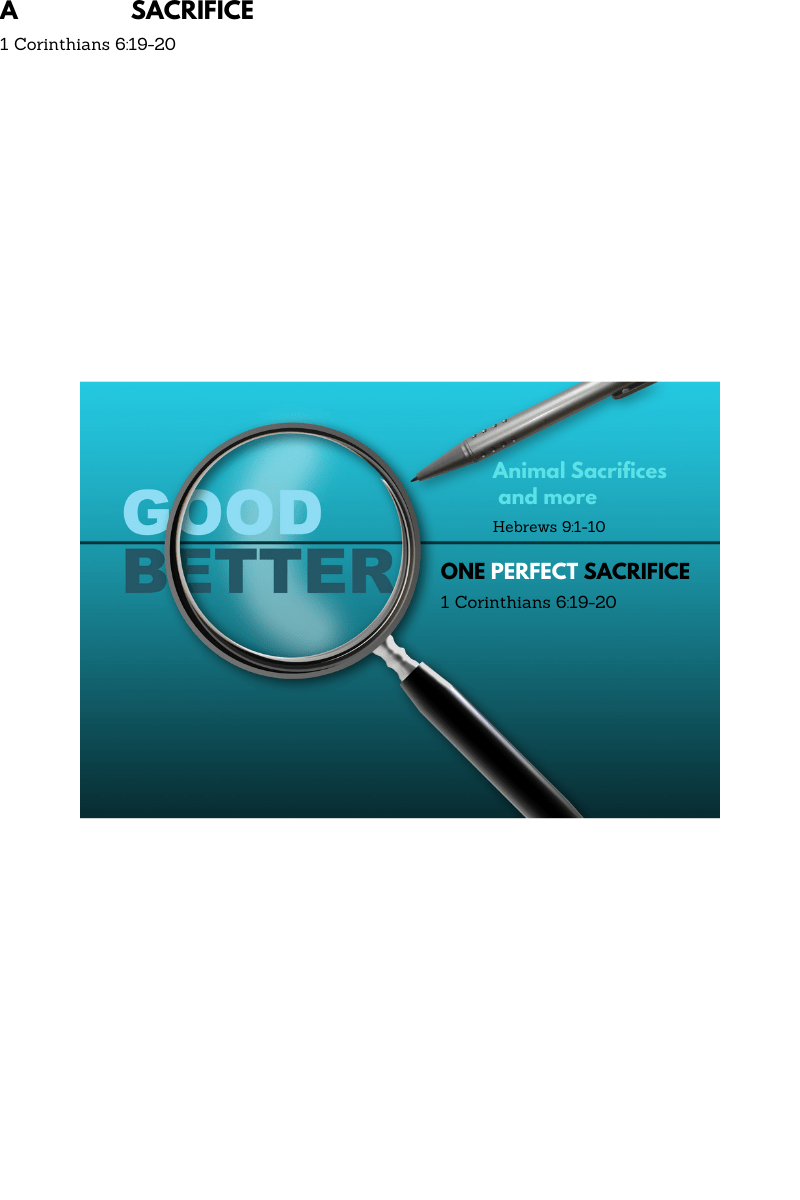
Now the first covenant, in fact, had regulations for worship and its earthly sanctuary. 2 For a tent was prepared, the outer one, which contained the lampstand, the table, and the presentation of the loaves; thisis called the Holy Place. 3 And after the second curtain there was a tent called the holy of holies. 4 It contained the golden altar of incense and the ark of the covenant covered entirely with gold. In this ark were the golden urn containing the manna, Aaron’s rod that budded, and the stone tablets of the covenant. 5 And above the ark were the cherubim of glory overshadowing the mercy seat. Now is not the time to speak of these things in detail. 6 So with these things prepared like this, the priests enter continually into the outer tent as they perform their duties. 7 But only the high priest enters once a year into the inner tent, and not without blood that he offers for himself and for the sins of the people committed in ignorance. 8 The Holy Spirit is making clear that the way into the Holy Place had not yet appeared as long as the old tabernacle was standing. 9 This was a symbol for the time then present, when gifts and sacrifices were offered that could not perfect the conscience of the worshiper. 10 They served only for matters of food and drink and various ritual washings; they are external regulationsimposed until the new order came. Hebrews 9:1-10
Christ’s Service in the Heavenly Sanctuary
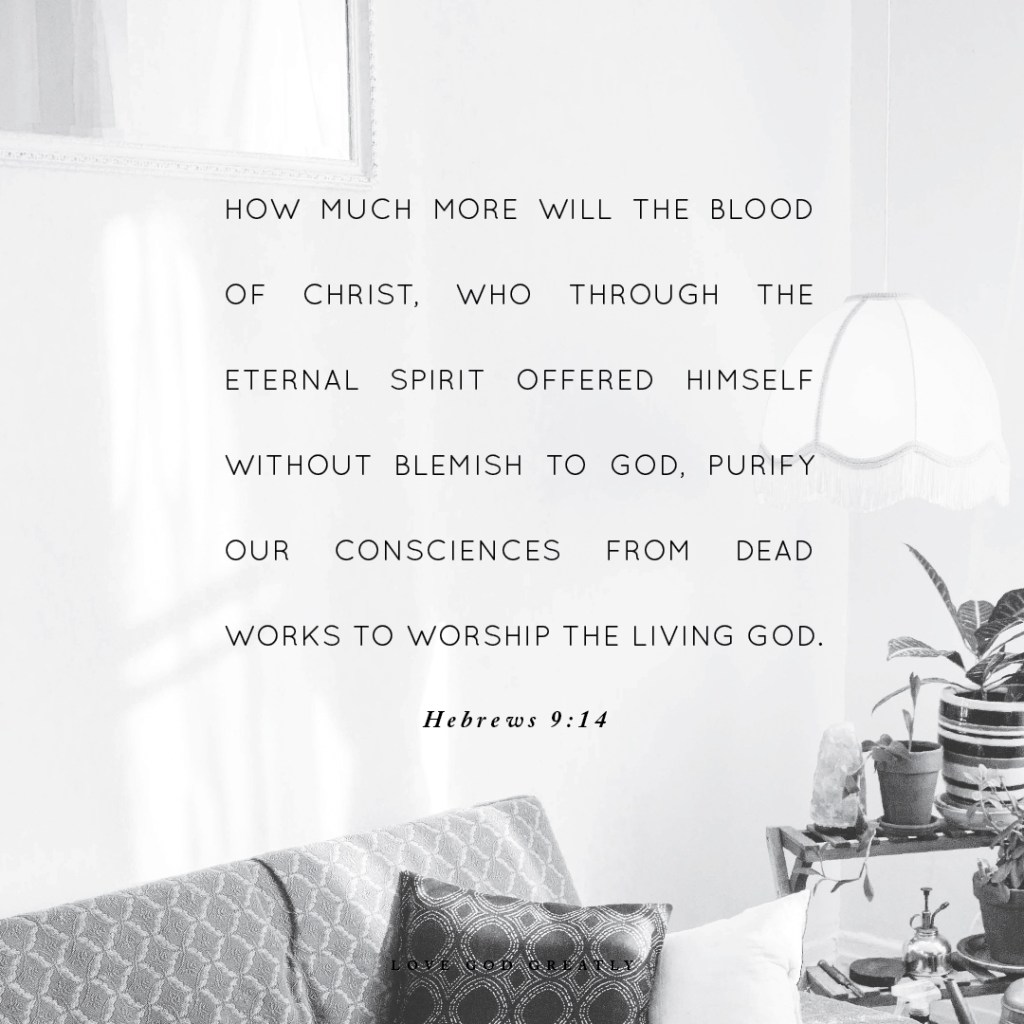
But now Christ has come as the high priest of the good things to come. He passed through the greater and more perfect tent not made with hands, that is, not of this creation, 12 and He entered once for all into the Most Holy Place not by the blood of goats and calves but by His own blood, and so He Himself secured eternal redemption. 13 For if the blood of goats and bulls and the ashes of a young cow sprinkled on those who are defiled consecrated them and provided ritual purity, 14 how much more will the blood of Christ, who through the eternal Spirit offered Himself without blemish to God, purify our consciences from dead works to worship the living God.
15 And so He is the mediator of a new covenant, so that those who are called may receive the eternal inheritance He has promised, since He died to set them free from the violations committed under the first covenant. 16 For where there is a will, the death of the one who made it must be proven. 17 For a will takes effect only at death, since it carries no force while the one who made it is alive.
Hebrews 9:11-17
Don’t you realize that your body is the temple of the Holy Spirit, who lives in you and was given to you by God? You do not belong to yourself, 20 for God bought you with a high price. So you must honor God with your body.
1 Corinthians 6:19-20
Father, You are good! In Your goodness, You bought me with a high price and made a WAY where there was, or seemed to be, no way. Because of Your goodness, we no longer need the Tabernacle of long ago because You have made us Your Temple. The Tabernacle was good and beautiful in its purpose and design and it pointed Your people to the better WAY, the Messiah, yet to come. However, as they knew then and we see clearly now – the gifts and sacrifices they made could not perfect the conscience of the worshiper. So, You, in Your goodness, took away the need for the regulations, rituals, and animal sacrifices that were a part of the Tabernacle ‘system’ – by sending the promised and long-awaited Redeemer, Jesus Christ. The sinless Redeemer, Your only begotten Son, was a PERFECT Sacrifice whose death, burial, and resurrection made a WAY! He conquered sin and death and made THE ONLY WAY for us to enter into Your Presence and be the dwelling place for the Holy Spirit. So that, now through His eternal sacrifice and Your gift of His Spirit in me, I AM ABLE, with a clear conscience, to WORSHIP You in Spirit and in TRUTH, to walk in FREEDOM from sin and to live for You as His WITNESS! Yes, Father, You are good.
Jesus said to him, “I am the way, and the truth, and the life. No one comes to the Father except through Me.” John 14:6
The Arrangement and Ritual of the Earthly Sanctuary
Now the first covenant,[a] in fact, had regulations for worship and its earthly sanctuary. 2 For a tent was prepared, the outer one,[b] which contained[c] the lampstand, the table, and the presentation of the loaves; this[d] is called the Holy Place. 3 And after the second curtain there was a tent called the holy of holies. 4 It contained the golden altar of incense and the ark of the covenant covered entirely with gold. In this ark[e] were the golden urn containing the manna, Aaron’s rod that budded, and the stone tablets of the covenant. 5 And above the ark[f] were the cherubim[g] of glory overshadowing the mercy seat. Now is not the time to speak of these things in detail. 6 So with these things prepared like this, the priests enter continually into the outer tent[h] as they perform their duties. 7 But only the high priest enters once a year into the inner tent,[i] and not without blood that he offers for himself and for the sins of the people committed in ignorance.[j]8 The Holy Spirit is making clear that the way into the Holy Place had not yet appeared as long as the old tabernacle[k] was standing. 9 This was a symbol for the time then present, when gifts and sacrifices were offered that could not perfect the conscience of the worshiper. 10 They served only for matters of food and drink[l] and various ritual washings; they are external regulations[m] imposed until the new order came.[n]
Or do you not know that your body is the temple of the Holy Spirit who is in you,[a] whom you have from God, and you are not your own? 20 For you were bought at a price. Therefore glorify God with your body.
 Me From the Inside Out