Posted in Bible study, From Broken to Restored, From the Insideout, Journey Through The Word, Quiet Time

Purpose Matters

based on the LGG Study, From Broken to Restored / w6d1

Scripture: Nehemiah 13:1-14; Matthew 21:12-16 / SOAP: Matthew 21:13

Jesus entered the temple courts and drove out all who were buying and selling there. He overturned the tables of the money changers and the benches of those selling doves. 13 “It is written,” he said to them, “‘My house will be called a house of prayer,’ but you are making it ‘a den of robbers.’”

Matthew 21:12 and 13
A Look at Nehemiah

Our ongoing journey through Nehemiah is winding down this week and bears some close observation as we near the end. Today’s 14 verses deal with a time when one of the priest had repurposed a room that God had purposed for the the grain offering, the incense, and the vessels, along with the tithes of the grain, the new wine, and the olive oil. The priest didn’t just repurpose the room but made it a large storeroom for a relative to use. Nehemiah makes it clear that during this time he had gone back to serving the King and had not been in Jerusalem when the priest had taken over the storeroom. When Nehemiah found out what “evil” the priest had done he became very upset and threw everything out and gave instructions for the room to be purified. Once it was purified he restored it to its original purpose – including the “grain offering and the incense; he also made sure it would no longer be neglected. Because he did these things all of Judah once again brought the “tithe of the grain, the new wine, and the olive oil to the storerooms.”

Nehemiah’s Prayer Request

Following Nehemiah’s return and restoration project he makes a humble request of God to remember him for what he had done. At first glance this prayer may seem less than humble but he clarifies the intent of his heart’s purpose by specifically asking God to “not wipe out the kindness [Nehemiah had] done for the temple of [his] God and for its services!”

It wasn’t about what Nehemiah had done but why he had done it.

A New Testament Example

Today’s SOAP passage, Matthew 21:13, shows Jesus’ reaction to a similar situation as that of Nehemiah’s. We see Jesus, the one typically so full of love and compassion, “[driving] out all those who were selling and buying in the temple courts, and [turning] over the tables of the money changers and the chairs of those selling doves.” However, as with Nehemiah, Jesus’ words that followed his actions clarified His intent and heart’s purpose. Quoting from the Old Testament, He said to those involved, “It is written, ‘My house will be called a house of prayer,’ but you are turning it into a den of robbers!”

Jesus’ anger was clearly ‘righteous anger’ aroused because the people were misusing the House of God, His Father. Not only were they cheating the people who had come to the temple for righteous purposes they were robbing God of the joy and glory and honor He received when the people sought Him in prayer and sacrifice. This explains the statement Jesus made when He boldly identified the guilty parties as “robbers!”

Jesus’ anger wasn’t just about Him not liking what they were doing. It was about His jealousy for God and what they were taking away from Him.

Make it Personal: Reflection

Today, God’s presence indwells our hearts through His Holy Spirit. As we look at the way the temple of God was supposed to be treated, what does that mean for our hearts?

Going Further

Today’s LGG Blog Post offers more insight

Read about the House of Prayer and Den of Robbers
Posted in Bible study, From Broken to Restored, From the Insideout, Journey Through The Word, LGG Study, Quiet Time

based on the LGG Study, From Broken to Restored /w5d5

Scripture: Nehemiah 13:1-3; Numbers 22:1-14; Ruth 1:16-17 / SOAP: 2 Tim 3:16-17

Every scripture is inspired by God and useful for teaching, for reproof, for correction, and for training in righteousness, that the person dedicated to God may be capable and equipped for every good work.

2 Timothy 3:16-17

I love this passage from 2 Timothy. If you or anyone else you know ever wants to know why reading the Bible is so important – here’s the answer. It is inspired by God for the purpose of empowering and equipping those who are dedicated to God for “every good work”. Paul breaks it down to Timothy like this, God’s Word is able to …

  • teach us right from wrong
  • reproof, which basically means to rebuke or scold
  • correct us, to help turn one back to the right way – and to
  • train God’s people to not just do what is right but to live righteously

Paul writes in Romans 10:17, “So then faith comes by hearing, and hearing by the word of God.” “So then” marks this statement as a conclusion. If we desire to be in God’s Kingdom, hearing is essential. Such a person must live by faith. Salvation is by grace through faith, and faith comes by hearing.

My church has a monthly magazine and I have the privilege of being the content/copy editor. It is absolutely one of the favorite things I get to do! I’m working on the October issue right now and it is all about the Bible. We aren’t quite done with it yet, but I can already tell you it is going to be one of my favorite. Why? Because I love the Bible, the living and active Word of our God. It is the light for the path of every believer, the conviction of every sinner, the comforting balm for every broken or storm battered child of God, it is the wisdom for all who seek answers, and it is so much more. “Hearing it is essential,” for Paul wrote that faith comes by hearing and hearing by the Word of God; and knowing it is strength and power against the enemy, for the Psalmist wrote – I have hidden [God’s] Word in my heart so that I might not sin against [Him]. Is it any wonder that we are to treasure it, share it, and study it to show ourselves approved by God, workmen who don’t need to be ashamed and who can not only discern it well but explain it well. Clearly, God’s Word is vitally important both to the saved and the unsaved. May we be faithful to make the Word an integral part of our lives that spills out to others and brings glory to the Father.

For I am not ashamed of the gospel, for it is the power of God for salvation to everyone who believes, to the Jew first and also to the Greek.

Romans 1:16
Make it Personal / Reflection

Have you fallen into a sinful pattern, as the Jews had? What is God calling you to repent of? Are you willing to turn from sin and back to Him?

Going Further

Don’t forget to check out today’s LGG Blog

Posted in Bible study, From the Insideout, Journey Through The Word, LGG Study, Quiet Time

Investing

based on the LGG Study, From Broken to Restored / W5D4

Scripture: Nehemiah 12:44-47; Leviticus 7:28-36 / SOAP: 1 Timothy 5:17-18

Elders who provide effective leadership must be counted worthy of double honor, especially those who work hard in speaking and teaching. For the scripture says, “Do not muzzle an ox while it is treading out the grain,” and, “the worker deserves his pay.”

2 Timothy 5:17-18

Do you ever read Scripture and think – UH? Like what did I just read or why would this be important? In your heart you know the answer is “because it is the Word of God”- it’s able to train us in righteousness, it is able to reveal God’s will to us, and it is able to judge the thoughts and attitudes of our hearts. It’s a lamp to guide our feet and it is able to keep us from sinning against God – so I read the “uh” verses again – but my mind doesn’t absorb it – and I praise God for being patient with me and I thank Him for others who have studied and written commentaries on passages that stump me. So today’s LGG Journal entry/devotion proved quite helpful – I hope it is for you as well.

Excerpts from the LGG Journal entry for week5/day4 – From Broken to Restored:

On the heels of the choirs singing and the people celebrating the rebuilding of the Jerusalem wall, Nehemiah makes it clear that “part of re-establishing worship and setting the community right before God meant taking care of the priests and those ministering to the people. – In other words, God set up a system to care for those who ministered to His people.”

“When the people were following God and walking in His ways they were faithful to make offerings.” These offerings were meant as provision for the Levites and the priests who had been set apart by God. In other words the offerings were used to feed the priests.” It was a sign that Israel was spiritually healthy if their priest had plenty of food. As the Jews re-established a system and pattern of worship – they made sure they set aside the portions for the priests and Levites as God had commanded.”

Continuing their commentary, and thankfully making it a bit of a personal application

In his letter to Timothy, Paul instructed him to honor those who provided effective leadership to the body of Christ. He reminded Timothy to support those in ministry and to encourage the congregation to do well.

“Today, we don’t make sacrifices and offerings at a temple, but we do need to care for those God has set as leaders over the community of faith. God has appointed many people to minister to the body of Christ in a variety of ways, and as believers, It is our responsibility to support them financially. No matter the amount, whatever we can give, our faithfulness to give and support ministry and church leaders is a direct investment in the advancement of the kingdom of God.”

Aww, that we have been called the sons and daughters of God! Oh the sweetness of being brought into a relationship with Him, the Father-Son-and Holy Spirit. And the sheer delight of knowing how much God cares for His people, how He sets up systems of provision, and how He invites us to participate and “invest in the advancement” of His kingdom. – May we not lose sight of any of this and “may we be faithful to always support and serve those God has called to support and serve the church.”

Posted in Bible study, From Broken to Restored, From the Insideout, Journey Through The Word, Quiet Time

REJOICE!

based on the LGG Study, From Broken to Restored/w5d3

Nehemiah12:27-43 / SOAP: Nehemiah 12:43

And on that day they offered great sacrifices and rejoiced, for God had given them great joy. The women and children also rejoiced. The rejoicing in Jerusalem could be heard from far away.

Nehemiah 12:43

“Lift up your heart,
Lift up your voice!
Rejoice, again I say, rejoice!”

Rejoice, The Lord is King! / Author: Charles Wesley (1744)

Not only did this tune come to mind after I read and studied through today’s passage but before reading it – my morning devotion directed me to Philippians 4:4 which says – “Rejoice in the Lord always, and again I say rejoice.” Don’t you love when two things that have nothing to do with one another are put together and seemingly stamped with the thumbprints of God?

The Jerusalem wall was complete and now it would be dedicated, complete with a joyful celebration of thanksgiving. It was a celebration not just of the wall’s completion but of God’s goodness. There would be choirs and instruments and the priests and Levites leading the way. It would include men, women, and children. This was no simple dedication or small celebration. Why? Because God had given them great joy. Their rejoicing was meant to be shared – not hidden or quiet but broadcasted – to God’s Glory!

Thoughts to Consider

Consider these thought provoking statements from a Love God Greatly Devotional writer:

  • “How often do we stop to celebrate when we see evidence of God working in our lives? When a prayer is answered or when God performs a miracle in our lives, we often continue without celebrating. It can be easy to forget the wonders God has done for us when we don’t take the time to stop, thank Him, and rejoice in His goodness.”
  • “how can we learn to rejoice more in God? It is hard to do when we fill our minds with other things, especially worldly entertainment — things we watch on TV or scroll through on our phones. We must fight against everything that diminishes our joy in GOd. We cannot delight ourselves in God when our minds are not engaged with Him. Neither can we rejoice in Him when we can’t see how glorious and wonderful He is. But we can – and should – ask Him to reveal more of Himself to us when we read the Bible and meditate on his Words and promises. For “in [His] presence, there is fullness of joy” (Psalm 16:11).”
Make it Personal – Reflection

How can you celebrate God and His work in your life? Praise Him for His faithfulness in the past and the ways He will continue to keep His promises in the future.

Going Further

Finding our highest joy in God is an important matter

  • Philippians 3:1
  • Psalm 37:4

Today’ Love God Greatly Bloghttps://lovegodgreatly.com/lgg-blog/

Posted in Bible study, From Broken to Restored, From the Insideout, Journey Through The Word, LGG Study, Quiet Time

Doing Good

based on the LGG Study, From Broken to Restored, w5d2

Scripture: Nehemiah 11:1-12:26; Galatians 6:6-10 / SOAP: Galatians 6:9

So we must not grow weary in doing good, for in due time we will reap, if we do not give up.

Galatians 6:9

As believers we are called by God to do good. We have been shown by Christ what that looks like. Part of the fruit of the Spirit that all believers are endowed with is ‘goodness’. The question is – what exactly is this goodness? It’s good deeds, loving others as Christ loves us, it is being kind and gentle in Spirit, it is putting others above ourselves, and treating others as we would want to be treated, it is helping those in need and comforting those who are hurting … Goodness is all of these things and more and it is not only an important part of the believer’s life, it is an important witness to the world, for as Jesus taught His disciples, good deeds that are seen by others bring glory to God in heaven. So in the words of Paul, let us not grow weary in doing good. In-fact, whenever we are able let us us do good to everyone, particularly to other believers.

“Let your light shine before others, that they may see your good deeds and glorify your Father in heaven.” 

Matthew 5:16

Why does Paul say “Don’t grow weary in doing good.”? If we’re honest in answering this question we will have to admit the answer is simply – because it isn’t always easy, desirable, or appreciated by others. We will be tempted to pay more attention to our own needs and desires and time schedules or whatever/whoever is vying for our attention; not to mention, we will literally be tired and not want to take the time to “do good.” It is in these times – we must remember – the promised reward, which is eternal life, is worth it. – Not sure about that? Check out verses seven and eight, where the Galatians are told that if they live for themselves they will reap corruption, but if they live in/by the Spirit they will gain eternal life from the Spirit.

A man reaps what he sows. Whoever sows to please their flesh, from the flesh will reap destruction; whoever sows to please the Spirit, from the Spirit will reap eternal life.

Galatians 6:7-8
Make it Personal – Reflection

What work has God given you to do? How are you stewarding and guarding what He has given you, even if it is, for the moment, just in your own heart?

Going Further
  • For more insight on what it means for believers to do good visit gotquestions.org
  • For more insight on what Galatians 6:9 means visit Bibleref.com
Posted in Bible study, From Broken to Restored, From the Insideout, Journey Through The Word, LGG Study, Quiet Time

The Heart’s Treasure

based on the Love God Greatly Study, From Broken to Restored / w5d1

Scripture: Nehemiah 10:28-39 / Matthew 6:21

For where your treasure is, there your heart will be also.

Matthew 6:21

Clearly, if our “treasure” (what we count most valuable) is in the pleasures of this world – like people…things…jobs…money…family…opinions… then our heart will chase after and be devoted first and foremost to these ‘things’. Whole-hearted, God first devotion comes from God being first in our thoughts and lives. Consider the words of Jesus, who said – “No one can serve two masters. For you will hate one and love the other; you will be devoted to one and despise the other. You cannot serve God and be enslaved to money.” (Matt 6:24). Or, who can forget the chief example of devotion to God in Mark 12:29-31, when Jesus said the greatest commandment is to love the Lord our God with all of our heart, soul, mind, and strength. Why is it so important to be devoted to God and to love Him above all else? We find the answer in Matthew 22:40, where Jesus explains that The entire law and all the demands of the prophets are based on this command and the one that is equal to it, which is loving your neighbor as yourself. –

Make it Personal – Reflection

Reflect on Matthew 6:21, what is your true treasure?

Going Further

Today’s LGG Blog

Posted in Bible study, From Broken to Restored, From the Insideout, Journey Through The Word, LGG Study, Quiet Time

In My Blood

based on the LGG Study, From Broken to Restored / w4d5

Scripture: Nehemiah 9:38-10:27; Jeremiah 31:31-33; Luke 22:14-20 / SOAP: Luke 22:19-20

Then he took bread, and after giving thanks he broke it and gave it to them, saying, “This is my body which is given for you. Do this in remembrance of me.” 20 And in the same way he took the cup after they had eaten, saying, “This cup that is poured out for you is the new covenant in my blood.

Luke 22:19-20

A covenant was a significant commitment. God used covenants throughout the history of His people to make promises to them, promises He kept regardless of their faithfulness.

Excerpt from Into the Text /LGG Journal w4d5 / From Broken to Restored
The Covenants in the Bible

“What are the covenants in the Bible?” The online Bible commentary, Gotquestions.org begins their answer with this opening statement: “The Bible speaks of seven different covenants, four of which (Abrahamic, Palestinian, Mosaic, Davidic) God made with the nation of Israel. Of those four, three are unconditional in nature; that is, regardless of Israel’s obedience or disobedience, God still will fulfill these covenants with Israel. One of the covenants, the Mosaic Covenant, is conditional in nature. That is, this covenant will bring either blessing or cursing depending on Israel’s obedience or disobedience. Three of the covenants (Adamic, Noahic, New) are made between God and mankind in general, and are not limited to the nation of Israel.”

In our three passages today, we see the people of Nehemiah’s day making a covenant to keep the covenant. Interesting concept but this excerpt from “Bible Project” commentary on this passage is quite helpful – “the returning exiles make a covenant to keep a covenant, committing themselves to the Law of Moses and the people of God. They had broken the covenant and received the curses which led them into exile. Now in their return and repentance, they recommit to the old covenant which included faithfulness to God through marrying those who also worshipped God; observance of Sabbath and Sabbaticals; and giving firstfruits and tithes, ensuring the temple and temple worship were maintained.”

The second and third passages deal with the “New Covenant”, first in the Old Testament with the people of Judah and Israel, and then in Luke 22 with New Testament believers via the blood of Christ. This was the ultimate covenant, unbreakable, unchangeable, unbeatable covenant. It was the covenant made “in the blood” of Jesus. As the LGG team points out today in the journal, “We remember the covenant God has given us by participating in the Lord’s Supper. When we take the elements, the bread and wine, we remember the covenant Jesus made with those who believe in Him. We remember that He has done all that is necessary to uphold this covenant and that all we need to do is place our faith in Him.”

New Covenant (Jeremiah 31:31-34). The New Covenant is a covenant made first with the nation of Israel and, ultimately, with all mankind. In the New Covenant, God promises to forgive sin, and there will be a universal knowledge of the Lord. Jesus Christ came to fulfill the Law of Moses (Matthew 5:17) and create a new covenant between God and His people. Now that we are under the New Covenant, both Jews and Gentiles can be free from the penalty of the Law. We are now given the opportunity to receive salvation as a free gift (Ephesians 2:8-9).

Gotquestions.org
Making it Personal – Reflection

Why is it important to regularly partake in the Lord’s Supper with other believers?

If you are not a believer and have never entered into the Covenant that promises forgiveness of sin and freedom from the Law – please send me a message. I would love to share the Gospel with you and help you to understand the gift and reality of God’s free gift of salvation.

Going Further

Don’t forget to check out today’s Love God Greatly blog

More about the covenants: https://www.gotquestions.org/Bible-covenants.html

Nehemiah Overview (This is a must-read – simply follow the link below)

  • chrome-extension://efaidnbmnnnibpcajpcglclefindmkaj/https://www.csmedia1.com/doxa-church.com/nehemiahpart9.pdf
Posted in Bible study, From the Insideout, Journey Through The Word, Quiet Time

A God of Forgiveness

based on the LGG Study, From Broken to Restored / w4d4

Scripture: Nehemiah 9:5-37 / SOAP: Nehemiah 9:16-17

“But they—our ancestors—behaved presumptuously; they rebelled and did not obey your commandments. 17 They refused to obey and did not recall your miracles that you had performed among them. Instead, they rebelled and appointed a leader to return to their bondage in Egypt. But you are a God of forgiveness, merciful and compassionate, slow to get angry and unfailing in your loyal love. You did not abandon them,

Nehemiah 9:16-17

Today’s journey is spent solely in the ninth chapter of Nehemiah. It opens with a beautiful call to worship. Perhaps you’ve read it before or have been in a church service where it was read aloud – it is one of my favorites and it merits a bit of our attention. While it is not the centerpiece of the chapter verses five through fifteen recount miraculous and compassionate acts of our God. God’s works are extolled. He is lifted high with glory and honor for all He did for His people.

Stand up and praise the Lord your God who is from everlasting to everlasting. Blessed be your glorious name and may it be exalted above all blessing and praise. You alone are the Lord. You made the heavens, even the highest heavens, the earth and all that is on it the seas and all that is in them. You give life to everything and the multitudes of Heaven worship You.

Nehemiah 9:5-6

However, verse sixteen brings an abrupt halt to the concentrated worship inducing praises of God and what He had done. The remainder of the passage then goes back and forth from focusing on Israelites rebellious acts despite what God had done for them and God’s goodness. It points out habitual rebellion … their calls of destress … and God’s abundant compassion … that is until He gave them over to their enemies. The passage highlights conviction and confession and having to deal with the consequences of sin. It paints the picture of how God’s people, despite God’s goodness, patience, and compassion toward them, became slaves in the land He had graciously given them to enjoy.

Over and Over it was the Same Pattern

But they rebelled … they refused to obey … BUT GOD did not abandon them … they did atrocious things … BUT GOD showed compassion, gave His Spirit, provided food and clothes … But they rebelled … BUT GOD heard and delivered them … but they turned again and God gave them over to their enemies …

Excerpts from Nehemiah 9

The back and forth rebellion and atrocities of the people versus God’s compassion and forgiveness are bitter-sweet pictures but good lessons and reminders for us today. May we learn from them and strive to be grateful and faithful people of our God! May continually remember that He is forgiving, merciful and compassionate, slow to get angry and unfailing in loyal love. The One who has not abandoned us but embraced us through the blood of Jesus Christ, His only begotten son.

Making It Personal – Reflection

When was the last time you were so convicted by the Holy Spirit that it led you to worship? Have you ever experienced this?

Going Further

What the Bible says about Rebellion

Posted in Bible study, From Broken to Restored, From the Insideout, Journey Through The Word, LGG Study, Quiet Time

Conviction, Confession, Forgiveness

based on the Love God Greatly study, From Broken to Restored / w4d3

Scripture: Nehemiah 9:1-4; Leviticus 26:39-45 / SOAP: 1 John 1:9

But if we confess our sins, he is faithful and righteous, forgiving us our sins and cleansing us from all unrighteousness.

1 John 1:9

All of our passages in today’s study reveal the seriousness that God places on sin. It is so serious that it requires action on our part – that action is the confession of sin, meaning we admit our guilt before God – and in repentance turn away from the sin back to God and His way. In the Old Testament this meant offering a sacrifice to make atonement for the sin, however, in the New Testament that all changed with the sacrifice of Christ on the cross. His righteous blood was sufficient to ‘once and for all’ pay for the sins of man unlike any animal sacrifice that was or could ever be given.

While 1 John 1:9 is God’s promise to beleivers – that when/if we confess our sins, God is faithful and righteous to forgive the sins. The added blessing is that God doesn’t just forgive the sins but He cleanses us from all unrighteousness. However, we must not ignore or miss the fact that this forgiveness comes “when/if” we “confess” our sins to God. When sins remained unconfessed they become a problem for us1, a stumbling block for others2, and a hindrance to our relationship with God3.

1Hebrews 12:7–11; 1 Corinthians 11:30

2Matthew 18:5-7; Matthew 18:8

  • 3If, as children of God, we choose to remain in our sin, then we choose the consequences that go with that choice. Broken fellowship and lack of growth result. However, those who persist in sin need to reexamine their true relationship with God (2 Corinthians 13:5) – Gotquestions.org;
  • See also Isaiah 59:2
    • Unconfessed sin works like a drape. Imagine standing by a south window on a cold winter day. The air is frigid, but the sun is shining through the window. It begins to warm you, and you bask in its glow. Then you pull the drape closed. Instantly, the warmth stops. Is it because the sun has stopped shining? No, it is because something has come between you and the sun. The moment you open the drape, the sun can warm you again. But it is up to you. The barrier is inside the house, not outside.
Making it Personal – Reflection

Was the people’s repentance genuine? How does genuine repentance differ from ritual repentance? Which one honors God more?

Going Further

Don’t miss today’s insight in the LGG Blog

A Sin Offering: https://www.gotquestions.org/sin-offering.html

The Danger of Unconfessed Sin

A Stumbling Block

Posted in Bible study, From Broken to Restored, From the Insideout, Journey Through The Word, LGG Study, Quiet Time

Remember

based on the LGG Study, From Broken to Reformed /w4d2

Scripture: Nehemiah 8:13-18; Leviticus 23:33-43; and Deuteronomy 8:1-11 / SOAP: Deuteronomy 8:11

Be sure you do not forget the Lord your God by not keeping his commandments, ordinances, and statutes that I am giving you today.

Deuteronomy 8:11

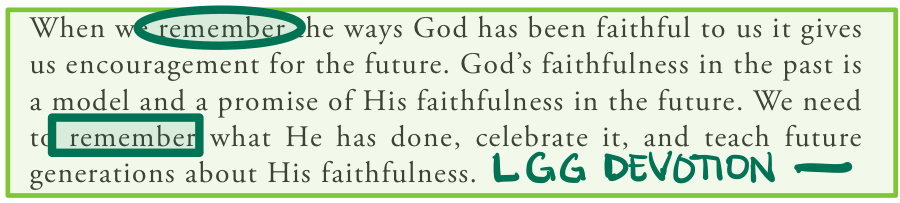
I’m guessing you would agree with me when I say that some Old Testament passages can be confusing. I think in some ways that is the case with today’s reading. However, the thing that is made clear is that God wants us to remember what He has done and expects us to do what He has commanded. It seems equally clear that when we forget God and what He has done we will fail to obey what He has told us or commanded us to do

Make it Personal – Reflection

What significant things has God done for you that you need to remember? Celebrate His faithfulness as you remember the things He has done?

Going Further

More about the Feast of Booths: https://www.gotquestions.org/Feast-of-Tabernacles.html