Posted in Bible study, From the Insideout, Quiet Time

The Ministry of Jesus Begins

12 When Jesus heard that John had been arrested, he left Judea and returned to Galilee. 13 He went first to Nazareth, then left there and moved to Capernaum, beside the Sea of Galilee, in the region of Zebulun and Naphtali. 14 This fulfilled what God said through the prophet Isaiah:

15 “In the land of Zebulun and of Naphtali,
    beside the sea, beyond the Jordan River,
    in Galilee where so many Gentiles live,
16 the people who sat in darkness
    have seen a great light.
And for those who lived in the land where death casts its shadow,
    a light has shined.”

Isaiah 9:1-2

17 From then on Jesus began to preach, “Repent of your sins and turn to God, for the Kingdom of Heaven is near.” Matthew 4:12-17

So where do we focus our attention today?

  • John being arrested?
  • Jesus hearing of the arrest and heading back to Galilee?
  • A prophesy fulfilled?
  • or – Jesus beginning His preaching ministry, with the message “repent of your sins and turn to God, for the Kingdom of God is near? *note the message didn’t change, just the deliverer

I believe they must all be considered to gain the full impact of verse 17, where Jesus begins to preach. Clearly each event led to the next and was laced with the fingerprints of God’s perfect timing. John was sent as a messenger, to prepare the way for the Lord, the Messiah whom he had baptized. The one of whom he said, “He (Jesus) must increase, but I must decrease.” . Once Jesus entered the scene , John was well aware that his ministry was nearing its end and this, by the Gospel’s accounts, began with John’s arrest. The same is true of Jesus who, when He heard that John had been arrested, did not hurry to his aid but rather back to Galilee. Why? Because He knew the message John had been preaching – one of repentance and turning to God because the Kingdom of Heaven is near- had to continue; He also knew God’s intention was for Him to carry the news to the lost, which according to the prophecy of Isaiah would begin with the Gentiles in Galilee “where so many Gentiles lived“.

For the Son of Man came to seek and save those who are lost.”

Luke 19:10

Both Jesus and John knew the Father’s plan was for Jesus to be exalted and they were committed to it. I do not suggest that John knew he would be arrested but simply that he understood things would be changing. He was yielded to God’s calling on his life, yielded to Christ increasing and him decreasing, but he continued to speak the truth in boldness, unapologetically preparing the way for the Lord. John’s message led him to prison and ultimately to his death. (Read the story) Jesus also knew and understood the Father’s plan – His timing, purpose, and the importance of the message – and He went in that direction. His commitment to the Father’s plan, like John’s, also led to His arrest and subsequent crucifixion.

Wow! If we didn’t know the rest of the story we might be tempted to think – “if commitment to God means heartache and death – why commit?” The answer can be found throughout Scripture, such as in Jesus’ answer to the thief on the cross – “today you will be with me in paradise”, or in the promise and pledged love of God to give all who believe in Him eternal life, or even in the words of Jesus to the crowd when He explained that to be His disciple they had to give up their own way, take up their cross daily, and follow Him. If you think the first two requirements are harder than the last check out what Jesus had just told them about His life in verse 22 of Luke 9, “The Son of Man must suffer many terrible things,” he said. “He will be rejected by the elders, the leading priests, and the teachers of religious law. He will be killed, but on the third day he will be raised from the dead.  Following Christ may not be easy or desirous at times but as He told them at the conclusion of His discipleship requirements … the end result is LIFE.

“if you try to hang on to your life, you will lose it. But if you give up your life for my sake, you will save it.”

Luke 9:24

May we seek to know the Word of God (2 Timothy 2:15), His purpose for the world (John 3:16-17), His call upon our life (Matt 28:18-20), and, like John and Jesus, may we be committed and yielded to follow accordingly.

MefromtheNsideout
Posted in Bible study, From the Insideout, Quiet Time

The Temptation of Jesus

Read Matthew 4:1-11

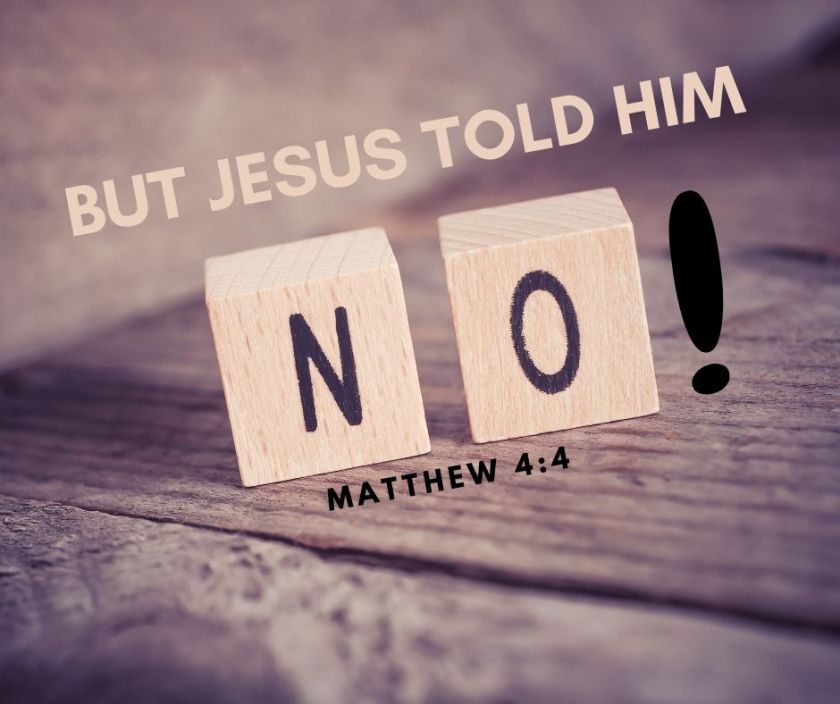
In today’s reading Matthew shares insight and wisdom from the life of Christ that will help us overcome the temptations we will inevitably face. Christ had just been baptized and was led by the Spirit into the wilderness where He was to be tested. Bibleref.com explains, that “it was God’s intention that Jesus should endure this time of testing.” [For a full explanation of 4:1 visit https://www.bibleref.com/Matthew/4/Matthew-4-1.html. ] However, the focus of today’s passage for me became verse 4, which follows Satan’s pointed temptation to Jesus, who had been fasting, to turn stones into loaves of bread (4:3). While Jesus, no doubt, could have easily met this temptation He instead answers Satan, directly, with a firm “No!” He then uses Scripture to confirm His choice.

During that time the devil came and said to him, “If you are the Son of God, tell these stones to become loaves of bread.” But Jesus told him, “No! The Scriptures say, ‘People do not live by bread alone, but by every word that comes from the mouth of God.’”

Matthew 4:3-4 (NLT)

Actually, every other time I have ever read or heard this Scripture taught my mind has been drawn to the use of God’s Word to combat the temptations, and rightfully so. We should always be ready with Scripture when we meet temptations – after all God’s Word is our primary weapon against sin which is why David answered his own question in Psalm 119, “How can a young man keep His way pure?” with these words, “By obeying God’s Word.” He goes on to explain how he does that, “I seek You (God) with all of my heart, do not let me stray from your commandments. I have hidden Your Word in my heart that I might not sin against You.” Temptation is clearly combatted with God’s Word. However, it is equally clear to me today that it is good and right to be direct and firm with the ‘tempter’ and say “no”! What a great example of handling our temptations, “But Jesus told him, ‘No!'”.

How can a young man keep his way pure?

By keeping your word.

10 I have sought you with all my heart;

don’t let me wander from your commands.

11 I have treasured your word in my heart

so that I may not sin against you.

Psalm 119:9-11 (CSB)

Jesus’ example makes me think of the campaign, “Just Say No!”, used in the “War on Drugs during the 80’s and 90’s to discourage children from using illegal drugs. Perhaps, as children of God, we should make this our campaign against temptations this year – “Say No to Satan!”. We are only 10 days in to the new year, yet it is already clear to me that there will be, as with every other year, daily temptations. Perhaps we will be tempted to mimic the behavior of the world (Romans 12:2), or to fear (Isaiah 41:10), or complain (Phil 2:14-16), or become angry (Eph 4:26, James 1:20) and unforgiving (Col 3:13), or to use our words to tear down instead of build up (Eph 4:29), the list of temptations are endless (the combatting Scriptures are equally endless) … but regardless of how or when the temptation comes may our answer be, like Jesus’, a firm and resolved NO! Let’s “Say NO to Satan!” and watch him flee in 2022.

Submit yourselves therefore to God. Resist the devil, and he will flee from you.

James 4:7 (ESV)

Posted in Bible study, From the Insideout

The Baptism of Jesus Matthew 3:13-17

John had been baptizing those who were repenting and turning to God. Now Jesus comes to be baptized by John. What an honor, right? John, however, understood that Jesus was the Messiah and did not need to repent of anything or turn to God, as was the requirement for baptism (Matthew 3:6). If anything, John understood his own sin and believed he should be baptized by Jesus not the other way around.

Reflection Question:

How did Jesus change John’s mind?

What happens after the baptism is relayed by Matthew in a beautiful picture of words that describe the love, joy, and pleasure that God took in seeing His son baptized – a symbol of being buried in death and raised to life. He also describes a scene of God’s Spirit descending like a dove, which one of my favorite Bible references describes like this:

God the Father immediately responds to Jesus’ baptism in a powerful way. As Jesus emerges from being fully immersed in the water of the Jordan River, the heavens are opened. Jesus sees God the Holy Spirit descending from heaven like a dove and coming to rest on Him.

It’s unclear from the descriptions in the other Gospels whether only Jesus saw the heavens opened and the Spirit descend. This might have been witnessed by everyone present. Or, perhaps it was only perceived by Jesus and John (John 1:32). Luke does specify that the Holy Spirit took solid, bodily form (Luke 3:22). However, the phrase “like a dove” can either refer to the visual appearance of the Spirit, or to the manner in which the Spirit descended. As such, it’s not explicitly clear that the Holy Spirit looked like a literal dove.

Bibleref.com in regard to Matthew 3:16

While John’s experience with Jesus is unique to only him, I am reminded what a privilege it is to serve God/Jesus in any way. I am equally convicted to remember the privilege and have a humble spirit like John, who surrendered to serve/baptizing as Christ requested – knowing, as Jesus told him, “It should be done, for we must carry out all that God requires.” 

Posted in Bible study, From the Insideout


John the Baptist Prepares the Way

Matthew 3:1-12

In our passage today we are introduced to John the Baptist. This isn’t the first reference to John in the Scriptures. As Matthew shares in 3:3, Isaiah proclaimed John would come. Matthew affirms the prophecy with his own introduction of John by introducing him not only as one living in the Judean wilderness but as one proclaiming the message of Jesus. Matthew also paints a picture of John for us by describing his preaching style, the way he dressed, what he ate, and how the people were attracted to him, but even better, how they responded to his message by repentance and turning to God.

People from Jerusalem and from all of Judea and all over the Jordan Valley went out to see and hear John. And when they confessed their sins, he baptized them in the Jordan River.

Matthew 3:5-6

However, the words that really captured my attention today are found in verses 8 and 9, where John addresses the Pharisees and Sadducees who had come to “watch” the baptism. He calls them out – demanding them to prove with their lives that they have repented and turned to God. He warns them not to think they are safe simply because they are descendants of Abraham.

Prove by the way you live that you have repented of your sins and turned to God. Don’t just say to each other, ‘We’re safe, for we are descendants of Abraham.’ That means nothing, for I tell you, God can create children of Abraham from these very stones. 

Matthew 3:8-8

This is the true message of the Gospel and of the Savior John was preaching, and we would do well to heed the warning. Our salvation isn’t based on whether or not our parents are Christians or if we go to church … Nor does it matter if we attended a Christian school or can recite Bible verses from Genesis to Revelation, and have read through the Bible every year of our life. It isn’t based on our good deeds, bad deeds, or our knowledge of who God is. Salvation is based on faith alone in Christ alone. God’s Word says that we are saved by grace through faith in Christ Jesus and not by our own efforts or works (Ephesians 2:8-9). No matter how hard or long we try we will never be good enough to earn salvation. Only God, by His grace and His mercy through Christ, can give us our salvation. It is a gift freely given to all who place their faith in Christ Jesus, the only “begotten”, sinless Son of God who died in our place – so that we could become the sons and daughters of God.

May we be careful not to place our hope and faith in what we know, or do, or for that matter what we don’t do – but rather in Jesus alone, the one who came, not to condemn the world but in order to save the world.

For God did not send his Son into the world to condemn the world, but in order that the world might be saved through him.

John 3:17
Posted in Bible study, From the Insideout

Read Matthew 2:13-23

If we were to “soap” only one of these verses it most likely would be verse 16, where we read of Herod’s anger at being duped by the wise men. If we were to ‘soap’ the passage – we most likely would list the subsequent murder of all the little boys and note how the angel’s message and Joseph’s obedience were used to spare the life of Jesus. We might even note the similarities of this passage to that of a similar edict in Exodus from which Moses was spared, Exodus 1:15-22.

Herod was furious when he realized that the wise men had outwitted him. He sent soldiers to kill all the boys in and around Bethlehem who were two years old and under, based on the wise men’s report of the star’s first appearance.

Matthew 2:16

However, as I read through this passage what caught my attention this time were several sets of repeated phrases; so I went back to highlight the unfolding story of these early days/years following Jesus’ birth. Notice with me there are two times where we read that “an angel of the Lord appeared to Joseph in a dream”, and once where he was “warned in a dream”, (13, 19, and 22). It is apparent in each instance that the angel brought instructions/warnings in order to protect but also to position them where God wanted them to be. This was another of the highlighted similarities. In verses 14 and 23 we read how the angel’s appearance and Joseph’s obedience fulfilled the prophecies that had been spoken. These same verses, 14 and 23, reveal Joseph’s obedient response to the angel’s instructions – which is the third set of highlighted similarities.

I believe we can learn much from these observations. We may not have an angel of the Lord appear to us in a dream but we do know that God has placed His Spirit in us to teach us and to remind us of all that He has said. We would be wise to be alert to His teaching and reminders as well as to live yielded and obedient as Joseph did. Another application comes in the form of comfort and peace knowing that God makes a habit of protecting and positioning His children according to His perfect plan – knowledge that leads us to a deeper trust.

 But when the Father sends the Advocate as my representative—that is, the Holy Spirit—he will teach you everything and will remind you of everything I have told you.

John 14:26

Posted in Bible study, LGG Study

Read: Luke 1:46-55 and Psalm 113; SOAP: Psalm 113:1-2

Praise the Lord!

Yes, give praise, O servants of the Lord.

    Praise the name of the Lord!

Blessed be the name of the Lord

    now and forever.

Psalm 113:1-2

Reflection: It’s the last Friday of our Advent study, The greatest Gift Given, and it’s time to praise the Lord again. Is there something you can praise Him for today? Think back through the week – where did you see God’s fingerprints or hear HIs voice. What has He done that you know could only have been Him? Have you known peace in your heart or mind? Take some time to give God praise! Let’s end our study time together with some Praise for the Greatest Gift Ever!

I pray you have a wonderful Christmas celebration! Our Savior has arrived—the King of kings and Lord of lords! Our Redeemer has been born and we get to join with angels in heaven as we sing His praises. Before the gifts are opened, before the meals are shared, before the carols are sung, sing praise to God, for He alone is worthy.

Read the full devotional from the Love God Greatly Team

And don’t forget the blog

Posted in Bible study, LGG Study
Read: John 14:27-31; SOAP: John 14:27

Reflection: What does it mean that Christ has given you His peace? How is the peace that Christ gave us different than anything the world can offer?

“I am leaving you with a gift—peace of mind and heart. And the peace I give is a gift the world cannot give. So don’t be troubled or afraid.

John 14:27

“In His great mercy and wisdom, God continues to give us good and perfect gifts, not just for today, but for our future.” Read today’s full devotional

Posted in Bible study, LGG Study

Peace of Mind

 Don’t worry about anything; instead, pray about everything. Tell God what you need, and thank him for all he has done. Then you will experience God’s peace, which exceeds anything we can understand. His peace will guard your hearts and minds as you live in Christ Jesus.

And now, dear brothers and sisters, one final thing. Fix your thoughts on what is true, and honorable, and right, and pure, and lovely, and admirable. Think about things that are excellent and worthy of praise.

Philippians 4:6-8

Paul taught the people of Philippi to not be anxious about anything. He encouraged them to talk to God about their concerns and needs, and to set their minds on things that are true and honorable, and right and pure, and lovely and admirable. They were told to think about things that are excellent and praiseworthy. It seems Paul had learned that the best way to put out the fires of anxiety is to change the focus of his mind. – Go ahead, give it a try – I promise it works!

Reflection: What do you think about when you become anxious? Is it a help or a hindrance to the peace we read about here in Philippians – peace that guards our hearts and minds?

Read today’s devotional to find out what we should do with all of our anxious thoughts –

Love God Greatly Devotional
Posted in Bible study, LGG Study

The Gift of Peace

I invite and encourage you to join me for this final week of our study as we explore God’s gift of PEACE.

We will discover how to have peace in our hearts, minds, circumstances, and future – and then we will finish the study with a look at Mary’s song of praise. You won’t want to miss a single day!

And the peace of God that surpasses all understanding will guard your hearts and minds in Christ Jesus.

Philippians 4:7

Week 6 Challenge: In Philippians 4:6-8 Paul tells his readers the peace of Christ guards our hearts. Hows does meditating on things that are true , worthy of respect, just, pure, lovely, commendable, excellent, or praiseworthy guard our hearts and minds? This week, take time to evaluate your thoughts, making sure to focus on things that match this list.

Posted in God is good

Jesus, Light of the World

Jesus spoke to the people once more and said, “I am the light of the world. If you follow me, you won’t have to walk in darkness, because you will have the light that leads to life.”

John 8:12

Father, You are Good. As James says, You are the giver of every perfect gift, James 1:17. You are the giver of the gift of LIGHT and LIFE to You be the glory. For in your goodness You have given us The Light that shines in the darkness. Light that leads to life according to John 8:12. Light that frees us to follow Jesus out of the darkness. It frees us to to be the light to the darkness around us, to love like He loves, to be kind and tenderhearted, forgiving others as You, in Your goodness, have forgiven us. It is a light, the only TRUE SOURCE OF LIGHT, that shines through us and leads others to You.

In the same way, let your light shine before others, so that they may see your good works and give glory to your Father who is in heaven.

Matthew 5:16

Thank You for the ‘gift of Light’ that has led me to Life in Jesus Christ, and for the joy that comes from both. Joy that comes from not walking in the darkness but in the glorious light, and in the joy that comes from ‘life in Christ’, 2 Corinthians 5:17.

Therefore, if anyone is in Christ, the new creation has come: The old has gone, the new is here!

2 Corinthians 5:17