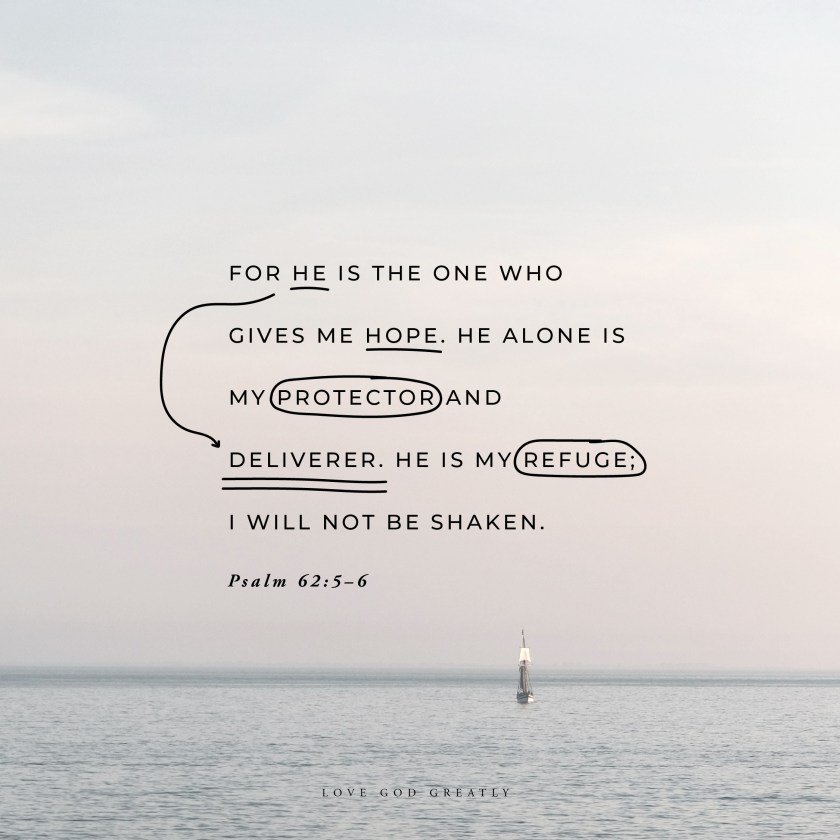
Let all that I am wait quietly before God, for my hope is in him. 6 He alone is my rock and my salvation, my fortress where I will not be shaken. 7 My victory and honor come from God alone. He is my refuge, a rock where no enemy can reach me. 8 O my people, trust in him at all times. Pour out your heart to him, for God is our refuge.
Psalm 62:5-8 NLT [for your preferred translation click on the Scripture link above]
Observations
God is worth waiting on, for real hope comes only from Him. He alone is our protector, deliverer, and refuge. Because of Him – I am not “shaken” when troubles come.
God is the only one who gives me hope.
ak
Application
When I am in danger, whether from earthly forces or spiritual, He is my protector. I can trust in Him.
When I am threatened or afraid, I can hide myself in His refuge, I can rest secure in His shelter – knowing that I am safe and protected.
Prayer: Response to God’s Word
Father, thank You for being all that You are to us, Your Children. Thank You for being a safe refuge in times of trouble. Thank You for Your living and active Word and Presence that provide strength, protection, and refuge.
But we have this treasure in clay jars, so that the extraordinary power belongs to God and does not come from us. 8 We are experiencing trouble on every side, but are not crushed; we are perplexed, but not driven to despair; 9 we are persecuted, but not abandoned; we are knocked down, but not destroyed, 10 always carrying around in our body the death of Jesus, so that the life of Jesus may also be made visible in our body.
2 Corinthians 4:7-10
Observations:
The first question that begs to be asked when ‘soaping’ this passage is – what is the “treasure” mentioned in verse seven? According to 2 Corinthians 4:6-7, the treasure is the light of the knowledge of the glory of God in the face of Jesus. In other words, the Treasure is the Gospel of Jesus Christ.
According to a commentary by Bibleref.com, “Paul has been defending himself from allegations of practicing falseness with the Corinthians. Some may have even accused him of being manipulative or a false apostle. To counter these arguments, Paul has emphasized his sole mission: to deliver the true gospel of Jesus and to proclaim that Christ is Lord. Paul insists that he and his friends see themselves as mere servants to the Corinthians for Christ’s sake. In his first letter to this church, Paul gave numerous indications that he was not interested in personal gain or fame” (1 Corinthians 1:10–17; 9:12–16).
BibleRef.com / 2 Corinthians 4:7-8
The next question then, is what, or who, are the clay jars? To Paul’s original audience, the clay jars would have represented something very fragile, and as Paul explained to the Corinthians – God used the fragile vessel “so that” everyone would understand, “the extraordinary power belongs to God and does not come from us.” However, metaphorically speaking, Paul, in an effort to answer – or better yet – silence those accusing him and his team of “practicing falseness”, Paul was referencing himself and his team as the clay jars. Paul’s heart was the vessel that God had shown His light in. The same is true of everyone who names the name of Christ today, and according to Scripture, we too, have been given the mission to carry this Gospel message to the world.”
And then he told them, “Go into all the world and preach the Good News to everyone.
Mark 16:15
So often it seems we are bombarded with ‘trouble’. Even then – perhaps, especially then – we can, like Paul and his team,, be reflections of Jesus. We must remember though, it wasn’t because of their power or strength but because of God in them; and as we saw in our recent post, it was also the power of God through the prayers of others.
Paul’s illustration of suffering was meant to help the Corinthians see and understand that what others were seeing in and from him was all about God’s power and glory – as the “life of Jesus was made visible in them.” This should have been evident in the way they handled all of their ‘troubles’, for through it all, even in their weakness and struggle, they did not turn away from following Christ and making Him known to others. They knew He had not abandoned them and they endured with hope of the “eternal weight of glory far beyond all comparison” (15-17) to what they were experiencing now.
Application
Do not let today’s trouble crush you or drive you to despair. If you are persecuted or suffering because of following Jesus, remember He has not abandoned you. If your troubles have knocked you down or simply knocked the wind out of your sail, don’t lose hope – for you belong to Jesus and to God the Father, and in them we cannot and will not be destroyed.
While it may not be easy to live for Jesus in this world – we must remember the goal set before us – and that is to make Him known. May all our troubles, and our responses to the troubles, make Him visible to the watching world.
Prayer: Response to God’s Word
Father, Paul’s words are challenging. I confess it is sometimes easy to lose hope or to despair. Yet they are equally encouraging to be reminded that You have not and will not abandon us. We belong to You and we will not be destroyed. These are the truths that help me to endure with hope. Guard us Father where we are vulnerable and strengthen us where we are weak – and in all these things grace us with Your protection. Through it all and above it all help us to make Jesus visible to the watching world. – In Jesus’ Name – Amen and amen –
Indeed we felt as if the sentence of death had been passed against us, so that we would not trust in ourselves but in God who raises the dead. He delivered us from so great a risk of death, and he will deliver us. We have set our hope on him that he will deliver us yet again, 11 as you also join in helping us by prayer, so that many people may give thanks to God on our behalf for the gracious gift given to us through the help of many.
2 Corinthians 1:9-11
Observations
So often in our suffering we are brought to the end of ourselves so that we remember to not trust in ourselves but rather in God – the One who is able to raise the dead.
Paul moves from talk of his suffering to a focus on God and how He delivered them from death and the confidence that God would continue to deliver them. –
Paul credits the Corinthians for their gift of prayer and the help it was to him and his team, urging them to give thanks to God on their behalf.
In reference to suffering – No one likes to suffer, but if Paul and his team had not suffered, people would not have prayed and seen or rejoiced in the answer. Sometimes our suffering is about more than us.
As noted by the underlined words in the above definition of prayer, by gotquestions.com, prayer should be an active part of every Christian’s life. It is thoughts and words, spoken or whispered, standing or sitting, or as Paul says – “kneeling”. It is born from a hope set in God and out of a desire to talk to Him, to seek His help or forgiveness in some matter – or to simply adore Him and praise Him for who He is and/or what He has done. It can be as simple as a sentence, a word, or a thought, or it can be detailed and involved and as long as it takes to pour your heart out to Him, as Hannah did (1 Samuel 1:8-15).
Prayer and the deliverance or answers it brings is a gift to both those who are praying and the ones they are praying for.
Praying offers us the opportunity to rejoice in what God does and allows us to be a part of His work. Let’s commit to being people who faithfully seek the Lord in prayer.
Another benefit of suffering is found here. When believers turn to God for help in suffering and see how He provides exactly what is needed, their faith is strengthened. They continue to rely on him and grow confident in God’s willingness and ability to save them.
Bibleref.com / 2 Corinthians 1:10
Prayer – Response to God’s Word
Father, this awesome privilege of prayer can so often be viewed and/or used selfishly to petition Youonly for our own needs, wants, fears, or complaints – but help us to remember that prayer is so much more than this. It is the privilege to fellowship with You or to give You praise or to pray for others in need, be it spiritual, physical, or material need. It is, above all, the privilege of drawing near to You and the window of opportunity to see You work, be it the sweetest, smallest answer, or the great and miraculous! There is great comfort in prayer, as well as peace, and joy, and rejoicing when we draw near to You and when we sense You drawing near to us, as is Your promise. And Father, as we are seeing in this study, it is through prayer that we find the strength and hope to endure. Help us, as Your children, to be faithful in drawing near to You in prayer – to embrace this opportunity and privilege to walk with You and talk with You through life. Let us live lives of prayer – keeping our eyes and our faith fixed on You – praying continually as Paul wrote – for in this alone will we have an enduring hope and a strengthened faith – Amen, in Jesus’ name!
Therefore, since we are surrounded by such a huge crowd of witnesses to the life of faith, let us strip off every weight that slows us down, especially the sin that so easily trips us up. And let us run with endurance the race God has set before us. 2 We do this by keeping our eyes on Jesus, the champion who initiates and perfects our faith. Because of the joy awaiting him, he endured the cross, disregarding its shame. Now he is seated in the place of honor beside God’s throne. 3 Think of all the hostility he endured from sinful people; then you won’t become weary and give up.
Hebrews 12:1-3
Observations and applications
There are many lessons packed into these three small verses, like how Jesus is the pioneer of our faith, meaning He led the way or set the example for the life of faith He has called us to live. Perhaps the most beautiful lesson is the way the author wrote about what and how Jesus “endured”, namely the cross, “disregarding its shame”. This only sinless son of God took our sin and shame and we should , as Bibleref.com writes – “make every effort to ‘hold fast’ (Hebrews 3:6; 10:23), setting aside sin and selfishness as we pursue whatever path God has placed in front of us. This is the essence of godly faith: to trust God with our future, despite how hard it might be in the present.”
Jesus is the ultimate example of what it means to endure.
To run the race God has mapped out for us – we must get rid of things that hinder us – such as sin and things of earth that bind us or weigh us down. We must also keep our eyes on Jesus, the champion of our faith. Why? Because it is just too easy to give into fears and weariness when our eyes are not on Him. Remember, our battles are different than the typical earthly warfares. In Ephesians, chapter six, Paul explained that our battles are not against flesh and blood enemies, but against evil rulers and authorities of the unseen world. Since we cannot see our enemy we must prepare our minds for the battle. This, at least in part, is why Scripture teaches, or warns us, to guard the mind and to keep our thoughts on Him. Actually, Paul shared his personal battle of the mind with the church at Rome. He told them that there was another power within him that was at war with his mind. The power made him a slave to the sin that was still in him and he wanted to help others who might also struggle with this. Because of this, it seems, Paul used letter after letter to drill the warning into New Testament believers and not just the warning but the ways to overcome the battle, whether it was of the mind or present and real earthly matters.
Because I have found them very helpful to my own battles many of the “how tos’ are referenced here with the hope that they will also help you.
Romans 12;2 … To avoid copying the customs and behaviors of this world we must let God change the way we think.
Colossians 3:2 … Think about the things of heaven not the things of earth
Philippians 2:5 … Think like Christ – You should have the same attitude toward one another that Christ Jesus had…
who though he existed in the form of God did not regard equality with God as something to be grasped, but emptied himself by taking on the form of a slave, by looking like other men, and by sharing in human nature.He humbled himself, by becoming obedient to the point of death
Philippians 2:6-8
Jesus Himself made it known the importance of the mind in relation to His followers.According to Jesus’ teaching, both the focus and the allegiance of the mind were important to God.
But [Jesus} turned and said to Peter, “Get behind me, Satan! You are a stumbling block to me, because you are not setting your mind on God’s interests, but on man’s.” Matthew 16:23
We even hear its importance in His infamous answer to the Pharisee in Matthew 22:37, where He replied – “‘Love the Lord your God with all your heart, with all your soul, and with all of your mind.'”
Long before Jesus walked on the earth Isaiah told the people, “[God] will keep in perfect peace all who trust in Him, all whose thoughts are fixed on Him.”
The Bible is full of helpful tips, promises, and more when it comes to overcoming the enemy – which is key to our endurance – and why Scripture is the believer’s greatest weapon of warfare. Consider Paul’s words to the believers in Ephesus and, by extension, to believers today concerning the armor of God.
Finally, be strengthened in the Lord and in the strength of his power. 11 Clothe yourselves with the full armor of God, so that you will be able to stand against the schemes of the devil. 12 For our struggle is not against flesh and blood, but against the rulers, against the powers, against the world rulers of this darkness, against the spiritual forces of evil in the heavens. 13 For this reason, take up the full armor of God so that you may be able to stand your ground on the evil day, and having done everything, to stand. 14Stand firm therefore, by fastening the belt of truth around your waist, by putting on the breastplate of righteousness, 15 by fitting your feet with the preparation that comes from the good news of peace, 16 and in all of this, by taking up the shield of faith with which you can extinguish all the flaming arrows of the evil one. 17 And take the helmet of salvation and the sword of the Spirit (which is the word of God). 18 With every prayer and petition, pray at all times in the Spirit, and to this end be alert, with all perseverance and petitions for all the saints.
Ephesians 6:10-18
If we want to endure, and not just endure, but endure with hope we must be prepared to stand firm. However we cannot stand firm without the Word of God, which is specifically referred to by Paul as the Sword of the spirit. While the other pieces of armor may not specifically be referred to by Paul as the “Word of God”, almost all have some connection to the Word. Check out today’s, ‘Going Deeper’ for more details.
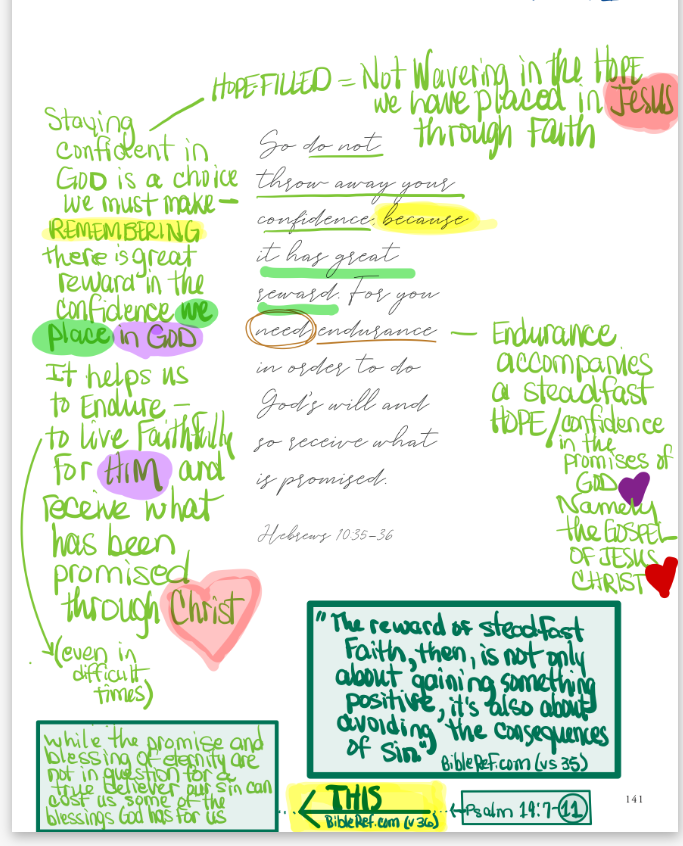
I found verse thirty-nine a wonderful reminder of the power of our faith. While most translations render the verse – “whose souls will be saved“, the NET version translates it like this: “But we are not among those who shrink back and thus perish, but are among those who have faith ‘andpreserve their souls.’ “I love this! It means the same thing, of course, as the other translations but it jumped off the page at me with the emphasis of faith’s longevity. Faith is a spiritual preservative – so powerful of a preservative – it will never expire.
Faith is a spiritual preservative – so powerful of a preservative – it will never expire.
My brothers and sisters, consider it nothing but joy when you fall into all sorts of trials, 3 because you know that the testing of your faith produces endurance. 4 And let endurance have its perfect effect, so that you will be perfect and complete, not deficient in anything.
James 1:2-4
Observations
My mom, who is in a rehab facility, wants to come home so much. Sadly, she has to stay so she can get daily therapy in order to become strong enough to stand and walk on her own when we aren’t with her. We’ve been having a lot of conversations about this lately, so while I was reading today’s passage, I was reminded that this same principle applies to our spiritual lives. You see, we can work out every day to build up our physical strength and endurance, but if we don’t use the muscles we’ve worked out we will never progress. The same is true spiritually. If we are not spending daily time in God’s Word and putting into practice what we read, we will become spiritually weak and unable to “endure” when troubles come our way. However, when the trials come and we continue to follow Jesus’ way – our roots grow deeper in Jesus’ strength and godly character, and we become more sure-footed with every trial. When our roots are planted deep in Him and our way of thinking is ‘trained’ or focused on Him – we will stand firm in our faith and live a life that truly reflects Him and deters the enemy.
Trials not only reveal the genuineness of our faith, they strengthen our faith.
Application
We can learn much from James’ opening remarks here, in verse two. We are encouraged to consider our trials or troubles nothing but joy. This type of consideration will require us to retrain our thinking, our outlook, and perspective. Paul made similar statements through out his writings and included the “how-to” instructions. One of my favorites is Philippians 4:6-8, where we read:
Don’t worry about anything; instead, pray about everything. Tell God what you need, and thank him for all he has done.Then you will experience God’s peace, which exceeds anything we can understand. His peace will guard your hearts and minds as you live in Christ Jesus. And now, dear brothers and sisters, one final thing. Fix your thoughts on what is true, and honorable, and right, and pure, and lovely, and admirable. Think about things that are excellent and worthy of praise.
Philippians 4:6-8
With a diet, when the end of the day comes you either feel good/stronger if you stayed on track, or weak and frustrated, if you didn’t. It seems, as I read James 1:12, that in essence James is saying something similar; like, ‘when the “end of the day comes” we will rejoice if we have done well – reaping the benefits of His promises; and borrowing from Matthew 25:21, perhaps the blessing of hearing God say, “Well done, my good and faithful servant. You have been faithful in handling this small amount, so now I will give you many more responsibilities. Let’s celebrate together!”
Prayer, in response to God’s Word
Father, thank You for Your Word and Your Spirit who not only teaches us from it but reminds us of all that Christ said. Thank You for the strength that this builds in us and the power it has to enable us to stand firm in the troubles that come our way. Thank You for the reminder that our trials are meant to make us stronger. Help us to endure each trial with patience and the intention of glorifying You by keeping our eyes on the goal of being perfect and complete, not lacking in anything. – In Jesus’ Name, amen
From the Word to Worship, through song
Through it all – I’ve learned to trust in Jesus, I’ve learned to trust in Jesus – I’ve learned to trust in God! Through it all – I’ve learned to depend upon Hs Word …
Today’s Reading: luke 8:43-48 / SOAP: Luke 8:43 and 48
Now a woman was there who had been suffering from a hemorrhage for twelve years but could not be healed by anyone. – Then he said to her, “Daughter, your faith has made you well. Go in peace.”
Luke 8:43, 48
I encourage you to read this recap as though you’ve never heard the story before.
Hope Surged
She had suffered from the hemorrhage for twelve years now. She sought help and had suffered at the hands of the doctors, she had spent all the money she had trying to find relief but no one could heal her. To make it worse, this particular disease, being one of blood, would have prohibited her from worshipping or sacrificing at the Temple, and most likely lonely – as no one would want to come near her- for to do so made them unclean. Imagine, twelve years of constant bleeding, twelve years of jeers and stares and little to no contact with others, twelve years of searching for help, but to no avail. Weakened by the disease and emotionally tired of it all, her hope fading away as she had nothing left to give for help. At the end of herself, there seemed to be one last strand of hope. She had heard about a man named Jesus, a teacher and a prophet, but what captured her attention was that He was known to be a healer. Hope surged within her, believing if she could just touch His robe, she would be healed. In desperation she made her way through the crowd and reached out from behind him – managing to just touch the edge of His coat – but with that one touch the bleeding stopped and her body was healed.
The Power of Our Faith
Imagine now her excitement and relief mixed with what must have been a certain concern and anxiousness to escape the crowd without being noticed. Remember, those who recognized her would not have been happy that she had been in their midst lest they had been ‘contaminated’ by her touch and certainly she would not have wanted her touch to have rendered the healer contaminated. Yet, somehow Jesus knew that someone had touched Him and he wanted to know who. Now imagine her fear of being found out but then her delight as she fell before Him and shared the details of what had transpired and heard Him say, “Daughter, your faith has made you well. God in peace.”
Afterthoughts:
Simply and Profoundly Faith
It seems at first glance that just touching the hem of His garment was enough to bring the full power of his healing to her body! Perhaps, indirectly it was ; however, we must not miss Jesus’ reply to her as she explained the reason and result of her touch. He did not commend her for reaching out, nor did He boast of some power in His garment, but rather, He made it clear that it was simply and profoundly her faith that made her well .
The Only One
Jesus wasn’t the only one she looked to for help – but He was the only one who had the power to truly heal her – and He charged her nothing.
A woman in the crowd had suffered for twelve years with constant bleeding. 26 She had suffered a great deal from many doctors, and over the years she had spent everything she had to pay them, but she had gotten no better. In fact, she had gotten worse. 27 She had heard about Jesus, so she came up behind him through the crowd and touched his robe. 28 For she thought to herself, “If I can just touch his robe, I will be healed.” 29 Immediately the bleeding stopped, and she could feel in her body that she had been healed of her terrible condition. Jesus realized at once that healing power had gone out from him, so he turned around in the crowd and asked, “Who touched my robe?” 31 His disciples said to him, “Look at this crowd pressing around you. How can you ask, ‘Who touched me?’” 32 But he kept on looking around to see who had done it. 33 Then the frightened woman, trembling at the realization of what had happened to her, came and fell to her knees in front of him and told him what she had done. 34 And he said to her, “Daughter, your faith has made you well. Go in peace. Your suffering is over.”
Mark 5:25-34
Response to God’s Word
Father, may my faith always be so strong that I draw near and reach out when I am suffering or hurting or afraid or in need – believing that even just a touch of You will be enough to bring healing and peace.
Going Deeper
Before Jesus gets far, however, He feels power going out of Him. He discovers that a woman who suffers from chronic bleeding has had the courage to touch His robe in faith, hoping she will be healed. When she realizes Jesus knows what she did, she is understandably frightened. A woman—a woman with an issue of blood who was therefore considered unclean—touching a rabbi was unheard of. She rightly expects Jesus to be angry despite the deliverance she senses she has received. To her surprise, He calls her “daughter,” praises her faith, and blesses her. For the first noted time, Jesus heals with no overt intent; the woman and her faith call on His power and she is healed.
But Hannah replied, “Not so, my lord! I am a woman under a great deal of stress. I haven’t drunk wine or beer. But I have poured out my soul before the Lord. 16 Don’t consider your servant a wicked woman. It’s just that, to this point, I have spoken from my deep pain and anguish.”
1 Samuel 1:15-16
If you’ve known me long, heard me teach, or read many of my blogs you have likely heard or read my story of being childless for the first eight years of marriage. It is tempting to apologize for the repetitiveness, but I don’t, for it is the testimony of God’s work in my life. It was a time when He revealed my lack of contentment in Him. My desire for a child had become so much greater than my desire for God that my trust and hope in Him were barely visible at times. I was hurt when I saw or heard about others who were pregnant; and I was disappointed, even angry, with God every month when I realized, yet again, that I wasn’t pregnant.
In the beginning, I would cry out to God in prayer – much like Hannah, but as the years went on I would “act out”, so to speak. I would chase after other things that I believed could satisfy – for somewhere in my mind I had traded hope in God for hope in my circumstances. My hope had been shaken and shaken hard. I was a good “church girl”, so on Sundays and Wednesdays glimpses of faith and hope would shine light into the wilderness I was trapped in. I was miserable, my marriage was on shaky ground, my friends were having babies so my friendships were threatened – some were even ruined, and I found myself just going through the motions of life … until I found myself spilling my anguish out to my mother one afternoon as we sat on the front porch of her home. While we had a good relationship it was not one where we talked about personal issues like this, so trust me when I say it was a God thing, His perfect timing. I whined about not being pregnant and told her how miserable I was in every area of life and she said, something to the effect of – maybe you just need to learn to be content – which was followed up with some Scripture her Pastor had recently shared in a message. Her response perturbed me at first but I listened to her talk, dried my tears and eventually went home – and poured myself out to God like never before. In the days that followed God began working on my heart and mind and changing me from the inside-out. And, much like with Rachel and Leah in our previous post and Hannah from today, God ‘remembered’ me and within a very short time I learned I was pregnant.
… for I have learned how to be content with whatever I have.I know how to live on almost nothing or with everything. I have learned the secret of living in every situation, whether it is with a full stomach or empty, with plenty or little.For I can do everything through Christ, who gives me strength.
1 Corinthians 4:11-13
In today’s story, Hannah poured herself out before the LORD. She was so caught up in her prayer, she didn’t realize that Eli, the priest, was watching her; nor did Eli realize that Hannah was praying in her mind to God – instead he thought she was drunk and encouraged her to put away her wine. Of course, Hannah replies that she isn’t drunk but rather under a great deal of stress and pouring out her “soul before the LORD.” She doesn’t elaborate on the source of stress but does request that Eli not consider her a wicked woman but rather to understand that she was pouring herself out before the LORD. She wasn’t speaking from drunkenness but rather from deep pain and anguish.
Scripture says that Eli told Hannah to, “Go in peace, and may the God of Israel grant the request that you have asked of him.” (1 Samuel 1:17) Following her encounter with Eli and his encouraging blessing, Hannah “went her way and got something to eat. Her face no longer looked sad.” She had been refreshed by the prayer of Eli and the next day her mind and heart were occupied with God in worship before returning home. Scripture tells us that soon after this Hannah learned she was pregnant.
The entire family got up early the next morning and went to worship the Lord once more. Then they returned home to Ramah. When Elkanah slept with Hannah, the Lord remembered her plea, 20 and in due time she gave birth to a son. She named him Samuel, for she said, “I asked the Lord for him.”
1 Samuel 1:19b-20
Response to God’s Word
Father, thank You for allowing us to pour our “souls” out to You. We are a people who need You and You have made it clear from Old Testament to New that we can bring You our fears, our desires like ‘childlessness”, our finances, our concerns, worries, and needs. Help us to trust in You even when we cannot see Your hand. You are a good and faithful father. – Amen!
He did not waver in unbelief about the promise of God but was strengthened in faith, giving glory to God. 21 He was fully convinced that what God promised he was also able to do.
Romans 4:20-21
The Bigger Picture
Romans chapter 4 is an illustration of justification. I believe it is good to read/review the book of Romans often and particularly this chapter – which was instrumental in my late 20s and early 30s to understanding God’s grace and being able to stand firm in my salvation. It is a beautiful word picture of the TRUTH of our salvation.
So while we are only given verses 20 and 21 to SOAP, I would encourage you to look at the whole passage (13-25). It’s in these verses you will see that the promise of eternal life is not by keeping the law – but – by “the righteousness that comes by faith,” and even this is by God’s grace to all who believe. This may seem redundant information – as our studies touch on this a lot – which is because it is the crux of the Gospel message. Salvation is not by works that we have done or ever can/will do; it is solely by the grace of God, through the blood of His only begotten Son, and our faith in that truth.
For if they become heirs by the law, faith is empty and the promise is nullified.
Romans 4:14
Abraham’s life is one unknown after another it seems. He followed God out of his comfort zone into the unknown and was forever waiting for the fulfillment of the promise(s),specifically those mentioned in Genesis 12:1-3. It’s here we read of God calling Abraham to “go from his country to another land.” If he went, God promised to make Abraham a great nation, to bless him, to make his name great, to bless those who blessed him and curse those who dishonored him, and to bless all of the families of the earth through Abraham (Genesis 12:1–3). Some of these He saw answered and rejoiced, others were never realized in His lifetime but according to our SOAP passage today, he did not waiver in unbelief about the promise of God that he would inherit the world, which is apparently Paul’s summation of the promises from Genesis. Because of this, his faith was strengthened and this gave glory to God.
Fully Convinced
How about you? Is your faith full and firm in God’s promise or is it empty and the promise nullified? It is a daunting question for sure but one we would be wise to occasionally examine so that we are not found wavering in our faith in the promises of God that are ours through Christ. Wavering may seem normal with such a promise as the Gospel presents but it is vital that we come to a place that we are fully convinced that what God has promised He is also able to do. As we continue in this belief our faith will grow stronger and God will be glorified.
The one who doubts is like a wave of the sea that is driven and tossed by the wind –
Father, You are a promise maker and a faithful promise keeper. Your Word is yes and amen in Jesus Christ and we are blessed by You. The world is full of challenges and obstacles and we have an enemy who is the father of lies, so help us to stand firm in our beliefs, unwavering, like Abraham and strengthened in our faith, giving glory to You. Where there is doubt quickly speak Truth over us. Help us to faithfully be in Your Word and let us be fully convinced that what you have promised You have done and are also able to do. For only when we are fully convinced will we live in unwavering belief of the Gospel message … only then will we see the beauty of Your amazing grace, unending mercies, and abounding and abiding love. It is in these truths we will be able to press on in enduring hope through all of life.
But as it is, they aspire to a better land, that is, a heavenly one. Therefore, God is not ashamed to be called their God, for he has prepared a city for them.
Hebrews 11:16
Who are “They”?
When studying Scripture, it is important to look back to the previous verse(s), exploring the people and things talked about, in order to understand the pronouns in the current verse. For instance in our SOAP verse today, we must know who was “aspiring to a better land” in order to understand who God “is not ashamed” of or who “He has prepared a city for.”
In this case, looking back, we find that the writer is referring to Abraham, Isaac, Jacob – and others like them; they are the “heroes of the faith.” They were the ones who remained faithful, not turning back even though they never received the things they were promised. They believed the promise that there was a better “homeland” and did not return to the one they, by faith, had left behind. Instead, they “trusted God’s ability to bring about His promises out of things unseen.”
Now faith is the certainty of things hoped for, a proof of things not seen. –
Hebrews 11:1
Made Right With God
“They realized that God’s promises aren’t necessarily tied to some physical earthly benefit. Instead, God is working all things for good, from a heavenly eternal plan.” So, because they lived out their faith – not wavering in their trust in God – God was not ashamed of them. “It was their faith leading to obedience, not the actions themselves, which made them acceptable to God.” [quotes borrowed from bibleref.com, Hebrews 11:16]
The same is true for us today, for when we walk by faith and not by sight, placing our trust in Jesus, we are made right with God – no longer His enemies but the children He, by grace, adopts as His own.
The grace and goodness of God are on full display in Christian reconciliation. “You were his enemies, separated from him by your evil thoughts and actions. Yet now he has reconciled you to himself through the death of Christ in his physical body. As a result, he has brought you into his own presence, and you are holy and blameless as you stand before him without a single fault”
Father, thank you that though we were once Your enemies, You – by grace – made a way for us to have a relationship with You. By grace, the work of Christ on the cross, and our faith in Him we stand before You unashamed – no longer condemned because we are in Christ Jesus, in whom You are well pleased! Thank you for the examples of those who have gone before us, who by faith did not turn back from following You, though they did not see Your promises come true in their lifetime. Like them we are strangers and foreigners on this earth – waiting for our heavenly homeland. Though we may grow weary in the wait Father, help us to stand firm – fixing our eyes on Jesus, the author and perfecter of our faith, who for the joy set before Him, endured the cross – scorning its shame. Help us not to turn away from His commands but to press on to the mark of the Your high calling in Christ our Lord and Savior. Help us to endure in the hope we have in Christ and in Your promises – Amen and amen in Jesus’ name amen!