Posted in Bible study, Devotion, From the Insideout, Journey Through The Word, She, Volume 2

Ruth, Part 4

Adapted from She, Volume 2/p69-72

Read: Ruth 3:1-20; Ruth 4; and Matthew 1:5

As someone who used to scheme and manipulate situations to get a desired result, the opening lines of Ruth chapter three catch my attention every time. Whether it was culturally acceptable to arrange marriages in that day and time, the conversation that ensues seems to fall under the plotting and scheming category of any generation or culture.

One day her mother-in-law Naomi said to Ruth, “My dear daughter, isn’t it about time I arranged a good home for you so you can have a happy life? And isn’t Boaz our close relative, the one with whose young women you’ve been working? Maybe it’s time to make our move. 

Ruth 3:1-2

It is worth noting that marriage arrangements were the custom of the day in which Naomi and Ruth lived. So, the argument could be made that they were simply following the lead or path that was opened when Boaz extended her the kindness, protection, and provision of gleaning in his field. As bibleref.com commentary explains, “Naomi has a problem. She wants Boaz, an older, highly honored Jewish man, to marry Ruth, her young Moabite daughter-in-law. Culturally, there is nothing about this scheme that makes sense. But Naomi knows Ruth deserves the best in life, and she’s resolved to make it happen. Naomi must balance several things all at once. She needs to figure out how Ruth can propose to Boaz while keeping safe and maintaining enough privacy that Boaz doesn’t lose face for talking with a foreign widow.”

Ruth Proposes

Ruth was a willing participant and followed all of the instructions Naomi gave her. After seeing/hearing all that Boaz had done thus far, there was no reason for either woman to doubt that Boaz, as a “near kinsman who could redeem them, would do what he could”2. Whether it is the man or woman who proposes, I think we would all agree that no one wants to hear the answer, ‘Yes, but…’. Unfortunately, however right he was, this is the answer that Boaz gives Ruth.

The Lord bless you, my daughter!’ Boaz exclaimed. ‘You are showing even more family loyalty now than you did before, for you have not gone after a younger man, whether rich or poor.3 Now don’t worry about a thing, my daughter. I will do what is necessary, for everyone in town knows you are a virtuous woman. But while it’s true that I am one of your family redeemers, there is another man who is more closely related to you than I am. 

Ruth 3:10-12

Despite her Moabite heritage, Ruth had come to be known as a kind and virtuous woman, and even though another man was a closer redeemer than Boaz, Boaz was the one whom God had prepared to be her redeemer.

12 But while it’s true that I am one of your family redeemers, there is another man who is more closely related to you than I am. 13 Stay here tonight, and in the morning I will talk to him. If he is willing to redeem you, very well. Let him marry you. But if he is not willing, then as surely as the Lord lives, I will redeem you myself! Now lie down here until morning.”

14 So Ruth lay at Boaz’s feet until the morning, but she got up before it was light enough for people to recognize each other. For Boaz had said, “No one must know that a woman was here at the threshing floor.” 15 Then Boaz said to her, “Bring your cloak and spread it out.” He measured six scoops[a] of barley into the cloak and placed it on her back. Then he[b] returned to the town.

16 When Ruth went back to her mother-in-law, Naomi asked, “What happened, my daughter?”

Ruth told Naomi everything Boaz had done for her, 17 and she added, “He gave me these six scoops of barley and said, ‘Don’t go back to your mother-in-law empty-handed.’”

18 Then Naomi said to her, “Just be patient, my daughter, until we hear what happens. The man won’t rest until he has settled things today.”

Ruth 3:12-18

While Naomi told Ruth she wouldn’t have to wait long, she also told her to “be patient.” Those two words can be very good advice, however they can also be a very annoying and often challenging statement. Yet, according to the commentary by Bibleref.com, just as Naomi had predicted, it is only a few hours later that Boaz goes to the city gates. Determined to do all he could to help care for Ruth and Naomi, Boaz follows the cultural demands of the day, which are described in the first twelve verses of Ruth, chapter four. They are a wonderful display of Boaz’s character, and I believe, his respect and heart’s desire to marry Ruth.

The Story of the Sandal

Boaz went to the town gate and took a seat there. Just then the family redeemer he had mentioned came by, so Boaz called out to him, “Come over here and sit down, friend. I want to talk to you.” So they sat down together. Then Boaz called ten leaders from the town and asked them to sit as witnesses. And Boaz said to the family redeemer, “You know Naomi, who came back from Moab. She is selling the land that belonged to our relative Elimelech. I thought I should speak to you about it so that you can redeem it if you wish. If you want the land, then buy it here in the presence of these witnesses. But if you don’t want it, let me know right away, because I am next in line to redeem it after you.”

The man replied, “All right, I’ll redeem it.”

Then Boaz told him, “Of course, your purchase of the land from Naomi also requires that you marry Ruth, the Moabite widow. That way she can have children who will carry on her husband’s name and keep the land in the family.”

“Then I can’t redeem it,” the family redeemer replied, “because this might endanger my own estate. You redeem the land; I cannot do it.”

Now in those days it was the custom in Israel for anyone transferring a right of purchase to remove his sandal and hand it to the other party. This publicly validated the transaction. So the other family redeemer drew off his sandal as he said to Boaz, “You buy the land.”

Then Boaz said to the elders and to the crowd standing around, “You are witnesses that today I have bought from Naomi all the property of Elimelech, Kilion, and Mahlon. 10 And with the land I have acquired Ruth, the Moabite widow of Mahlon, to be my wife. This way she can have a son to carry on the family name of her dead husband and to inherit the family property here in his hometown. You are all witnesses today.”

11 Then the elders and all the people standing in the gate replied, “We are witnesses! May the Lord make this woman who is coming into your home like Rachel and Leah, from whom all the nation of Israel descended! May you prosper in Ephrathah and be famous in Bethlehem. 12 And may the Lord give you descendants by this young woman who will be like those of our ancestor Perez, the son of Tamar and Judah.” Ruth 4:1-12

Then Boaz said to the elders and to the crowd standing around, “You are witnesses that today I have bought from Naomi all the property of Elimelech, Kilion, and Mahlon. 10 And with the land I have acquired Ruth, the Moabite widow of Mahlon, to be my wife. This way she can have a son to carry on the family name of her dead husband and to inherit the family property here in his hometown. You are all witnesses today.”

Ruth 4:9-10

Scripture paints a beautiful picture of the story, allowing us to see the amazingly personal hand of God carrying out His purposes and plans for generations upon generations to come.

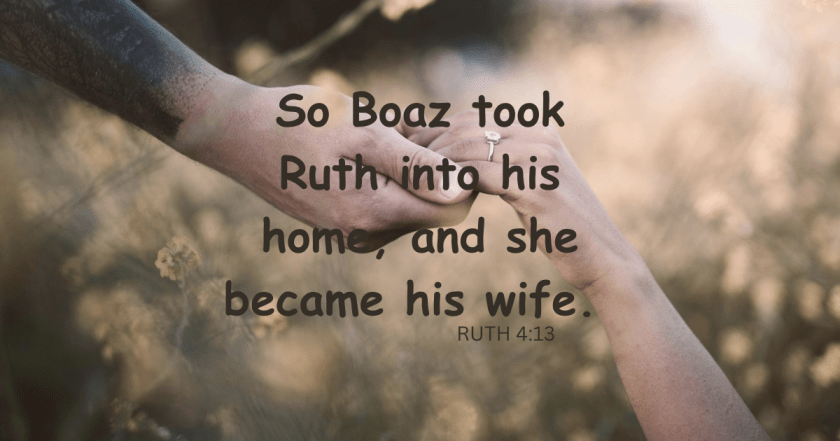
So Boaz took Ruth into his home, and she became his wife. When he slept with her, the Lord enabled her to become pregnant, and she gave birth to a son. (Ruth 4:13) – Cue the water works and celebration, for Naomi (and Ruth) have been redeemed and restored!

Then the women of the town said to Naomi, “Praise the Lord, who has now provided a redeemer for your family! May this child be famous in Israel. 15 May he restore your youth and care for you in your old age. For he is the son of your daughter-in-law who loves you and has been better to you than seven sons!”

Ruth 4:14-15

As the study journal points out, Ruth’s son would be the grandfather of King David of Israel. And fourteen generations after him, Jesus Christ would be born of the same lineage. ~ for even more details on the beautiful plan of God in and through the story of Ruth and the glorious arrival of Jesus, “in whom we have redemption through His blood, the forgiveness of sins, according to the riches of His grace5“, click here.

Reflection and Application
  • Why do we need a Redeemer?
  • What was the name of Ruth and Boaz’s son, and how does he play a part in the life of Jesus, our Redeemer?
The More We Know

Would you like to know more about Jesus, My Redeemer?
Posted in Bible study, Journey Through The Word, She, Volume 1

Deborah

Adapted from the study ‘She, volume 1, p. 21-22

Read: Judges 4 & 5

God’s Word tells us that Deborah was a prophetess, the wife of Lapidoth, and that she judged Israel.

  • Which of those things surprises you the most and why?
    • For me, it is that she (a woman) “judged Israel,” and that she judged for forty years (5:31), and during that time: “the land had rest.” Please understand, for me – this isn’t said with an attitude of, “look what a woman can do”, but rather it is about remembering that God chooses and appoints those He wants to use and empowers them to accomplish the thing which He has purposed for them to do. We only have to be ready and surrender to His call.

It is helpful to know that not all prophets, or in this case prophetesses, were judges; nor were all judges prophets. However, here in Judges 4:4, Deborah is recognized as both. Which the “She” study guide points out, p 21:

  • The fact that she was a prophetess means that “the Lord had gifted her with the ability to discern the purposes of God and declare it to others.”
  • As for the fact that she was a judge, according to Judges 17:6… “She judged in a time when men did that which was right in their own eyes.”
    • It may surprise you to know that while Deborah was the only woman Judge over Israel recorded in the Bible, she was not the only prophetess. The Bible lists many others, including:
      • Old Testament:
        • Miriam: (Moses’ sister, leader in worship)
        • Deborah: (Judge and prophetess)
        • Huldah: (Confirmed Josiah’s discovery of the Law)
        • Isaiah’s wife: (Unnamed, gave prophetic names to sons)
        • Noadiah: (False prophetess who tried to stop Nehemiah)
      • New Testament:
        • Anna: (Prophesied about the infant Jesus in the Temple)
        • The four daughters of Philip: (Prophesied in Caesarea)
        • Other Mentions/Traditions:
      • Jezebel: (False prophetess in Revelation).
      • Some traditions also include Hannah (mother of Samuel) or Abigail (wife of David) as prophetesses, though not always explicitly titled as such in Scripture.

I share this not to distract from Deborah, but to remind us that God is not bound by cultural norms … but can raise up who He chooses – and does so always with a purpose. Why is this important? Because, as women, we must understand that God calls not just men, but women, to lead. We must be surrendered and ready to serve where and how He leads us. I particularly appreciate this quote from the study guide: “She led by faithfully doing as she said she would do.” Friends, wherever God has called you and whatever He has called you to do, may we do so, determined to give Him all the glory. May we also, like Deborah, “faithfully fix our heart upon the LORD, rejoicing and singing praise to the LORD among the people, making known through our celebration the greatness of our God and of His works and provisions on our behalf.

Reflection and Application:
  • What is most interesting to you about Deborah?
  • What can we learn from her and apply to our own lives?
  • How can you be/are you a leader?

I invite you to leave a reply below or at today’s Journey Through the Word FB post.

The More We Know

I invite you to scroll down and leave a comment … or join the discussion at Journey through the Word

Posted in Bible study, Devotion, From the Beginning to Forever, From the Insideout, Journey Through The Word, LGG Study

Dry Ground

Based on the LGG Study, From the Beginning to Forever/w3d3

Read: Ex 14:19-31; SOAP: Ex 12:13 / (for further reading Ex 12:33-37; Ex 14:5-18)

Then the angel of God, who had been leading the people of Israel, moved to the rear of the camp. The pillar of cloud also moved from the front and stood behind them. 20 The cloud settled between the Egyptian and Israelite camps. As darkness fell, the cloud turned to fire, lighting up the night. But the Egyptians and Israelites did not approach each other all night.

21 Then Moses raised his hand over the sea, and the Lord opened up a path through the water with a strong east wind. The wind blew all that night, turning the seabed into dry land. 22 So the people of Israel walked through the middle of the sea on dry ground, with walls of water on each side!

23 Then the Egyptians—all of Pharaoh’s horses, chariots, and charioteers—chased them into the middle of the sea. 24 But just before dawn the Lord looked down on the Egyptian army from the pillar of fire and cloud, and he threw their forces into total confusion. 25 He twisted[a] their chariot wheels, making their chariots difficult to drive. “Let’s get out of here—away from these Israelites!” the Egyptians shouted. “The Lord is fighting for them against Egypt!”

26 When all the Israelites had reached the other side, the Lord said to Moses, “Raise your hand over the sea again. Then the waters will rush back and cover the Egyptians and their chariots and charioteers.” 27 So as the sun began to rise, Moses raised his hand over the sea, and the water rushed back into its usual place. The Egyptians tried to escape, but the Lord swept them into the sea. 28 Then the waters returned and covered all the chariots and charioteers—the entire army of Pharaoh. Of all the Egyptians who had chased the Israelites into the sea, not a single one survived.

29 But the people of Israel had walked through the middle of the sea on dry ground, as the water stood up like a wall on both sides. 30 That is how the Lord rescued Israel from the hand of the Egyptians that day. And the Israelites saw the bodies of the Egyptians washed up on the seashore. 31 When the people of Israel saw the mighty power that the Lord had unleashed against the Egyptians, they were filled with awe before him. They put their faith in the Lord and in his servant Moses.

Exodus 14:19-31

As I read through this the first time, all I could think about was how the Israelites must have felt. The amazement at the dry ground…fear at the walls of water on their right and left…and undoubtedly at the army of Egyptians that pursued them. Then I read through it again and found myself jotting down phrases and verses that flooded my thoughts.

“If God is for us, who can stand against us?”

Lean not on your own understandings.”

Trusting in God is essential to following Him wherever He leads. 🦋

“Even the wind and seas obey Him.”

Listen and obey ~ right away, all the way, and in a cheerful way.

“My God is so big, so strong, and so mighty there’s nothing my God cannot do!”

Was it amazement or awe, fear or excitement, was adrenaline pushing them forward, or caution holding them back? Whatever they were feeling, Moses had stretched out his hand toward the sea, and the LORD had driven the sea apart by a strong east wind all that night, and He made the sea into dry land. The water was divided, and God’s people were delivered through the waters and saw that their pursuers were dead. Scripture records that they saw the great power that the LORD had exercised over the Egyptians; they feared the LORD, and they believed in the LORD and in His servant Moses.

Friends, as today’s journal entry so beautifully puts it: “When we come to a crossroads in life, when it seems as if there’s no other option but defeat, lean on the power of God. Our job, like the Israelites’, is to be still, lay all our problems before the Almighty One, and wait for His deliverance. It will come, in His good time.”

From the Beginning to Forever/journal p103
Posted in Bible study, Devotion, From the Beginning to Forever, From the Insideout, Journey Through The Word, LGG Study

The Power of the Blood

based on the LGG Study, From the Beginning to Forever/w3d2

Read: Ex 12:1-13; SOAP: Ex 12:13 / (for further reading Ex. 7:1-7)

The First Passover

12 While the Israelites were still in the land of Egypt, the Lord gave the following instructions to Moses and Aaron: “From now on, this month will be the first month of the year for you. Announce to the whole community of Israel that on the tenth day of this month each family must choose a lamb or a young goat for a sacrifice, one animal for each household. If a family is too small to eat a whole animal, let them share with another family in the neighborhood. Divide the animal according to the size of each family and how much they can eat. The animal you select must be a one-year-old male, either a sheep or a goat, with no defects.

“Take special care of this chosen animal until the evening of the fourteenth day of this first month. Then the whole assembly of the community of Israel must slaughter their lamb or young goat at twilight. They are to take some of the blood and smear it on the sides and top of the doorframes of the houses where they eat the animal. That same night they must roast the meat over a fire and eat it along with bitter salad greens and bread made without yeast. Do not eat any of the meat raw or boiled in water. The whole animal—including the head, legs, and internal organs—must be roasted over a fire. 10 Do not leave any of it until the next morning. Burn whatever is not eaten before morning.

11 “These are your instructions for eating this meal: Be fully dressed, wear your sandals, and carry your walking stick in your hand. Eat the meal with urgency, for this is the Lord’s Passover. 12 On that night I will pass through the land of Egypt and strike down every firstborn son and firstborn male animal in the land of Egypt. I will execute judgment against all the gods of Egypt, for I am the Lord! 13 But the blood on your doorposts will serve as a sign, marking the houses where you are staying. When I see the blood, I will pass over you. This plague of death will not touch you when I strike the land of Egypt.

Exodus 12:1-15

Praise God, this side of the cross, we do not have to literally paint blood over the door frames of our home. We do not have to find a spotless lamb and go through all of the steps required of our ancestors. Why? Because our lamb was provided by God from Heaven, He gave His life on a sinner’s cross that was meant for us, and now He dwells in us through the Spirit we received from God. Jesus Christ is the spotless Lamb who takes away the sins of the world1, and His righteousness has been placed on all who have, by faith, believed in Him, the risen Lamb of God! It is by His blood and righteousness that the wrath of God passes over us.2

The More We Know

Then the Lord said to Moses, “Pay close attention to this. I will make you seem like God to Pharaoh, and your brother, Aaron, will be your prophet. Tell Aaron everything I command you, and Aaron must command Pharaoh to let the people of Israel leave his country. But I will make Pharaoh’s heart stubborn so I can multiply my miraculous signs and wonders in the land of Egypt. Even then Pharaoh will refuse to listen to you. So I will bring down my fist on Egypt. Then I will rescue my forces—my people, the Israelites—from the land of Egypt with great acts of judgment. When I raise my powerful hand and bring out the Israelites, the Egyptians will know that I am the Lord.”

So Moses and Aaron did just as the Lord had commanded them. Moses was eighty years old, and Aaron was eighty-three when they made their demands to Pharaoh.

Exodus 7:1-7

Friend, if you have never put your faith in Jesus, you are in danger, for only those who are covered in the blood of the lamb will be spared from the wrath of God. I would love to introduce you to the Lamb of God, who takes away the sins of the world. Please visit the Know These Truths link below to learn more about the Lamb of God, whose blood can save your soul.

Posted in Bible study, Devotion, From the Insideout, Journey Through The Word, LGG Study, Psalm 119, Quiet Time

Come and Find Me

Based on Love God Greatly’s study of Psalm 119 / w8d4

Scripture: Psalm 119:174-176 / SOAP: Psalm 175-176

O Lord, I have longed for your rescue,
    and your instructions are my delight.
175 Let me live so I can praise you,
    and may your regulations help me.
176 I have wandered away like a lost sheep;
    come and find me,
    for I have not forgotten your commands

Psalm 119:174-176. NLT

Observation of the Journey

“The psalm ends on the reminder that the power and greatness of God’s word does not rest only in its literary brilliance. Its greatness and glory is in the fact that God comes to us and seeks us in and through His word.”

David Guzik1

We have read throughout this journey how the Psalmist loves God’s Word, he delights in it, he obeys it – but he here cries out to God: “Rescue me… Let me live… Come and find me.” He confesses that he has wandered away like a lost sheep who longs to be found. Can I just tell you, my friends, that while this may, to some, sound like an odd scenario given his love for the Lord and His ways – it does not sound odd to me, for I find it a puzzle piece from my own life. I have been in that place where I have found myself loving Him but veering off the path and finding myself stuck in the wilderness. The threads of sin entangling me, the lies of the enemy pulling me further and further away from the narrow path, and the sound of my Shepherd’s voice. I longed for it at times and wondered how I had gotten so far away. I truly loved His Word, but I found myself in the place of the Apostle Paul; I wanted to do what was right, but I didn’t do it. Instead, I did what I hated.2

I love the way Charles Spurgeon explains this passage. He wrote:

The Psalmist was not like a dog, that somehow or other can find its way back; but he was like a lost sheep, which goes further and further away from home; yet still he was a sheep, and the Lord’s sheep, his property, and precious in his sight, and therefore he hoped to be sought in order to be restored.” (Spurgeon), cited by David Guszik, Enduring Word – Psalm 119:175-176

Like the Psalmist, I, too, called out to God, asking Him to rescue me, to come and find me, to help me live—not as one dead in their sins but as one alive in Christ and safe in the “sheepfold.” God not only rescued me but pursued me; even as I turned from Him, He pulled me back with His staff and led me to safety. He surrounded me with His protection. He became my refuge, my shield, and my defender.

Response to the Journey

If you have wandered away or strayed from the right path – call out to God. He will find you and rescue you. Do you want to live in slavery or in the rich, free life that Christ died to give you? Tell Him, He will come and find you and lead you safely back to the ‘fold.’

We are like sheep, but we are not without a Shepherd. We can call out to God, and He will rescue us. Find delight in His instructions, and do not forget His commands. As Soloman said of His wisdom, it brings delight to those who find it and healing to their whole body. (Prov. 4:20-22)

Prayer for the Journey

Father, You have pursued and rescued Your people throughout history. but what better story than the one found in Hosea, a picture of Your relentless love for Your beloved but adulterous people, Israel? Through His story, we know that You are a good and faithful Shepherd, or- as pictured in Hosea3, a good and faithful, unbelievably loving husband. May we delight in Your Word and not forget Your commands. May we be quick to follow after You, and if we stray, may we be even quicker to call out to You and rejoice when You lead us back to safety. – Thank You for rescuing me and changing me from the inside out! 🦋

Posted in Advent, Advent, Bible study, From the Insideout, Journey Through The Word, LGG Study, Quiet Time, The Promised Messiah

The Hope of Israel

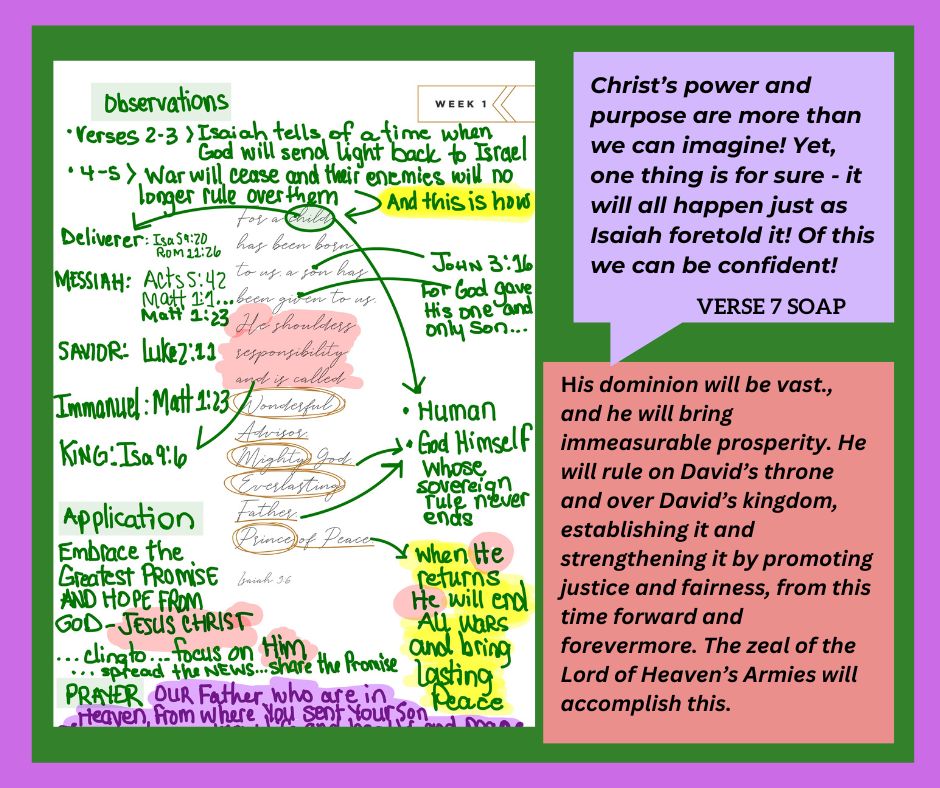
Scripture: Isaiah 9:1-7 / SOAP: Isaiah 9:6-7

For a child has been born to us,
a son has been given to us.
He shoulders responsibility and is called
Wonderful Adviser, Mighty God, Everlasting Father, Prince of Peace.

His dominion will be vast, and he will bring immeasurable prosperity.
He will rule on David’s throne and over David’s kingdom, establishing it and strengthening it by promoting justice and fairness, from this time forward and forevermore. The zeal of the Lord of Heaven’s Armies will accomplish this.

Isaiah 9:6-7

In our larger passage, verses two through five are a message from the prophet Isaiah that tells of a time when God will send light back to Israel. War will cease and Israel’s enemies will no longer rule over them. Verses six and seven tell us how that will happen.

Oh the beauty of a promise kept and of hope given. Through God’s Word we have seen the child, the son that Isaiah spoke of, born to a virgin who called His name Emmanuel. We have seen Him on a cross bearing the weight of sins that belonged to the world. We have watched as God let Him die and listened as He cried in agony, “My God, My God – why have You forsaken Me?” We’ve peered into the tomb with Mary and the others to see the grave clothes but no body and then watched as He later ascended into heaven. Perhaps we’ve even doubted with Thomas but then realized the reality of His presence and cried out as Thomas did, “My Lord, and my God!” By faith we now believe that He sits at the right hand of God’s throne interceding on our behalf. And by faith we believe and wait with great anticipation for His promised return. Yes, oh yes! There is beauty in a promise kept and that beauty comes in the hope, peace, and strength that come from knowing Him .

Feel free to share your thoughts (observations, application …) about today’s passage – in the comment section
Reflections on Today’s Journey
  • Who is Jesus to you?
  • Why is He such an important person?
  • Why do so many people still follow Him?
Going Further
Posted in Bible study, From the Insideout, LGG Study

Waiting for Deliverance

Today’s Reading: Isaiah 2:1-5; SOAP: Isaiah 2:5
Observation: A prophecy about Israel’s future and ours

God gave Isaiah a message about Judah and Jerusalem. Isaiah’s words would have been questionable at best and totally unbelievable at worst in the minds of his listeners – who had been warned of exile and destruction if they did not repent of their idolatrous ways. His words were nonetheless true and coming. Yes, the words were given to a nation about to go into exile because of their idolatrous ways – but Isaiah points them to a better day of hope and restoration.

From the book of Genesis forward throughout the Old Testament there was the promise of one who would crush the head of the serpent, and one who would save His people from their sins. Then there is the passage where Isaiah talks of how God was preparing a way where there seemed to be no way … or consider the words of the Apostle Matthew, when he said:

“Behold, the virgin shall conceive and bear a son, and they shall call his name Immanuel”

Matthew was connecting Jesus [Immanuel, God with us] to the prophecy of Isaiah in Isaiah 7:14, where he said:

Therefore the Lord himself will give you a sign. Behold, the virgin shall conceive and bear a son, and shall call his name Immanuel.

Whether this prophecy of Isaiah is solely referring to the birth of Jesus is debatable among scholars but clearly God’s inspired word through Matthew attributes truth to this understanding.

While we look forward to the second coming of Christ, the people of Judah were given hope and would have been looking forward to the first coming – the first Advent – the coming of the Messiah.

Application: What can we learn from this?

Clearly Isaiah is giving hope but he is also giving them an instruction to not wait to follow the LORD but to live in His ways now. They would enjoy peace “now” if they submitted to Him and faithfully walked in His ways. The same is true for us in this world of chaos and idolatry that seems to hold no hope and demands us to wait – on what at times can appear to be an unbelievable promise – but is nonetheless the hope of our faith.

I love this quote from the LGG devotional and I think it best sums up for us what Isaiah was telling the people then – and can still speak hope to us today:

“That is the character of our God. No matter what we have done or how we (personally and corporately) have turned against Him, He is the God who restores. He sent His Son as the redeemer of our souls. He is the hope we have, the promise of restoration. When we walk in His guiding light, we see the future hope we have in Him.

LGG Devotion, day 1 of 2022 Advent, The God who Restores
Prayer: Response to God’s Word

Father, while this is a message for the tribe of Judah in the days of Isaiah, Your prophet – I thank you for the hope it brings to all nations. For by faith, those who have believed in Your only begotten Son, will be among those who dwell in Your Kingdom. Blessed be Your glorious and gracious name! In the Name of the One in whom I have placed my hope and faith – Amen.

Your Turn: Reflections on the Word Read

Even though God promised to judge His people for their sin, He offered a glimpse into the future glory of Jerusalem.

  • What does this reveal about His character?
  • What does this mean about us, in our season of waiting?

(I invite you to share your thoughts/answers in the comment section …. If you do not know Jesus as your Savior please message me and let me share with you the greatest gift you will ever receive.)

Posted in Bible study, Choosing God Instead of the World, LGG Study

Keeping the Covenant

Week 3, Day 3 of Choosing God Instead of the World, A Love God Greatly Study

Scripture Reading: Genesis 35 and Deuteronomy 30:16-20 (SOAP: Deuteronomy 30:15-16)

15 “Now listen! Today I am giving you a choice between life and death, between prosperity and disaster. 16 For I command you this day to love the Lord your God and to keep his commands, decrees, and regulations by walking in his ways. If you do this, you will live and multiply, and the Lord your God will bless you and the land you are about to enter and occupy. Deuteronomy 30:15-16 NLT
Observation:

In our Deuteronomy passage we hear Moses encouraging the Israelites. Were we to listen to the whole “farewell speech” we would hear him reminding the people of all God had done for them and of what He had promised to do for them. Here in this section – what we hear is the reminder that God has set a choice before them – and what He expects their choice to be. They can choose life and prosperity or death and disaster. This makes me think of Jesus’ words to the Pharisees in John 10:10, when He told them He had come that the sheep, [believers] might have a rich and satisfying life, but the thief [the ruler of this world] comes to steal, and kill, and destroy – that certainly sounds like death and disaster to me. It also reminds me of Paul’s declaration, in Romans 6:23, that the wages of sin is death but the gift of God is eternal life in Christ Jesus our Lord! Seems to me that while Moses was making a specific speech to the Israelites in Deuteronomy, God, through Christ has made the same offer available to the world today. We can choose the wages of our sins – or – His gracious and merciful gift of eternal life. To put it another way – we can choose Him [God] or the world.

Application: How then should we Live?

Life or death? Prosperity or disaster? God instead of the world? The answer to all of these questions seems crystal clear – doesn’t it? Yet so many have chosen option ‘b’ to each of the questions – even as believers who have chosen life over death by placing our faith in Jesus – we still find it difficult at times to choose option ‘a’ as the answer to the second and third questions. We choose ‘life’ through faith in Christ but then choose the world instead of His ways more often than not. In doing so we forego the prosperous and blessed life and relationship with God that Christ came to give, John 10:10. This kind of living comes with a warning from Matthew’s Gospel, where he recorded the Lord saying, “I never knew you”.

21 “Not everyone who says to me, ‘Lord, Lord,’ will enter the kingdom of heaven, but the one who does the will of my Father who is in heaven. 22 On that day many will say to me, ‘Lord, Lord, did we not prophesy in your name, and cast out demons in your name, and do many mighty works in your name?’ 23 And then will I declare to them, ‘I never knew you; depart from me, you workers of lawlessness.’

Matthew 7:21-23

One other note on this application and the “fire-insured Christian”, a believer with one of his/her feet in heaven and the other running after the world. The verses we find just prior to 21-23 seem to provide another good reminder not to treat salvation like an insurance policy. For rest assured, The Lord will be the one to judge whether or not your ‘policy’ is creditable or not.

So, every healthy tree bears good fruit, but the diseased tree bears bad fruit. 18 A healthy tree cannot bear bad fruit, nor can a diseased tree bear good fruit. 19 Every tree that does not bear good fruit is cut down and thrown into the fire. 20 Thus you will recognize them by their fruits.

Matthew 7:17-20 ESV

How then should we live if we want to bear fruit? Since I love a list when it comes to ‘how tos’ and ‘to dos’, let’s make a list so we can see how we are doing …

  • We should love the Lord our God with all of our heart, mind, soul, and strength. (Mark 12:29-31)
  • We should walk in His ways, keep His commandments, statutes, and ordinances If you’re wondering what Moses meant by the words, according to gotquestions.org they are all Hebrew words referring to commands from God to be obeyed by God’s people regardless of the situation you are in.
  • We should be enjoying His blessings of life and provision (property, in the case of the Israelites)
Prayer: My Response to God’s Word

Oh LORD, my God – You are to be loved, imitated and obey. Help me to live this way – so that I might find favor in Your eyes and know Your blessing – In Jesus’ name – Amen and Amen!

Your Turn:
  • What’s your prayer response?
  • How will you choose to follow God today?
  • What temptations are you feeling?
  • What is pulling you away from God and toward the things of the world?
Want More?

Visit LGG for today’s blog

Posted in Bible study, Choosing God Instead of the World, LGG Study

Israel

Week 2, Day 5 of Choosing God Instead of the World, A Love God Greatly Study
“Your name will no longer be Jacob,” the man told him. “From now on you will be called Israel, because you have fought with God and with men and have won.”  Genesis 32:28 NLT
observations:

I had so many things jotted down as I read through this passage but when I went to some commentaries to see if anyone explained the blessing – there was no real explanation to the blessing, only that he received it. What I did find though – I knew I had to share … so, foregoing my normal observations I offer you this wonderful insight to today’s passage. I promise you it is worth the time – and I encourage you to slow down and soak it in and even read it again…I did and it was so much better the second and third time. It has much to offer and it has in itself been a blessing to be – I pray the same for you. –

What is the meaning of Jacob wrestling with God? by Gotquestions.org

“To best answer this question, it helps to know, among other things, that deep-seated family hostilities characterized Jacob’s life. He was a determined man; some would consider him to be ruthless. He was a con artist, a liar, and a manipulator. In fact, the name Jacob not only means “deceiver,” but more literally it means “grabber.”

To know Jacob’s story is to know his life was one of never-ending struggles. Though God promised Jacob that through him would come not only a great nation, but a whole company of nations, he was a man full of fears and anxieties. At a pivotal point in his life, Jacob was about to meet his brother, Esau, who had vowed to kill him. All Jacob’s struggles and fears were about to be realized. Sick of his father-in-law’s treatment, Jacob had fled Laban, only to encounter his embittered brother, Esau. Anxious for his very life, Jacob concocted a bribe and sent a caravan of gifts along with his women and children across the River Jabbok in hopes of pacifying his brother. Now physically exhausted, alone in the desert wilderness, facing sure death, he was divested of all his worldly possessions. In fact, he was powerless to control his fate. He collapsed into a deep sleep on the banks of the Jabbok River. With his father-in-law behind him and Esau before him, he was too spent to struggle any longer.

Fleeing his family history had been bad enough; wrestling with God Himself was a different matter altogether.

But only then did his real struggle begin. Fleeing his family history had been bad enough; wrestling with God Himself was a different matter altogether. That night an angelic stranger visited Jacob. They wrestled throughout the night until daybreak, at which point the stranger crippled Jacob with a blow to his hip that disabled him with a limp for the rest of his life. It was then that Jacob realized what had happened: “I saw God face to face, and yet my life was spared” (Genesis 32:30). In the process, Jacob the deceiver received a new name, Israel, which likely means: “He struggles with God.” However, what is most important occurred at the conclusion of that struggle. We read that God “blessed him there” (Genesis 32:29).

In Western culture and even in our churches, we celebrate wealth, power, strength, confidence, prestige, and victory. We despise and fear weakness, failure, and doubt. Though we know that a measure of vulnerability, fear, discouragement, and depression come with normal lives, we tend to view these as signs of failure or even a lack of faith. However, we also know that in real life, naïve optimism and the glowing accolades of glamour and success are a recipe for discontent and despair. Sooner or later, the cold, hard realism of life catches up with most of us. The story of Jacob pulls us back to reality.

Frederick Buechner, one the most read authors by Christian audiences, characterizes Jacob’s divine encounter at the Jabbok River as the “magnificent defeat of the human soul at the hands of God.” It’s in Jacob’s story we can easily recognize our own elements of struggle: fears, darkness, loneliness, vulnerabilities, empty feelings of powerlessness, exhaustion, and relentless pain.

Even the apostle Paul experienced similar discouragements and fears: “We were harassed at every turn—conflicts on the outside, fears within” (2 Corinthians 7:5). But, in truth, God does not want to leave us with our trials, our fears, our battles in life. What we come to learn in our conflicts of life is that God proffers us a corresponding divine gift. It is through Him that we can receive the power of conversion and transformation, the gift of not only surrender, but freedom, and the gifts of endurance, faith, and courage.”

Application: How Then Should I Live?

We must stay in the battle. No matter how hard or how long it takes, we must not give up until we have received God’s blessing.

Me – from the inside-out

The writers from gotquestions.org go on to share the perfect answer to our question of how we should live in light of the message – “In the end, Jacob does what we all must do. He confronts his failures, his weaknesses, his sins, all the things that are hurting him . . . and faces God. Jacob wrestled with God all night. It was an exhausting struggle that left him crippled. It was only after he came to grips with God and ceased his struggling, realizing that he could not go on without Him, that he received God’s blessing (Genesis 32:28-29).

What we learn from this remarkable incident in the life of Jacob is that our lives are never meant to be easy. This is especially true when we take it upon ourselves to wrestle with God and His will for our lives. We also learn that as Christians, despite our trials and tribulations, our strivings in this life are never devoid of God’s presence, and His blessing inevitably follows the struggle, which can sometimes be messy and chaotic. Real growth experiences always involve struggle and pain.

Jacob’s wrestling with God at the Jabbok that dark night reminds us of this truth: though we may fight God and His will for us, in truth, God is so very good. As believers in Christ, we may well struggle with Him through the loneliness of night, but by daybreak His blessing will come.

Prayer: Response to God’s WoRD

Father, thank You for the reminder that we are New Creations with new characters- We are changed from the Inside-out! Thank You for giving me Your name and for helping and teaching me to prevail.

One last interesting nugget of truth… In reference to our focus verse (28)

Jacob’s new name was “Israel”, which means “God Fights”. “The new name is meant, at least in part, to describe Jacob’s new character, – based on the fact that God fights for him and, more importantly, for the nation that will one day come from him.”

Bibleref.com Genesis 32:28
Your Turn:

In what ways has God transformed your identity?

In what ways have you seen God strip you of self-reliance?

Posted in Bible study, Choosing God Instead of the World, LGG Study

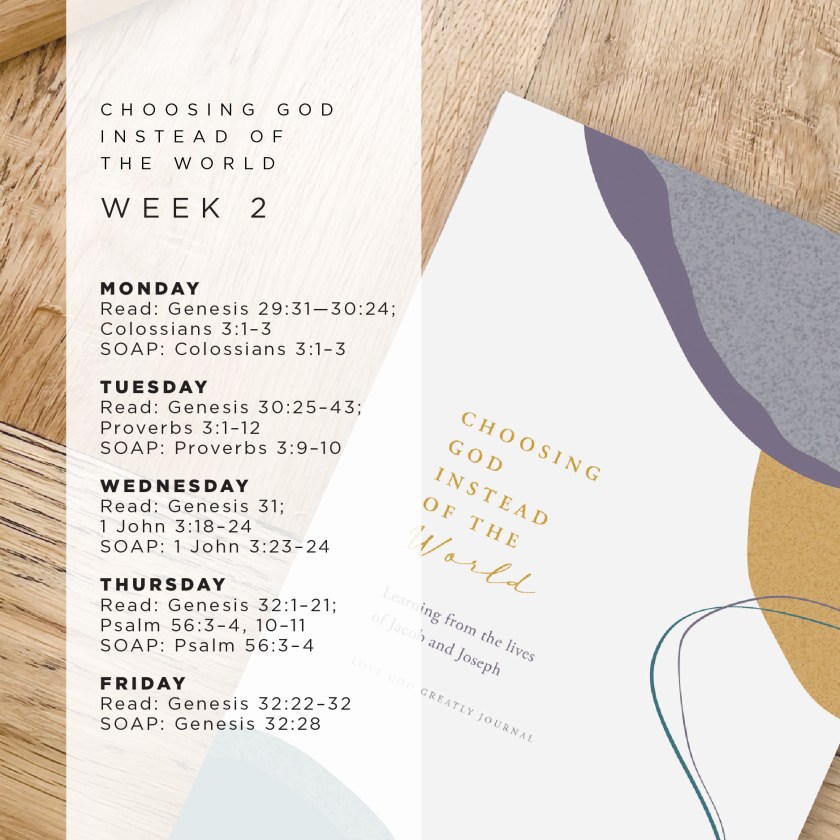
Choosing God Instead of the World: Looking Ahead to Week 2

A Love God Greatly Bible Study about the lives of Jacob and Joseph

In the second week of our study, we will watch as Jacob contends not only with his “sister-wives” but their servants given to him as early prototypes of ‘surrogate mothers’. If it sounds like a lot of drama – it is, with all of the jealousy, guilt, manipulation, and discontent you might imagine. We will also watch as Jacob becomes the father of 11 sons and at least one daughter, he seeks Laban’s permission to leave for his homeland, and prepares to reconnect with Esau. In the midst of the unfolding story we will continue to learn why and how to choose God instead of the world.

We will continue to work on our memory verse from John 14:15

But this week’s focus verse(s) will come from day one’s reading of Colossians 3:1-3. A passage that we will see the need for in Jacob’s life story as well as our own.

Therefore, if you have been raised with Christ, keep seeking the things above, where Christ is, seated at the right hand of God. Keep thinking about things above, not things on the earth, for you have died and your life is hidden with Christ in God.

Colossians 3:1-3

This Week’s Challenge from the team at Love God Greatly:

This week, record the major events of Jacob’s life. Do these things occur because of Jacob’s plans or God’s deliverance? How does Jacob’s manipulations or impatience affect each outcome? Take time to reflect on the ways you attempt to “help” God accomplish His purposes.