Posted in Bible study, From the Insideout, LGG Study

Enough that we Might Know

Today’s Reading: John chapter 21

This is the disciple who testifies about these things and has written these things, and we know that his testimony is true. 25 There are many other things that Jesus did. If every one of them were written down, I suppose the whole world would not have room for the books that would be written.

John 21:24-25 NET
The Things We Could Talk About

Sometime after Jesus revealed Himself to Thomas He appeared to them again and we could focus on the events that took place – like the miraculous catch of fish, or Jesus’ conversation with Peter about feeding His sheep, or the type of death Peter would face. Instead we will conclude our study with John’s conclusion of the Gospel and why it’s important to the quest of being secure in our eternity.

Through Their Testimony

As we have learned from this book, the words of Scripture are meant to lead us to know/believe in Jesus Christ and in the One who sent Him. This being true we naturally want to know that the sources of the word are trustworthy, how they are related to the Christ they profess. What we find here is that John wrote or dictated as one who was an eyewitness to the stories shared. He was loved and trusted by Jesus, which is perhaps most evident when, from the cross, Jesus placed His mother under John’s care, John 19:26–27. The point however, isn’t how much Jesus loved John or why but that John is a reliable source. Which, if we are staking our eternal security on words that were written centuries ago by those we do not know we want to know they are reliable. After all, Jesus Himself prayed in John 17:20, “I am not praying only on their behalf, but also on behalf of those who believe in me through their testimony …” Don’t misunderstand me, I do not mean to take God out of the picture nor am I inferring we must trust the reliability of man over trusting that the Bible is God-breathed, 2 Timothy 3:16, However, He chose to use humans, just like us, to write the words and so having knowledge of these people and why God might have used them or what role they played surely enhances the way we listen to or read their presentations. Perhaps John understood this and thus addresses it here to close his book.

“When Jesus saw his mother there, and the disciple whom he loved standing nearby, he said to her, ‘Woman, here is your son,’ and to the disciple, ‘Here is your mother.’ From that time on, this disciple took her into his home.” 

John 19:26-27
He Knew THe Importance of Jesus

I love that John wanted to testify about these things so that others would know the man and the friend that Jesus was. However, I also appreciate that he couldn’t help but point out that the things he had shared were no where near all that could be shared about His friend, His teacher, The Christ. John was, as we should be, impressed with Jesus. He knew Jesus’ importance and the value of what He had to offer and believed in the dire need to proclaim it so that, as Jesus prayed, “the world will know that you sent me, and You have loved them just as You have loved me.” (John 17:23)


Read Today’s LGG Blog

Posted in Bible study, From the Insideout, LGG Study

That You May Believe

Today’s Reading: John 20:19-31

31 But these are recorded so that you may believe that Jesus is the Christ, the Son of God, and that by believing you may have life in his name.

John 20:31 NET

From the second chapter of John the Scriptures make it clear that all of the miraculous ‘signs and wonders’ and all of the “I Am” statements were meant to help others believe that Jesus was the Christ, the Son of God, and have life in His name.

Jesus did this as the first of his miraculous signs, in Cana of Galilee. In this way he revealed his glory, and his disciples believed in him.

John 2:11 NET

As we near the end of John’s Gospel he makes it clear that not only were the miraculous signs done so that others could believe but they were recorded for the same reason.

The B.I.B.L.E. Yes that’s the book for me

Some would argue that the Bible is antiquated, others will say it’s awful that people have allowed the new systems of technology to replace the “Good Book”. However, the things written about Christ and what He did during His ministry are important and are to be valued in any means available. As Paul said in Romans 1:16, they have the power to save. So, having believed these Words and having received the gift of salvation we must now share them so others may also believe and be saved. Regardless of how we share them – whether from the pages of a well-worn Bible or from the latest ipad or phone – they must be shared. Consider this, while the new technology may be a distraction to some it enables people with poor eyesight, like me, who can’t see the words on the page of a Bible in a dimly lit room to see the words crystal clear on a screen.

Prayer

Father, thank You for these WORDS, all the words of Your book, but especially these that are written about Jesus. Thank You for Your Son and His signs and wonders done so that we might believe that He is the Christ, Your SON. Thank You that by believing we can have life in His name. Help me/us be faithful to share these WORDS – the Gospel of Jesus – so that others may believe and be saved. For this end Christ came to earth and lived and died and rose victorious.

Posted in Bible study, From the Insideout, LGG Study

Now This Is Eternal Life

Today’s reading: John 17

 Now this is eternal life: that they know you, the only true God, and Jesus Christ, whom you have sent. 

John 17:3
Eternal Life

When we talk about glorifying something or someone we typically are referring to making them known – drawing attention to them or to what they’ve done – and giving them the place of honor. In this first section of John 17, Jesus lifts up His request to the Father to make Him known – not that He may boast but that He may glorify the Father. However, there is a second reason that I see and that is found in our focus verse today (3). God’s purpose in sending Jesus was so whoever believed in Him would have Eternal Life. Jesus has been making Himself and the Father known during His time on earth both to the disciples and all who would listen to the message or saw the miracles. Having come to the end of His time on earth He points out to the Father, that He has been successful in what He was sent to do. His reasoning for deeming it successful was that the disciples had accepted the message God had sent Him to give and they knew with certainty that He came from God. And this, by Jesus’ definition, is eternal lifethat they know both the Father and the Son whom He sent.

For I gave them the words you gave me and they accepted them. They knew with certainty that I came from you, and they believed that you sent me.

John 17: 8
Our Mission

Our mission as believers is to keep the message going. It’s a mission made possible, according to Jesus, by the spoken testimony of the believers that God sent Jesus to save. The mission is accomplished with more than words though, it is to be the action of loving others as Christ has loved them, (John 13:34-35; 15:8, and 17:20). We accomplish the mission by living in a way that the world will know Him through us – just as He lived in a way that the world would know God through Him. Don’t miss the passion Christ had for the mission to save the world and to make the Father known. We’ve seen it throughout the book of John and we see it here as He prays and emphasizes His hope that the world will believe that God has sent Him. I believe it is clear from His words in this prayer that Jesus’ hope was that we would share in His passion.

my Prayer

Father I don’t have to feel like you are using me. I don’t have to know anyone is listening – I only have to live and love like Jesus, who kept the message going so the world would know You – the only true God and Him, who You sent to save us.

The Emotions of Jesus

One final thing I can’t help but point out – and that is how Jesus prayed and longed for those who had believed in Him. We can feel His excitement in verse 7 over them truly understanding His relationship with the Father and the Father’s real and present role in all that had been happening. I could also feel His true longing for those who belong to Him to be with Him. This is how He longs for all of us who are His. May we equally long for Him and for the Father; and may we pray for the lost to believe.

Don’t miss today’s LGG Blog

Posted in Bible study, From the Insideout, LGG Study

My Father, the Gardener

Today’s Reading: John 15:1-16:33

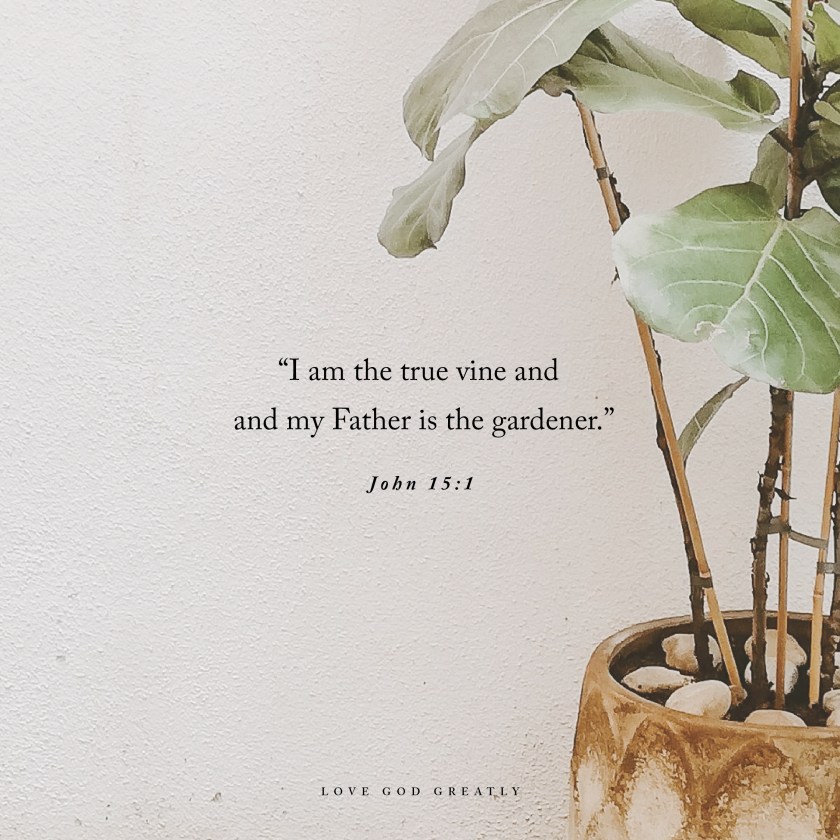
“I am the true vine and my Father is the gardener.

John 15:1
God’s Role

This is the last of the “I AM” statements in the book of John, and a bit unique to the rest of the statements. Jesus not only identifies Himself in the statement but He also identifies the Father, saying “I am the true vine and my Father is the gardener”. While Jesus has mentioned the Father in some of his other “I AM” statements or their explanations He was mentioned in connection to Jesus and who He was. However, by introducing the Father as the gardener who prunes the branches – we now see not only what role He plays in the life and ministry of Christ – but also in the life and ministry of His followers.

 He cuts off every branch in me that bears no fruit, while every branch that does bear fruit he prunes so that it will be even more fruitful. 

John 15:2

Needless to say, God plays many roles in the lives of His people but oh the beauty of the gardener. Tending to our tender roots, watching over us and eager for us to grow healthy and strong. He prunes us so we will grow more fruit and He protects us from those branches that are bearing no fruit by taking them away. Because of the “Gardener”, I am able to stay attached to The True Vine, who keeps me from dying. I cannot survive apart from Him. He says when I remain in Him – a word He used often in this teaching – and He remains in me then I will bear much fruit. The fruit is dependent on a living thriving relationship where both parties are involved. He goes on to say that the Father or the gardener, as He is pictured here, is honored when we bear much fruit and show that we are His disciples.

As I read through this passage I’ve been reminded of my love of ferns and it hit me – I am their gardener. Not only are they a beautiful display of my favorite color but they are a soft and inviting foliage for any setting. I put ferns out from early spring to late fall every year. On the back porch they fill a variety of containers and can be seen from inside the home, enjoyed on the porch, or by the pool. On the front porch they hang from hooks, grace tables, line the steps and add beauty to old crocks. As their gardener they depend on me to water them, feed them, and on the front porch they especially need me to keep the birds from nesting in them, the beetles from eating them, and the sun from scorching them. Throughout the season I may have to cut away the occasional fronds that have turned brown or played host to a rogue beetle or two. It hurts me just a bit to do this but I know they will be better because of it. I love watching them grow and I delight in their personalities greatly affected by the amount of light and temperatures. I rotate them often giving them equal time to share in the sun and shade. I realize, as I type this, that they sound like a lot of care or work but they bring me joy and add beauty to our home. To borrow a line from Jesus about the Father, I am honored when they bear more and more beauty reflecting the love and care they have been given.

Symbolism and Application

The symbolism for me is this – Just like my ferns are a beautiful display of my favorite color, we are to be a beautiful display of Jesus, God’s only begotten Son. We are to be an attractive reminder of Him- the One of whom God said, “I am well pleased”. We are to surrender to the “gardener’s” pruning and remain in the vine, so that we can bear much fruit and show that we are His. In this way we honor the Father. Much like a home adorned with beautiful ferns, our lips should flow with the message of Christ and our lives are to be adorned with the fruit of His Spirit. Love, joy, peace, patience, kindness, goodness, faithfulness, gentleness, and self-control should define the landscape of our lives – the chief of which is LOVE. For “they will know we are Christians by our love”.

And they’ll know we are Christians by our love, by our love,
yes, they’ll know we are Christians by our love.

I do not own the rights to this chorus but borrowed it from https://wordtoworship.com/song/14526

Don’t miss today’s LGG Blog

Posted in Bible study, From the Insideout, LGG Study

Lazarus Come Out

Today’s Reading: John 11:1-44

25 Jesus told her, “I am the resurrection and the life. Anyone who believes in me will live, even after dying. 26 Everyone who lives in me and believes in me will never ever die. Do you believe this, Martha?” 27 “Yes, Lord,” she told him. “I have always believed you are the Messiah, the Son of God, the one who has come into the world from God.” 

John 11:25-27
I AM

Our passage today introduces the fifth of Jesus’ “I Am” Statements when He tells Martha: I Am the resurrection and the life. He went on to explain that “The one who believes in Me will live even if he dies, and the one who lives and believes in Me will never die.” I love that when asked, Martha affirms her belief by addressing Jesus as “Lord” and making a clear statement of exactly who Jesus is and where He has come from.

Jesus Wept

They were having this conversation because Martha’s brother, Lazarus, had been sick and died. Lazarus was Jesus’ friend and it is clear as the story unfolds just how special Lazarus and his sisters, Mary and Martha, were to Jesus. Not only do we read how He was greatly distressed at their grief and even wept. Yet, even in His weeping there was division, for while some saw it as a testimony of His deep love for Lazarus others viewed it as a lack of action on Jesus’ part and once again His power and character were brought into question. When He heard them raise the question, “Couldn’t He have done something to keep Lazarus from dying?” the Scripture says He was intensely moved again.

At the Tomb

Being intensely moved – Jesus went to the tomb and said, “Take away the stone.” – Then looking upward, He thanked the Father for listening to Him and expressed His desire for the people that were watching to believe that God had sent Him – and then – “Jesus shouted in a loud voice, “Lazarus, come out!” – and Lazarus came out and at Jesus’ command he was unwrapped from the burial clothes and let go. Ah, the power of our God and of our Savior.

God’s Glory

Just as Jesus had said, in the beginning of this story (John 11: 1-15), Lazarus’ sickness led not to His death but to God’s glory. Surely the Son of God was glorified through it as the people watched in wonder, not only the incredible evidence of Mary and Martha’s real and present pain in their loss but also the faith that they exhibited, and of course the resurrection and the life of Lazarus by the One who had declared Himself to be – “The Resurrection and the Life.”

So the sisters sent a message to Jesus, “Lord, look, the one you love is sick.” When Jesus heard this, He said, “This sickness will not lead to death but to God’s glory, so that the Son of God may be glorified through it.”

John 11:3-4
Some Helpful Behind the Scene Commentary
Chapter Summary
Jesus has left the vicinity of Jerusalem to avoid hostile religious leaders. While gone, He receives word that a good friend, Lazarus, is sick. In fact, Lazarus has died by the time this message reaches Jesus. He purposefully waits a few days before returning to Bethany, arriving four days after Lazarus' burial. In front of Lazarus' mourning sisters—who Jesus weeps with—and an assembled crowd, Jesus raises Lazarus from the dead in a stirring and spectacular miracle. This is the seventh of John's seven ''signs'' of Jesus' divine power. In response, religious leaders coordinate in their effort to have Jesus murdered.   BibleRef.com @ John chapter 11

Posted in Bible study, From the Insideout, LGG Study

I Was Blind But Now I See

Recommended Reading: John chapter 9 and SOAP 9:39

 Then Jesus told him, “I entered this world to render judgment—to give sight to the blind and to show those who think they see that they are blind.”

John 9:39 NLT
It wasn’t Sin

Sometime after Jesus had escaped the murderous plot of those who were hostile to Him in John chapter eight, “He saw a man who was blind from birth”. His disciples were curious and asked who was to blame for the man’s blindness – him or his parents. Jesus’ answer may surprise you. He said, “It wasn’t sin that caused the man’s blindness.” Jesus laid the answer at God’s feet when He replied that it happened – “so that the acts of God would be seen through him”. Even if you’re familiar with the story, I believe most would admit that the answer Jesus gave was not what anyone expected. It’s important to note this part of the chapter and all that happens after it to truly understand what Jesus meant both throughout the chapter and in today’s focus verse.

The rest of the passage tells what happens to the man, so read and watch for the “acts of God” all the way to the last verse. You will watch Jesus give the man a mud bath on his eyes and send him to wash off in the pool. You will stand in awe as he returns no longer blind! You will hear as the man testifies several times about what Jesus did. He will be doubted and questioned, his parents will be questioned, and yet there will still be disbelief – but the man does not waver in his testimony. In fact he becomes more adamant that the man who healed him was surely from God! Finally you will see the man profess his faith in the Lord Jesus Christ – which I think you would agree is a pretty good result of ‘the acts of God’.

What Jesus Came To Do

According to our focus verse today, John 9:39, Jesus came to the world “to render judgment”. What? Doesn’t the Scripture say that He didn’t come to judge or condemn as some translations say it? We just read in John 3:16 and 17 that He was sent to save the world not condemn (or judge) it. Paul’s letter to the Romans says that “there is therefore now no condemnation for those who are in Christ Jesus”. So why does Jesus say what seems to contradict the words of John and Paul? Because, in order to bring salvation “sin” has to be judged – He did not come to condemn us – but the sin that had entangled us – in order that we might be saved. To be sure – there will be those who, having heard and seen the truth, will still reject God – but didn’t we just read in John 3:36, “Whoever believes in the Son has eternal life, but whoever rejects the Son will not see life, for God’s wrath remains on them. Because of their rejection they will be forever separated from God.

I couldn’t read this chapter without having to search for answers to several of the verses along the way, specifically our focus verse, and the ones that followed. They proved to be a bit confusing, especially because we know from other passages, that God did not send His son to ‘judge’ the world but to save it – the fine line is this … Jesus came to bring salvation and for that to happen “judgment had to be made on and against sin”, as one commentary says. To better understand this, as well as the full chapter, visit the link below and simply click on the verse or verses that may have you wanting more clarity.

https://www.bibleref.com/John/9/John-chapter-9.html

Choose This Day Whom You Will Serve

Despite the confusion that can arise with some passages in the God’s Word, we must not allow the questions that arise cloud the TRUTH. Rest assured, those who TRUST in God will be given sight and understanding (6-7 and 35-37). It is equally certain that those who reject the TRUTH of God that they have both heard and seen will be ‘made blind’ by their ‘own decision’ to reject God and live in disbelief. In the Old Testament Joshua told the people to choose whom they would serve, the LORD or the god of the Amorites and in the New Testament we are given much the same choice – the way of the world, which leads to sin and death or salvation through Jesus Christ – who sets us free from from the law of sin and death, (Romans 6:1-2, 14-15). Jesus was referring to money (material wealth) when He taught His disciples that they couldn’t serve two masters, because they would either love the one or hate the other – but we can certainly equate the teaching with any thing that has a hold on us and draws us away from God. So, like Joshua and his people, we must choose – The way of Christ which leads to God and eternal life – or the way of the world ruled by the dark forces and leading to impending judgment and eternal death. – As for me, I choose the way of Christ.

Posted in Bible study, From the Insideout, LGG Study

The Light of the World

Suggested Reading – John 7:53-8:59 and SOAP: John 8:12

Jesus spoke to the people once more and said, “I am the light of the world. If you follow me, you won’t have to walk in darkness, because you will have the light that leads to life.”

John 8:12 NLT
From the “Bread of Life” to “The Light of the World”

Jesus continues to introduce Himself to the people, hoping to help them see and know who He is and what He was sent to do. He continues to draw attention to the Father, “who sent” Him, making sure they know that He is not their of His own “initiative”. In this rather lengthy but powerful conversation between Jesus and both the crowd of people following Him plus some of the religious leaders – Jesus dives headlong into more controversial territory with another “I Am” statement, equating Himself not only with God but basically as God.

Following His conversation with the adulterous woman ( 8:3-11), Jesus immediately makes His second “I Am” statement, this time not as the “Bread of Life” but as “The Light of the world”. Proceeding with an explanation, He teaches that those who follow Him will no longer have to walk in the “darkness of the world”, but in the “Light” of His Presence. The teaching is best explained by this commentary from BibleRef.com at John 8:12

This incident occurs during the Feast of Booths in Jerusalem. Jesus has already used festival rituals as analogies for His role as Messiah (John 7:37–38). As part of this major festival, lamps would be lit using wicks made from priestly garments. In addition, light was a powerful metaphor in Hebrew thinking (Psalm 84:11; Malachi 4:2). "Light," for the Jewish person, was the ultimate ideal, a representation of salvation, knowledge, and goodness. For Jesus to claim to be the "light of the world" was no small thing. In fact, it is a claim to equality with God. Even further, the Greek of this passage indicates Jesus' claim to be "the" light, not merely "a" light. In the text's original Greek, Christ says "Egō eimi to phos tou kosmou," which explicitly claims He is the single, solitary source of "light."

Those who follow Christ, in truth, may stumble into darkness, but they will never perpetually "walk" in it (John 12:46; Psalm 36:9).     

https://www.bibleref.com/John/8/John-8-12.html
For Us

For those of us who are believers and followers of Jesus the application is simple and sweet – We have been set free from the power and death that the darkness bring and in its place we have been given the ‘Light of Life’. As sweet and simple as the application is – there is an equally profound lesson to be noticed and applied – and that is the message that Jesus gave to those who had believed – which was basically not just to say they believed but to faithfully live out what He was teaching.

“You are truly my disciples if you remain faithful to my teachings. (31)

Unsatisfied words lead to violence – Yet many believe

Despite the fact that He was questioned, responded to indignantly, repeatedly doubted, and ultimately assaulted – “many of the people believed“. (30) I hope you will read the dialogue to see how gracious yet bold Jesus was with His answers and pointed statements of truth. There was one basic question the crowd and leaders asked that all of the other questions seemed to boil down to and that being, “Who do you claim to be?” To which He answered, “If I glorify myself, my glory means nothing. My Father, whom you claim as your God, is the one who glorifies me.” (54)

Prayer

Father, yet another beautiful Scripture filled with and portraying Your love, and the depth of it through Jesus Christ. The Light of the World! Light that brings HOPE to all who believe – all those who follow Him will be set FREE from the darkness! A darkness that leads to death BUT is not greater than the LIGHT of LIFE!

Posted in Bible study, From the Insideout, LGG Study

A Packaged Deal

Suggested Reading – John Chapter 7

While Jesus was teaching in the Temple, he called out, “Yes, you know me, and you know where I come from. But I’m not here on my own. The one who sent me is true, and you don’t know him. But I know him because I come from him, and he sent me to you.”

John 7:28-29
History, Rituals, and Irony

Jesus challenges the Jewish people with this statement from verses 28-29, a statement that brings into question who they are – basically a rerun of the conversation He had with the Jews He addressed in Jerusalem, noted in chapter 5. Both conversations took place during the 7-day “Feast of Booths”, also known as the “Festival of Tabernacles”. The Festival was a celebration commemorating Israel’s journey through the wilderness. Because it was rich with history and rituals the crowd would have been large and the city crowded which means this conflict would have been all the more intense and public. Don’t miss the irony, a festival where God’s people are celebrating their ancestor’s journey through the wilderness and they’ve just been told by Jesus, the Son of God, that they don’t even know God.

The rituals of this festival reminded the people of how God had provided for Israel during their journey out of Egypt. 

Bibleref.com @ John7:2
Where in the world

The people contended that they knew where Jesus was from and that this meant He couldn’t be the Christ because no one would know where the Messiah was from, vs 27. So, He shouts out, acknowledging they knew where He was from – well, at least they knew where in this world He was from – but what they didn’t know, or who they didn’t know – was God, the One who sent Him. Basically He repeats the message He delivered to the Jews in Jerusalem just days earlier. Jesus wants them to understand that it’s the One who sent Him that they do not know.

This is a direct criticism of Israel's spiritual state, and an extremely personal reproach. Israel's ultimate point of pride was its identity as God's chosen people. No other nation could make that claim—and here, Jesus tells God's chosen people that they do not know God! Their rejection of God (John 5:39–40) has resulted in a rejection of the One sent by God (John 6:29). Stubbornness and pride have made them resistant to the truth (John 7:17).     Bibleref.com @ John 7:28
You Can’t Have One Without the Other

I noticed three specific things in these two verses:

  1. God sent Jesus to the people
  2. Jesus always points to the Father for those who come to Him must believe in the One who sent Him, (John 5:24).
  3. Jesus speaks with humble but certain authority.
My Response
  • To live like Jesus means I cannot shrink back when others challenge or threaten what I know is truth from God
  • I should speak with humble authority-
  • I should always promote God and Christ above myself and all others
My Prayer

Father, You are the One who sent Jesus, the One who comes in Your Name and authority to save those who believe in Him and in You who sent Him! Father, I have believed – Help me and use me to share the message of the Gospel which is Your power to save. In Jesus’ Name – Amen and Amen!

Be sure and check out today’s LGG Blog Post

Love God Greatly Blog

Posted in Bible study, From the Insideout, LGG Study

This is a Difficult Saying

Simon Peter replied, “Lord, to whom would we go? You have the words that give eternal life. We believe, and we know you are the Holy One of God.

John 6:68-69 NLT

Suggested Reading: John 6:59-71

Some Context

Jesus had been teaching and talking with some Jews in the synagogue who didn’t understand His teaching that He was the “bread of life”, specifically the teaching that He was the “bread that came down from heaven.” Bread, that would allow those who ate from it to live forever (6:52-58) It turns out that the comment they make here in verse 60, about it being a difficult statement and “who can understand it”, was more than simply a ‘we don’t understand what you mean’ response. The phrase is perhaps better translated – “This is a hard teaching. Who can accept it?” or “This is a hard saying; who can listen to it?” The statement indicated, according to one commentary1, that they were offended by or couldn’t tolerate the statement. It seems most of His disciples or followers were deeply offended by the teaching because they were looking for a conquering hero, not one who sacrifices His life but of great and visible victory.

The phrase "hard saying" here comes across in English with much less force than it does in Greek. The teachings of Jesus are being described here as sklēros, which means "offensive or intolerable." To these people, Jesus' words are not merely "difficult," they are "unacceptable."  BibleRef.com on John 6:60
Are You In or out?

The passage says because of the offense “many of His ‘disciples’ quit following Him.” (Please note, in this situation the word “disciples” isn’t referring to His inner circle of 12 but rather to the large crowd of followers.) This is when Jesus holds the 12 accountable – questioning them as to their intentions – and receiving a staunch declaration of allegiance from Peter on behalf of them all it would seem. “Simon Peter answered Him, “Lord, to whom would we go? You have the words of eternal life. We have come to believe and to know that you are the Holy One of God!” What I love most about this statement is that Peter’s determining factor was the truth of who they believed Jesus to be.

So, Who Do You Say He Is and Why?

The only good and right application here, it seems to me, is to echo Peter’s words and allegiance to Christ – “The Holy One of God”. We mustn’t be naive though – this is no easy allegiance – but it is the best and right one! There is no one like Jesus, no one who can offer eternal life, and no other Son of God!

Prayer

Father, thank you for leading me to “Team Jesus.” Thank you for calling me and saving me from my self and the ways of the world! Thank you for Peter’s reminder that there in NO BETTER WAY, and thank you for all the ways You have shown me the TRUTH of who JESUS IS

Don’t forget to visit the LGG page for today’s blog post

1Biblereference.com @ John 6:60

Posted in Bible study, From the Insideout, LGG Study

When it Becomes Personal

Suggested Reading: John 4:43-54 and SOAP: John 4:53-54

 Then the father realized that that was the very time Jesus had told him, “Your son will live.” And he and his entire household believed in Jesus. 54 This was the second miraculous sign Jesus did in Galilee after coming from Judea.

John 4:53-54 NLT
Miracle Worker or Jesus?

What drew you to Jesus? The official in our story today had heard about Jesus, the miracle worker. So, naturally, when he heard Jesus was back in town he went looking for him – not just to gawk at the “miracle worker” but to ask him to help his sick son. The official pleaded with Jesus to “come down and heal the boy but instead, Jesus simply told the father that the boy would live and sent him home. The father did not continue to beg and plead but chose to believe what Jesus had said and headed toward home – no doubt to see the boy for himself and confirm the miracle – which is exactly what happened. Actually, before he even saw the boy he was greeted with the news that his son was going to live and that the improvement had happened at the time Jesus had told him, “your son will live.” Because of the miracle, not only did the boy’s father believe but his servants believed. The official had heard about a miracle worker and sought him out to heal his son – but he found so much more – for he found Jesus, the Son of God.

Life-Changing

It is a life-changing moment when we see Jesus not just as a miracle worker but as the life-giving Lamb of God who takes away the sins of the world. He is the real and present, intimately involved with His people, Son of God. The One who sees us and hears us and the One who gives and restores life. We must come to Him believing, but like the official in today’s account of the second miracle, we must often move forward believing without seeing … believing expecting Him to do great and wonderous things … believing and knowing He will do what is good and right and perfect according to His plan … believing and trusting and rejoicing that what is done will be for our good and His glory … believing and sharing our hope all along the way.

Prayer

Father, surely we are attracted by the wonder of who You are and what You can do- but there is nothing so special as when we know You to be a personal God full of grace and mercy, and power and love. May we not hide but share Your miraculous works