Originally posted by ourdailyverse.com / Feb 11, 2025
What a beautiful truth to know that we can rely on the love God has for us. It is a gift to know that the God who created us and adopted us as His own – is Himself – LOVE and has invited us to abide in Him … click the devotional button for encouragement and inspiration about the life-changing power of God’s love.
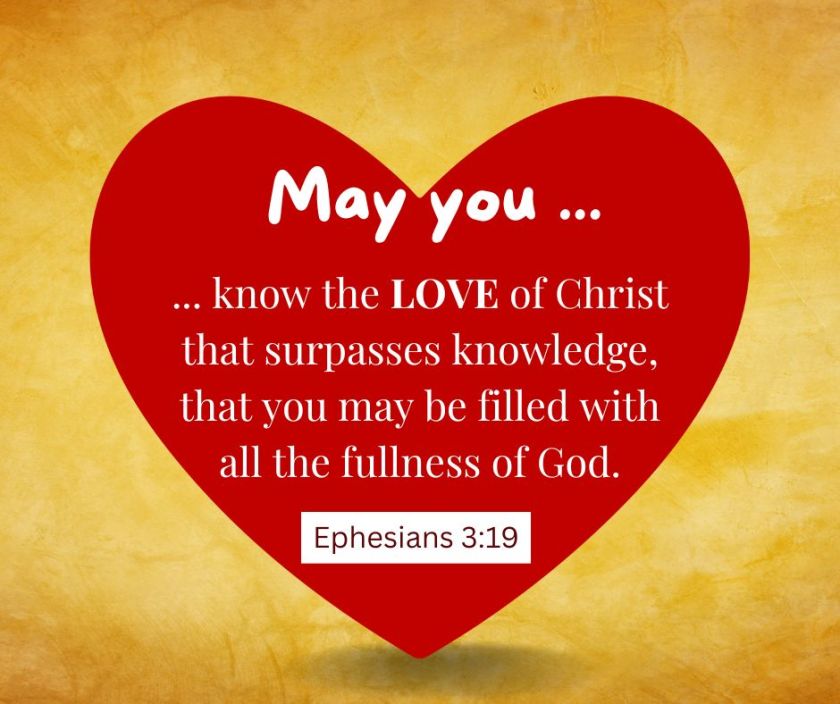
God’s love for us passes knowledge; it is vast and complete, and yet He urges us to lean into its impossible dimensions and to rest there.
Michele Morin / Living Our Days / August 9, 2018
One of the prayers I learned to pray for women in my life years ago, specifically those who have been/are in my life-groups, is found at the center of this nugget of gold I’m sharing today, borrowed from the archive of Living Our Days. The prayer comes from the pen of the Apostle Paul and is found in chapter three of Ephesians. – I pray it for all who come upon this post and read the words within – that you may understand that God’s love for us not only passes knowledge; but that it is vast and complete. May you learn to lean into its impossible dimensions and find rest there.
My Prayer for You For this reason I bow my knees before the Father, 15 from whom every family in heaven and on earth is named, 16 that according to the riches of his glory he may grant you to be strengthened with power through his Spirit in your inner being, 17 so that Christ may dwell in your hearts through faith—that you, being rooted and grounded in love, 18 may have strength to comprehend with all the saints what is the breadth and length and height and depth, 19 and to know the love of Christ that surpasses knowledge, that you may be filled with all the fullness of God.
Ephesians 3:14-19
The following blog was originally posted on August 9, 2018
May I experience your loyal love, O Lord, and your deliverance, as you promised. 42 Then I will have a reply for the one who insults me, for I trust in your word. 43 Do not completely deprive me of a truthful testimony, for I await your justice. 44 Then I will keep your law continually now and for all time. 45 I will be secure, for I seek your precepts. 46 I will speak about your regulations before kings and not be ashamed. 47 I will find delight in your commands, which I love. 48 I will lift my hands to your commands, which I love, and I will meditate on your statutes.
Psalm 119:41-48 NET
The psalmist longed for expressions of God’s chesed (Hebrew for “covenant loyalty, faithful love”) in light of the persecution and hostility against him. He sought God’s salvation from oppression. The freedom offered to the person who walks according to God’s word enables him to remain strong through adversity and to maintain his focus on God’s decrees. The righteous person is courageous enough to speak of the Lord, and he will not be ashamed.
HCSB Commentary on Psalm 119:41-48
Have you ever experienced a time or even a season when it felt like God was absent? In your struggles, you search for signs of Him, a fingerprint or a whisper, something that lets you know He is near and hasn’t forgotten you. You know that God loves you and has promised deliverance. Like the psalmist, you long to feel that He is near – you want to experience His promise of deliverance; you want to feel His love and know He hasn’t forgotten you. While we don’t know for sure who wrote this Psalm and find few commentaries on the ‘story behind the scenes’, it seems to me the psalmist was dealing with these emotions. Yet, in the absence of experiencing or feeling God’s presence near, he proclaims his trust in God’s Word and announces he will find security by seeking God’s Word, or as the Holman Christian Standard Bible translates it – “focusing on God’s decrees.”
As I read through this passage and began making my observations, an old hymn flooded my mind and seemed to sum it up nicely for me. You may remember the hymn, “Trust and Obey.”Like our passage today, the song is a reminder that while troubles will come and doubts and fears will arise, and while we will undoubtedly experience sorrows and burdens from grief and loss – when we faithfully “do His good will, He abides with us still, and with all who will trust and obey.” Friends, you may not be experiencing God’s love right now, you may not be seeing His fingerprints or hearing even a whisper from Him – but to borrow from a quote I once read and from teachings throughout the Scriptures- “when you can’t see God’s hand, trust His heart.”
Not a doubt or a fear, not a sigh or a tear, Can abide while we trust and obey. Trust and obey, for there’s no other way To be happy in Jesus, but to trust and obey. will trust and obey.
Living Out the Journey (Application)
When we TRUST in the LORD – when we know His love and salvation – we will be able to answer those who taunt or insult us … we will walk in freedom when we are devoted to His commandments because we will not be weighed down with the sway and guilt of sin… In other words, we will be controlled by His Spirit in word and deed from the inside out, and we will know life and peace rather than a life that leads to death (Romans 8:6).
So, letting your sinful nature control your mind leads to death. But letting the Spirit control your mind leads to life and peace.
Romans 8:6 NLT
In searching out the commentaries for clarity on this portion of our journey, I ran across the following treasure from the Blue Letter Bible. I’ve shared just the portion on our soap passage – however, you can find the entire Psalm explained in “The More We Know” section at the end of this post.1
a. Let Your mercies come…Your salvation according to Your word: Here the psalmist acknowledged that mercy and salvation come from God to man through the word of God. The word of God doesn’t merely point us toward mercy and salvation, as if it were a self-help book. It actually brings mercy and salvation to us.
i. The psalmist rightly said mercies, in the plural. God’s gracious mercy to us is so great that it can only be described in the plural, with mercy piled on top of mercy.
ii. “He desires mercy as well as teaching, for he was guilty as well as ignorant.” (Spurgeon)
He needed mercy, not only teaching.
He needed many mercies, so the request is in the plural.
He needed mercy from God more than from man, so the request is made to God.
b. So shall I have an answer for him who reproaches me, for I trust in Your word: Trust in God’s word provides an answer to those who reproach us. The disapproving voices we often hear can be answered by our abiding trust in the approval that we believers find in God.
i. When we believe who God is and what He has done for us in Jesus Christ, the disapproval of this world is answered.
Study Guide for Psalm 119 / BlueLetterBible.org (41-42)
And I will walk at liberty: Having just spoken of the obedience that comes from having God’s word within, the psalmist now testifies that this obedience brings a life of liberty. Freedom comes through obedience and submission to God.
i. It is proven in many lives, in both the positive and the negative: Obedience and the pursuit of God’s word and wisdom lead to liberty. Disobedience, rejection of God’s word, and reliance upon one’s own wisdom lead to bondage.
ii. “Saints find no bondage in sanctity. The Spirit of holiness is a free spirit; he sets men at liberty and enables them to resist every effort to bring them under subjection. The way of holiness is not a track for slaves, but the King’s highway for freemen.” (Spurgeon)
Study Guide for Psalm 119 / BlueLetterBible.org (45)
Prayer for the Journey
Father, Your Word is full of instruction and examples from those who have walked before us. The teachings and examples both warn us and encourage us, and they fill us with wisdom – that if we are wise, we will heed. We have been gifted Your Holy Spirit, and we have been promised that You will never leave or forsake us, but like the Psalmist, we find ourselves at times in places where we can not sense Your presence – help us – in these times to pray the prayer of this Psalmist: May I experience your loyal love, O Lord, and your deliverance, as you promised. Help us to know the security that comes from seeking Your Word diligently, with all our hearts – that we might not be controlled by the sinful nature but by Your Spirit. – Amen and amen!
W1D2 of the study: “Who Should I Be?”, by; Mefromthensideout
Today’s Focus Scripture: Psalm 86:15 and 1 John 4:7-8
But you, O Lord, are a compassionate and merciful God. You are patient and demonstrate great loyal love and faithfulness.
Dear friends, let us love one another, because love is from God, and everyone who loves has been fathered by God and knows God. 8 The person who does not love does not know God, because God is love.
Psalm 86:15 and 1 John 4:7-8 NLT
Agape is the word used to describe the love of God and it, as all of the other attributes we will study, are a requirement for holiness. The more detailed definition is that “agape is an act of the will, an intelligent, purposeful attitude of esteem and devotion; a selfless, purposeful, outgoing attitude that desires to do good to the one loved.” In other words, as Jen Wilkin goes on to write, “agape does not merely feel, it acts. It is the word Paul uses in Romans 5:8 to describe why God sent His Son, and it is the word Jesus uses in 1 John 4:7 and 8 to teach His disciples to love their enemies – even those who hate them. It is also the term used by Paul in 1 Corinthians 13:4-8, one of my favorite love passages and an absolutely beautiful example of God’s agape/love.
Agape is patient and kind; agape does not envy or boast; it is not arrogant or rude. It does not insist on its own way; it is not irritable or resentful; it does not rejoice at wrongdoing, but rejoices with the truth. Agape bears all things, believes all things, hopes all things, endures all things. Agape never ends.
1 Corinthians 13:4-8
In our first focus verse today (Romans 5:8), the Psalmist writes a wonderful description of Agape, [God’s love] – pointing out that God is compassionate, merciful, patient, and has demonstrated not only a great loyal love but faithfulness.
In the second of the focus verses (1 John 4:7-8), we are given instructions as believers, those who know God’s love [agape], to love others. So serious is the instruction that there is clarification that if we aren’t loving we do not know God – because God is love.
And as we see in the 1 Corinthians passage, verses 4-8, agape is indeed a very purposeful, act of the will to love, a selfless, purposeful, outgoing attitude that desires to do good to the one loved. Actually if we back up to read verses 1-3 of chapter 13 we see the effects of not having agape [God’s love]. Jen writes this commentary on the passage, “If I seek to be holy without agape, I add nothing. I am nothing. I gain nothing.” In other words, we can go through all of the motions of loving others through the gifts God has given us, we can even use our resources to help the poor or give our life on the behalf of another, but if we do so without a heart of love for God [agape] and those we serve – then it amounts to nothing. All of the words, or God given gifts and knowledge, even our faith and gifts of sacrifice without love would be of no real value.
Paul describes the love he’s talking about. It’s not a love of swollen feelings that may come and go. It’s not the love of flowery or eloquent words. This is God’s love—from the Greek agape—often described as “unconditional love” by Christians. It is unconditional in the sense that it does not depend on the one being loved, but on the commitment of the one acting
Bibleref.com on 1 Corinthians13:1-3
Loving like God loves is not an easy calling. Actually, it is quite costly. Consider John 13:15 where it is said, “No one has greater love than this – that one lays down his life for his friends.” Jen says it like this, “The costliness of agape is evident in the cross.” Jesus points this out to those wishing to follow Him – when He says to do so means “turning from their selfish ways, taking up their cross daily, and following Him.” (Luke 9:23). In other words, love as Christ loves the Church – even if it costs us – and it will. When we choose to follow Christ and to live and love by God’s standards it will cost us. Jen gives a list of the cost and effect in her book, saying, “it costs us our pride, our comfort, our self-will, our self-sufficiency. At times, it costs us amicable relationships with family, our expectation of safety, and more.” But she goes on to say, “in laying these aside, we learn the worthiness of the object of our love in a deeper way. We find increasing freedom, and as we mature, we resolve to love God no matter what it costs us.” Christ gave a new command to us in John 13:34, where He said, “Love one another, just as I have loved you, you should love each other.” Loving our neighbor comes with a costs as well, “our preferences, our time, our financial resources, our entitlement, our stereotypes. At times, it costs us our popularity, respect, and more. But in laying these aside, we learn the brokenness of the object of our love in a deeper way. We find increasing empathy, and as we mature, we resolve to love our neighbor no matter what it costs us. This is the kind of love that marks believers as distinct from the world.”
God’s will for us is not hidden from our eyes, as we have seen in His word, He wants us to be people who love Him, with all of our heart, soul, mind, and strength; and to love others as we do ourselves. Paul said it like this – “Don’t just pretend to love others, really love them”, (Romans 12:9). And as we saw in John 13:34, He wants us to love as He has loved us. In Jen’s application of the attribute of love, she encourages her readers, “When faced with a decision, ask yourself: Which choice enables me to grow in agape for God and others? And then choose according to His will.”
My Response to God’s Word
Father, Thank you for your agape, a love like no other – a love that moved You to act on our behalf, to send your only Son to a world clothed in sin and worthy of death, not the abundant life You have given all who believe. Your love is selfless, purposeful, with an outgoing attitude that desires to do good to us even though we do not deserve it. How utterly great is Your love and character! Help me to love like You Father. To love as Jesus loved us, to act in love according to the love You have shown me. Father let my life be characterized by Your holiness and love – a reflection that will bring You glory, honor, and praise. Help me to turn from my selfish ways, to take up my cross daily and follow You – no matter the costs. – In Jesus’ name – Amen!
NOTE: Borrowing from the format of “In His Image”, at the end of each chapter you will find verses, questions, and a prayer prompt to help you remember and apply what you have read. Consider keeping a journal in which you copy or paraphrase each of the verses for meditation, noting what each adds to your understanding of the attribute covered in the chapter. Then journal your answers to the questions, as well as a prayer of response.
1. Why do you think the idea that “God is love” is so popular with the world? How doour human notions of what love is pollute the way we think about this phrase, even as believers?
2. Think of the most loving person you have ever known. How did he or she demonstrate love? Which of the four types of love (eros, philia, storge, or agape) was most evident?
3. What person (or kind of person) are you most likely to categorize as “unlovable”? What is it about that person’s personality type or behavior that makes him or her unlovable in terms of earthly love? What would it cost you to love that person as you have been loved?
4. How should a desire to grow in agape impact our relationship with God positively? How should it impact our relationships with others positively? Give a specific example of each.
Pray
Write a prayer to God asking him to show you where your love for him has been conditional. Ask him to show you who you have wrongly viewed as “unlovable.” Ask him to give you clear opportunities to demonstrate costly love for others. Thank him that his love for you is irrevocable and unconditional.




 Me From the Inside Out