Based on w3d2 of LGG’s For Such A Time As This
Read: Esther 4:1-7 and SOAP: Psalm 51:17
The sacrifice God desires is a humble spirit — O God, a humble and repentant heart you will not reject.
Psalm 51:17
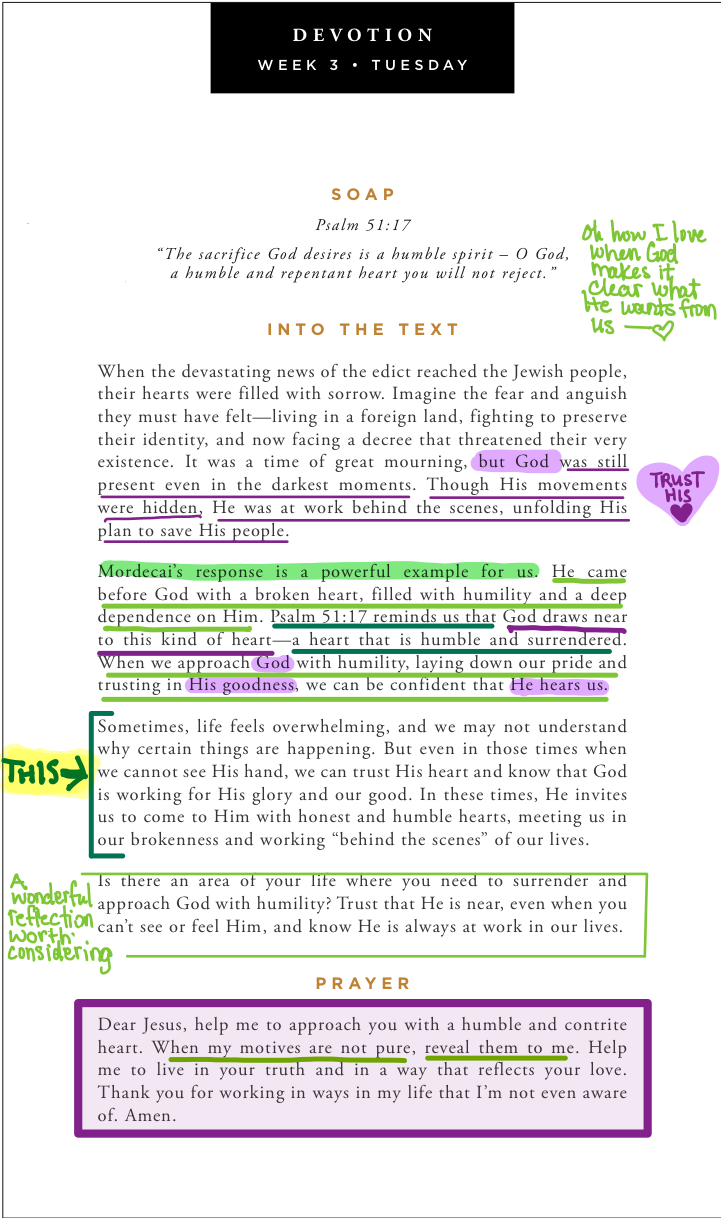
Based on w3d2 of LGG’s For Such A Time As This
The sacrifice God desires is a humble spirit — O God, a humble and repentant heart you will not reject.
Psalm 51:17
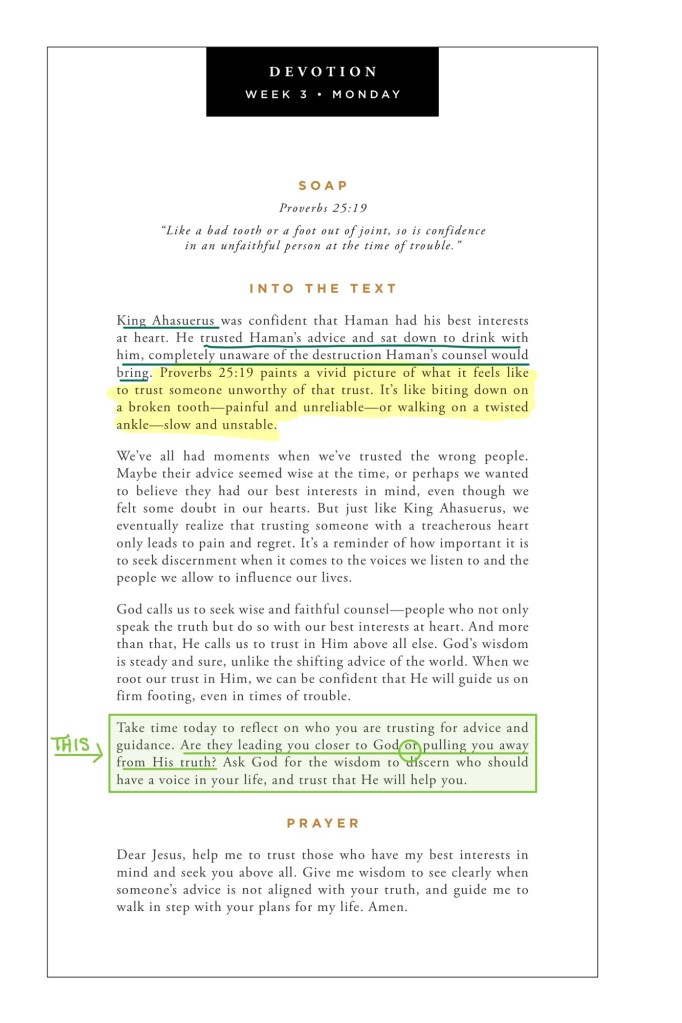
Based on w3d1 of LGG’s For Such A Time As This
“Like a bad tooth or a foot out of joint, so is confidence in an unfaithful person at the time of trouble.” Proverbs 25:19
Friends, I am having ongoing problems with my eye and am trying to limit my screen time. Unfortunately, since my job requires a good deal of screen time, blogging and studying must be curtailed for at least another week. Meanwhile, I will be posting the journal entries here along with the reading for the day, as well as links for more insight. – I hope you’ll stick with me for the journey and keep my eye situation in your prayers.
For more insight visit: https://lovegodgreatly.com/for-such-a-time-as-this/signet-ring/
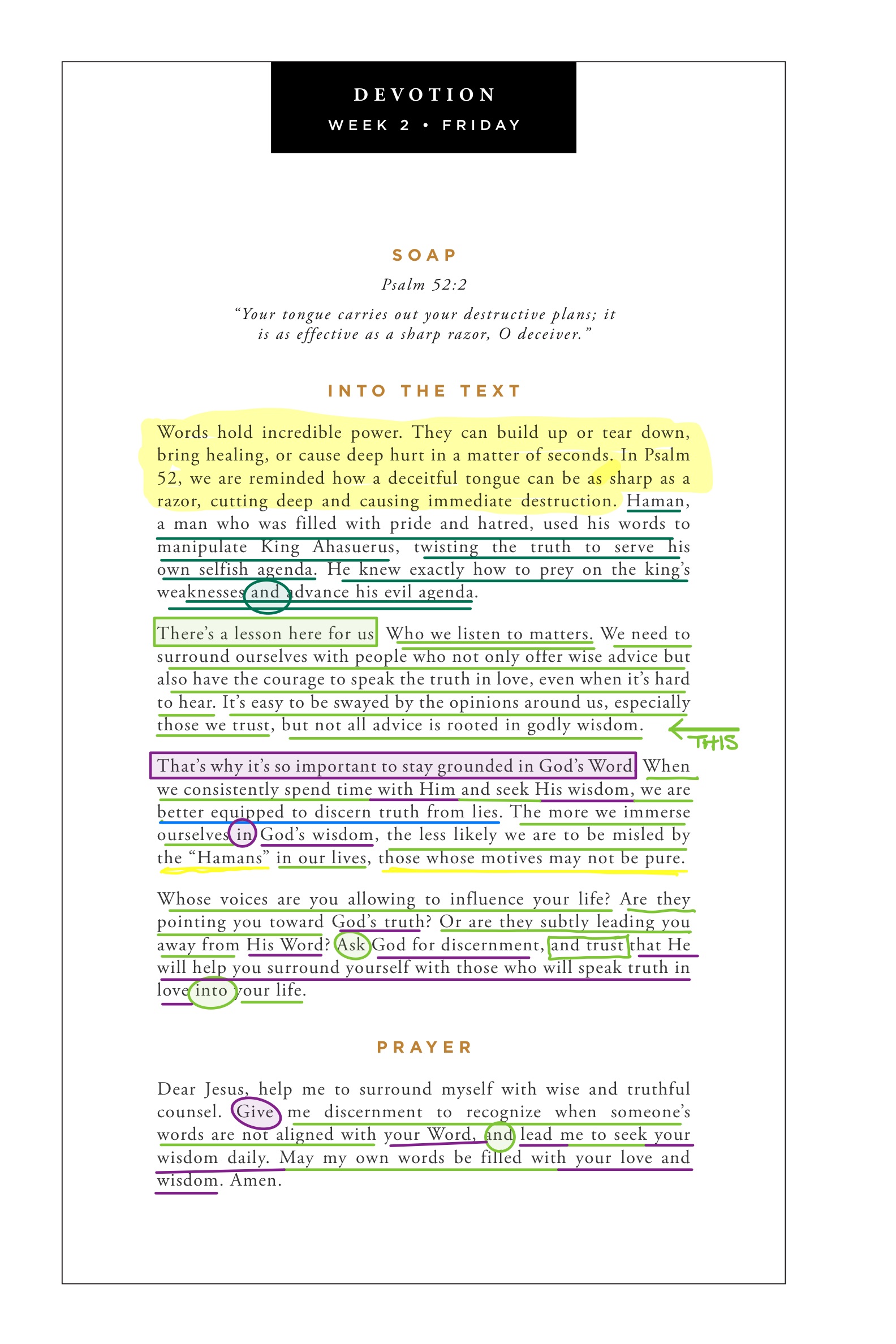
Based on the LGG Study, For Such A Time As This, w2d5
All day long you plot destruction.
Psalm 52:2
Your tongue cuts like a sharp razor;
you’re an expert at telling lies.
Due to an ongoing problem with a recent injury to my eye, I am having to limit my time on the computer. Thankfully, today’s Love God Greatly journal entry is absolutely fabulous. It is insightful into what’s happening in the story of Esther and Mordecai, and it is filled with wise instruction for us today. I’m reminded again of the children’s song from the days of my childhood that was used to train children to be careful with what they saw, heard, said, did with their hands, or went with their feet – always circling around to the the final line of each chorus: “… there’s a Father up above and He’s looking down in love … oh be careful little ‘mouth what you speak.” If you’ve never struggled with what you say or using your words to manipulate others, then this may not register with you as it has with me, but something tells me every reader can benefit from the teaching of this passage and journal entry. May it be a rich blessing – and a rich lesson both for how we speak and who we listen to.
based on the LGG Study, For Such A Time As This, w2d4
Come, let us bow down and worship.
Psalm 95:6
Let us kneel before the Lord, our Creator.
This first portion of this Psalm is a reminder of who God is and what He has done but also who we, as God’s people, are in connection to Him. It is equally a beautiful invitation to not only consider who He is but to respond to Him in worship. The psalmist calls the people of God not necessarily to a particular physical posture but foremost to a posture of the mind and heart. For surely if God’s people recall that He has protected and delivered them, if they remember His greatness – His superiority to all other gods, and the fact that the earth and the seas are His – surely then – they will be moved to worship Him with every part of their being.
Come, let us sing for joy to the Lord.
Psalm 95:1-7a
Let us shout out praises to our Protector who delivers us.
2 Let us enter his presence with thanksgiving.
Let us shout out to him in celebration.
3 For the Lord is a great God,
a great king who is superior to all gods.
4 The depths of the earth are in his hand,
and the mountain peaks belong to him.
5 The sea is his, for he made it.
His hands formed the dry land.
6 Come, let us bow down and worship.
Let us kneel before the Lord, our Creator.
7 For he is our God;
we are the people of his pasture,
the sheep he owns.
Today, if only you would obey him.
In today’s journey through Esther, we find Mordecai still among the servants in the king’s gates. This position has proven helpful thus far, but now he finds himself in a place where he is called to bow down and pay homage (a show of great respect and honor) to Haman, the king’s highest official. I am always delighted to read that Mordecai not only refused to bow or pay homage, but he also let it be known to the other servants of the king that he was a Jew, which was the reason he would not bow. While his revelation of his lineage stood in contrast to his instructions that Esther stay silent about hers, there was a time and purpose for both, which, as we will see in the story, God uses and honors both.
Friends, living in the twenty-first century, we may not find ourselves sitting in a king’s gates or living with rulers who make us bow down to them or “pay homage.” However, I think we would be careless to miss the things and/or people who, in many ways, whether by coercion or following the cultural norms we do often “bow down to” or give more homage to than we do our God. Like Mordecai, as children of the one true living God, we are neither to worship nor bow down to any other (man or god). In light of the warning/reminder found in Psalm 95:7b-11, may we be careful and faithful to “bow down” (whether physically or in our attitude) and worship only before the Lord, our Creator. For He is our God, and we are the people of His pasture, the sheep He owns. Today, let us commit to living obediently with hearts and attitudes of honor and worship before Him.
Father, there is no one like You, no other god, and no other man who compares to You. You are the true and living God who has loved us with an unfathomable love. You have lavished that love on us. We were prisoners on death row, and You offered us freedom through faith in Your Son, Jesus Christ. You have washed us white as snow and filled us with Your Spirit, empowering us to live and love like Jesus and to know You as a child knows his/her father. I am mesmerized by You and truly stand with hands raised and head bowed in awe of You. – Thank You for the example of Mordecai and for the reminder to bend our knees to no one and nothing else besides You. In the name of Jesus – for Your eternal glory, Amen!
You are Lord of creation
We Bow Down
And Lord of my life
Lord of the land and the sea
You were Lord of the heavens
Before there was time
Lord of all lords You will be
… We bow down
And we worship You Lord
We bow down
And we worship You Lord
We bow down
And we worship You Lord
Lord of all Lords You will be
The second portion of Psalm 95:6 is in part an invitation to remember what happens when we turn away from God; yet it is also a warning of sorts. The people had seen what God could do and would do on their behalf, and yet they challenged His authority and tried His patience with their disobedience and refusal to return to Him. They chose other gods and the ways of the people around them, and roused God’s anger against them. May we remember this warning from the Psalmist: not to be stubborn but obedient. May we not challenge His authority and try His patience, but remember the work of His hands and heart for His people. May we not disgust Him as that generation did, but instead bring Him honor by obeying His commands. Let us be careful not to rouse His anger but faithfully press on to the high calling and one day dwell with Him forever.
Today, if only you would obey him.
Psalm 95:7b-11
8 He says, “Do not be stubborn like they were at Meribah,
like they were that day at Massah in the wilderness,
9 where your ancestors challenged my authority,
and tried my patience, even though they had seen my work.
10 For forty years I was continually disgusted with that generation,
and I said, ‘These people desire to go astray;
they do not obey my commands.’
11 So I made a vow in my anger,
‘They will never enter into the resting place I had set aside for them.’”
Based on For Such A Time As This, A Love God Greatly Study – w2d3
Listen to advice and receive discipline,
Proverbs 19:20
that you may become wise by the end of your life.
When we read today’s passage from Esther, we may be tempted to think that a lot of what happens is by coincidence. However, while we may not read God’s name on the page, rest assured, none of what we read happens by coincidence or accident. Everything, from the timing of the exile to Mordecai raising Esther, to Esther learning to listen to and follow his advice, to Esther becoming queen, and the fact that Mordecai was sitting in the king’s gate, where he learned of the assassination plot, happened with a purpose. Look at the list – marvel and count the ways that God worked to accomplish His purpose. Some reveal how God’s hand has already moved, while the full picture of others will be seen later in the story.
Just as none of these events happened by accident, our lives will not reflect Christ to those around us by accident or happenstance. As today’s journal entry points out, if we desire to run the race well, we must be purposeful in seeking out godly wisdom and walking close to God, so that when we finish the race, we will hear the words, “Well done, good and faithful servant.”
As for the SOAP passage from Proverbs 19:20, today’s journal entry points out that “it is a reminder that true wisdom often comes through listening to advice and accepting instruction. This can be challenging, especially when we think we’ve already figured things out. But a heart that’s willing to learn is a heart that grows. Like Esther, who listened to Mordecai’s counsel, we, too, are called to seek guidance from wise, godly people who can help us navigate life’s decisions.”
Excerpt from For Such A Time As This, p75
Father, Your sovereignty inspires me and never ceases to amaze me. Thank You for the blessing of Your acts seen on the pages of Your Word, even where Your name does not appear. Thank you for the courage and the boldness of Mordecai and Esther, and for the teaching of this Proverb to seek and listen to Godly counsel so that we may become wise by the end of our lives. Help us to seek Your counsel above all others, but to heed the words of wisdom from those godly saints You have placed in our lives. I am also reminded by today’s events in the king’s gates that often You allow us to hear things so that we might be a help to others – make me a better listener, Father, not so distracted by self and the world, so that I might be a faithful servant in Your hands. – In the sweet and powerful name of Jesus – amen!
Note: Remember, the goal I mentioned earlier in our journey is to listen and watch for God. For while we do not see/read His name on the pages of the book of Esther, God was working all things together for the good of His people. Keep your eyes open and jot down glimpses you catch of Him throughout the journey. Training ourselves to do this can make such a difference in our own lives when we are struggling to see or sense His presence. – How have you seen Him working in your life? Do you see Him today?
Based on the study, For Such A Time As This, by Love God Greatly
And the king loved Esther more than all the other women, and she met with his loving approval more than all the other young women. So he placed the royal high turban on her head and appointed her queen in place of Vashti.
Esther 2:17
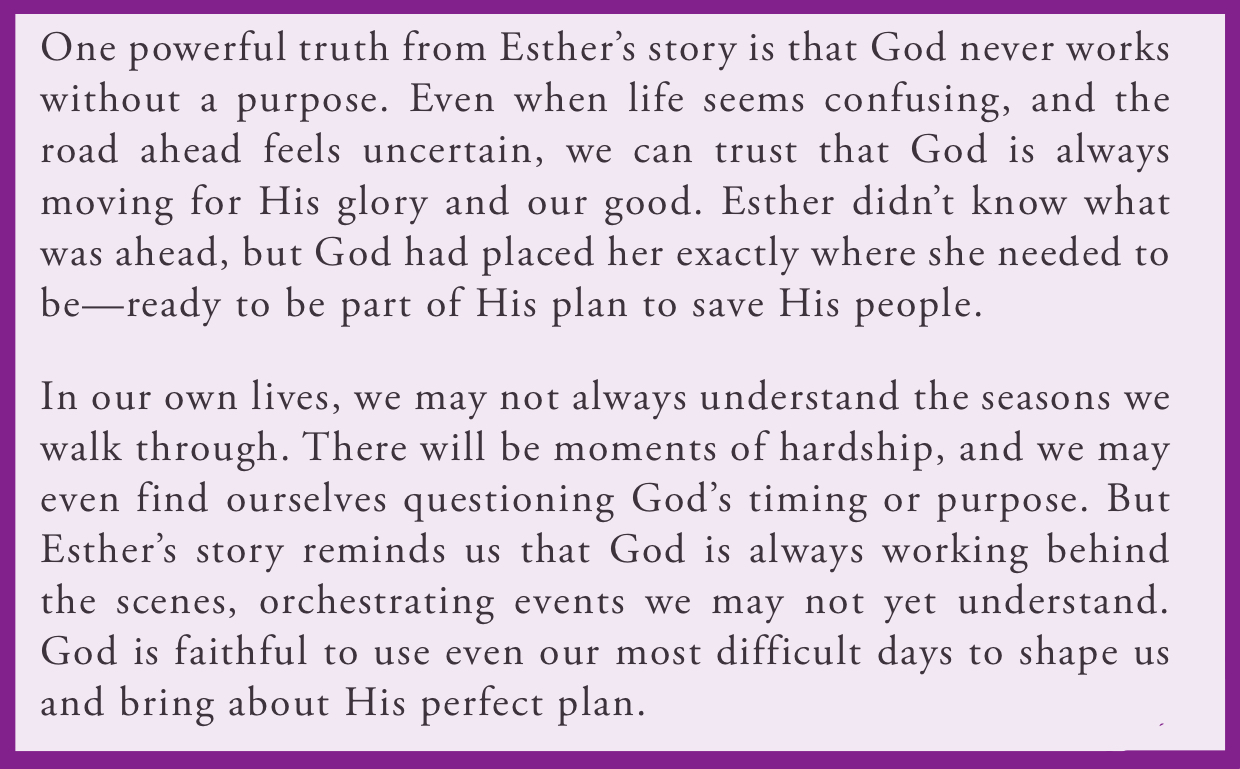
“And the king loved Esther more than all the other women, and she met with his loving approval more than all the other young women.” Regardless of how often I have read this story, this line gets me every time. I think it’s because, for me, seeing God work behind the scenes is the real beauty of Esther’s story. As I read it today, I could not help but think of David and Goliath. Weird, right? Yet somehow, the odds that a young shepherd boy and his sling would take down the mighty giant with one stone seem very comparable to a Jewish girl named Esther, being chosen as one of “many attractive young women,” paraded before the king, and being chosen queen of Persia. There was something different about Esther that stood out, something that caused her to not only find favor in the king’s eyes but to be loved more than any of the other women. I believe that, as surely as God was with David, providing all that he needed to defeat the Giant, He was also with Esther, giving her all that she needed to capture the king’s heart.
Seeing God work behind the scenes is the real beauty of Esther’s story.
Friends, in the daily battles to slay the giants and come out on top of the demands of the day-to-day to-do list and challenges life throws at us, may we find God at work within us. May we trust Him to give us victory even when the way seems or looks impossible. May we remember that the battle, whatever it is, belongs to the Lord our God. May we never doubt that nothing, absolutely nothing, is impossible with God!
From Such A Time As This, journal entry p71
Father God, I am so grateful for all the ways I have seen You work in my life. I look back to my childhood and I see Your hand, through my teen years, my married years, childbirth, hardships, joys, and sorrows. Even in the days that I ignored You or fled from You – I look back and see how in love You pursued me. As a child, when I was hit by the car – you spared me. When I had the tubal pregnancy – it was You who brought me through the emergency surgery. When I struggled with overwhelming anxiety – You came to my rescue and delivered me from captivity to fear. Father the list is endless and each memory strengthens me for the battles of today – for I look on them with confidence that You my God are with me – You have gone before me and come behind me and have filled me a hope that pierces through the darkness and guards me from the pits that seek to engulf. Your purposes are trustworthy and and good. Blessed be Your holy name, O Lord God Almighty! The battles and the victories belong to You! – Amen and amen!
Based on the study, For Such A Time As This, by Love God Greatly,w2d1
How blessed is the one who obeys (fears) the Lord,
Psalm 112:1
who takes great delight in keeping his commands.
Have you ever found yourself chasing after the things of the world, believing or even hoping they would bring the happiness/contentment you were looking for? Let me clarify—I’m not necessarily referring to the ‘bad’ things of the world, though that would be a valid question as well. However, let’s just assess the ‘good’ things we might chase after, like family, friends, a dream-sized body, dream jobs, dream homes, even dream churches, or how about the dream ‘happiness’ that everyone else seems to have. I’ll be the first to say that I have, and I’m guessing the largest percentage of those reading this would answer yes.
Being the first to say yes to the question, I certainly haven’t asked it to cast guilt or shame, but rather to offer encouragement to stop and reflect on today’s verse from Psalm 112:1. How blessed is the one who obeys (fears) the Lord, who takes great delight in keeping his commands. This is one of the many verses throughout the Bible that point us to the only true and lasting source of a blessed (contented, happy, joy-filled…) life. Speaking from experience, there is nothing more frustrating and often heartbreaking than chasing after something or someone that we believe will fulfill our joy/happiness, only to find disappointment as the happiness soon disappears or leaves us wanting more. “The truth is, we can never fill the deepest desires of our hearts with the things of this world. Yet, there is a different kind of joy, a lasting joy, that can only be found in the fear of the Lord and delighting in His ways.” As believers, we must realize this truth, teach it well to our children or others around us, and make the necessary changes in our hearts, minds, and lifestyles.
The truth is, we can never fill the deepest desires of our hearts with the things of this world. Yet, there is a different kind of joy, a lasting joy, that can only be found in the fear of the Lord and delighting in His ways.
For Such A Time As This, p67
Because it is vitally important to grasp this truth and let it take root within us, I am sharing portions of today’s journal entry with the hope that you will understand what it is to “fear the Lord,” and the importance of delighting in His commands/ways. When this becomes our lifestyle, happiness may still seem elusive, but we will most assuredly know the blessings and joy of the Lord.
“Psalm 112:1 gives us a beautiful reminder of where true joy and blessing are found – in fearing the Lord and delighting in His ways. To ‘fear’ the Lord means to stand in awe of His greatness and to live with a deep reverence for who He is. When we hold God in His proper place of honor, everything changes. Our hearts begin to delight in His Word. The emptiness of our hearts goes away as He fills that void, and we find the lasting joy we’ve been searching for. This fear of the Lord is not a fear of punishment but a life-changing reverence that brings us closer to Him.”
For Such A Time As This, p67
Friends, like Esther and Mordecai, we are people living in a foreign land. It is a land full of uncertainties, temptations, and demands, and we are warned that though we live in the world, we must not copy the behavior and customs of the world. Instead, as our journey through Esther will reveal about her, we must choose — “to walk in obedience to God and His calling on our lives. “She found her strength and purpose in seeking and honoring Him, and God’s protection followed. In the same way, when we live in awe of God, trusting Him in every situation, we will experience the kind of joy that isn’t dependent on our circumstances.”
True happiness isn’t about what we have or where we are; it’s about who we know — God Himself. When we turn to Him and seek His ways, He fills our lives with a joy that can’t be shaken.
For Such A Time As This, p67
Father, while Your name is not on the pages of Esther’s story, Your presence is clearly seen. I see Your protection and Your provision in Esther finding favor with Hegai and being placed in the best quarters and in a place where Mordecai could daily see how she was doing. I see Your wisdom and sovereignty through Mordecai’s instructions that Esther not divulge that she was a Jew. Father, in a world and time when we sometimes can’t see You in our struggles, this passage brings hope and encouragement. It brings instruction and admonishment to live as people who fear/obey You and take delight in keeping Your commands. Help us to remember that happiness isn’t about what we have or where we are, but about knowing You. Let us keep our eyes on You and faithfully follow Your ways – that we might know the blessings of Your joy and peace and not be shaken. – In the name of Jesus – Amen.
Read: Esther 2:1-4 and SOAP: Ephesians 5:15
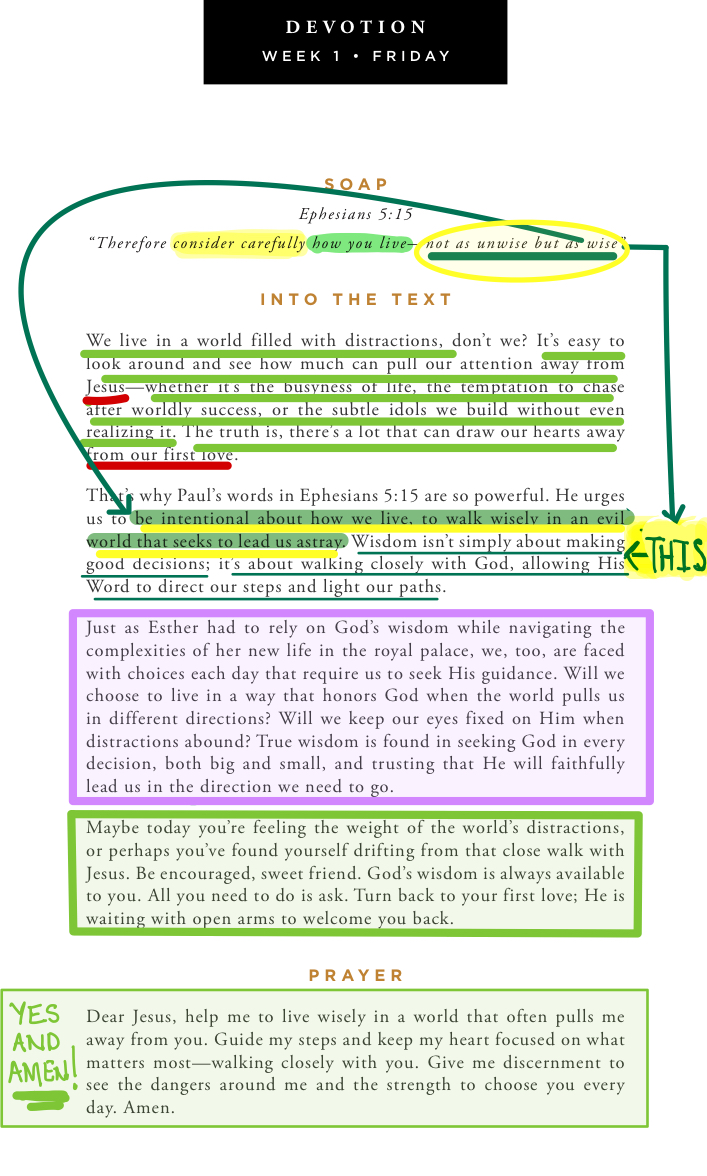
Therefore, consider carefully how you live – not as unwise but as wise – Ephesians 5:15
Read: Esther 2:1-4 and SOAP: Ephesians 5:15
“For Such A Time As This,” as we will see throughout our journey, applies to Esther in her day and—as we have seen this week—we can learn much from the truths that surround her story. Of course, not in the sense that we live in palaces filled with riches to display or have week-long ‘banquets’ celebrating our wealth and power—but surely we live in a world filled with distractions of other varieties, wrong responses, demanding our own way, and the temptation to follow the world’s ways rather than God’s. Which is why today’s SOAP passage points us to the words of Paul in Ephesians 5:15.
We must carefully consider how we live. Specifically, we are to live as wise and not unwise. This lesson is important and one that will play out throughout the rest of our journey. The question is, how do we do live as wise and not unwise? Today’s journal entry1 has a wonderful answer … May we take it to heart and daily seek God’s help to walk wisely in such a time as this.
based on the LGG Study: For Such A Time As This, w1d4
However, let each one of you love his wife as himself, and let the wife see that she respects her husband.
Ephesians 5:33
As we saw yesterday, the king’s counsel was not from “godly” men. Yet, when we observe the story of Esther carefully, we will see that God was working behind the scenes, setting the stage for Esther, a Jew, to become queen to the King of Persia.
Today’s study of Esther focuses on verses nineteen through twenty-two, which detail the advice given to the King by his counselors. Counsel that basically banished Queen Vashti and allowed for the King to choose a new queen. However, the passage also emphasizes the importance of making this known throughout the kingdom so that all the women will give honor to their husbands. Friends, whether we are married or unmarried, we must remember that “All Scripture is inspired by God and is useful to teach us what is true and to make us realize what is wrong in our lives. It corrects us when we are wrong and teaches us to do what is right.” (2 Timothy 3:16)
I realize that if we are not married, we may want to say Ephesians 5:33 doesn’t speak to us. However, as that thought came to my own mind, I was reminded that it is the call of God on every believer to love and respect Him (Deut 6:5; Mark 12:29-30). Likewise, regardless of our marital status, Jesus made it clear that we are to love others as He has loved us, (John 13:34); There is no qualifying statement indicating that we only have to do this “If he respects us;” nor do I find a qualifier for the words of Christ – commanding that we love just as He has loved us. Yet, I did find it good and helpful to read these words from today’s journal posting. I pray they are a blessing to you as well.
Marriage is a beautiful reflection of God’s love when both husband and wife seek to honor Him. In Ephesians 5:33, we’re reminded of the delicate balance in marriage. A husband is called to love his wife as Christ loves the church, and a wife is called to respect her husband. Both love and respect are essential for a thriving marriage. Just as a wife longs to feel loved, a husband desires to feel valued and respected.
But what happens when this balance is broken? In the story of King Ahasuerus and Queen Vashti, we see the consequences of love and respect missing from their relationship. The king’s request put Queen Vashti in a difficult position, asking her to do something she wasn’t comfortable with. Instead of protecting her, he unlovingly placed her in a situation that ultimately cost her the crown. This is not the way God intended marriage to be.
For those of us who are married, respecting our husbands is one way we show them love and appreciation. It’s how they feel cherished for the ways they lead and serve our families. But above all, we must first respect and honor God with our actions. When we choose to obey God, even when it’s hard, we trust that He sees us and will care for us, no matter the outcome.
Sweet sister, if you find yourself in a situation where standing up for what is right could come at a cost, be encouraged. God sees your heart, and He will always honor your obedience to Him.”
For Such A Time As This/journal p53
Father, I pray for courage for every woman who belongs to you to courageously stand for what is right. For those who are married, help them, even when it is difficult, to honor You in their marriage by showing love and respect to their husbands. Whether we are married or unmarried, Father, help us honor You in all areas of our lives, trusting You to protect us and provide for every situation. Yes and Amen in Jesus’ name!
Today’s portion of our journey has been a sweet reminder to be thankful for the wise and godly counsel God has provided for me throughout my life. From parents to grandparents, to Pastors, teachers, and Christian friends, the blessing of godly wisdom/counsel has been readily available. I have sought it often and treasure it greatly. Sadly, this was not the case with King Ahasuerus (or Xerxes, as he was otherwise known). Xerxes had many advisers, but none who would lead him with godly wisdom. Because they were worldly, they imparted worldly wisdom to the king, “which led him down a path of confusion and poor decisions.”1
Even with Godly counsel at my disposal, it is easy to succumb to or even listen to the “voices that are loudest or most convenient. Social media, self-help books, or even well-meaning friends can quickly become our go-to sources for advice.2” However, Scripture tells us to seek God’s will in all we do, not to depend on our own understanding, but let Him show us which way to go. As Proverbs 14:8 points out, to do it any other way is the foolishness of fools. Godly wisdom is rooted in His Word, and His Word will never lead us wrong or fail us.
Who we choose to walk alongside us in these moments makes all the difference. Are we surrounding ourselves with people who point us back to God’s truth! Are they speaking God’s truth into our situations or adding more confusion?
For Such a Time As This, Journal, p49
I ache for those who do not know God and those who have no true concern for His opinion. How sad and dangerous it is for those who do not know what it is like to have faith and confidence in Him and His wisdom and truth. Their concern is with the earthly kingdom and what will please or displease others, or what will get them where they want to go, rather than with what is good and right to do and what leads them where God wants them to go. May we be ready disciples of the Word – ready with an answer for the hope that is in us, ready to point others to God’s truth, which is light and life and peace.
Note: There is more than poor counsel and sorrow in today’s passage. For while we do not see/read His name on the pages of the book of Esther, God was working all things together for the good of His people. Keep your eyes open and jot down glimpses you catch of Him throughout the journey. Training ourselves to do this can make such a difference in our own lives when we are struggling to see or sense His presence. – How have you seen Him working in your life? Do you see Him today?
Father, teach us and help us to seek Your wisdom above all when troubles come our way. Thank You for the people You have surrounded me with throughout my life – who belong to You, love You, and have imparted wisdom and counsel from Your Word. Help me to do the same for others – In Jesus’ Name – Amen.
For more insight visit https://lovegodgreatly.com/lgg-blog/
 Me From the Inside Out