The women we’ve studied this week revealed stories and lives of surrender in the face of many different situations. Mary, a virgin, surrendered to the unexpected and unbelievable news that she was pregnant. Abigail and Esther both faced incredible danger and possible death and yet with eyes on God they showed us both courage and humility in the way they responded to their specific challenges. While Moses’ mother and the poor widow shared vastly different stories they both revealed not only courage but great faith in God and selfless love. There is much that can be learned from these beautiful stories. They are worthy of reading to ourselves, our children, or our grandchildren many times throughout the year. Lest we forget how God works miracles and blesses those who, by faith, follow Him even though it may mean danger or sacrificing their desires for His.
Trusting God isn’t always easy. He allows things in and around us that don’t make sense and that often cause us to wonder where He is. However, as we see through each of these women and those we have studied before them – He is faithful, loving, protective, kind, compassionate, understanding, and purposeful in His care for us.
Consider these stories and their truths often so that you do not grow weary and lose heart. Fix your eyes on Him and not the circumstances of Your life and surrender, even as Christ did in the garden, saying, “Not my will but yours be done”, or as Mary said to Gabriel, “Yes, I am a servant of the Lord. Let this happen to me according to your word”.
Trust in the Lord with all your heart,
and do not rely on your own understanding;
6 think about Him in all your ways,
and He will guide you on the right paths.
Proverbs 3:5-6 HCSB
And we know that God causes everything to work together for the good of those who love God and are called according to his purpose for them.
Romans 8:28 NLT
If you missed any of this week’s devotions from me you’ll find them at this link
If you missed any of the Love God Greatly Blogs for week 4 you’ll find them at these links:
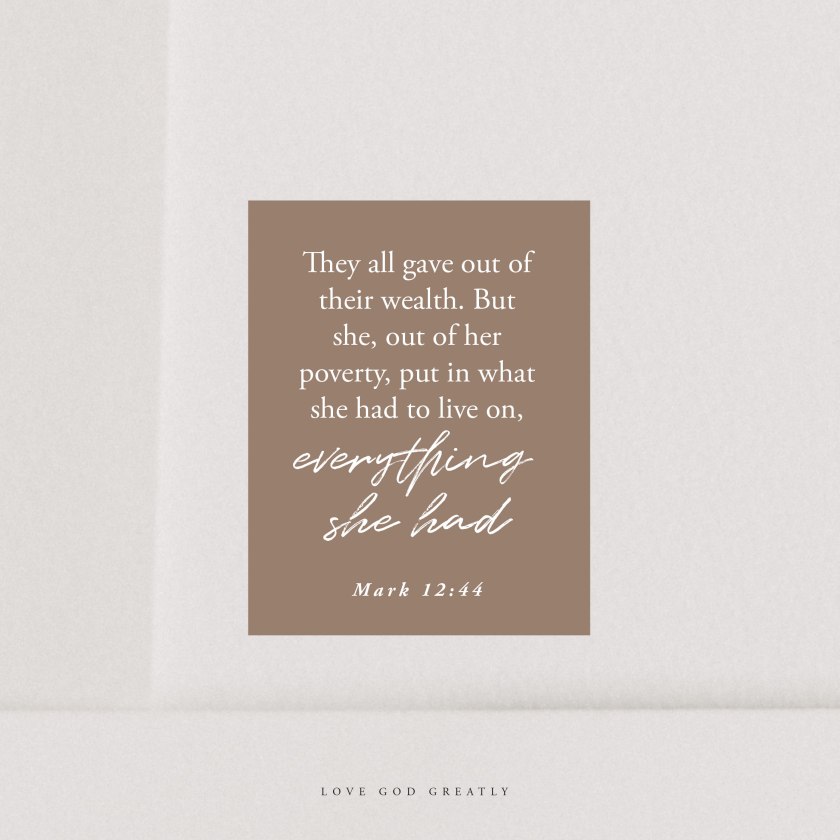
Jesus called his disciples to him and said, “I tell you the truth, this poor widow has given more than all the others who are making contributions. 44 For they gave a tiny part of their surplus, but she, poor as she is, has given everything she had to live on.”
Mark 12:41-44 NLT
Observations:
In the “making of disciples” Jesus didn’t always stand and preach but instead used real life situations to show and tell/teach them how to live. He observed people and events and used them as teachable moments. His observations of the poor widows gift was an opportunity to teach them about the real importance of giving an offering and the judgment that should and shouldn’t be made.
It’s important to note that Jesus wasn’t teaching that the wealthy should not give or that the poor should give all they have. Rather, He was pointing out how they gave – the wealthy gave out of their wealth, in other words not from what they needed but from what was left over – meaning it cost them nothing. The widow, however, gave out of her poverty or more specifically what she had to live on. Her offering cost her everything and it was her gift that Jesus pointed out as the greater gift. Again, not because it was monetarily more but because of what it cost her.
How Then Should We Live?
We should live as the ‘poor widow’, giving not out of what we have left over – but from what we need to live on. Did she have to give it all? No, I don’t think so, for Jesus didn’t use the moment to teach that “she gave what was expected” but rather that her two coins were more than all that the wealthy had given. This type of giving requires faith and surrender in every way. Give from the heart, give as the Lord leads you to give, and let whatever you give be a sweet smelling sacrifice to the Lord.
I think this is a good lesson for examining not only what we give but why we give, making sure that our gifts are acts of the heart rather than habit – as though we are paying a monthly bill.We must not see God as a debt collector but as the One who, by grace1, paid our debt2.He paid our sin-debt with the life of His son; and this was a free gift, one given out of His love3, not as a reward for something we had done1. When we see God as the extravagant gift giver that He is, we will give as the widow, not as though we could ever repay Him – but out of hearts of love – a love born out thankfulness and adoration for who is, what He has done, and what He’s promised to those who believe.
1Ephesians 2:8-9, For by grace you have been saved through faith. And this is not your own doing; it is the gift of God,
2Romans 3:23, For everyone has sinned; we all fall short of God’s glorious standard. and Romans 6:23, For the wages of sin is death, but the free gift of God is eternal life through Christ Jesus our Lord.
3John 3:16, “For God so loved the world, that he gave his only Son, that whoever believes in him should not perish but have eternal life."
Prayer Response:
Father, Giver of life and love, of provisions and grace and endless mercies – You clearly give from the heart as is evident in the gift of Your Son. May we be so generous and purposeful in our own giving. And may each gift bring You pleasure and glory and be useful in drawing others to You – in His Name, Amen!
Your Turn:
What’s your take away from the poor widow’s story?
Reflection Questions:
The poor widow in Mark 12 gave everything she had:
Why did her sacrifice mean so much?
What did her giving reveal about her heart and her faith in God?
Want More?
Visit Love God Greatly for their Friday Blog and while you’re there check out the details on our next study.
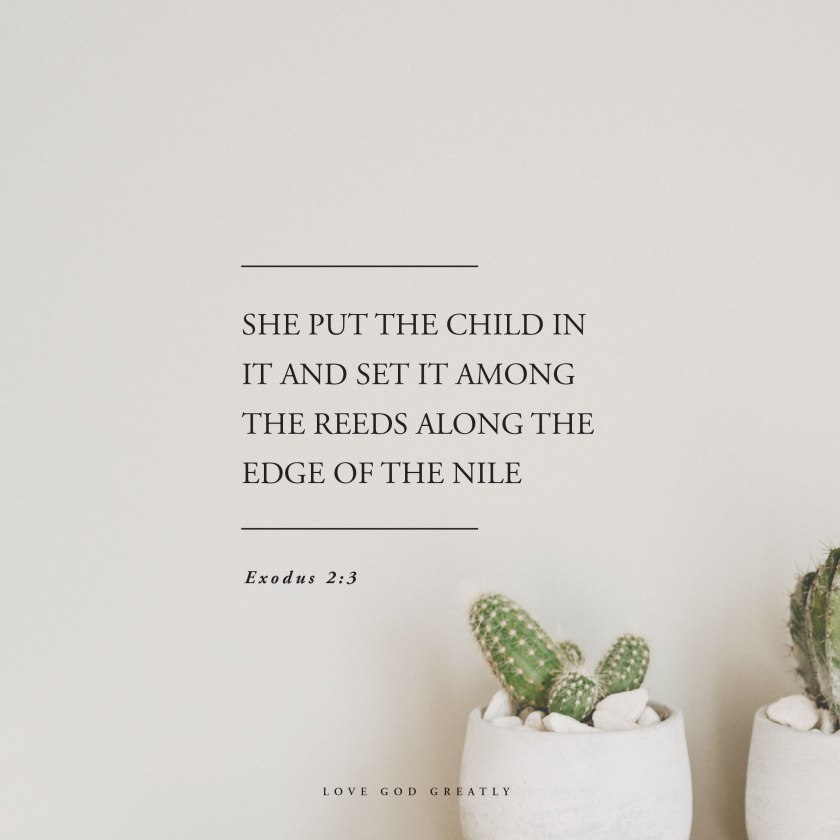
But when she could no longer hide him, she got a basket made of papyrus reeds and waterproofed it with tar and pitch. She put the baby in the basket and laid it among the reeds along the bank of the Nile River.
Exodus 2:3 NLT
Observations:
Background
Chapter 1 tells how the Israelites were multiplying and their numbers posed a threat to the Egyptians and to their ruler, Pharaoh. He saw them as such a threat that he ordered all baby boys to be killed, first by mid-wives and when that didn’t work – he ordered them to be thrown into the Nile. It was during this time that Moses’ mother became pregnant.
We know from our reading, 2:1-10, that Moses was born to descendants of Levi, the priestly tribe. While this may not be crucial to today’s story, it will be an important part of Moses’ life in the years to come and is yet another picture of God’s perfect design and how He is always working behind the scenes of our lives.
Steps of Faith
What is important to today’s story of Moses’ mother are the steps she took to save the life of her son. She hid him for three months, she made a safe boat for him, she placed it carefully in the Nile, in a way that it would be hidden, and yet noticeable to someone who might stop to bathe along the river’s edge. Read the passage carefully and see others that God used in Moses’ rescue story, from the mid-wives who secretly refused to kill the babies as ordered, to his sister Miriam who played look-out once he was in the river and ensured that their mother would be the nurse maid, and of course, Pharaoh’s daughter who was moved with compassion to keep the child. They were all instruments strategically placed and moved by faith, love, or compassion to act on Moses’ behalf.
How Then Should We Live?
Act in faith. Throughout of of Scripture this is the lesson. Paul summarized it very well when he told the Corinthians, “For we walk [live, act, respond …] by faith and not by sight, 1 Corinthians 5:7. When things look hopeless and mandates loom around us that affect the general population, ourselves/jobs, or those we love – we must not lose hope but do what we know is right in God’s eyes and trust Him with the outcome.
From where we are positioned we must stay alert and act timely and wisely as opportunity presents and God leads. We would also be wise to remember that while Pharaoh’s daughter may not have been one of God’s children, He still used her in positioning Moses right where He wanted him. As Paul said in Romans 8:28, and I believe is applicable here – “We know that in all things God works for the good of those who love Him, who are called according to His purpose.” There is much comfort to be found in this truth when we find ourselves in the place of Jochebed, Moses’s mother, having to trust God in such an unthinkable and heart-wrenching situation.
Prayer Response:
Father, even when situations seem hopeless – even when man’s edicts put us or those we love in danger or in situations that go against our faith – help us to act in unwavering faith on what is good and right. Help us to keep our eyes on You – to trust You and give You praise in all things – You have given us Your Spirit for this purpose. All to Your glory-amen
Your Turn:
What’s your take away from Esther’s story?
Reflection Questions:
Moses’ mother was faced with a horrible decision.
How did her surrender and sacrifice play into her determination to save the life of her son?
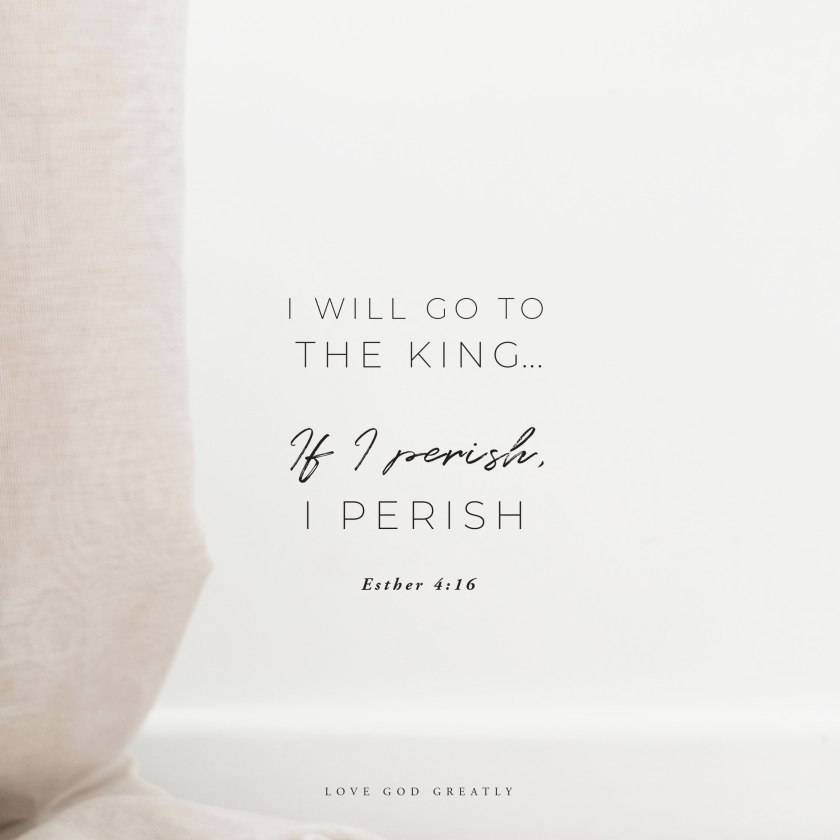
“Go and gather together all the Jews of Susa and fast for me. Do not eat or drink for three days, night or day. My maids and I will do the same. And then, though it is against the law, I will go in to see the king. If I must die, I must die.”
Esther 4:16 NLT
Observations:
Esther’s Background
To quote the commentary on Esther from Gotquestions.org, “Esther is the Jewish maiden who became queen of Persia and rescued her people from a murderous plot to annihilate them.” Esther’s full story, filled with drama, intrigue, and more, is found in the Book of Esther. It is a story worth reading at least once a year, as a reminder of God’s mercy and grace to His people and how He positions and uses the least expected people in the unfolding of His plan. If you aren’t familiar with Esther’s story, or if it’s been a while since you’ve read it, I suggest reading at least the first three chapters prior to chapter 4 so that you can fully appreciate and learn from Esther’s faith and surrender in today’s lesson.
Esther’s family was from the Tribe of Benjamin, one of the 12 sons of Jacob. According to verse six of Esther, chapter 2 her family had been among those who had been exiled from Jerusalem to Babylon by King Nebuchadnezzar. It’s in that same chapter that we read, “When her father and mother died, Mordecai {Esther’s older cousin] adopted her into his family and raised her as his own daughter.”
Following a somewhat scandalous event at the palace the King gave the order that the current Queen, Vashti, be forever banished from the presence of King Xerxes, and that the king should choose another queen more worthy than she.
As a result of the King’s decree, Esther (who is described in chapter 2 as both beautiful and lovely), along with many other young women, was brought to the king’s harem at the fortress of Susa and placed in Hegai’s care. Verse 9 of chapter 2 says that Hegai, [the king’s eunuch in charge of the harem], was very impressed with Esther and treated her kindly. He quickly ordered a special menu for her and provided her with beauty treatments. He also assigned her seven maids specially chosen from the king’s palace, and he moved her and her maids into the best place in the harem.
Important to note is that no one in the palace knew about Esther’s nationality and family background because Mordecai had directed her not to tell anyone. While some may question Mordecai’s instructions, it is easy to see how God used Esther’s silence about the matter.
Today’s Story
While no one in the palace knew Esther’s true identity, she knew and outside the place walls Mordecai knew and thus our story today. God used them both as examples of faith and heroes of His people.
Mordecai, heartbroken and distraught over the pending destruction of the Jews. I’m telling you – you have to read the story to know how Mordecai even knew what was happening. But, what we see here is that he did know and he makes it known to Esther, and instructs her not just to help – but to do so at the risk of her own life. She resists at first, making Mordecai aware that on penalty of death she could not go uninvited into the presence of the King. Mordecai responds with perhaps one of my favorite passage in the book of Esther:
Mordecai sent this reply to Esther: “Don’t think for a moment that because you’re in the palace you will escape when all other Jews are killed. 14 If you keep quiet at a time like this, deliverance and relief for the Jews will arise from some other place, but you and your relatives will die. Who knows if perhaps you were made queen for just such a time as this?” 15 Then Esther sent this reply to Mordecai: 16 “Go and gather together all the Jews of Susa and fast for me. Do not eat or drink for three days, night or day. My maids and I will do the same. And then, though it is against the law, I will go in to see the king. If I must die, I must die.”
Esther 4:13-16
Mordecai didn’t walk away throwing up his hands – with an ‘I’ve done everything I can do’ attitude; nor did he say he understood Esther’s concern, instead he painted the whole picture for Esther, which, by Esther’s responses, was exactly what she needed to hear. She surrendered to the instructions with one condition or stipulation that she would first fast, in this case, according to gotquestions.org commentary, the fast would be associated with seeking God in conjunction with passionate prayer1. She also charged Mordecai and the rest of the Jews to join her in the fast for three nights and days. “Afterward”, she said, “I will go to the king, even though it violates the law.” Surely this is a picture of being beautifully surrendered.
Esther was living outside of her element. She was taken away from her people to a palace, put on display for the King, given a regimen and diet that were not customary for her. We may think – wow! if only someone would pick me up and place me in a palace, give me maids, and spa treatments – what’s not to love about that- right? Well, obviously whether she was enjoying it or not isn’t the question – perhaps she was – there’s certainly nothing wrong with enjoying where God has placed us. However, we must not lose focus of who we are and what we are meant for. In the middle of it all she was reminded by Mordecai of who and whose she was, where she came from, and made to see or at least consider that perhaps her royal status was meant for more than her enjoyment … perhaps it was meant for the salvation of her people. Which is exactly what we know from Scripture – this side of the story.
Mordecai’s faith was evident in that he knew that should Esther pass up the opportunity to speak for her people, God would send freedom and protection for the Jews by some other means. Esther’s faith was evident in not only being willing to “face death” should that be the case but also in putting God first through fasting and prayer and engaging her people to do the same, undoubtedly meaning for all of them to use the time calling out to Him on her behalf.
We would be wise, like Mordecai, to be one who encourages others with the truth rather than encourage or uphold their fears. We would be wise, if like Esther, we pray for and strive for such mindsets of faith that lead us to surrender.
It may very well be that you have achieved royal status for such a time as this!
Esther 4:14b NET
Prayer Response:
Father, how beautiful and challenging is the story of Esther. Beautiful in the fact that regardless of who we are or where we are You can pick us up and place us where You want us to be, so that we are positioned for Your work. The story is equally daunting though, knowing that where you place us may come with greater responsibility than we could have ever imagined or wanted. Help us live as Esther did, turning to You in our fears and willing to surrender – even in the face of death. Help us to stay focused like Mordecai did – keeping You always as our perspective and willing to encourage others with the truth – for Your glory and the salvation of Your people.
Your Turn:
What’s your take away from Esther’s story?
Reflection Questions:
Esther was faced with a hard decision, risk her life or the lives of her people.
How do her actions in Esther 4 reveal her strength?
When Abigail saw David, she quickly got off her donkey and bowed low before him. 24 She fell at his feet and said, “I accept all blame in this matter, my lord. Please listen to what I have to say.
1 Samuel 25:23-24 NLT
Observations:
What we know about Abigail:
Abigail was married to Nabal, an wealthy and evil man (2-3)
She was both wise and beautiful (3)
She was respected and trusted by their servants do what was right and wise (14-17)
Time and again she acted quickly and with wisdom (18-20, 23, 36-37 and 42)
When she spoke with David, she spoke with the LORD God as her perspective (26-31)
She knew right from wrong and sought forgiveness for her husband’s actions and encouraged David to do what was right in the sight of the LORD (28-31)
How Then Should We Live?
We would be wise to follow Abigail’s example and keep God as our perspective in all things. By her conversation with David it appears to be that having a godly perspective helped Abigail not panic when danger was near, she sought forgiveness when necessary, and spoke with wisdom and respect. Act quickly but not rash.
Prayer Response:
Father, the story of Abigail is beautifully inspired though she was the wife a a wicked man she kept You in mind. You gave her wisdom and strength where it would have been easy to run and hide or to berate her husband. You showed her your favor and used her humility and courage in a mighty way. May I live surrendered. – In the power of Your Spririt –
Your Turn:
What’s your take away from Abigail’s story?
Reflection Questions:
What stood out to you the most Abigail’s response to David?
How do you think her hospitality and courage influenced David’s response to her and her family?
38 Mary responded, “I am the Lord’s servant. May everything you have said about me come true.” And then the angel left her.
Luke 1:38 NLT
My Observations:
Who was Mary?
Mary was a virgin from Nazareth, a town also known as Galilee. She was engaged to a man by the name of Joseph who was a descendant of David. She was favored by God, chosen to bear the Messiah, God’s only Son. She was guaranteed a healthy, safe delivery, and a “Holy” child – which eased her fears.
The Angel’s Visit:
An angel, named Gabriel, who was sent by God, came to Mary, greeting her as one who was favored and one whom the LORD was with. He encouraged her to not be afraid and asked her to listen to the message he had brought. As if being greeted by an angel wasn’t shocking enough, try learning from the angel that you’re going to have a baby boy – talk about a unique gender reveal! The angel gave her all of the details, even what to name the baby, whose the baby really was, how great the baby would be, and how His future would turn out.
“You will conceive and give birth to a son, and you will name him Jesus. 32 He will be very great and will be called the Son of the Most High. The Lord God will give him the throne of his ancestor David. 33 And he will reign over Israel forever; his Kingdom will never end!” … 35 The angel replied, “The Holy Spirit will come upon you, and the power of the Most High will overshadow you. So the baby to be born will be holy, and he will be called the Son of God.”
Luke 1:31-33, 35 NLT
Oddly enough Gabriel even told her about Elizabeth, her cousin, being six months pregnant with a son. Perhaps this is what sparked Mary’s visit to Elizabeth that we read about last week.
Mary’s Response:
We could jump right to verse 38 and see Mary’s ultimate and “beautifully surrendered” response. However, in doing so we would miss some crucial and equally beautiful responses from the minute the angel appeared.
Mary didn’t run from the angel but she received him and entertained his greeting and announcement, which is obvious from Luke’s description that reads: “Mary was greatly troubled by [Gabriel’s] words” and [she] began to wonder about the meaning of this greeting”. When the angel asked her to listen, she obviously did so – because when he was done speaking, she asked Gabriel a question. Mary said to the angel:
“How will this be, since I have not been intimate with a man?”
Luke 1:34 NLT
Following Gabriel’s enlightening reply, Mary gives her final response – which is one of beautiful surrender, acknowledging both her awareness of what is happening and her surrender to the LORD who is bringing it about. It’s worth reading again:
Mary responded, “I am the Lord’s servant. May everything you have said about me come true.”
Luke 1:38
How Then Should We Live?
While we will never receive the message that Mary received from Gabriel, we should always be prepared and willing to hear from God and, like Mary, we should consider what He says. We should not be afraid – remembering that if He’s asking us to do something then He has already prepared us for it. We should live positioned and ready to be used by God. After listening to what He asks of us we should, respectfully, ask any questions we might have and surrender in faithful obedience.
Prayer Response:
Father, How great and wonderful are Your ways. How amazing and powerful are Your acts. I marvel at Your work to position Mary and to use her in such an unexpected and marvelous way. I stand in awe of her beautiful surrender and pray that I, and those who have read or heard this lesson, might always be prepared and never turn away from what You call us to do. – In His name and strength and for Your glory – Amen!
Your Turn:
So, what’s your take-away from today’s passage?
Refection Questions:
What does Mary’s response teach us about her?
How would you have responded if you had been in her shoes?
4 But whoever drinks some of the water that I will give him will never be thirsty again, but the water that I will give him will become in him a fountain of water springing up to eternal life.” 15 The woman said to him, “Sir, give me this water, so that I will not be thirsty or have to come here to draw water.” John 4:14-15
My Observations:
Crucial to this encounter with the Samaritan woman is the word “whoever”. It is equally important to understand the importance of who Jesus was speaking to –
She was a woman and a Samaritan. He had five husbands and was living with one who was not her husband; because of her lifestyle she was a known outcast and considered ‘unclean’. Jesus’ ongoing answers and conversation seem to soften her attitude and many others are brought to meet Him.
your turn:
What’s your take away from the story of the Samaritan woman?
How then Shall We Live?
Jesus clearly asked water from this woman to engage her in conversation and offer her the living water he has to offer. From my understanding He did so at great risk to His reputation – considering, not only that she was a woman but her lifestyle and the fact that she was a Samaritan. In what He did He set the example of how we are to live as His witnesses.
Don’t be afraid to reach the “outcast” with the love of Jesus
Make “whoever” a part of our conversation with the ‘thirsty’
Give the word out like cups of cold water to those who are thirsty (in need of ‘eternal life’)
Tell others what we know about Jesus and where they can find Him
My Prayer Response:
Father, thank You for the examples of Jesus. Help us to live and love like Him. When we open our mouths fill us with the words that will help those who are “thirsty” receive the gift of eternal life. Help us to ‘see’ those who are seeking more and to engage with them regardless of how they respond, regardless of their status in life, and regardless of what others think.
So Hagar named the Lord who spoke to her, “You are the God who sees me,” for she said, “Here I have seen one who sees me!” Genesis 16:13 NET
My Observation:
Who Was Hagar?
Hagar was the Egyptian slave girl to Sarah
She became the slave wife to Abraham because of Sarah’s impatience for the child God had promised them
As a result of Sarah’s impatience Hagar gave birth to Ishmael, Abraham’s son
Through her plight she came to see God as El Roi, the God who sees ‘me’.
What We must not miss
It’s easy to read Hagar’s story and get lost in our thoughts or conversations and judgements about Sarah and Abraham actions … how they didn’t trust God … how they acted on their own … how Abraham could have taken a slave wife, and why in the world Sarah would give him another woman (cultural acceptance or not) … how Sarah complained about Hagar … and eventually insisted that Hagar and the child be sent away … and the list goes on – BUT we must not miss how God used it all! He used it not only to fulfill His promise of a child to Abraham and Sarah – BUT Godrevealed Himself to Hagar as El Roi – He was no longer just the God of her masters but He was the “One”, whom she saw and the “One” who saw her”. On top of that, He not only rescued Hagar and her son but He promised to be with her son as he grew. What a comfort Hagar must have found in this promise in the midst of her aloneness and desperation.
How Then Should We Live?
Sarah and Abraham offer good lessons in “trusting God”, not going ahead of Him, not forsaking His ways for our desires, and not playing God (trying to do or make happen what He promised). BUT GOD, through Hagar, reveals to us the importance of listening for and to Him, of being attentive to what He says, taking comfort in His Words, and seeing Him for who He really is. We must learn to listen for Him and to know Him as the God who sees us. He should not be just another god, like the gods Hagar would have known as an Egyptian. No, He must become personal to us so that, like Hagar, we will be able to say: “You are the God who sees me,”; and if we are wise we will mark the times (places, incidents, and ways we have seen or heard Him) just as she did when she said, “Here I have seen one who sees me!”. These markers or remembrances will become our testimonies of faith. Their memories will strengthen us when life presses in and perhaps be an encouragement to others we know along the way.
He comforts us in all our troubles so that we can comfort others. When they are troubled, we will be able to give them the same comfort God has given us.
2 Corinthians 1:4
Your turn
What’s your take-away from Hagar’s story?
Prayer Response:
Blessed be Your Holy Name God! You are the God who sees me! You know my name! You hear me when I call. You see me when I’m hidden away or when I’m hurting or afraid. You hear me wherever I am! You are with me and You are always doing what you said You would do, and You are always working everything together fo the good of those who love You and are called according to your purpose. In this I trust and find my strength!
Then God took note of Rachel. He paid attention to her and enabled her to become pregnant. 23 She became pregnant and gave birth to a son. Then she said, “God has taken away my shame.” 24 She named him Joseph, saying, “May the Lord give me yet another son.” Genesis 30:22-24
MY OBSERVATIONS:
What a saga! One sister (Rachel) loved by Jacob and the other (Leah) given to him in marriage by trickery.
The BibleReference.com commentary explains that the phrase “God took note of Rachel …” means that He looked with favorable consideration on her but not before…
He looked with compassion on Leah who was unloved and enabled her to become pregnant (verse 31).
the birth of 9 more sons, some given to Leah while others were given to Leah’s and Rachel’s servant girls.
“THEN… ” This one little word in Scripture is so often followed by some great news or event that it always catches my attention … and in this case – as with the story of Hannah – what follows “then” resonates with my heart. Years have passed, Rachel – though settling for children through her servant girl – has waited miserably and now finds herself, finally, pregnant because God has looked on her with “favorable consideration”. You see, it wasn’t that God had truly forgotten or not seen Rachel in all of this time – but rather that God is strategic and purposeful in all He does. As we saw with Hannah, and as I learned in my own life – God is the one who enables or withholds children being born. This is paramount in the story of Rachel and Leah and Mary and Elizabeth and every other woman in the Bible. Until we understand the truth of it we will forever struggle when we cannot see God’s hand in our lives. Trusting His heart is the essence of walking by faith and not by sight.
After the Then
Rachel gave birth to a son and she named him Joseph, which was to say – “May the LORD give me yet another son.” A greedy statement? I don’t think so, but rather believe it was Rachel’s acknowledgement of what she knew was God’s doing and her genuine desire for God’s favor to continue.
How Then Do We Live
I think an important take-away from this passage is to REMEMBER.
Remember – even when it seems God is ignoring us – He isn’t. What He is doing is working all things together for the good of His children.
It’s also important to pray big, Remembering and believing that there’s nothing God cannot do, literally! With God ALL things are possible.
Remember, God’s timing and power are good and purposeful.
Prayer Response
Father, I have waited before for a child. I have, like Rachel. longed for my womb to be open, and felt ignored when You said – no, month after month and year after year. I praise You that I can look back now and know You weren’t ignoring me, You were waiting for the right time. THEN … You answered. May we never lose sight of Your Timing Father, whether it’s a child or a job, a marriage, or healing, whatever it is we are longing for – pleading for – Father, help us to trust Your heart even though we can’t see Your hand.
She had lived as a widow since then for eighty-four years. She never left the temple, worshiping with fasting and prayer night and day. 38 At that moment, she came up to them and began to give thanks to God and to speak about the child to all who were waiting for the redemption of Jerusalem.
MY OBSERVATIONS:
Wow! How can one small passage pack such an amazing message? From the obvious to the somewhat obscure, this familiar passage held so much that jumped off the page as though I had never read it before in my life.
helpful background details
Anna was a prophetess (verse 36), which means she was a woman who proclaimed God’s WORD – speaking everything God gave her to speak – and boy, did He give her a lot to speak on this day.
As verse 36 tells us, Anna was the “daughter of Phanuel, of the tribe of Asher“, meaning she was a descendant of Jacob.
When verse 38 says, “At that moment”, it is referring to the time Mary and Joseph had come to the Temple to present Jesus to the LORD; setting Him apart to the LORD was fulfilling the law’s requirement for every firstborn male.
Anna
Anna spent her life at the Temple. She worshiped God through fasting and praying both night and day, clearly she was devoted to God. In 2022, my Pastor preached on ‘worship’ as part of a series titled “The 7 Habits of Deeply Spiritual People”. The first, and what I believe he called the core habit, is “worship”. He shared several definitions of worship, including:
“giving or showing someone their worth“
“the outpouring of a soul because we’re at rest with God“
“the occupation of the heart with God Himself”
and “a conscious passion to glorify God in everything because He alone is deserving”
Pastor Lemming made the point that this type of worship only happens when we see God for who He really is. Clearly, Anna saw God for who He really was, and because she did, she was able to see Jesus, even as a young child, for who He really was – the long-awaited Messiah! It was her surrender that fueled her awareness of who He was, which in turn fueled her mission to “speak about the child to all who were waiting for the redemption of Jerusalem”.
Essential to Anna’s story and her worship is that she was a prayer warrior. She’s actually a great example of what Paul instructed the Colossians to be like in Colossians 4:2, when he said: “Be devoted to prayer.”
Be devoted to prayer, keeping alert in it with an attitude of thanksgiving.
Colossians 4:2
Note again Anna’s reaction in verse 38, “At that moment, [Anna] came up to [Mary and Joseph, and Jesus] to give thanks to God and to speak about the child, [Jesus], to all who were waiting for the redemption of Jerusalem.” With a heart beautifully surrendered to God, Anna was positioned to see and be a part of God’s presence and work.
How Then Should We Live?
Surely we are to live beautifully surrendered like Anna, daily worshiping God. We may not be at the physical “temple” night and day as she was, but what hit me as I was reading and digesting the passage were the words of Paul to the Corinthians that – we, our physical bodies, are the Temple of the Holy Spirit, who lives in us and was given to us by God. We are meant to worship God – showing Him His worth, recognizing His vast superiority, having a conscious passion to glorify Him in everything – “night and day”, just like Anna.
We are meant to proclaim Jesus just like Anna, for Jesus is the Gospel message, the very message that Paul said is the “power of God for salvation”.
For I am not ashamed of the gospel, for it is God’s power for salvation to everyone who believes, to the Jew first and also to the Greek.
Romans 1:16 NET
We are to be devoted to prayer as she was; it should not be something we only do in the morning and evening or when we have a desperate need. We are meant to pray “without ceasing”, staying alert to the opportunities and needs throughout the day to call on or cry out praises to Him on our own behalf or for others.
Prayer Response
Father – what beautiful words and instruction from a Scripture passage so familiar and yet somehow so new. Help us to live like Anna – devoted to You in every way – worshiping You night and day, fixed on You, unceasing in prayer, and unashamed to proclaim Jesus! ~ In the name of Jesus, so let it be ~



 Me From the Inside Out