Adapted from She, Volume 2 / pp 49-52
Read: Ruth 1:1-22
When a famine descended on the town of Bethlehem, Naomi and her husband, along with their two sons, left their home for Moab. Their intent was to dwell there for the duration of the famine, however they were there for at least ten years. During that time, Elimelech died, after which the sons both married Moabite women (which, for the record, Jewish law forbids).1 After they were married, the sons also died, leaving Naomi both widowed and childless, her only close family the two Moabite women, Orpah and Ruth. Not surprisingly, when Naomi received word that the famine was over in Bethlehem, she decided to return to her homeland, the land of God’s people.
With her two daughters-in-law she set out from the place where she had been living, and the took the road that would lead them back to Judah.
Ruth 1:7
Shortly into their trip, Naomi, willing to go on alone, urged both girls (the only family and connections to her sons that she had left) to return to their “mother’s house’, for they had dealt kindly with her through the years. I can only imagine the great sacrifice this was for Naomi.
Her explanation to them, found in Ruth 1:12-13, revealed that she felt that the Lord’s hand had gone out against her. However, as David Guzik notes in his commentary, “she still moved back toward Him (Jerusalem/Bethlehem) rather than further away. This was a sign of trust and drawing closer to God.”
Ruth’s Conversion
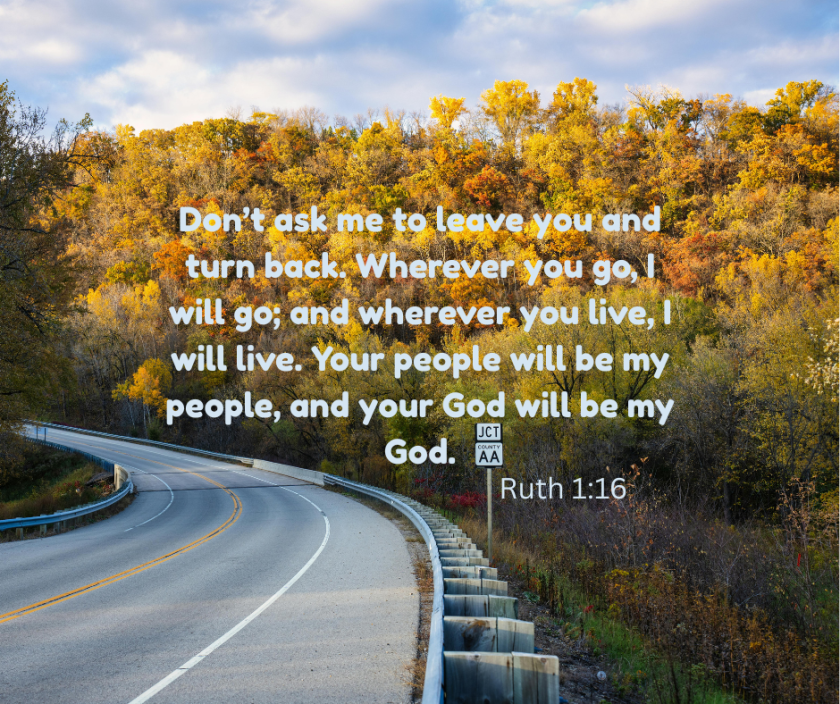
While Orpah chose to return home, Ruth chose to continue on with Naomi, declaring, “Don’t ask me to leave you and turn back. Wherever you go, I will go; and wherever you live, I will live. Your people will be my people, and your God will be my God” (Ruth 1:16). Ruth not only pledges herself to Naomi and her people, but to Naomi’s God – the true and living God of Israel.
Don’t ask me to leave you and turn back. Where ever you go, I will go; and where ever you live, I will live. Your people will be my people, and your God will be my God.2
Ruth 1:16
When they arrived back in Bethlehem, Naomi told those who greeted her not to use the name Naomi but to use Mara instead, explaining that the Lord had dealt very bitterly with her; she had gone away full but had returned empty. She no longer felt worthy of the name Naomi, which means ‘pleasantness’, because clearly bitterness had consumed her.
It is important to note, as the study guide points out, that there are many names changed by God throughout Scripture (Abram to Abraham, Sarai to Sarah, Jacob to Israel, Saul to Paul…), but here, Ruth changed her own name because she was convinced that “the Lord had testified against her and the Almighty had afflicted her.”
It is important to notice that Naomi wasn’t oblivious to the drastic changes that occurred in her life, which were having a great impact on her. One commentator points out that this is most evident in her statement that “the Almighty(supreme ruler) had afflicted her,” instead of using the more personal name of Yahweh (the God who cares).
I went looking for answers as my own mind started questioning if the suffering of Naomi and her family was due to sin, such as their leaving Bethlehem due to the famine, or dwelling in the pagan land of Moab instead of staying and trusting God to carry them through the famine.
Concerning Naomi’s belief in the trouble that had come to her family, commentator David Guzik points out:
i. It is hard to say that this was the direct hand of God’s judgment against them. It is sometimes difficult to discern why tragic things happen. What is certain is that the change of scenery didn’t make things better.
ii. We sometimes think we can move away from our problems, but find we just bring them with us. No matter where you go, you bring yourself with you – so the same problems can continue in a different place.
Reflection and Application
Reflection: Naomi serves as an example that:
- Even after great pain and sorrow, we can return to where God would have us be.
- Sorrow can change our character if we let it.
Application: Consider these questions:
- How have you needed to return to the Lord in the past?
- Has bitterness ever affected you?

