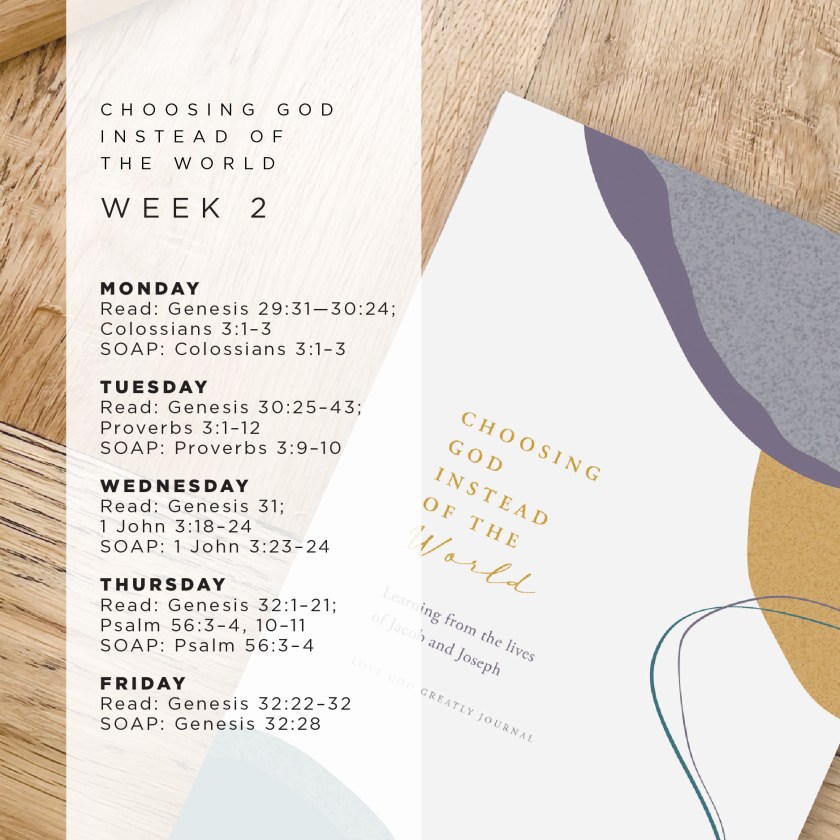
In the second week of our study, we will watch as Jacob contends not only with his “sister-wives” but their servants given to him as early prototypes of ‘surrogate mothers’. If it sounds like a lot of drama – it is, with all of the jealousy, guilt, manipulation, and discontent you might imagine. We will also watch as Jacob becomes the father of 11 sons and at least one daughter, he seeks Laban’s permission to leave for his homeland, and prepares to reconnect with Esau. In the midst of the unfolding story we will continue to learn why and how to choose God instead of the world.
We will continue to work on our memory verse from John 14:15
But this week’s focus verse(s) will come from day one’s reading of Colossians 3:1-3. A passage that we will see the need for in Jacob’s life story as well as our own.
Therefore, if you have been raised with Christ, keep seeking the things above, where Christ is, seated at the right hand of God. Keep thinking about things above, not things on the earth, for you have died and your life is hidden with Christ in God.
Colossians 3:1-3
This Week’s Challenge from the team at Love God Greatly:
This week, record the major events of Jacob’s life. Do these things occur because of Jacob’s plans or God’s deliverance? How does Jacob’s manipulations or impatience affect each outcome? Take time to reflect on the ways you attempt to “help” God accomplish His purposes.
What a week we’ve had traveling through the early stories of Jacob, from his birth as a twin to his most recent ordeal of thinking he had married Rachel, only to wake up to discoverit was Leah he had married. We’ve seen him trick his twin brother, Esau, out of his birthright … deceive his father, Isaac out of the covenant blessing that rightfully belonged to Esau … leave home and family to look for a wife among his mother’s people – an unplanned trip prompted by Esau’s plan to kill Jacob … connect with his mother’s people, fall in love with Rachel, work for his uncle Laban for seven years on the promise of Rachel’s hand in marriage, and now realizing that Laban had deceived him just as he [Jacob] had deceived his brother and father. I think you would agree we’ve seen some pretty good examples of why we should choose God over the world – why we should walk by the Spirit and not by the flesh.
During our second week we will explore the rest of Genesis 29 through Genesis 32 with a couple of side-trips through the New Testament as well as the Psalms and Proverbs. I hope you’ll stick with me on this journey through God’s Word – as we explore the ways and benefits of Choosing God Instead Of The World .
If you missed any of the posts – no need to search – you’ll find the links below.
Don’t be misled—you cannot mock the justice of God. You will always harvest what you plant. 8 Those who live only to satisfy their own sinful nature will harvest decay and death from that sinful nature. But those who live to please the Spirit will harvest everlasting life from the Spirit. 9 So let’s not get tired of doing what is good. At just the right time we will reap a harvest of blessing if we don’t give up. Galatians 6:7-9
Observation:
The sequence of events…
Jacob dupes Esau, deceives his father, and because his life is in danger he leaves home to find a wife among his mother’s people. On the way he has an encounter with God in a dream – which leads him to both worship and commit himself to God, following the encounter he finds his mother’s brother,Laban… falls in love with Laban’s younger daughter, Rachel … offers to work for Laban for seven years in order to marry her … works the seven years – but wakes up the morning after the wedding only to find out he had married her sister, Leah. Apparently, Laban had done to Jacob what Jacob had done to his brother and father. [Of course now we have an ‘elephant in the room’ – because the question begs to be asked, how in the world do you not know which sister you married until the morning after? While the answer isn’t given in Scripture the possibilities could be anything from “too much wine for Jacob, elaborate veils, cultural modesty, or Jacob’s wedding night nervousness caused him to miss this key fact, but we don’t really know1“.]
Just as Jacob’s deceitfulness had lasting consequences on his father, mother, and brother – as well as untold others – so it was with Laban’s trickery. The trick not only affected Jacob but Rachel and Leah and generations to come.
The Lesson
As we learn from Paul in Galatians 6:6-10, God’s grace does not negate the consequences of our choices and actions.
Application: How Then Should We Live?
According to the passage in Galatians, where Paul warns, “a person will reap what he sows”, and in light of Jacob’s experience, both as the one who deceived and the one who was deceived it is clear by God’s Word that we are to be careful with our choices – neither deceiving nor allowing ourselves to be deceived. This being true we must walk by the Spirit and not the flesh, and we would be wise to remember that while we may not aways see that what we do matters – it does. Therefore we must keep living in a way that agrees with our profession of faith. Or as Paul said to Timothy,
“Fight the good fight of the faith. Take hold of the eternal life to which you were called and about which you made the good confession in the presence of many witnesses.”
1 Timothy 6:12 ESV
Prayer: Response to God’s Word
Father – discipline is never easy and Your discipline is even harder to bear – in part because of the consequences we face but also because it grieves my spirit to know I’ve disappointed You. Thank You for the reminder to make good choices, to walk in the Spirit and not the flesh, and to consciously live in a way that reflects my profession of faith. – In His Name and Power – AMEN!
Your Turn:
What’s your take away from today’s reading?
Have you experienced times when God has clearly disciplined you?
What’s more, I am with you, and I will protect you wherever you go. One day I will bring you back to this land. I will not leave you until I have finished giving you everything I have promised you.” Genesis 28:15
Observation:
“Meanwhile Jacob left Beer Sheba and set out for Haran.” Isn’t it always in the “meanwhiles” of our lives that hope is most appreciated? Such is the case here with Jacob. Such a beautiful story of God introducing Himself to Jacob in a dream. God confirmed with Jacob the very thing His father had prayed over him would come to pass. The descendants and the lands and even more than Isaac asked or imagined … Jacob and his descendants would be the conduits of the blessings to all the families of the earth. God promised His presence and protection and to never leave him until all the promises had been fulfilled.
The beauty of the story doesn’t end with the promise of blessings that God speaks to Jacob but it culminates with Jacob’s response of worship and commitment to God.
Then Jacob awoke from his sleep and said, “Surely the Lord is in this place, and I did not know it.” 17 And he was afraid and said, “How awesome is this place! This is none other than the house of God, and this is the gate of heaven.”So early in the morning Jacob took the stone that he had put under his head and set it up for a pillar and poured oil on the top of it. 19 He called the name of that place Bethel, but the name of the city was Luz at the first. 20 Then Jacob made a vow, saying, “If God will be with me and will keep me in this way that I go, and will give me bread to eat and clothing to wear, 21 so that I come again to my father’s house in peace, then the Lord shall be my God, 22 and this stone, which I have set up for a pillar, shall be God’s house. And of all that you give me I will give a full tenth to you.”
Genesis 28:18-22 ESV
Application: How Then Should We Live?
While we may not trick a family member out of their ‘birthright or deceive an aging father into thinking we are the one who rightfully deserves his blessing, or encounter God in a dream like Jacob did. We would be wise to listen and look for the daily blessings He lavishes on us that reveal His grace, grace that exceeds our sin and our guilt, just like it did Jacob’s. When we see this clearly like Jacob did we will be much more likely to respond like he did – with worship of and commitment to God.
Prayer: Response to God’s Word
Thank you for words of hope God. Whether we are fleeing for protection from danger or looking to find a mate – a job – or something else – These words fill us with HOPE that reminds us You are there – in control. You are with us and in Your goodness, You go ahead of us, and You are faithful to Your promises! – To Your name be all glory and praise – Amen!
Your Turn:
What’s your take away from today’s reading?
How do you respond when God intervenes in your life?
Are you led to worship like Jacob was, or do you tend to explain His work as mere coincidence?
May God Almighty bless you and give you many children. And may your descendants multiply and become many nations! 4 May God pass on to you and your descendants the blessings he promised to Abraham. May you own this land where you are now living as a foreigner, for God gave this land to Abraham.” Genesis 28:3-4 NLT
Observation:
Jacob had tricked Esau, his brother, out of his birthright and deceived his father, Isaac, into giving him the blessing that rightfully belonged to Esau, as the firstborn. which eventually led to the Covenant blessing that we find in chapter 28 and verse 4. In my human understanding I am blown away by Isaac’s prayer of blessing on his son even after all Jacob had done. In spite of the trickery, manipulation, and deception Isaac blessed Jacob with all of “the wealth and political power” that was his to give1 and ultimately he prayed for God to bless Jacob with the descendants and the land that had been promised to Abraham.1
Jacob will leave Isaac’s household with both Isaac’s blessing for wealth and political power and the covenant blessing of God with Abraham for multitudes of offspring and possession of the land.
1 Bibleref.com commentary on Genesis 28:4
In this ‘covenant blessing, Isaac acknowledges that God is in control. He recognizes God’s promises that Abraham’s descendants would be vast and acknowledges Jacob will be the one to possess the land promised to God’s people.
He prayed words that spoke of trusting God to be in control. Regardless of the way things appeared, Isaac trusted God to keep His promise. He kept his eyes on God and did not lose sight of the covenant He had made with Abraham.
Application: How Then Should We Live?
Trust God It’s not always easy, some might say it’s one of the most difficult parts of the Christian life – but it is none-the-less the example Scripture gives us – trust God, don’t lose sight of His promises. Trust Him even when things appear to have worked out wrong, trust Him when you’ve been wronged, and trust Him when you can’t see any hope that His promises will come true. In other words, when life and people disappoint us – we should still trust God.
I believe the key to trusting God is to keep our eyes on Him. The prophet Isaiah said, God would keep in perfect peace those who trust in Him, those who fix their thoughts on Him. In the New Testament, after giving instructions to not worry about anything but to pray about everything, Paul encouraged the believers to fix their thoughts on God – to think – not about things that had them worried or upset, but rather to think about things that are true and honorable, and right and pure, lovely and admirable, or excellent and worthy of praise. When these are the thoughts we dwell on, regardless of our circumstances, not only will we know God’s peace but our prayers will undoubtedly be less frantic and more like the Covenant blessing that Isaac was able to pray over his son. A prayer of hope and faith in His God and in the promise He had made of future blessing – even though his son’s actions had changed the expected path of God’s promise to Abraham.
Prayer: Response to God’s Word
Father, thank You for the reminder of Your complete control but even more how we are to respond in the midst of what doesn’t go the way we thought it was supposed to. Help me to keep my eyes on You and Your promises – and to pray accordingly. – Yes and amen!
Your Turn:
What’s your take away from today’s reading?
Do you believe God will provide for you without your help?
In what ways do you depend on your own strengths or cleverness instead of depending on God?
Do Not Love This World
15 Do not love this world nor the things it offers you, for when you love the world, you do not have the love of the Father in you. 16 For the world offers only a craving for physical pleasure, a craving for everything we see, and pride in our achievements and possessions. These are not from the Father, but are from this world. 17 And this world is fading away, along with everything that people crave. But anyone who does what pleases God will live forever.  1 John 2:15-17
Observation:
Sight, sound, touch, hearing … our senses are catalyst for desires. From things we need to things we enjoy to things we’ve never tried but know someone else enjoys – from the time of the garden – our desires have been an issue. John’s warning about these desires is simple – they are not from God but from the world. He also reminds his readers that the world will one day come to an end while God’s kingdom and all who choose His will over the world’s- will live forever.
Seems like an easy choice, right? So why is it that, like Eve, we see something and it looks pleasing to the eye so we ignore what we know to be the right choice and go for the desirable? We all know the eyes aren’t the only culprits, all of the senses we have get involved and pull our attention in all sorts of directions that ultimately lead to desires and choices that may not line up with God’s will. Oh that we would consider John’s warning and check our desire against His Word before we take a bite of what the world is offering, which in Esau’s case was food versus his birthright.
He was famished, and most likely depleted of strength and energy to make the right choice or to care about anything other than his hunger. This is obvious by his reaction to Jacob’s proposition of the bowl of stew for Esau’s birthright. Esau certainly wasn’t about to die – he simply valued and desired the appetite of his flesh more than his birthright as Isaac’s oldest son.
Application: How Then Should We Live?
1 John 2:15-17 is a perfect companion, though an antithesis of sorts, to the example of Esau and Jacob that we find in the Genesis passage. John teaches his readers “[don’t] love the world or the things in the world”. So sure is he of this teaching that He declares the person who loves the world “does not have the love of the Father in Him”. He zeroes in on the “desires of the flesh”, pointing out that “the world offers only a craving for physical pleasure, a craving for everything we see, and pride in our achievements and possessions” (NLT). These, John says, are not from the Father. BibleRef.com’s explanation of verse 17 says it best – concluding “John’s condemnation of worldly thinking. John notes that this world is temporary. The world is temporary for each person, since every person dies. The physical earth is also temporary, since God will make a new earth in the end (Revelation 21—22). As a result, the desires of this world are also temporary.” The bottom line to our question of application and how we should live is this, “Believers are to resist evil desires, following the example of Jesus” (Matthew 4:1–11).
My synopsis, Don’t allow ourselves to become so enamored with the desires, the teachings, the thinking, of this world that they overtake us– and change the focus of our faith and what’s important to God, our heavenly Father. Feed the Spiritual-self, actually saturate ourselves with the Word so we don’t fall prey to the desires of the flesh. Finally, value what the Father values so that we do not trade the will of the Father and “a life lived in fellowship with Him”, for the ways and things of the world. To be sure, “doing God’s will cannot save us, — We are saved by Christ’s sacrifice, when we put our – faith in Him (Ephesians 2:8–9). However, a natural outcome of salvation is a desire to do God’s will (Ephesians 2:10). This is a hallmark of the believer, and only the believer will live with God forever. — Doing God’s will or desires is to be the goal of the believer.”1
1quotes from Bibleref.com on 1 John 2:15-17
Having opened their eyes to the wrongness of loving the things of the world John drives the point home by making sure they understand the futility of choosing the world – since “this world is fading away, along with everything that people crave. But anyone who does what pleases God will live forever”.
MefromtheNsideout and 1 John 2:17 NLT
Prayer: Response to God’s Word
Father, the world offers us much to love and to choose from – they are readily available and accessible – guard us from temptations of thinking, acting, and talking or living like the world. Help us to be so saturated with Your Word and aware of Your Presence so that we don’t fall prey to the deceivers of this world. – In Jesus’ Name!
Your Turn:
What’s your take away from today’s reading?
What does it mean to choose the things of God?
Can you choose the things of God and the things of the world? Why or why not?
But now, O Jacob, listen to the Lord who created you.
    O Israel, the one who formed you says,
“Do not be afraid, for I have ransomed you.
    I have called you by name; you are mine.  Isaiah 43:1
Observation:
I love that our reading gives us a glimpse of Jacob’s story to go with our key verse. From the brief glimpse we learn not just that Jacob was the son of Isaac and Rebekah, and the grandson of Abraham, but I love that we also see that Isaac prayed to the LORD on behalf of Rebekah because she was childless. Not only did God answer Isaac’s prayer but He filled her womb with twins. We will look more at Jacob through the story in Genesis in the coming days but today we find a message delivered to “Jacob” by Isaiah the Prophet.
First let’s establish that Isaiah’s message is from God, then we should clarify who Isaiah is speaking to. While Isaiah references both Jacob and Israel, it is helpful to know that these names are now synonymous. This is because God had renamed Jacob Israel after he overcame his struggle with God (Gen 32:8). At some point the names also became the name of God’s people which can add some confusion when reading through certain passages. Suffice it to say for this passage, Isaiah’s use of the names are both in reference to the people.
A Message of Hope
So, here in Isaiah 43:1, God is delivering a message of hope through Isaiah to His people, the people He had chosen, or as stated here – those He had formed and called by name. A more in-depth reading of Isaiah 43 would reveal that God’s people would be scattered to other nations – thus the message of hope in verse one. God is telling them not to be afraid when troubles come because He would protect them, and as Isaiah goes on to say, God would gather them back together again.
While God sent this message specifically to the Jewish people, we can rest assured that it also applies to us who are believers in Jesus Christ. For according to Galatians 3:6-9, which we will look at on day five of our study, we are the children of Abraham, grafted in through our faith in Christ, (Rom 11:17).
In the same way, “Abraham believed God, and God counted him as righteous because of his faith.” 7The real children of Abraham, then, are those who put their faith in God. 8What’s more, the Scriptures looked forward to this time when God would make the Gentiles right in his sight because of their faith. God proclaimed this good news to Abraham long ago when he said, “All nations will be blessed through you.”9So all who put their faith in Christ share the same blessing Abraham received because of his faith.
Galatians 3:6-9
This is one of my favorite truths of Scripture, as I imagine it brings me the same hope it brought to those in Isaiah’s day, to know that He calls me by name and will protect me, therefore I do not need to be afraid. Such truth and hope speaks peace to the fears, troubles, and concerns of this life.
Prayer: Response to God’s Word
Father, what an awesome God you are and have always been and always will be! You love with an everlasting love, grafting us in to Your family so that we can claim Your promises that are yes and amen in Jesus Christ. Thank You that we do not have to be afraid, for we know you are with us and will protect us because You have called us by name – we are Yours! Amen and Amen! In Jesus Name –
Your Turn:
Find a journal and jot down your thoughts/answers. I believe you will find it a great enhancement to the study.
Scripture Reading: Malachi 1:6-8, 3:1, 4:5-6; Matthew 11:14, Luke 1:17; and Isaiah 57:14-19
God Forgives the Repentant14 God says, “Rebuild the road Clear away the rocks and stones so my people can return from captivity.” 15 The high and lofty one who lives in eternity the Holy One, says this: “I  live in the high and holy place with those whose spirits are contrite and humble. I restore the crushed spirit of the humble  and revive the courage of those with repentant hearts. 16 For I will not fight against you forever; I will not always be angry. If I were, all people would pass away—all the souls I have made. 17 I was angry,
so I punished these greedy people. I withdrew from them, but they kept going on their own stubborn way. 18 I have seen what they do, but I will heal them anyway! I will lead them.
I will comfort those who mourn, 19 bringing words of praise to their lips. May they have abundant peace, both near and far,” says the Lord, who heals them.  Isaiah 57:14-19  NLT
Observation: What’s the Message?
Every day, throughout this study, I have read the verses and looked for ways that they point us to our need for Jesus. Some passages have been more obvious than others but today’s proved to be challenging for me. Here’s where I landed …. Malachi 1:6-8 was a reminder that our sins require a sacrifice acceptable to God, but then it also prompted to praise God that Jesus is forever a perfect sacrifice. This reminded me that The sacrifice pleasing to God is a broken spirit. God will not despise a broken and humbled heart. The other two passages from Malachi as well as the ones from Matthew and Luke seem to point us yet again to John the Baptist and his role as the one who would prepare the way for our Lord.
The sacrifice pleasing to God is a broken spirit. God, You will not despise a broken and humbled heart.
Psalm 51:17
It is the passage from Isaiah however, that captured my attention. I confess it grabbed my attention mostly because I couldn’t figure it out and that always bugs me – so I chased down some information on its meaning and was glad I did. From all that I read, my synopsis is – it’s all about Christ making a way for us to have a relationship with God! However, I want to share with you a few bullet points from an article I read that I hope will help you reach the same ‘hallelujah’ I did.
Christ is the one who opens the way for a great returning to God (14)
Christ is the one in whom the “lofty one” – whose name is Holy comes to dwell with the oppressed and lowly (15)
Christ’s death is why God can acquit a guilty people without dropping the charges (16)
It is by Christ’s stripes that we are healed (18)
Everything hoped for in this passage comes to us – even to us Gentiles – in Jesus Christ.
Piper, from whose article I borrowed these points, went on to say, “We can read it as a personal offer of hope to any of us who will accept the healing of humbling and the cure of a crushed spirit.”
Application: How Then Should We Live?
From the inferior sacrifices of Malachi’s day to yet more reminders of John coming to prepare the way we are once again reminded of our need for Jesus. If we do not acknowledge this need daily, in both our hearts and minds, I am convinced that we will live as though we do not need Him.
We must not allow ourselves to live as though we can save ourselves or make ourselves better – we need a savior and that savior cannot be a pastor, a church, a child or spouse or friend, it can not be a job or good works. The only savior able to meet the demands of our Holy God is His Righteous Son, Jesus Christ.
Sin is the key because it is often the stumbling block that keeps us from dealing with the daily reality of our need for Jesus. We convince ourselves the questionable things we think, do, say, or watch really aren’t that bad. We play the grace card sometimes before we’ve even committed the sin – content that He will forgive us – we proceed with the sin. We should not make light of sin or treat it as a mistake – we need to humble ourselves before Him, confess our sin for what it is and deal with the sorrow that contrition brings. Remember, a humble and contrite heart He will not despise and according to this passage in Isaiah it is with the contrite and humble that He lives.
Prayer: Response to God’s Word
Father, how blessed we are that You sent Jesus to open a way to You, to acquit us of our quilt, to come and dwell among us, to heal us by His stripes, and to offer us hope and an eternal future with You. May we daily consider what You have done for us and live accordingly. Guard us from living in ignorance or rebellion – knowing what You’ve done for us but choosing our own way over Yours. Help us to be aware of our sin and may it make us contrite and humble, for it is with a humble and contrite heart You will dwell. To You be the glory, honor, and praise now and forever – Amen!
6 God sent a man, John the Baptist, 7 to tell about the light so that everyone might believe because of his testimony. 8 John himself was not the light; he was simply a witness to tell about the light.
John 1:1-8 NLT
Observation: What’s the Message?
The message could just be that Jesus is the Word, that He was with God in the beginning, or that He was involved in all of creation. Certainly, before today when I thought about John chapter one that is the message I would have repeated. However reading it again today I was reminded that there is perhaps an even deeper more pertinent message – and that is that “life was in Him, and that life was the light of men. His was a light that could not be overcome by the darkness – a light that God sent so that all might believe and be saved through Him. A light that never goes out and is never overcome by the darkness. His is the light that guides our path and leads us to God.
Application: How Then Should We Live?
Day after day the Scriptures we have been going through point us to our need for Jesus. The one John the Baptist was sent to announce and prepare the way for. The One who is The Vine, our source of life enabling us to bear fruit. The One who is our Hope. The One who saves us from being alienated from God. The One who “became human and made His home among us … and who revealed God to us. The One who is both life and light to those living in darkness, dead in their trespasses and sins.
These truths, that in one way or another led us all to Christ, are the truths we are meant to cling to, motivation to seek Him daily and that remind us – we are to be lights for Him – the One true Light! We are messengers sent by God into all the world to bear witness of Him and testify of Him so that all will be believe and be saved.
Prayer: Response to God’s Word
Father, thank You for shining the Light of Jesus into the world, and especially – into my life so that I might be saved!. Thank You for those You sent to share the message with me, to testify about Jesus so that I might hear the good news and know who Jesus is! Father, may I be Your messenger and testify of Your goodness so that others might believe and be saved – In Jesus’ name –
What does John 1:7 mean? John the Baptist’s role as a witness is central to verse 7. He is sent to tell other people about the coming Messiah, which is Jesus. “Light” was the ultimate standard for Israel. Everything good was said to be “light,” evil was “darkness.” This not only implies good and evil, but knowledge and darkness. Just as Moses, the Old Testament law, and the temple were small lights pointing to Jesus, John the Baptist is a tiny light leading people to the One True Light. And, not just so that they would see, but so that they would believe. John’s ministry heavily revolved around baptism, which was already known to Jews of that time. Jews would sometimes baptize a person who wanted to convert to Judaism. But the Baptist was “converting” Jews! This is one reason he was interrogated by local religious leaders: why would God’s chosen people need to repent and convert? Bibleref.com
… ‘Prepare the way for the LORD’s coming! Clear the road for him! The valleys will be filled, and the mountains and hills made level. The curves will be straightened, and the rough places made smooth. And then all people will see the salvation sent from God.”
Prove by the way you live that you have repented of your sins and turned to God. Don’t just say to each other, ‘We’re safe, for we are descendants of Abraham.’
Luke 3:4-6, 8 NLT
Observation: What’s the Message?
“Prepare the way for the Lord, make His path straight,” basically – get all of the obstacles out of the way. from repentance of sins to everything else in-between, the goal was to help people be ready to meet the Messiah. The hope was those who heard the message would turn from their own ways to follow Jesus. We’ve looked at this message several times in this study – focusing on various aspects of it. However, in Luke’s version, what drew me in was John’s conversation with the crowds who were coming to be baptized. I’m sure he captured their attention with his flattery. I mean who doesn’t want to be addressed as a “brood of snakes”? On top of that he critiques their behavior as sinful by challenging them to “prove they’ve repented and turned to God”, and their attitudes as arrogant, thinking they had no need to repent because they were ‘descendants of Abraham.’ He bluntly let them know that God could call or create children from any means He desired, even a stone.If that wasn’t enough he zeros in on the fallout they will face if they choose their way instead of God’s. Some may think John harsh but he was simply and faithfully doing what he was born to do – prepare the way for the Lord”.
“You brood of snakes! Who warned you to flee the coming wrath? 8 Prove by the way you live that you have repented of your sins and turned to God. Don’t just say to each other, ‘We’re safe, for we are descendants of Abraham.’ That means nothing, for I tell you, God can create children of Abraham from these very stones. 9 Even now the ax of God’s judgment is poised, ready to sever the roots of the trees. Yes, every tree that does not produce good fruit will be chopped down and thrown into the fire.” Luke 3: 7-9
Application: How Then Should We Live?
It’s not the first time we’ve read about “bearing fruit” in this study. We’ve looked at the branches and the vine as well as the gardener and how he handles the branches. However, the first time we looked at it was when Jesus was teaching His disciples – while this time it is John trying to prepare those who have yet to meet Jesus. He wants them to understand that their repentance must lead to real change that produces fruit that makes the change visible. He especially doesn’t want them depending on their heritage in Abraham as their saving grace. While salvation places us into a community of faith it is not a communal faith. What I mean is this, each of us must believe in the Lord Jesus Christ to be saved. I can not get to heaven because my mother took me to church all the time or my grandmother had faith in Jesus. Nor am I saved because my grandfather taught Sunday School or my father was a deacon. Perhaps most who are reading this understood this truth before you read it here but John’s listeners would not have understood. The Israelites made up the crowd that John was speaking to, and being descendants of Abraham, he desperately needed them to understand that their heritage did not, could not, and would not satisfy the call of repentance
While salvation places us into a community of faith it is not a communal faith.
Prayer: Response to God’s Word
Father, from the beginning You called us to be devoted to You. For Adam and Eve it was that “one rule” – and through the generations since that time it has been the same – Choose Your way over what our eyes see as pleasing or our hearts desire. Help us to heed these words of John – and live in ways that prove our repentance, producing fruit that displays love, joy, peace, patience, kindness, goodness, faithfulness, gentleness, self-control and all things in accord with Your Spirit. So that others will see Jesus whom You sent to save the world.
Your Turn:
So what’s your take away from today’s Scriptures?
What are you doing or what can you do to prepare the way for the Lord?







 Me From the Inside Out