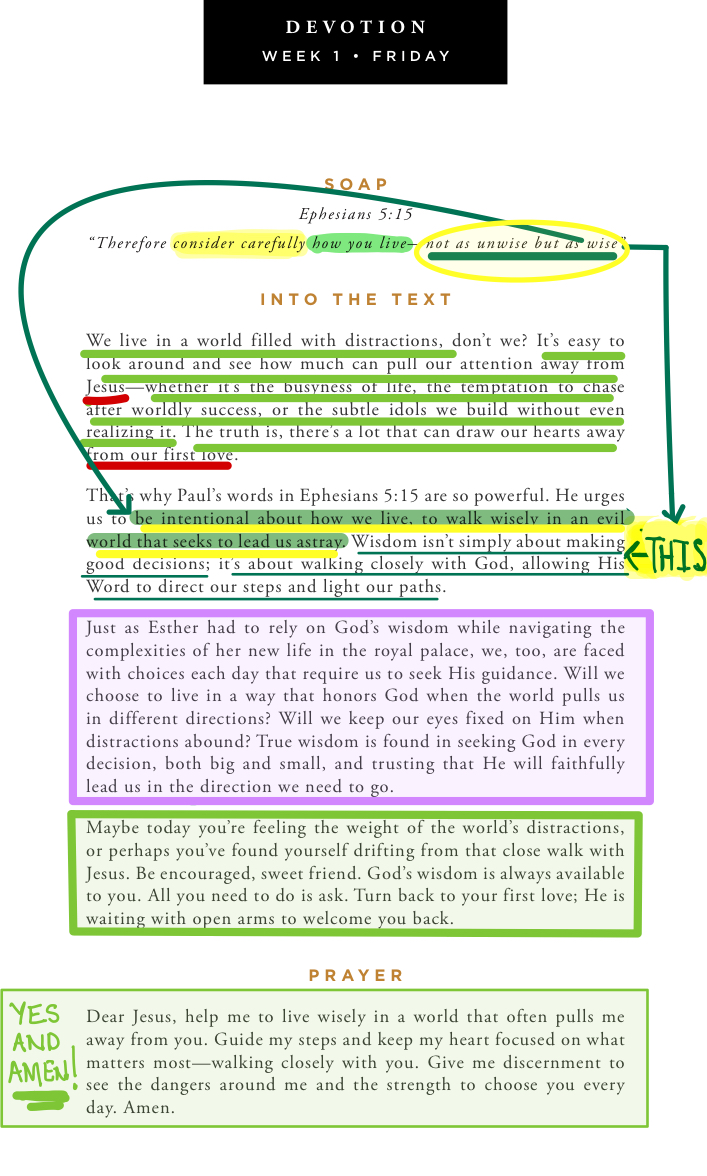
Therefore, consider carefully how you live – not as unwise but as wise – Ephesians 5:15
Read: Esther 2:1-4 and SOAP: Ephesians 5:15
“For Such A Time As This,” as we will see throughout our journey, applies to Esther in her day and—as we have seen this week—we can learn much from the truths that surround her story. Of course, not in the sense that we live in palaces filled with riches to display or have week-long ‘banquets’ celebrating our wealth and power—but surely we live in a world filled with distractions of other varieties, wrong responses, demanding our own way, and the temptation to follow the world’s ways rather than God’s. Which is why today’s SOAP passage points us to the words of Paul in Ephesians 5:15.
We mustcarefully consider how we live. Specifically, we are to live as wise and not unwise. This lesson is important and one that will play out throughout the rest of our journey. The question is, how do we do live as wise and not unwise? Today’s journal entry1 has a wonderful answer … May we take it to heart and daily seek God’s help to walk wisely in such a time as this.
However, let each one of you love his wife as himself, and let the wife see that she respects her husband.
Ephesians 5:33
As we saw yesterday, the king’s counsel was not from “godly” men. Yet, when we observe the story of Esther carefully, we will see that God was working behind the scenes, setting the stage for Esther, a Jew, to become queen to the King of Persia.
Today’s study of Esther focuses on verses nineteen through twenty-two, which detail the advice given to the King by his counselors. Counsel that basically banished Queen Vashti and allowed for the King to choose a new queen. However, the passage also emphasizes the importance of making this known throughout the kingdom so that all the women will give honor to their husbands. Friends, whether we are married or unmarried, we must remember that “All Scripture is inspired by God and is useful to teach us what is true and to make us realize what is wrong in our lives. It corrects us when we are wrong and teaches us to do what is right.” (2 Timothy 3:16)
I realize that if we are not married, we may want to say Ephesians 5:33 doesn’t speak to us. However, as that thought came to my own mind, I was reminded that it is the call of God on every believer to love and respect Him (Deut 6:5; Mark 12:29-30). Likewise, regardless of our marital status, Jesus made it clear that we are to love others as He has loved us, (John 13:34); There is no qualifying statement indicating that we only have to do this “If he respects us;” nor do I find a qualifier for the words of Christ – commanding that we love just as He has loved us. Yet, I did find it good and helpful to read these words from today’s journal posting. I pray they are a blessing to you as well.
Marriage is a beautiful reflection of God’s love when both husband and wife seek to honor Him. In Ephesians 5:33, we’re reminded of the delicate balance in marriage. A husband is called to love his wife as Christ loves the church, and a wife is called to respect her husband. Both love and respect are essential for a thriving marriage. Just as a wife longs to feel loved, a husband desires to feel valued and respected.
But what happens when this balance is broken? In the story of King Ahasuerus and Queen Vashti, we see the consequences of love and respect missing from their relationship. The king’s request put Queen Vashti in a difficult position, asking her to do something she wasn’t comfortable with. Instead of protecting her, he unlovingly placed her in a situation that ultimately cost her the crown. This is not the way God intended marriage to be.
For those of us who are married, respecting our husbands is one way we show them love and appreciation. It’s how they feel cherished for the ways they lead and serve our families. But above all, we must first respect and honor God with our actions. When we choose to obey God, even when it’s hard, we trust that He sees us and will care for us, no matter the outcome.
Sweet sister, if you find yourself in a situation where standing up for what is right could come at a cost, be encouraged. God sees your heart, and He will always honor your obedience to Him.”
For Such A Time As This/journal p53
Prayer
Father, I pray for courage for every woman who belongs to you to courageously stand for what is right. For those who are married, help them, even when it is difficult, to honor You in their marriage by showing love and respect to their husbands. Whether we are married or unmarried, Father, help us honor You in all areas of our lives, trusting You to protect us and provide for every situation. Yes and Amen in Jesus’ name!
A fool is quick-tempered, but a wise person stays calm when insulted.
Prov 12:16
Perhaps because I have heard and seen firsthand how alcohol can alter or even obliterate one’s thoughts and decisions, as I read today’s portion of Esther, it was easy to jump to the conclusion that the king’s request and subsequent reactions were due to the effects of the wine. However, I was quickly reminded of how easy it is for any of us to let the distractions of this world alter our thoughts and choices. This reminder made me think of some words from the Apostle Peter, who warned his readers to be sober-minded (self-controlled) and alert. He told them, “Watch out for your great enemy, the devil. He prowls around like a roaring lion, looking for someone to devour.”1 Life is full of distractions … our jobs, our health, our families, schedules, tiredness, and emotions; there are also our needs and wants, finances, and obligations. Add to this list gadgets like phones that we carry and often scroll endlessly and mindlessly through, and it’s safe to say we are easy prey. These distractions often leave us vulnerable to the enemy’s schemes. While wine may have played a part in the king’s reaction, clearly, delight and pride in his possessions seemed to play a great part in the week-long celebration.
Prudent is an adjective that means to act with or show care and thought for the future.
Today’s journey picks up where we left off – with the added knowledge that Queen Vashti was also hosting her own banquet for the women in the palace of the King. We find the King still entertaining and celebrating with his guests, and Scripture says, “feeling the effects of the wine.” Whether this was the cause of the events that transpired from that point or whether it was simply the nature of the King, his decisions and actions were certainly not those of a wise and prudent king. Instead, he acted rashly, as one showing no care or thought for the future. Being caught up in his celebrations and wanting to show off his beautiful queen was likely not uncommon for the day. However, the unexpected refusal of the queen would have humiliated the King and wounded his pride, which is obvious in what followed. Though, before we get too judgmental of the King, consider these words from today’s LGG Journal entry:
“I read this and sit here judging King Ahasuerus, yet how many times have I been there, too? I request my children to do something, but they defiantly refuse while out in public. A friend I’ve known for years suddenly doesn’t seem to value our friendship and make time for me. Or when I’m in a rush to get to an appointment and a distracted driver cuts me off as they enter my lane. In all these situations, my heart begins to race, and I’m tempted to get angry and lash out. And in those moments, I realize I’m not as different from King Ahasuerus as I’d like to think.”3
I don’t know about you, but I can definitely relate to the above scenarios, which makes the journal’s closing comments on the Proverbs portion of today’s journey not only helpful but also encouraging. Take a moment to soak it in, and let’s make it a truth we live out.
“In Proverbs 12:16, we read that a prudent person ignores the insult. Wait, what? God wants me to overlook insults instead of fighting back? Webster’s dictionary says that “Prudent” means to act or show care and thought for the future. Instead of immediately responding to a negative situation and acting like a fool. God wants me to pause and think about the future, contemplate the situation, and, if possible, ignore the offense. When we contemplate the future, it gives us time to calm down and better evaluate the situation. And when possible, ignore the insult.”4
A Prayer of Response
Father, help us be women who are wise and not fools who are easily angered when we are offended or upset. Help us to consider the future and the impact our reactions can have on it and those around us. Strengthen us to stay alert and to represent you well – In the name of Jesus – Amen!
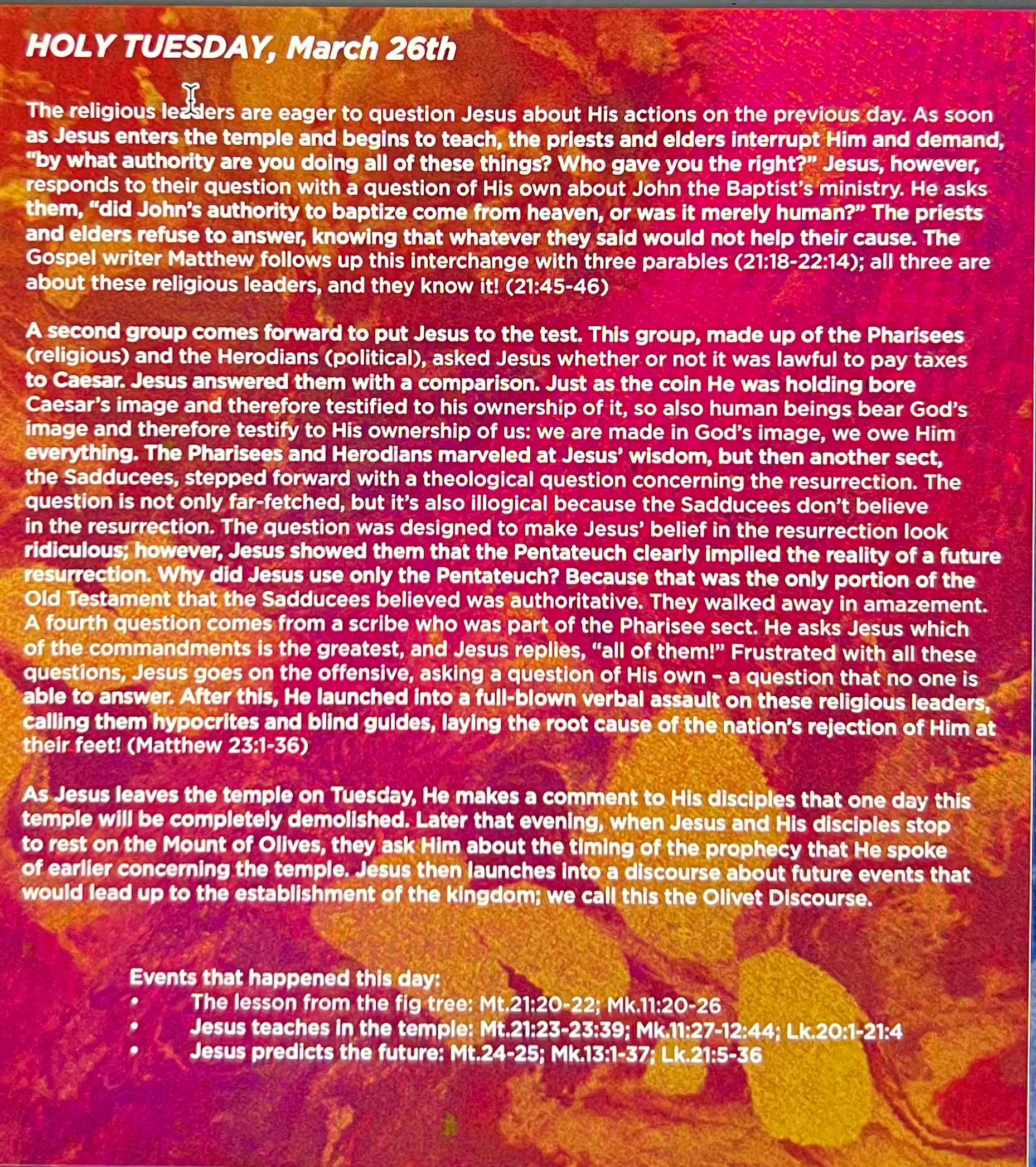
Now that Jesus had been arrested, the religious leaders wanted to try Him for His crimes. Jesus was tried six different times: the first three trials were before Jewish leadership, and the second three trials were before Roman officials. All six trials were expedited because the religious establishment wanted to arrive at the death sentence before the news of Jesus’ arrest got out among the people. Also, they needed the death sentence to be carried out before the Sabbath Day, which started Friday evening. The sixth and final trial takes place before Pilate. He renders his decision on the basis of expediency rather than truth or justice; he firmly believes Jesus to be an innocent man, but he also fears a riot and wants to satisfy the crowds who are yelling, “crucify Him!” In just a few hours, Jesus is tried six times and sentenced to death by crucifixion.
It’s almost 9 am as Jesus begins His journey to Golgotha by carrying His cross. At some point along the way, Roman soldiers force a man named Simon of Cyrene to carry Jesus’ cross because He is too weak. The site of Jesus’ crucifixion was outside of the city in keeping with the Jewish law requirement for executions (Heb.13:12). None of the Gospel authors provide any details concerning the actual crucifixion; they simply note the fact that it happened. Jesus was crucified at the third hour of the day (Mark 15:25), which is 9 am. Even on the cross, Jesus’ enemies continue to mock Him to the very end, “…He saved others, but He cannot save Himself…” (Luke 23:35-38). The irony is that if Jesus had come down from the cross, He would have saved Himself but not others. At noon, darkness descends on the land (Mark 15:33), lasting for three hours. At 3 pm, Jesus died for the sins of humanity (Luke 23:46). Immediately, the earth shook, and the curtain of the temple was torn from top to bottom, signifying that God’s people will now have direct access to God because of Jesus’ sacrifice. Jesus was taken off the cross before sundown and placed in a tomb provided by Joseph of Arimathea (Nicodemus assisted with the burial of the body). Two women, Mary Magdalene, and Mary (the mother of Joses) (Mark 15:47) observe Jesus’ burial location. They believe His body has not been sufficiently prepared because of the hasty nature of His burial; they plan to return after the Sabbath with additional spices and ointments.1
… Before we rush to Resurrection Sunday, let’s sit with the weight of Jesus’ sacrifice today. Let us sit with the pain of the Man of sorrows (Isaiah 53:3), who endured the wrath of God at the cross. Let us ponder the injustice of the spotless Lamb of God punished for our sins. Let us marvel at the astounding death of the Creator of life. Let us worship the King of glory who let go of the splendor of heaven to become flesh and blood, to humble Himself, to hunger and thirst, to suffer and hurt, to be betrayed and rejected, mocked and humiliated — all for love.
For the Good Friday Devo, please click the button below – you won’t want to miss it!
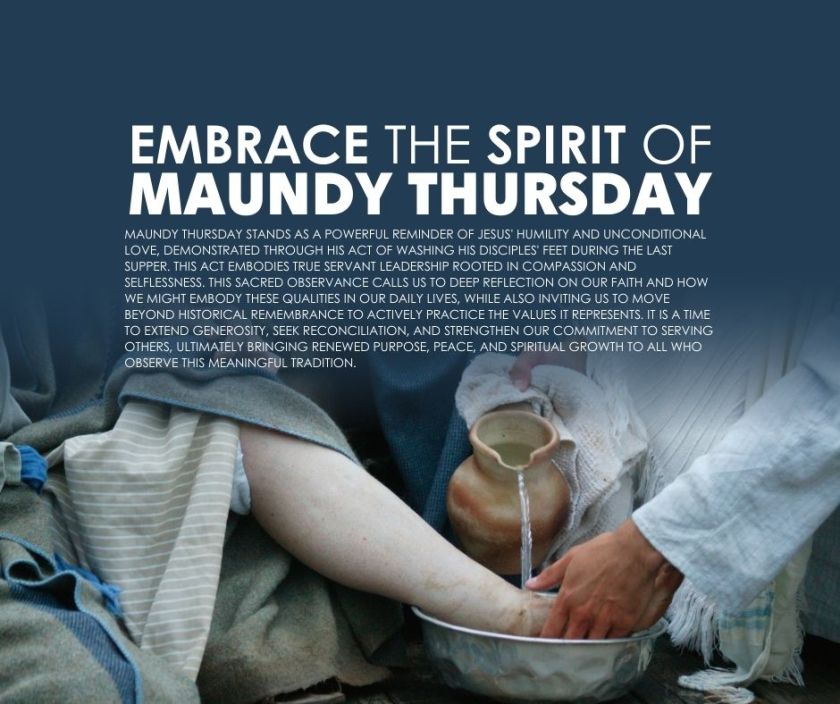
Jesus had already made initial contact with some of His followers in Jerusalem to secure a place in which the group would share in the Passover meal. Some scholars believe that Jesus’ arrangement of the meal location was made secretly so as to prevent Judas’ betrayal plot from interrupting the meal. Sometime during the meal, Jesus gets up and washes the disciples’ feet, even the feet of Judas. Jesus knew that Judas had already planned to betray Him (Jn.13:11), but He still proceeded to wash his feet anyway – that is the epitome of love. After the foot washing, Jesus makes a public declaration that there is a traitor at the table; the disciples are a bit confused about what Jesus meant, but Judas understands and promptly leaves the group to commence his actions of betrayal. As Jesus and His disciples continued the Passover meal, Jesus abruptly introduced a completely new explanation of the symbolism of bread and wine. These two elements now become part of our present-day observance of the Lord’s Supper (communion) as we remember His body and blood that were given in sacrifice for all humanity.
As the evening continues on, Jesus gives His followers some additional instructions because He knows that the time of His death is quickly approaching. These instructions are collected into a body of material that we often call the Upper Room Discourse. We can thank the Apostle John, as he is the only Gospel writer who includes this material (John 14-17). Toward the end of this discourse, Jesus offers up a prayer for His disciples (Jn.17:6-19) because He knows that these same disciples who are sitting at the table will fail in the face of persecution that very night. Specifically, He singles out Peter, saying that before the rooster crows, Peter will have denied Jesus three times. Of course, Peter vehemently denies that this would ever happen, assuring the Lord that he would follow Him to prison, even to death.
The night is late, and Jesus and His disciples head to the Garden of Gethsemane. The time for teaching and instruction is over, and the time for sorrow and distress is here. Jesus instructs the disciples to sit in a certain location while He takes Peter, James, and John with Him a little further to pray. Jesus pours out His heart to the Father, asking Him if there is any other way in which redemption can happen that would not include the cross. He knows He is about to bear God’s judgment as a sin sacrifice for all the world. Nevertheless, He knows that the Father’s will is by way of the cross, and He willingly submits Himself to the Father’s plan. Taking a break from His time of prayer with the Father, Jesus finds His disciples fast asleep. The only source of human support and help during the hardest moment of His life was sleeping away. Yet even in this shocking moment of the disciples’ carelessness, Jesus is more concerned for their welfare than His own – He knows that they, too, must pray so that they can be equipped to face the difficulties that lie ahead (Matt.26:41).
Judas, who left the scene earlier, now returns with a group of chief priests, Pharisees, and some Roman soldiers. Jesus steps forward and asks the group who they are here for, and when they answer, “Jesus of Nazareth,” Jesus replies, “I am HE.” When Jesus spoke these words (reminiscent of the phrase “I AM” in Exodus 3:14), the power behind those words caused the soldiers to retreat back and fall to the ground! Jesus permits the soldiers to arrest Him so long as they don’t arrest His followers. However, Peter does briefly resist by cutting off the right ear of the high priest’s servant; Jesus miraculously heals the ear and tells Peter that He must follow the Father’s plan. At this point, all the disciples flee the scene, leaving Jesus deserted and alone.
Events that happened this day: • The Passover meal: Mt.26:17-29; Mk.14:12-23; Lk.22:7-30; Jn.13:1-17:26 • Jesus predicts Peter’s betrayals: Mt.26:31-35; Mk.14:27-31; Lk.22:31-34 • The Garden of Gethsemane: Mt.26:36-46; Mk.14:32-42; Lk.22:40-46 • Jesus is betrayed: Mt.26:47-56; Mk.14:43-52; Lk.22:47-53; Jn.18:2-121
For Maunday Thursday Devo, please click the button below – you won’t want to miss it!
Where do you turn when you’re confronted with temptations, false accusations, or circumstances that cause you to doubt God? When we’re gripped by anger and hatred, it’s easy to say/believe we’ll never forgive or move past it, but what does God say about these situations? Or what about when you feel defeated by guilt, shame, and remorse? Do you hide from God or turn to His Word? These are just some of the tough situations we face in life. Speaking from experience, it’s far too easy to run from or turn away from God. I had a tendency to think I had to ‘fix myself’ first before I could run to God, but the truth I have come to understand is that the only true fix is turning to God and His Word. It’s there that we find instructions on how to deal with temptation or how we can overcome unrelenting anger and hatred. I truly believe, as I stated in the first part of this series, that for every discouraging, challenging, or overwhelming circumstance of your life, God’s Word has an encouraging answer filled with hope and light. So, again, I encourage you to print them off, write them down, or snap a picture with your phone. Read them often, share them with others, and praise God for them – knowing through them comes life and health and peace.
My son, pay attention to what I say; turn your ear to my words. 21 Do not let them out of your sight, keep them within your heart; 22 for they are life to those who find them and health to one’s whole body.
Proverbs 4:20-22
This collection of verses was originally published on gotquestions.org
When under powerful temptation: 1 Corinthians 10:13 “No temptation has seized you except what is common to man. And God is faithful; He will not let you be tempted beyond what you can bear. But when you are tempted, he will also provide a way out so that you can stand up under it.” James 4:7-8 “Submit yourselves, then, to God. Resist the devil, and he will flee from you. Come near to God and He will come near to you.” 2 Timothy 1:12 “He is able to keep what I committed to Him against that day.” Hebrews 2:18 “Because He Himself suffered when He was tempted, He is able to help those who are being tempted.” I am truly convinced, as I wrote in part one of this
When stung by your enemy’s false accusation: 1 Peter 3:14, 16 “But even if you should suffer for what is right, you are blessed. … keeping a clear conscience, so that those who speak maliciously against your good behavior in Christ may be ashamed of their slander.” Matthew 5:10-12 “Blessed are those who are persecuted because of righteousness, for theirs in the kingdom of heaven. Blessed are you when people insult you, persecute you, and falsely say all kinds of evil against you because of me. Rejoice, and be exceeding glad, because great is your reward in heaven” Romans 8:31-34 “What, then, shall we say in response to this? If God is for us, who can be against us? He who did not spare his own Son, but gave him up for us all—how will he not also, along with him, graciously give us all things? Who will bring any charge against those whom God has chosen? It is God who justifies. Who is he that condemns? Christ Jesus, who died—more than that, who was raised to life—is at the right hand of God and is also interceding for us.”
When circumstances lead you to doubt God: Psalm 42:5 “O my soul, why are you downcast? Put your hope in God: for I will yet praise Him, my Savior and my God.” Mark 9:24 “I do believe; help me overcome my unbelief!”
When gripped by unrelenting anger and even hatred: Ephesians 4:31-32 “Get rid of all bitterness, rage and anger, brawling and slander, along with every form of malice. Be kind and compassionate to one another, forgiving each other, just as in Christ God forgave you.” James 1:19-20 “My dear brothers, take note of this: Everyone should be quick to listen, slow to speak and slow to become angry, for man’s anger does not bring about the righteous life that God desires.” 1 John 4:20 “If anyone says, ‘I love God,’ yet hates his brother, he is a liar. For anyone who does not love his brother, whom he has seen, cannot love God, whom he has not seen.”
When defeated with guilt, shame, and remorse: 1 John 1:9 “If we confess our sins, He is faithful and just to forgive us our sins, and to cleanse us from all unrighteousness.” Romans 8:1-2 “Therefore, there is now no condemnation for those who are in Christ Jesus, because through Christ Jesus the law of the Spirit of life set me free from the law of sin and death.”
When about to go over the edge with overwhelming demands, pressures, and expectations: Matthew 11:28 “Come unto me, all you that labor and are heavy laden, and I will give you rest.” John 15:5 [Jesus said] “I am the vine; you are the branches. If a man remains in me and I in him, he will bear much fruit; apart from me you can do nothing.” Philippians 4:13 “I can do all things through Christ who strengthens me.”
When the road forks unexpectedly, or when the multiplied factors of a crucial decision bring darkening confusion: James 1:5 “If any of you lacks wisdom, he should ask God, who gives generously to all without finding fault, and it will be given to him.” 1 Corinthians 14:33 “God is not the author of confusion.” Proverbs 3:5-6 “Trust in the Lord with all your heart. Lean not on your own understanding. In all your ways acknowledge Him, and He shall direct your path.”
When you are famished of soul, longing for purity and righteousness: Matthew 5:6 “Blessed are those who hunger and thirst for righteousness, for they will be filled.” Psalm 23:3 “He leads me in paths of righteousness, for His name’s sake.”
When all roads have been cut off so that only despair seems left: 1 Corinthians 10:13 “No temptation has seized you except what is common to man. And God is faithful; he will not let you be tempted beyond what you can bear. But when you are tempted, he will also provide a way out so that you can stand up under it.” 2 Corinthians 4:8 “We are hard pressed on every side, but not crushed; perplexed, but not in despair.”
When the grave opens before you: John 3:16 “For God so loved the world that he gave his one and only Son, that whoever believes in him shall not perish but have eternal life.” John 11:25-26 “I am the resurrection and the life. He who believes in me will live, even though he dies; and whoever lives and believes in me will never die. Hebrews 2:14-15 “Since the children have flesh and blood, He too shared in their humanity so that by His death He might destroy him who holds the power of death—that is, the devil—and free those who all their lives were held in slavery by their fear of death.”
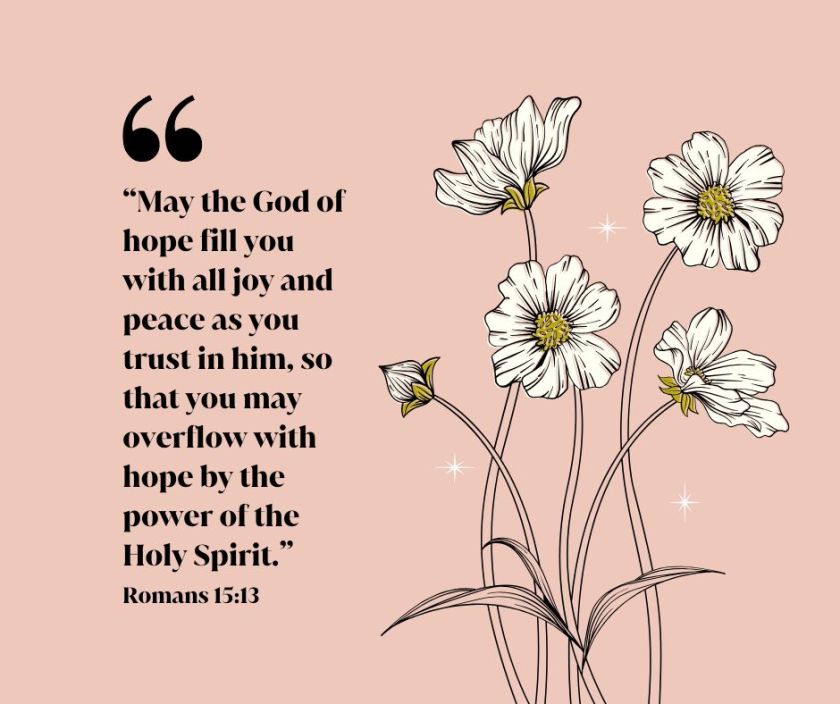
A blessing for all circumstances: Romans 15:13 “May the God of hope fill you with all joy and peace as you trust in him, so that you may overflow with hope by the power of the Holy Spirit.”
For every discouraging circumstance of your life, God’s Word has an encouraging answer filled with hope and light. Print them off, write them down, or snap a picture with your phone.
The collection of verses was originally shared by gotquestions.org
When you’ve lost something, or someone, who has been very precious to you: Matthew 5:4 “Blessed are those who mourn, for they shall be comforted.” Revelation 1:18 “I am alive forevermore.” John 11:25 “Jesus said to her, ‘I am the resurrection and the life. He who believes in me will live, even though he dies’”
When excruciating waves of chronic pain and weakness are crashing over your head: 2 Corinthians 12:9 “My grace is sufficient for you, for my power is made perfect in weakness.” Hebrews 4:16 “Let us then approach the throne of grace with confidence, so that we may receive mercy and find grace to help us in our time of need.”
When your cupboard is bare, and your last crumb has been scraped up: Matthew 6:33 “Seek first God’s kingdom and His righteousness, and all these things will be added to you.” Psalm 23:1 “The LORD is my shepherd, I shall not be in want.” 1 Thessalonians 5:18 “… give thanks in all circumstances, for this is God’s will for you in Christ Jesus.”
When no one seems to understand, or even to care: Psalm 55:22 “Cast your cares on the LORD and he will sustain you; he will never let the righteous fall.” Isaiah 40:11 “He tends his flock like a shepherd: He gathers the lambs in his arms and carries them close to his heart; he gently leads those that have young.”
When you are being persecuted for your faith: 2 Peter 2:9 “the Lord knows how to rescue godly men from trials and to hold the unrighteous for the day of judgment.” John 15:18 “If the world hates you, keep in mind that it hated me first.”
When the nation, the world, and even the family and the church, seem to be disintegrating: Isaiah 14:24: “The LORD of hosts has sworn, saying, ‘Surely, as I have thought, so it shall come to pass, And as I have purposed, so it shall stand.’” Jeremiah 29:11 “For I know the plans I have for you,” declares the LORD, “plans to prosper you and not to harm you, plans to give you hope and a future.”
When life’s fears and insecurities gang up on you: Psalm 27:1 “The Lord is my light and my salvation—whom shall I fear? The Lord is the stronghold of my life—of whom shall I be afraid?” Luke 12:7 “Indeed, the very hairs of your head are all numbered. don’t be afraid; you are worth more than many sparrows.” Romans 8:1 “There is, therefore, no condemnation to those who are in Christ Jesus.”
When your mood is dark: Psalm 118:24 “This is the day the Lord has made. Let us rejoice, and be glad in it.” Romans 8:29-30 “For those whom God foreknew he also predestined to be conformed to the likeness of his Son, that he might be the firstborn among many brothers. And those he called, he also justified; those he justified, he also glorified.”
When worn out and worn down to the point of giving up: Hebrews 12:2-3 “Let us fix our eyes on Jesus, the author and completer of our faith, who, for the joy set before Him endured the cross, despising its shame, and sat down at the right hand of the throne of God. Consider him who endured such opposition from sinful men, so that you will not grow weary and lose heart.”
When abandoned by everyone meaningful: Deuteronomy 31:6 “Be strong and courageous. Do not be afraid or terrified because of them, for the LORD your God goes with you; he will never leave you nor forsake you.” Hebrews 13:5-6 “… God has said, ‘Never will I leave you, never will I forsake you.’ So we say with confidence, ‘The Lord is my helper; I will not be afraid. What can man do to me?’”
When friends and even family seem to be abandoning God: Psalm 100:5 “God’s faithfulness endures through all generations.” 2 Timothy 3:1-4 “But mark this: There will be terrible times in the last days. People will be lovers of themselves, lovers of money, boastful, proud, abusive, disobedient to their parents, ungrateful, unholy, without love, unforgiving, slanderous, without self-control, brutal, not lovers of the good, treacherous, rash, conceited, lovers of pleasure rather than lovers of God”
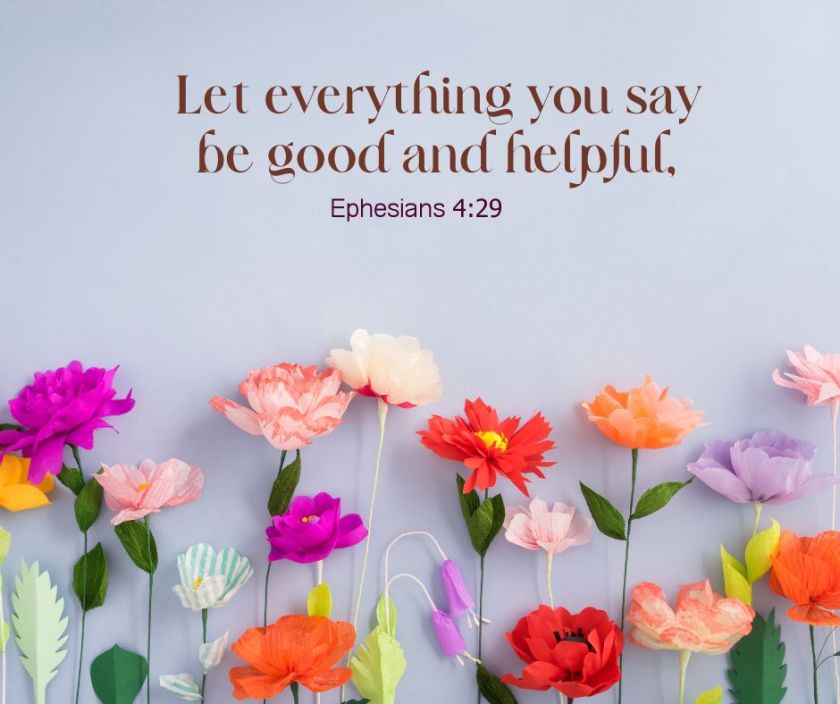
Don’t use foul or abusive language. Let everything you say be good and helpful, so that your words will be an encouragement to those who hear them.
Ephesians 4:29
I didn’t grow up in a home where foul or abusive language (or corrupt, as some translations say) was used. However, the second part of this verse is ingrained in my mind, as God has used it frequently through the years, sometimes daily, to correct how I use my words. God has been very patient with me, but even in the hard lessons, He has faithfully forgiven me, stuck by me, and trained me for righteousness. You see, it’s always been easy for me to get caught up in conversations without considering whether my words are “good and helpful.” So, Paul’s lesson to the believers of Ephesus has been God’s lesson to me more times than I can count – and I encourage you with the same: Be purposeful when you speak so that your words are an encouragement to those who are listening – not just to the person you are speaking to but to “all who might hear them.”
Let everything you say [be good and helpful], (so that) your words will be an encouragement (to those who hear them.)
Ephesians 4:29b
The Importance of Encouragement in the Believer’s Life
Encouragement makes it easier to live in a fallen world in a holy way. Encouragement makes it easier to love as Jesus loved (see John 13:34-35). Encouragement gives hope (Romans 15:4). Encouragement helps us through times of discipline and testing (Hebrews 12:5). Encouragement nurtures patience and kindness (see 1 Corinthians 13:4-7 and Galatians 5:22-26). Encouragement makes it easier to sacrifice our own desires for the advancement of God’s kingdom. In short, encouragement makes it easier to live the Christian life.
Without encouragement, life would soon feel pointless and burdensome. Without encouragement, we can be overwhelmed by the very real pains of our lives. Without encouragement, we feel unloved. Without encouragement, we begin to think that God is a liar or is unconcerned with our welfare. So, the Bible tells us to encourage one another, to remind each other of the truth that God loves us, that God equips us, that we are treasured, that our struggles are worth it.
Encouragement from the Bible gives us the will to carry on. It is a glimpse of the bigger picture. It can prevent burn-out. It can save us from believing lies (“sin’s deceitfulness”). Encouragement helps us experience abundant life (see John 10:10).
Gotquestions.org
Friends, my prayer for all of us is to not only encourage others faithfully but to listen for/to the encouragement others are speaking to us. – Mefromthensideout 🦋
Reflection: Who can you encourage today? What are some encouraging words someone has spoken to you?
The More We Know
My dear brothers and sisters, take note of this: Everyone should be quick to listen and slow to speak …



 Me From the Inside Out